

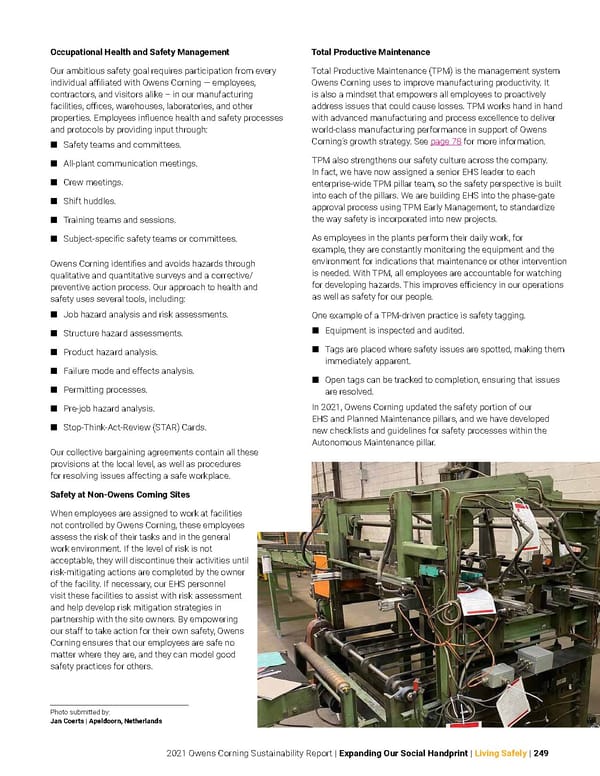
2021 Owens Corning Sustainability Report | Expanding Our Social Handprint | Living Safely | 249 Occupational Health and Safety Management Our ambitious safety goal requires participation from every individual affiliated with Owens Corning — employees, contractors, and visitors alike – in our manufacturing facilities, offices, warehouses, laboratories, and other properties. Employees influence health and safety processes and protocols by providing input through: ■ Safety teams and committees. ■ All-plant communication meetings. ■ Crew meetings. ■ Shift huddles. ■ Training teams and sessions. ■ Subject-specific safety teams or committees. Owens Corning identifies and avoids hazards through qualitative and quantitative surveys and a corrective/ preventive action process. Our approach to health and safety uses several tools, including: ■ Job hazard analysis and risk assessments. ■ Structure hazard assessments. ■ Product hazard analysis. ■ Failure mode and effects analysis. ■ Permitting processes. ■ Pre-job hazard analysis. ■ Stop-Think-Act-Review (STAR) Cards. Our collective bargaining agreements contain all these provisions at the local level, as well as procedures for resolving issues affecting a safe workplace. Safety at Non-Owens Corning Sites When employees are assigned to work at facilities not controlled by Owens Corning, these employees assess the risk of their tasks and in the general work environment. If the level of risk is not acceptable, they will discontinue their activities until risk-mitigating actions are completed by the owner of the facility. If necessary, our EHS personnel visit these facilities to assist with risk assessment and help develop risk mitigation strategies in partnership with the site owners. By empowering our staff to take action for their own safety, Owens Corning ensures that our employees are safe no matter where they are, and they can model good safety practices for others. Total Productive Maintenance Total Productive Maintenance (TPM) is the management system Owens Corning uses to improve manufacturing productivity. It is also a mindset that empowers all employees to proactively address issues that could cause losses. TPM works hand in hand with advanced manufacturing and process excellence to deliver world-class manufacturing performance in support of Owens Corning’s growth strategy. See page 78 for more information. TPM also strengthens our safety culture across the company. In fact, we have now assigned a senior EHS leader to each enterprise-wide TPM pillar team, so the safety perspective is built into each of the pillars. We are building EHS into the phase-gate approval process using TPM Early Management, to standardize the way safety is incorporated into new projects. As employees in the plants perform their daily work, for example, they are constantly monitoring the equipment and the environment for indications that maintenance or other intervention is needed. With TPM, all employees are accountable for watching for developing hazards. This improves efficiency in our operations as well as safety for our people. One example of a TPM-driven practice is safety tagging. ■ Equipment is inspected and audited. ■ Tags are placed where safety issues are spotted, making them immediately apparent. ■ Open tags can be tracked to completion, ensuring that issues are resolved. In 2021, Owens Corning updated the safety portion of our EHS and Planned Maintenance pillars, and we have developed new checklists and guidelines for safety processes within the Autonomous Maintenance pillar. Photo submitted by: Jan Coerts | Apeldoorn, Netherlands
 Owens Corning Sustainability Report Page 248 Page 250