

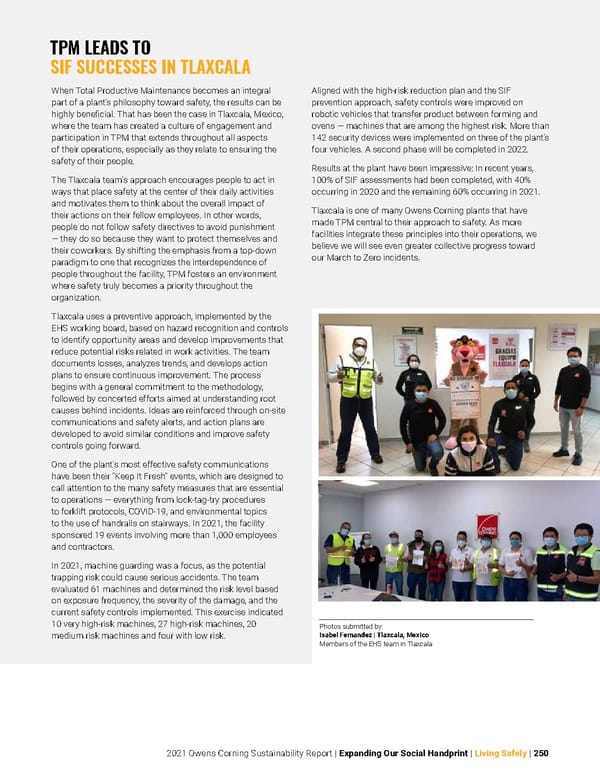
2021 Owens Corning Sustainability Report | Expanding Our Social Handprint | Living Safely | 250 When Total Productive Maintenance becomes an integral part of a plant’s philosophy toward safety, the results can be highly beneficial. That has been the case in Tlaxcala, Mexico, where the team has created a culture of engagement and participation in TPM that extends throughout all aspects of their operations, especially as they relate to ensuring the safety of their people. The Tlaxcala team’s approach encourages people to act in ways that place safety at the center of their daily activities and motivates them to think about the overall impact of their actions on their fellow employees. In other words, people do not follow safety directives to avoid punishment — they do so because they want to protect themselves and their coworkers. By shifting the emphasis from a top-down paradigm to one that recognizes the interdependence of people throughout the facility, TPM fosters an environment where safety truly becomes a priority throughout the organization. Tlaxcala uses a preventive approach, implemented by the EHS working board, based on hazard recognition and controls to identify opportunity areas and develop improvements that reduce potential risks related in work activities. The team documents losses, analyzes trends, and develops action plans to ensure continuous improvement. The process begins with a general commitment to the methodology, followed by concerted efforts aimed at understanding root causes behind incidents. Ideas are reinforced through on-site communications and safety alerts, and action plans are developed to avoid similar conditions and improve safety controls going forward. One of the plant’s most effective safety communications have been their “Keep It Fresh” events, which are designed to call attention to the many safety measures that are essential to operations — everything from lock-tag-try procedures to forklift protocols, COVID-19, and environmental topics to the use of handrails on stairways. In 2021, the facility sponsored 19 events involving more than 1,000 employees and contractors. In 2021, machine guarding was a focus, as the potential trapping risk could cause serious accidents. The team evaluated 61 machines and determined the risk level based on exposure frequency, the severity of the damage, and the current safety controls implemented. This exercise indicated 10 very high-risk machines, 27 high-risk machines, 20 medium risk machines and four with low risk. TPM LEADS TO SIF SUCCESSES IN TLAXCALA Photos submitted by: Isabel Fernandez | Tlaxcala, Mexico Members of the EHS team in Tlaxcala Aligned with the high-risk reduction plan and the SIF prevention approach, safety controls were improved on robotic vehicles that transfer product between forming and ovens — machines that are among the highest risk. More than 142 security devices were implemented on three of the plant’s four vehicles. A second phase will be completed in 2022. Results at the plant have been impressive: In recent years, 100% of SIF assessments had been completed, with 40% occurring in 2020 and the remaining 60% occurring in 2021. Tlaxcala is one of many Owens Corning plants that have made TPM central to their approach to safety. As more facilities integrate these principles into their operations, we believe we will see even greater collective progress toward our March to Zero incidents.
 Owens Corning Sustainability Report Page 249 Page 251