

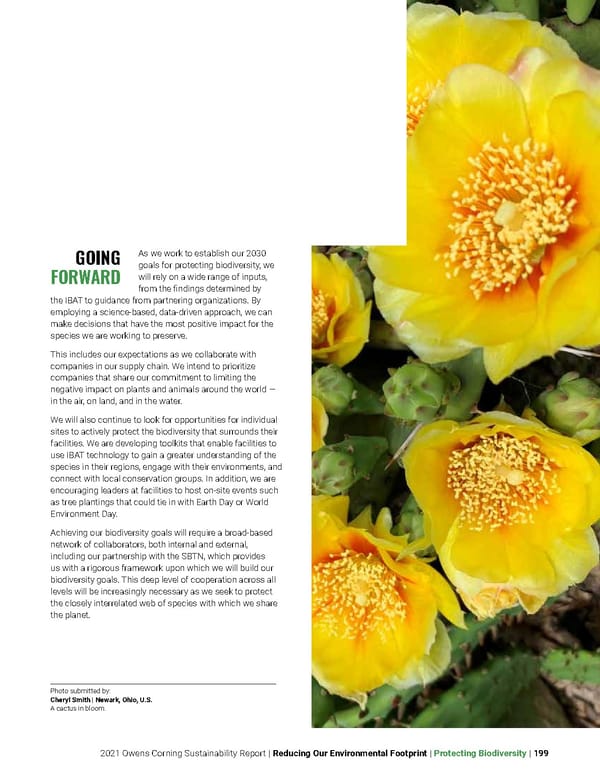
2021 Owens Corning Sustainability Report | Reducing Our Environmental Footprint | Protecting Biodiversity | 199 As we work to establish our 2030 goals for protecting biodiversity, we will rely on a wide range of inputs, from the findings determined by the IBAT to guidance from partnering organizations. By employing a science-based, data-driven approach, we can make decisions that have the most positive impact for the species we are working to preserve. This includes our expectations as we collaborate with companies in our supply chain. We intend to prioritize companies that share our commitment to limiting the negative impact on plants and animals around the world — in the air, on land, and in the water. We will also continue to look for opportunities for individual sites to actively protect the biodiversity that surrounds their facilities. We are developing toolkits that enable facilities to use IBAT technology to gain a greater understanding of the species in their regions, engage with their environments, and connect with local conservation groups. In addition, we are encouraging leaders at facilities to host on-site events such as tree plantings that could tie in with Earth Day or World Environment Day. Achieving our biodiversity goals will require a broad-based network of collaborators, both internal and external, including our partnership with the SBTN, which provides us with a rigorous framework upon which we will build our biodiversity goals. This deep level of cooperation across all levels will be increasingly necessary as we seek to protect the closely interrelated web of species with which we share the planet. GOING FORWARD Photo submitted by: Cheryl Smith | Newark, Ohio, U.S. A cactus in bloom.
 Owens Corning Sustainability Report Page 198 Page 200