

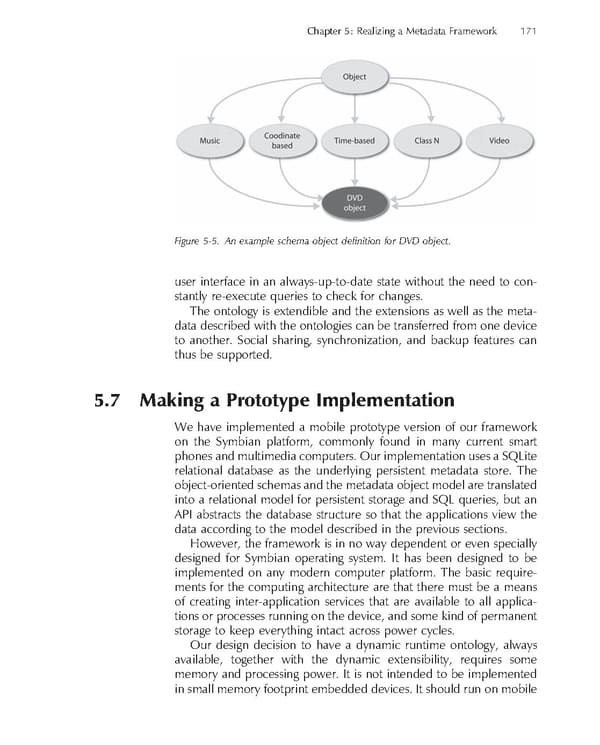
Chapter 5: Realizing a Metadata Framework 171 Figure 5-5. An example schema object defi nition for DVD object. user interface in an always-up-to-date state without the need to con- stantly re-execute queries to check for changes. The ontology is extendible and the extensions as well as the meta- data described with the ontologies can be transferred from one device to another. Social sharing, synchronization, and backup features can thus be supported. 5.7 Making a Prototype Implementation We have implemented a mobile prototype version of our framework on the Symbian platform, commonly found in many current smart phones and multimedia computers. Our implementation uses a SQLite relational database as the underlying persistent metadata store. The object-oriented schemas and the metadata object model are translated into a relational model for persistent storage and SQL queries, but an API abstracts the database structure so that the applications view the data according to the model described in the previous sections. However, the framework is in no way dependent or even specially designed for Symbian operating system. It has been designed to be implemented on any modern computer platform. The basic require- ments for the computing architecture are that there must be a means of creating inter-application services that are available to all applica- tions or processes running on the device, and some kind of permanent storage to keep everything intact across power cycles. Our design decision to have a dynamic runtime ontology, always available, together with the dynamic extensibility, requires some memory and processing power. It is not intended to be implemented in small memory footprint embedded devices. It should run on mobile
 Personal Content Experience Page 194 Page 196