

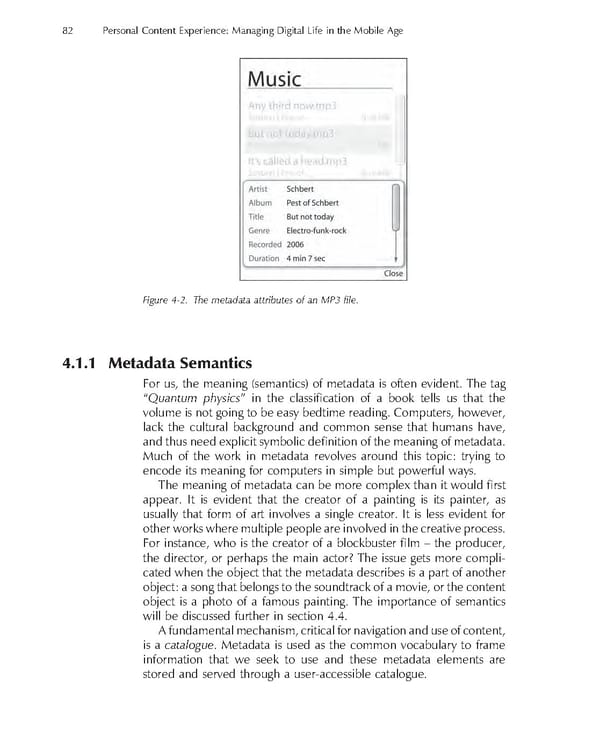
82 Personal Content Experience: Managing Digital Life in the Mobile Age Figure 4-2. The metadata attributes of an MP3 fi le. 4.1.1 Metadata Semantics For us, the meaning (semantics) of metadata is often evident. The tag “Quantum physics” in the classifi cation of a book tells us that the volume is not going to be easy bedtime reading. Computers, however, lack the cultural background and common sense that humans have, and thus need explicit symbolic defi nition of the meaning of metadata. Much of the work in metadata revolves around this topic: trying to encode its meaning for computers in simple but powerful ways. The meaning of metadata can be more complex than it would fi rst appear. It is evident that the creator of a painting is its painter, as usually that form of art involves a single creator. It is less evident for other works where multiple people are involved in the creative process. For instance, who is the creator of a blockbuster fi lm – the producer, the director, or perhaps the main actor? The issue gets more compli- cated when the object that the metadata describes is a part of another object: a song that belongs to the soundtrack of a movie, or the content object is a photo of a famous painting. The importance of semantics will be discussed further in section 4.4. A fundamental mechanism, critical for navigation and use of content, is a catalogue. Metadata is used as the common vocabulary to frame information that we seek to use and these metadata elements are stored and served through a user-accessible catalogue.
 Personal Content Experience Page 105 Page 107