

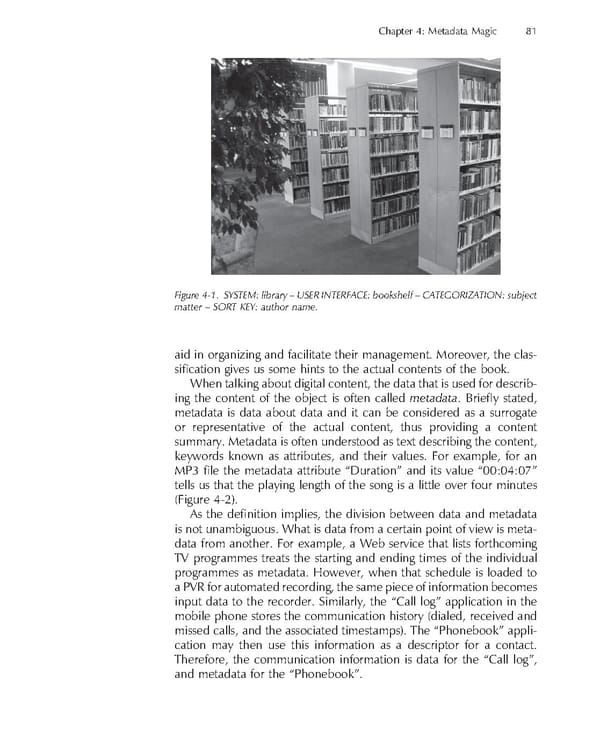
Chapter 4: Metadata Magic 81 Figure 4-1. SYSTEM: library – USER INTERFACE: bookshelf – CATEGORIZATION: subject matter – SORT KEY: author name. aid in organizing and facilitate their management. Moreover, the clas- sifi cation gives us some hints to the actual contents of the book. When talking about digital content, the data that is used for describ- ing the content of the object is often called metadata. Briefl y stated, metadata is data about data and it can be considered as a surrogate or representative of the actual content, thus providing a content summary. Metadata is often understood as text describing the content, keywords known as attributes, and their values. For example, for an MP3 fi le the metadata attribute “Duration” and its value “00:04:07” tells us that the playing length of the song is a little over four minutes (Figure 4-2). As the defi nition implies, the division between data and metadata is not unambiguous. What is data from a certain point of view is meta- data from another. For example, a Web service that lists forthcoming TV programmes treats the starting and ending times of the individual programmes as metadata. However, when that schedule is loaded to a PVR for automated recording, the same piece of information becomes input data to the recorder. Similarly, the “Call log” application in the mobile phone stores the communication history (dialed, received and missed calls, and the associated timestamps). The “Phonebook” appli- cation may then use this information as a descriptor for a contact. Therefore, the communication information is data for the “Call log”, and metadata for the “Phonebook”.
 Personal Content Experience Page 104 Page 106