

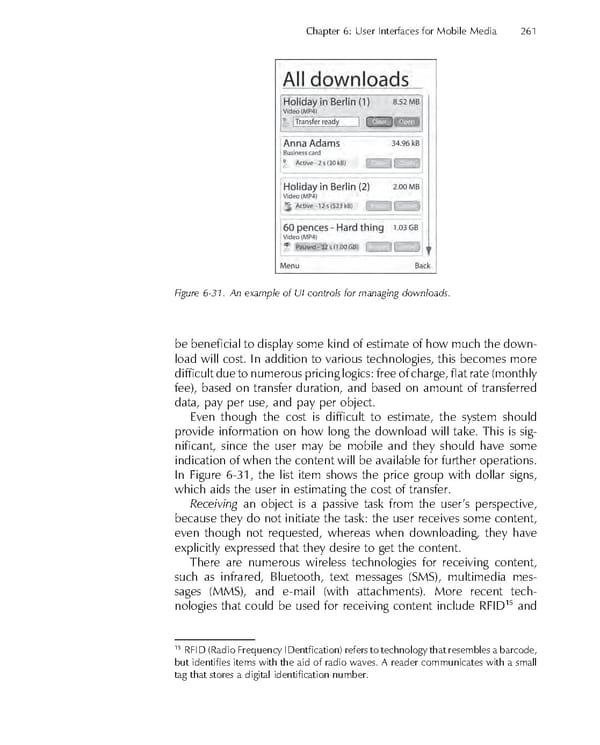
Chapter 6: User Interfaces for Mobile Media 261 Figure 6-31. An example of UI controls for managing downloads. be benefi cial to display some kind of estimate of how much the down- load will cost. In addition to various technologies, this becomes more diffi cult due to numerous pricing logics: free of charge, fl at rate (monthly fee), based on transfer duration, and based on amount of transferred data, pay per use, and pay per object. Even though the cost is diffi cult to estimate, the system should provide information on how long the download will take. This is sig- nifi cant, since the user may be mobile and they should have some indication of when the content will be available for further operations. In Figure 6-31, the list item shows the price group with dollar signs, which aids the user in estimating the cost of transfer. Receiving an object is a passive task from the user’s perspective, because they do not initiate the task: the user receives some content, even though not requested, whereas when downloading, they have explicitly expressed that they desire to get the content. There are numerous wireless technologies for receiving content, such as infrared, Bluetooth, text messages (SMS), multimedia mes - sages (MMS), and e-mail (with attachments). More recent tech - 15 nologies that could be used for receiving content include RFID and 15 RFID (Radio Frequency IDentfi cation) refers to technology that resembles a barcode, but identifi es items with the aid of radio waves. A reader communicates with a small tag that stores a digital identifi cation number.
 Personal Content Experience Page 284 Page 286