

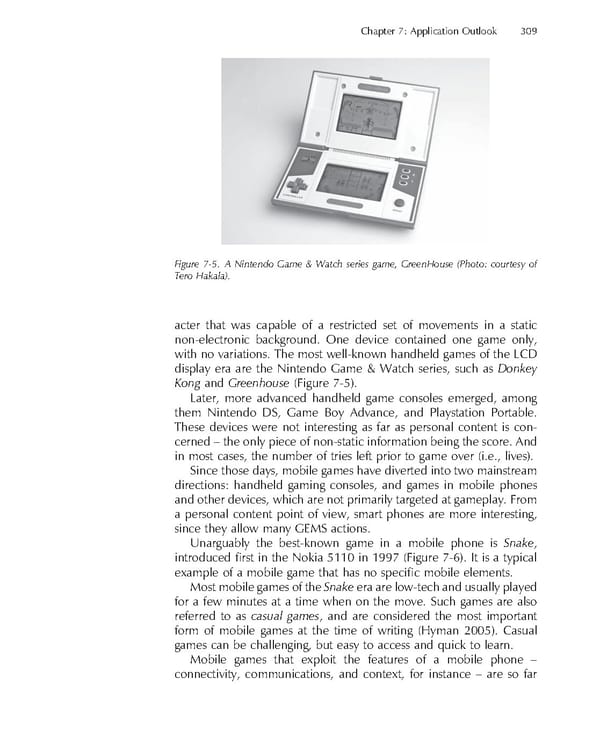
Chapter 7: Application Outlook 309 Figure 7-5. A Nintendo Game & Watch series game, GreenHouse (Photo: courtesy of Tero Hakala). acter that was capable of a restricted set of movements in a static non-electronic background. One device contained one game only, with no variations. The most well-known handheld games of the LCD display era are the Nintendo Game & Watch series, such as Donkey Kong and Greenhouse (Figure 7-5). Later, more advanced handheld game consoles emerged, among them Nintendo DS, Game Boy Advance, and Playstation Portable. These devices were not interesting as far as personal content is con- cerned – the only piece of non-static information being the score. And in most cases, the number of tries left prior to game over (i.e., lives). Since those days, mobile games have diverted into two mainstream directions: handheld gaming consoles, and games in mobile phones and other devices, which are not primarily targeted at gameplay. From a personal content point of view, smart phones are more interesting, since they allow many GEMS actions. Unarguably the best-known game in a mobile phone is Snake, introduced fi rst in the Nokia 5110 in 1997 (Figure 7-6). It is a typical example of a mobile game that has no specifi c mobile elements. Most mobile games of the Snake era are low-tech and usually played for a few minutes at a time when on the move. Such games are also referred to as casual games, and are considered the most important form of mobile games at the time of writing (Hyman 2005). Casual games can be challenging, but easy to access and quick to learn. Mobile games that exploit the features of a mobile phone – connectivity, communications, and context, for instance – are so far
 Personal Content Experience Page 332 Page 334