

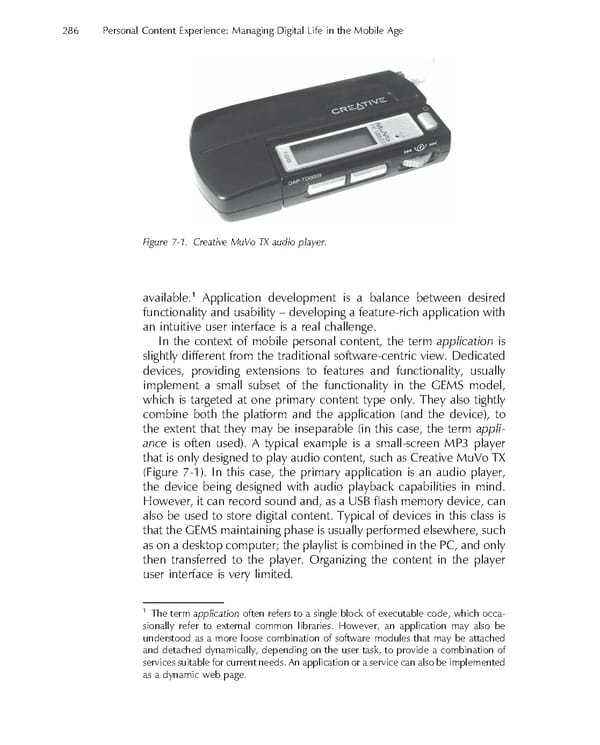
286 Personal Content Experience: Managing Digital Life in the Mobile Age Figure 7-1. Creative MuVo TX audio player. 1 available. Application development is a balance between desired functionality and usability – developing a feature-rich application with an intuitive user interface is a real challenge. In the context of mobile personal content, the term application is slightly different from the traditional software-centric view. Dedicated devices, providing extensions to features and functionality, usually implement a small subset of the functionality in the GEMS model, which is targeted at one primary content type only. They also tightly combine both the platform and the application (and the device), to the extent that they may be inseparable (in this case, the term appli- ance is often used). A typical example is a small-screen MP3 player that is only designed to play audio content, such as Creative MuVo TX (Figure 7-1). In this case, the primary application is an audio player, the device being designed with audio playback capabilities in mind. However, it can record sound and, as a USB fl ash memory device, can also be used to store digital content. Typical of devices in this class is that the GEMS maintaining phase is usually performed elsewhere, such as on a desktop computer; the playlist is combined in the PC, and only then transferred to the player. Organizing the content in the player user interface is very limited. 1 The term application often refers to a single block of executable code, which occa- sionally refer to external common libraries. However, an application may also be understood as a more loose combination of software modules that may be attached and detached dynamically, depending on the user task, to provide a combination of services suitable for current needs. An application or a service can also be implemented as a dynamic web page.
 Personal Content Experience Page 309 Page 311