

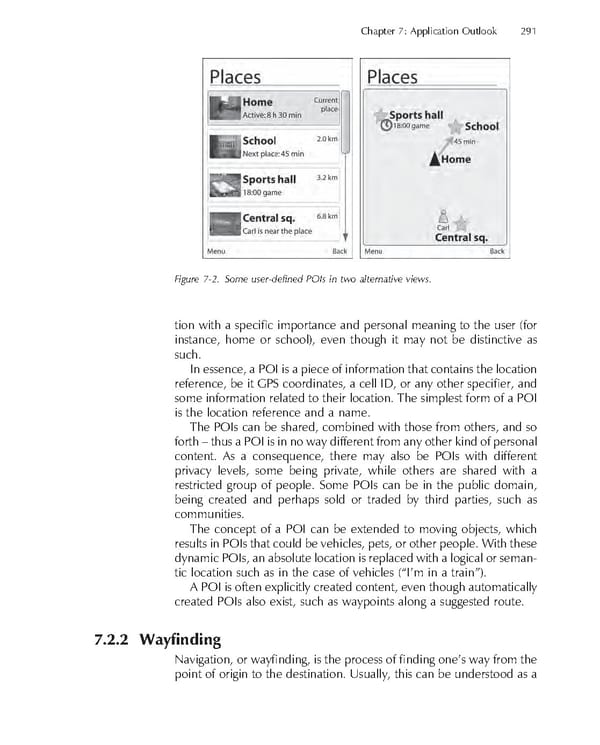
Chapter 7: Application Outlook 291 Figure 7-2. Some user-defi ned POIs in two alternative views. tion with a specifi c importance and personal meaning to the user (for instance, home or school), even though it may not be distinctive as such. In essence, a POI is a piece of information that contains the location reference, be it GPS coordinates, a cell ID, or any other specifi er, and some information related to their location. The simplest form of a POI is the location reference and a name. The POIs can be shared, combined with those from others, and so forth – thus a POI is in no way different from any other kind of personal content. As a consequence, there may also be POIs with different privacy levels, some being private, while others are shared with a restricted group of people. Some POIs can be in the public domain, being created and perhaps sold or traded by third parties, such as communities. The concept of a POI can be extended to moving objects, which results in POIs that could be vehicles, pets, or other people. With these dynamic POIs, an absolute location is replaced with a logical or seman- tic location such as in the case of vehicles (“I’m in a train”). A POI is often explicitly created content, even though automatically created POIs also exist, such as waypoints along a suggested route. 7.2.2 Wayfi nding Navigation, or wayfi nding, is the process of fi nding one’s way from the point of origin to the destination. Usually, this can be understood as a
 Personal Content Experience Page 314 Page 316