

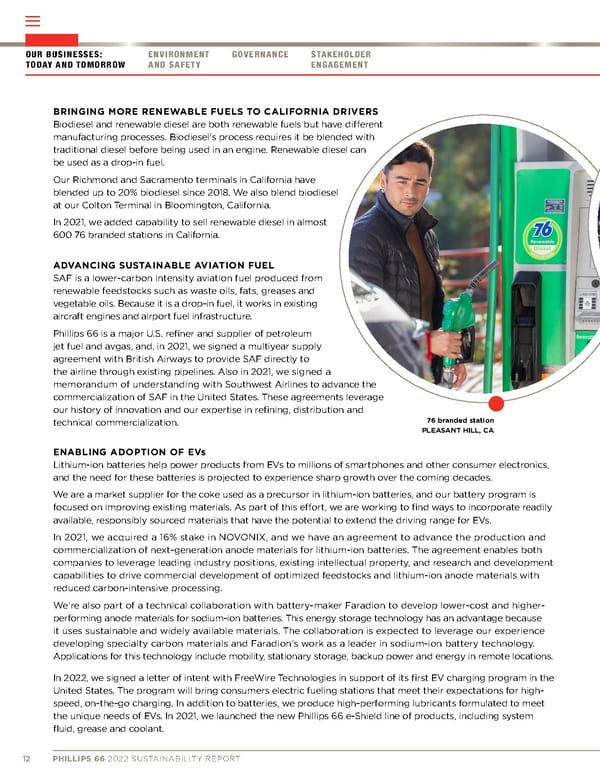
BRINGING MORE RENEWABLE FUELS TO CALIFORNIA DRIVERS Biodiesel and renewable diesel are both renewable fuels but have different manufacturing processes. Biodiesel's process requires it be blended with traditional diesel before being used in an engine. Renewable diesel can be used as a drop-in fuel. Our Richmond and Sacramento terminals in California have blended up to 20% biodiesel since 2018. We also blend biodiesel at our Colton Terminal in Bloomington, California. In 2021, we added capability to sell renewable diesel in almost 600 76 branded stations in California. ADVANCING SUSTAINABLE AVIATION FUEL SAF is a lower-carbon intensity aviation fuel produced from renewable feedstocks such as waste oils, fats, greases and vegetable oils. Because it is a drop-in fuel, it works in existing aircraft engines and airport fuel infrastructure. Phillips 66 is a major U.S. refiner and supplier of petroleum jet fuel and avgas, and, in 2021, we signed a multiyear supply agreement with British Airways to provide SAF directly to the airline through existing pipelines. Also in 2021, we signed a memorandum of understanding with Southwest Airlines to advance the commercialization of SAF in the United States. These agreements leverage our history of innovation and our expertise in refining, distribution and technical commercialization. ENABLING ADOPTION OF EV s Lithium-ion batteries help power products from EVs to millions of smartphones and other consumer electronics, and the need for these batteries is projected to experience sharp growth over the coming decades. We are a market supplier for the coke used as a precursor in lithium-ion batteries, and our battery program is focused on improving existing materials. As part of this effort, we are working to find ways to incorporate readily available, responsibly sourced materials that have the potential to extend the driving range for EVs. In 2021, we acquired a 16% stake in NOVONIX, and we have an agreement to advance the production and commercialization of next-generation anode materials for lithium-ion batteries. The agreement enables both companies to leverage leading industry positions, existing intellectual property, and research and development capabilities to drive commercial development of optimized feedstocks and lithium-ion anode materials with reduced carbon-intensive processing. We’re also part of a technical collaboration with battery-maker Faradion to develop lower-cost and higher- performing anode materials for sodium-ion batteries. This energy storage technology has an advantage because it uses sustainable and widely available materials. The collaboration is expected to leverage our experience developing specialty carbon materials and Faradion’s work as a leader in sodium-ion battery technology. Applications for this technology include mobility, stationary storage, backup power and energy in remote locations. In 2022, we signed a letter of intent with FreeWire Technologies in support of its first EV charging program in the United States. The program will bring consumers electric fueling stations that meet their expectations for high- speed, on-the-go charging. In addition to batteries, we produce high-performing lubricants formulated to meet the unique needs of EVs. In 2021, we launched the new Phillips 66 e-Shield line of products, including system fluid, grease and coolant. 76 branded station PLEASANT HILL, CA 12 PHILLIPS 66 2022 SUSTAINABILITY REPORT OUR BUSINESSES: TODAY AND TOMORROW ENVIRONMENT AND SAFETY GOVERNANCE STAKEHOLDER ENGAGEMENT
 Philips 66 ESG Report Page 13 Page 15