

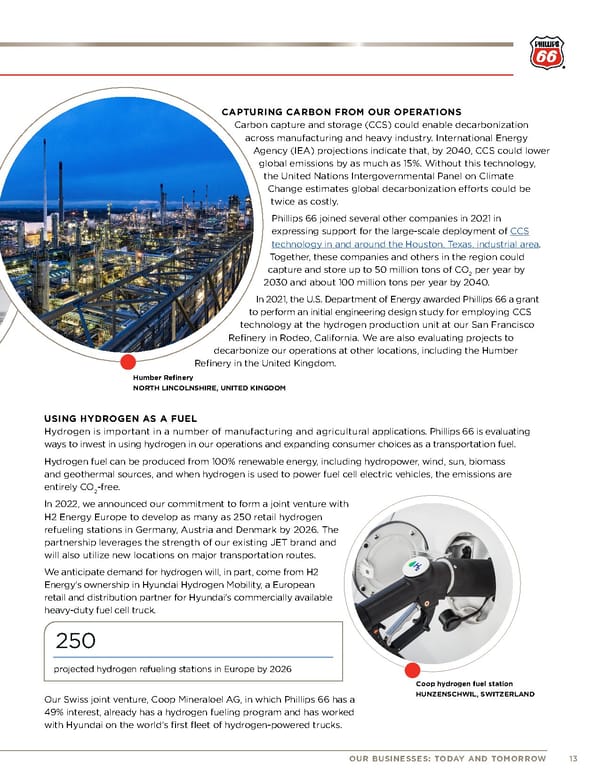
USING HYDROGEN AS A FUEL Hydrogen is important in a number of manufacturing and agricultural applications. Phillips 66 is evaluating ways to invest in using hydrogen in our operations and expanding consumer choices as a transportation fuel. Hydrogen fuel can be produced from 100% renewable energy, including hydropower, wind, sun, biomass and geothermal sources, and when hydrogen is used to power fuel cell electric vehicles, the emissions are entirely CO 2 -free. In 2022, we announced our commitment to form a joint venture with H2 Energy Europe to develop as many as 250 retail hydrogen refueling stations in Germany, Austria and Denmark by 2026. The partnership leverages the strength of our existing JET brand and will also utilize new locations on major transportation routes. We anticipate demand for hydrogen will, in part, come from H2 Energy’s ownership in Hyundai Hydrogen Mobility, a European retail and distribution partner for Hyundai's commercially available heavy-duty fuel cell truck. Our Swiss joint venture, Coop Mineraloel AG, in which Phillips 66 has a 49% interest, already has a hydrogen fueling program and has worked with Hyundai on the world’s first fleet of hydrogen-powered trucks. Coop hydrogen fuel station HUNZENSCHWIL, SWITZERLAND 250 projected hydrogen refueling stations in Europe by 2026 Humber Refinery NORTH LINCOLNSHIRE, UNITED KINGDOM CAPTURING CARBON FROM OUR OPERATIONS Carbon capture and storage (CCS) could enable decarbonization across manufacturing and heavy industry. International Energy Agency (IEA) projections indicate that, by 2040, CCS could lower global emissions by as much as 15%. Without this technology, the United Nations Intergovernmental Panel on Climate Change estimates global decarbonization efforts could be twice as costly. Phillips 66 joined several other companies in 2021 in expressing support for the large-scale deployment of CCS technology in and around the Houston, Texas, industrial area . Together, these companies and others in the region could capture and store up to 50 million tons of CO 2 per year by 2030 and about 100 million tons per year by 2040. In 2021, the U.S. Department of Energy awarded Phillips 66 a grant to perform an initial engineering design study for employing CCS technology at the hydrogen production unit at our San Francisco Refinery in Rodeo, California. We are also evaluating projects to decarbonize our operations at other locations, including the Humber Refinery in the United Kingdom. 13 OUR BUSINESSES: TODAY AND TOMORROW
 Philips 66 ESG Report Page 14 Page 16