

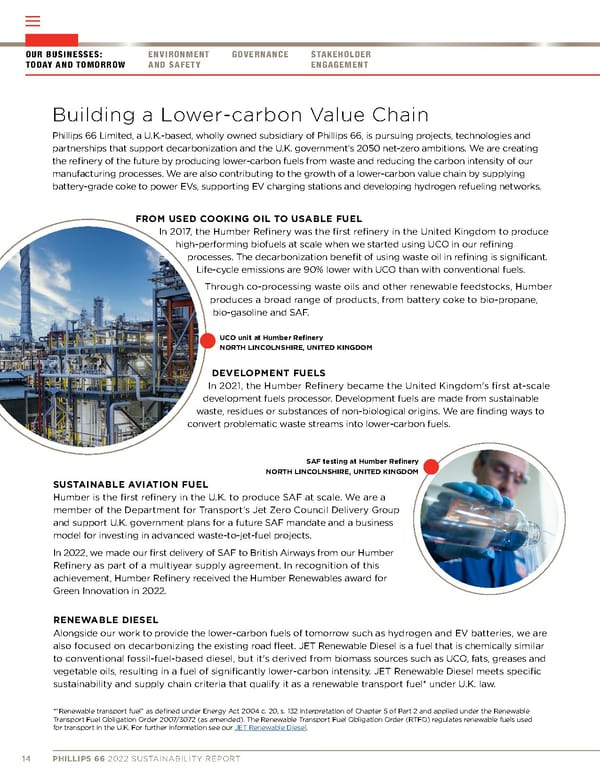
Building a Lower-carbon Value Chain Phillips 66 Limited, a U.K.-based, wholly owned subsidiary of Phillips 66, is pursuing projects, technologies and partnerships that support decarbonization and the U.K. government’s 2050 net-zero ambitions. We are creating the refinery of the future by producing lower-carbon fuels from waste and reducing the carbon intensity of our manufacturing processes. We are also contributing to the growth of a lower-carbon value chain by supplying battery-grade coke to power EVs, supporting EV charging stations and developing hydrogen refueling networks. SUSTAINABLE AVIATION FUEL Humber is the first refinery in the U.K. to produce SAF at scale. We are a member of the Department for Transport’s Jet Zero Council Delivery Group and support U.K. government plans for a future SAF mandate and a business model for investing in advanced waste-to-jet-fuel projects. In 2022, we made our first delivery of SAF to British Airways from our Humber Refinery as part of a multiyear supply agreement. In recognition of this achievement, Humber Refinery received the Humber Renewables award for Green Innovation in 2022. FROM USED COOKING OIL TO USABLE FUEL In 2017, the Humber Refinery was the first refinery in the United Kingdom to produce high-performing biofuels at scale when we started using UCO in our refining processes. The decarbonization benefit of using waste oil in refining is significant. Life-cycle emissions are 90% lower with UCO than with conventional fuels. Through co-processing waste oils and other renewable feedstocks, Humber produces a broad range of products, from battery coke to bio-propane, bio-gasoline and SAF. DEVELOPMENT FUELS In 2021, the Humber Refinery became the United Kingdom's first at-scale development fuels processor. Development fuels are made from sustainable waste, residues or substances of non-biological origins. We are finding ways to convert problematic waste streams into lower-carbon fuels. RENEWABLE DIESEL Alongside our work to provide the lower-carbon fuels of tomorrow such as hydrogen and EV batteries, we are also focused on decarbonizing the existing road fleet. JET Renewable Diesel is a fuel that is chemically similar to conventional fossil-fuel-based diesel, but it's derived from biomass sources such as UCO, fats, greases and vegetable oils, resulting in a fuel of significantly lower-carbon intensity. JET Renewable Diesel meets specific sustainability and supply chain criteria that qualify it as a renewable transport fuel* under U.K. law. UCO unit at Humber Refinery NORTH LINCOLNSHIRE, UNITED KINGDOM SAF testing at Humber Refinery NORTH LINCOLNSHIRE, UNITED KINGDOM *“Renewable transport fuel” as defined under Energy Act 2004 c. 20, s. 132 interpretation of Chapter 5 of Part 2 and applied under the Renewable Transport Fuel Obligation Order 2007/3072 (as amended). The Renewable Transport Fuel Obligation Order (RTFO) regulates renewable fuels used for transport in the U.K. For further information see our JET Renewable Diesel . 14 PHILLIPS 66 2022 SUSTAINABILITY REPORT OUR BUSINESSES: TODAY AND TOMORROW ENVIRONMENT AND SAFETY GOVERNANCE STAKEHOLDER ENGAGEMENT
 Philips 66 ESG Report Page 15 Page 17