

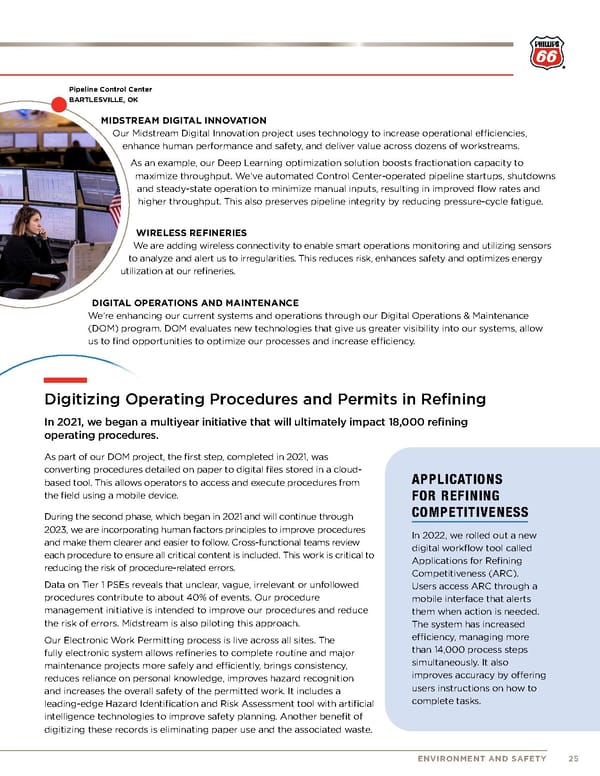
Digitizing Operating Procedures and Permits in Refining In 2021, we began a multiyear initiative that will ultimately impact 18,000 refining operating procedures. As part of our DOM project, the first step, completed in 2021, was converting procedures detailed on paper to digital files stored in a cloud- based tool. This allows operators to access and execute procedures from the field using a mobile device. During the second phase, which began in 2021 and will continue through 2023, we are incorporating human factors principles to improve procedures and make them clearer and easier to follow. Cross-functional teams review each procedure to ensure all critical content is included. This work is critical to reducing the risk of procedure-related errors. Data on Tier 1 PSEs reveals that unclear, vague, irrelevant or unfollowed procedures contribute to about 40% of events. Our procedure management initiative is intended to improve our procedures and reduce the risk of errors. Midstream is also piloting this approach. Our Electronic Work Permitting process is live across all sites. The fully electronic system allows refineries to complete routine and major maintenance projects more safely and efficiently, brings consistency, reduces reliance on personal knowledge, improves hazard recognition and increases the overall safety of the permitted work. It includes a leading-edge Hazard Identification and Risk Assessment tool with artificial intelligence technologies to improve safety planning. Another benefit of digitizing these records is eliminating paper use and the associated waste. MIDSTREAM DIGITAL INNOVATION Our Midstream Digital Innovation project uses technology to increase operational efficiencies, enhance human performance and safety, and deliver value across dozens of workstreams. As an example, our Deep Learning optimization solution boosts fractionation capacity to maximize throughput. We’ve automated Control Center-operated pipeline startups, shutdowns and steady-state operation to minimize manual inputs, resulting in improved flow rates and higher throughput. This also preserves pipeline integrity by reducing pressure-cycle fatigue. WIRELESS REFINERIES We are adding wireless connectivity to enable smart operations monitoring and utilizing sensors to analyze and alert us to irregularities. This reduces risk, enhances safety and optimizes energy utilization at our refineries. DIGITAL OPERATIONS AND MAINTENANCE We’re enhancing our current systems and operations through our Digital Operations & Maintenance (DOM) program. DOM evaluates new technologies that give us greater visibility into our systems, allow us to find opportunities to optimize our processes and increase efficiency. APPLICATIONS FOR REFINING COMPETITIVENESS In 2022, we rolled out a new digital workflow tool called Applications for Refining Competitiveness (ARC). Users access ARC through a mobile interface that alerts them when action is needed. The system has increased efficiency, managing more than 14,000 process steps simultaneously. It also improves accuracy by offering users instructions on how to complete tasks. Pipeline Control Center BARTLESVILLE, OK 25 ENVIRONMENT AND SAFETY
 Philips 66 ESG Report Page 26 Page 28