

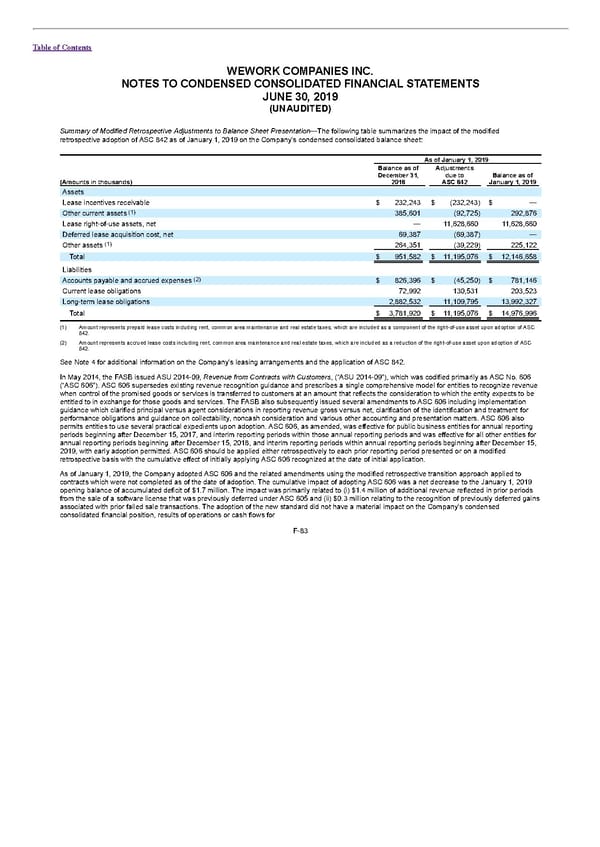
Table of Contents WEWORK COMPANIES INC. NOTES TO CONDENSED CONSOLIDATED FINANCIAL STATEMENTS JUNE 30, 2019 (UNAUDITED) Summary of Modified Retrospective Adjustments to Balance Sheet Presentation—The following table summarizes the impact of the modified retrospective adoption of ASC 842 as of January 1, 2019 on the Company’s condensed consolidated balance sheet: As of January 1, 2019 Balance as of Adjustments December 31, due to Balance as of (Amounts in thousands) 2018 ASC 842 January 1, 2019 Assets Lease incentives receivable $ 232,243 $ (232,243) $ — (1) Other current assets 385,601 (92,725) 292,876 Lease right-of-use assets, net — 11,628,660 11,628,660 Deferred lease acquisition cost, net 69,387 (69,387) — (1) Other assets 264,351 (39,229) 225,122 Total $ 951,582 $ 11,195,076 $ 12,146,658 Liabilities (2) Accounts payable and accrued expenses $ 826,396 $ (45,250) $ 781,146 Current lease obligations 72,992 130,531 203,523 Long-term lease obligations 2,882,532 11,109,795 13,992,327 Total $ 3,781,920 $ 11,195,076 $ 14,976,996 (1) Amount represents prepaid lease costs including rent, common area maintenance and real estate taxes, which are included as a component of the right-of-use asset upon adoption of ASC 842. (2) Amount represents accrued lease costs including rent, common area maintenance and real estate taxes, which are included as a reduction of the right-of-use asset upon adoption of ASC 842. See Note 4 for additional information on the Company’s leasing arrangements and the application of ASC 842. In May 2014, the FASB issued ASU 2014-09, Revenue from Contracts with Customers, (“ASU 2014-09”), which was codified primarily as ASC No. 606 (“ASC 606”). ASC 606 supersedes existing revenue recognition guidance and prescribes a single comprehensive model for entities to recognize revenue when control of the promised goods or services is transferred to customers at an amount that reflects the consideration to which the entity expects to be entitled to in exchange for those goods and services. The FASB also subsequently issued several amendments to ASC 606 including implementation guidance which clarified principal versus agent considerations in reporting revenue gross versus net, clarification of the identification and treatment for performance obligations and guidance on collectability, noncash consideration and various other accounting and presentation matters. ASC 606 also permits entities to use several practical expedients upon adoption. ASC 606, as amended, was effective for public business entities for annual reporting periods beginning after December 15, 2017, and interim reporting periods within those annual reporting periods and was effective for all other entities for annual reporting periods beginning after December 15, 2018, and interim reporting periods within annual reporting periods beginning after December 15, 2019, with early adoption permitted. ASC 606 should be applied either retrospectively to each prior reporting period presented or on a modified retrospective basis with the cumulative effect of initially applying ASC 606 recognized at the date of initial application. As of January 1, 2019, the Company adopted ASC 606 and the related amendments using the modified retrospective transition approach applied to contracts which were not completed as of the date of adoption. The cumulative impact of adopting ASC 606 was a net decrease to the January 1, 2019 opening balance of accumulated deficit of $1.7 million. The impact was primarily related to (i) $1.4 million of additional revenue reflected in prior periods from the sale of a software license that was previously deferred under ASC 605 and (ii) $0.3 million relating to the recognition of previously deferred gains associated with prior failed sale transactions. The adoption of the new standard did not have a material impact on the Company’s condensed consolidated financial position, results of operations or cash flows for F-83
 S1 - WeWork Prospectus Page 326 Page 328