


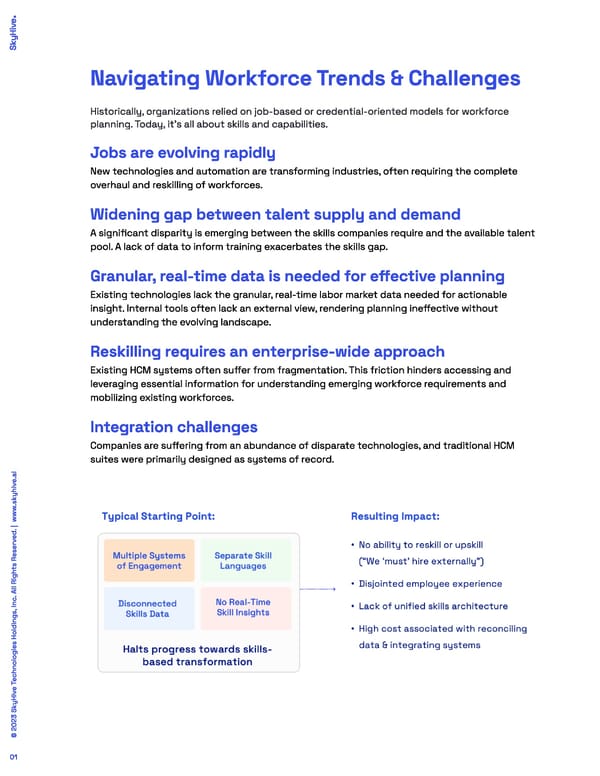
Navigating Workforce Trends & Challenges Historically, organizations relied on job-based or credential-oriented models for workforce planning. Today, it's all about skills and capabilities. Jobs are evolving rapidly New technologies and automation are transforming industries, often requiring the complete overhaul and reskilling of workforces. Widening gap between talent supply and demand A signi昀椀cant disparity is emerging between the skills companies require and the available talent pool. A lack of data to inform training exacerbates the skills gap. Granular, real-time data is needed for e昀昀ective planning Existing technologies lack the granular, real-time labor market data needed for actionable insight. Internal tools often lack an external view, rendering planning ine昀昀ective without understanding the evolving landscape. Reskilling requires an enterprise-wide approach Existing HCM systems often su昀昀er from fragmentation. This friction hinders accessing and leveraging essential information for understanding emerging workforce requirements and mobilizing existing workforces. Integration challenges Companies are su昀昀ering from an abundance of disparate technologies, and traditional HCM suites were primarily designed as systems of record. .ai e .skyhiv | www ed. ts Reserv All Righ . Inc echnologies Holdings, T e 3 SkyHiv © 202 01
 Skills Transformation Guide Page 1 Page 3