

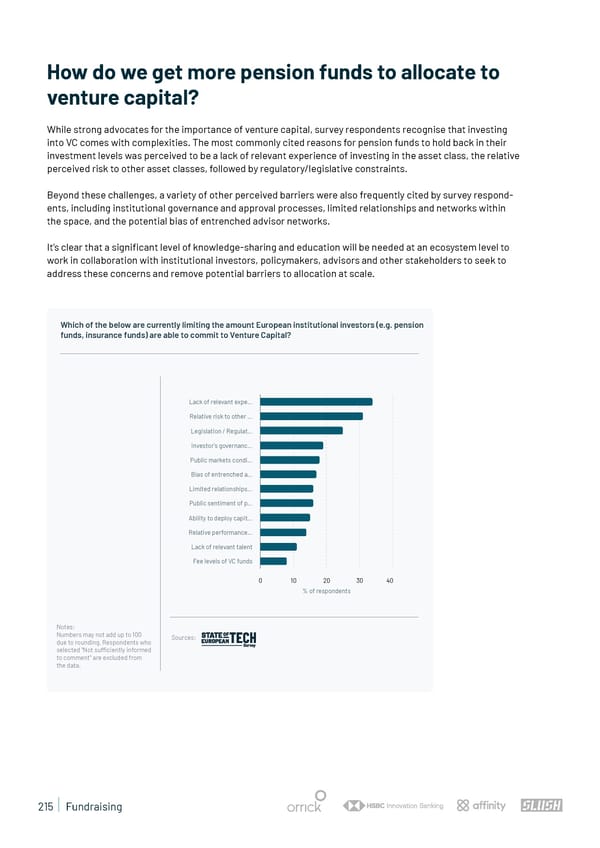
How do we get more pension funds to allocate to venture capital? While strong advocates for the importance of venture capital, survey respondents recognise that investing into VC comes with complexities. The most commonly cited reasons for pension funds to hold back in their investment levels was perceived to be a lack of relevant experience of investing in the asset class, the relative perceived risk to other asset classes, followed by regulatory/legislative constraints. Beyond these challenges, a variety of other perceived barriers were also frequently cited by survey respond- ents, including institutional governance and approval processes, limited relationships and networks within the space, and the potential bias of entrenched advisor networks. It’s clear that a signi昀椀cant level of knowledge-sharing and education will be needed at an ecosystem level to work in collaboration with institutional investors, policymakers, advisors and other stakeholders to seek to address these concerns and remove potential barriers to allocation at scale. Which of the below are currently limiting the amount European institutional investors (e.g. pension funds, insurance funds) are able to commit to Venture Capital? Lack of relevant expe… Relative risk to other … Legislation / Regulat… Investor’s governanc… Public markets condi… Bias of entrenched a… Limited relationships… Public sentiment of p… Ability to deploy capit… Relative performance… Lack of relevant talent Fee levels of VC funds 0 10 20 30 40 % of respondents Notes: Numbers may not add up to 100 Sources: due to rounding. Respondents who selected "Not su昀케ciently informed to comment" are excluded from the data. 215 | Fundraising
 State of European Tech | 2023 Page 214 Page 216