

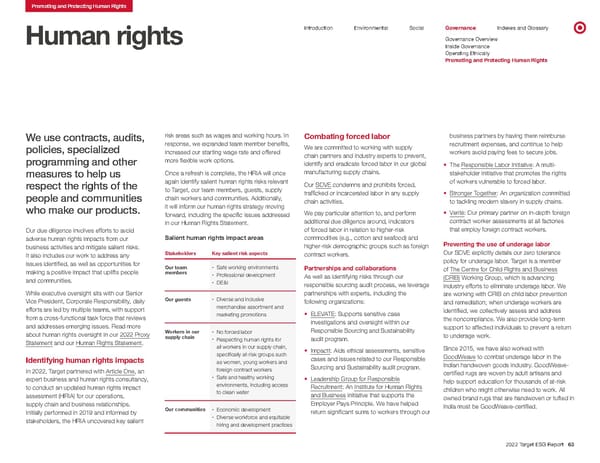
0 Promoting and Protecting Human Rights Human rights We use contracts, audits, policies, specialized programming and other measures to help us respect the rights of the people and communities who make our products. Our due diligence involves efforts to avoid adverse human rights impacts from our business activities and mitigate salient risks. It also includes our work to address any issues identified, as well as opportunities for making a positive impact that uplifts people and communities. While executive oversight sits with our Senior Vice President, Corporate Responsibility, daily efforts are led by multiple teams, with support from a cross-functional task force that reviews and addresses emerging issues. Read more about human rights oversight in our 2022 Proxy Statement and our Human Rights Statement . Identifying human rights impacts In 2022, Target partnered with Article One , an expert business and human rights consultancy, to conduct an updated human rights impact assessment (HRIA) for our operations, supply chain and business relationships. Initially performed in 2019 and informed by stakeholders, the HRIA uncovered key salient risk areas such as wages and working hours. In response, we expanded team member benefits, increased our starting wage rate and offered more flexible work options. Once a refresh is complete, the HRIA will once again identify salient human rights risks relevant to Target, our team members, guests, supply chain workers and communities. Additionally, it will inform our human rights strategy moving forward, including the specific issues addressed in our Human Rights Statement. Salient human rights impact areas Stakeholders Key salient risk aspects Our team members • Safe working environments • Professional development • DE&I Our guests • Diverse and inclusive merchandise assortment and marketing promotions Workers in our supply chain • No forced labor • Respecting human rights for all workers in our supply chain, specifically at-risk groups such as women, young workers and foreign contract workers • Safe and healthy working environments, including access to clean water Our communities • Economic development • Diverse workforce and equitable hiring and development practices Introduction Environmental Social Combating forced labor We are committed to working with supply chain partners and industry experts to prevent, identify and eradicate forced labor in our global manufacturing supply chains. Our SOVE condemns and prohibits forced, trafficked or incarcerated labor in any supply chain activities. We pay particular attention to, and perform additional due diligence around, indicators of forced labor in relation to higher-risk commodities (e.g., cotton and seafood) and higher-risk demographic groups such as foreign contract workers. Partnerships and collaborations As well as identifying risks through our responsible sourcing audit process, we leverage partnerships with experts, including the following organizations: • ELEVATE : Supports sensitive case investigations and oversight within our Responsible Sourcing and Sustainability audit program. • Impactt : Aids ethical assessments, sensitive cases and issues related to our Responsible Sourcing and Sustainability audit program. • Leadership Group for Responsible Recruitment : An Institute for Human Rights and Business initiative that supports the Employer Pays Principle. We have helped return significant sums to workers through our Governance Indexes and Glossary Governance Overview Inside Governance Operating Ethically Promoting and Protecting Human Rights business partners by having them reimburse recruitment expenses, and continue to help workers avoid paying fees to secure jobs. • The Responsible Labor Initiative : A multi- stakeholder initiative that promotes the rights of workers vulnerable to forced labor. • Stronger Together : An organization committed to tackling modern slavery in supply chains. • Verité : Our primary partner on in-depth foreign contract worker assessments at all factories that employ foreign contract workers. Preventing the use of underage labor Our SOVE explicitly details our zero tolerance policy for underage labor. Target is a member of The Centre for Child Rights and Business (CRIB) Working Group, which is advancing industry efforts to eliminate underage labor. We are working with CRIB on child labor prevention and remediation; when underage workers are identified, we collectively assess and address the noncompliance. We also provide long-term support to affected individuals to prevent a return to underage work. Since 2015, we have also worked with GoodWeave to combat underage labor in the Indian handwoven goods industry. GoodWeave- certified rugs are woven by adult artisans and help support education for thousands of at-risk children who might otherwise need to work. All owned brand rugs that are handwoven or tufted in India must be GoodWeave-certified. 2022 Target ESG Report 63
 Target ESG Report Page 62 Page 64