

Target ESG Report
2022 Target Environmental, Social and Governance Report
0 Introduction Environmental Social Governance Indexes and Glossary What’s Inside 2 Introduction 3 A Message From Our Chairman and CEO 4 Q&A With Our Senior Vice President of Corporate Responsibility & President of the Target Foundation 5 Who We Are 6 Target Forward: Our Sustainability Strategy 8 ESG Priorities 9 Stakeholder Engagement 11 Progress Highlights 12 Environmental 13 Environmental Overview 14 Inside Environmental 15 Investing in Circularity 19 Climate Action 24 Responsible Resource Use 31 Social 32 Social Overview 33 Inside Social 34 Supporting Our Team Members 39 Board and Workplace Diversity 43 Products and Guest Experiences Built on Fairness and Equity 46 Serving and Strengthening Communities 53 Governance 54 Governance Overview 55 Inside Governance 56 Operating Ethically 63 Promoting and Protecting Human Rights 65 Indexes and Glossary 66 About This Report 67 GRI Index 84 SASB Index 89 SDG Index 96 TCFD Index 99 UNGPRF Index 105 Glossary Our report’s cover artwork was created by Raúl Villanueva. Raúl is a Mexican graphic designer and illustrator, and a member of the Target creative team. His work is influenced by his cultural heritage, personal experiences, art history and pop culture. Meet the cover artist . 2022 Target ESG Report 2
0 Introduction Environmental Social Governance Indexes and Glossary A Message From Our Chairman and CEO A Message From Our Chairman and CEO Q&A With Our SVP of CR Who We Are Target Forward: Our Sustainability Strategy ESG Priorities As I reflect on a year that was marked by tremendous growth and continued volatility, one thing never wavered: the Target team’s commitment to care. Our global team of approximately 450,000 stepped up to navigate complex challenges, each and every day, finding new ways to care for each other, our guests and our communities. In doing so, they deepened trust and connection with the millions of stakeholders we serve. And the past year has done more than reinforce Target’s ability to meet stakeholders’ evolving needs. The care I see from our team strikes me as both a differentiator in our industry and an outstanding asset in addressing the great social and environmental challenges of our time. Applying our business strengths in service to people and the planet is also making our business more innovative and resilient and positioning us for continued growth. Moving Target Forward 2021 marked another year of rapid growth on top of 2020’s record results. We kept investing in our team, who are the key to our success. Today, as we continue navigating headwinds, our team is even more closely connected through our culture — and more committed to serving families and communities than ever before. That ambition — to serve people and bring joy — has been at the heart of our business for 60 years. It is the foundation of our decades-long legacy of corporate responsibility and sustainable practices, which we built upon in 2021 with the launch of Target Forward. This latest chapter in our sustainability strategy redefined what it means to apply our size, scale, purpose and values toward benefiting the world around us. And we rigorously organized around our vision: to co-create an equitable and regenerative future for all. Target Forward influences every corner of our business, informing how we source and design products, power our operations, select partners, invest in our team and communities, and countless other decisions. And it advances progress on Target’s environmental, social and governance (ESG) priorities. A vision guided by clear priorities Today, we’re taking an even more focused and rigorous approach to ESG across our business, including this inaugural ESG report, which builds on our long history of corporate responsibility reporting. It reflects our belief that transparency, prioritization, ambitious goal-setting and continual learning are essential to holding ourselves accountable and achieving transformative change. Our ESG priorities align to our Target Forward vision, while Stakeholder Engagement Progress Highlights addressing other topics that are important to us and to our stakeholders, including cybersecurity and governance. Neither our strategy nor goals are designed to be static. As with any ambitious undertaking, we will continually listen, evaluate and adjust as we learn and respond to evolving dynamics. Results driven by a culture of care All of these priorities, including our ambition to accelerate opportunity and equity, start with supporting the well-being, health and safety of our team. In 2021, we invested in ongoing pandemic support, including frontline bonuses; an evolved staffing model meant to provide more stable hours and paychecks; and benefits designed to increase equitable opportunities, including debt-free education assistance. Fortune ranked Target second among best large companies to work for, and this year, we announced a new starting wage range of $15 to $24 per hour and expanded access to healthcare benefits to even more of our team and their families. We built on our long-standing diversity, equity and inclusion (DE&I) strategy and deepened our commitments as an anti-racist organization. We’ve long set ambitious, multi-year DE&I goals, and we met or exceeded nearly all of our latest round — increasing promotions and reducing turnover for team members of color, while making strides in more diverse representation across the team, especially in our officer ranks. And we’re on-track to meet commitments from our Racial Equity Action and Change (REACH) committee, including investing $2 billion in Black-owned businesses by 2025. We’re proud of our progress and the new connections and commitments we’re making through these efforts, but this work is never finished. As the following pages show, we also advanced on efforts to reduce environmental impact through renewable energy projects, circular design and more. For instance, as we work to become a net zero enterprise by 2040, we’re driving sustainability and emissions accountability across our supply chain, and we retrofitted our first net zero energy store. Our team is designing with more regenerative, recycled or sustainably sourced materials, including in guest- favorite owned brands such as Cat & Jack, Universal Thread and Everspring. Bringing our impact to scale Target has entered our third fiscal year since the pandemic began. In that time, we’ve grown by tens of billions of dollars and invested more than ever in our team. We’ve emerged a larger and stronger company, with even more loyal guests turning to Target as a source of joy and stability in an ever-evolving world. That growth translates to greater responsibility — and opportunity. Through our ESG and Target Forward commitments, and our perpetual focus on learning and improvement, we remain focused on bringing our impact to scale. And as we connect our bold approach to sustainability to the power of collaboration and a team that is committed to caring, growing and winning together, I am more optimistic than ever about our ability to drive positive outcomes for all. Brian Cornell Chairman and CEO 2022 Target ESG Report 3
0 Q&A With Our SVP of CR & President of the Target Foundation Introduction Environmental Social A Message From Our Chairman and CEO Q&A With Our SVP of CR Who We Are Target Forward: Our Sustainability Strategy ESG Priorities Stakeholder Engagement Progress Highlights Governance Indexes and Glossary Unveiled in June 2021, Target Forward is our vision for co-creating an equitable and regenerative future together with our guests, partners and communities. Amanda Nusz, who oversees our Target Forward strategy, offers her insights on Target Forward’s progress to date and how Target is striving to reach its bold ambitions. What’s most exciting about the Target Forward strategy a year into the rollout? I’m delighted that team members see Target Forward as a natural extension of our culture. Our teams understand that it’s integral to how we strengthen and expand our business with a clear vision for our future. Caring for people and the planet has been central to Target’s mission for decades, and Target Forward builds upon that legacy by establishing tangible, measurable goals aligned against critical ambitions . One key to the widespread enthusiasm for Target Forward is that the vision was wholeheartedly embraced and championed by Target’s leadership. They are deeply invested in this strategy and the milestones, enabling Target Forward to be fully consolidated across our enterprise. By participating in the co-creation and voicing their expectations in execution, our leaders have helped ensure our teams work arm in arm toward our shared organizational success. This approach has extended across our stakeholder ecosystem, as investors, guests and suppliers have also reacted positively to how we are bringing Target Forward to life through new and highly impactful programs. What has led to the high internal engagement? Our Target Forward strategy was created with input from team members, partners and communities, as well as insights from guests. This collective approach has made the strategy and work meaningful for all. Given the interconnected Target Forward framework and goals, it’s nearly impossible for any team to work on the strategy in isolation. Team members see how Target Forward focuses on the issues they care about and are energized by the fact that the actions we are taking today are destined to shape a more sustainable and equitable world tomorrow. What are some of the biggest accomplishments stemming from Target Forward? I’m encouraged that since its launch only a year ago, our teams have taken significant steps “forward” with Target Forward across all three of our ambitions. One example of how we are designing and elevating sustainable brands is the launch of Target Zero , an initiative to help our guests more easily find hundreds of products across our assortment that create less packaging waste. With respect to furthering diversity, equity and inclusion (DE&I), Target now offers a debt-free education assistance benefit to our more than 340,000 full-time and part-time team members. In March 2022, we completed the conversion of our Vista, California, store to become Target’s first net zero energy store – furthering our journey toward net zero greenhouse gas emissions by 2040. These are just a few of the ways we are bringing solutions to life that better serve our communities and the environment. Dozens of Target Forward initiatives are underway, and we are in the process of finalizing the roadmaps for others, an effort led by hand-selected teams of experts both within and outside of Target. As we remain dedicated to learning through this process, we expect to find the pathway to our goals continuously evolving, based on new information and as we respond to those changing dynamics. What role do external partners play in the success of Target Forward? Target Forward hinges on the input and participation from hundreds of Target vendors and suppliers, plus countless organizations we partner with in the communities we serve. To achieve aggressive goals, and to maximize the impact of our efforts at scale, Target Forward relies on a diverse set of stakeholders. It’s the only way to achieve meaningful social and environmental change. By seeking differing viewpoints and engaging experts to address challenges and opportunities, Target Forward is poised to succeed in helping tackle such critical issues as racial equity, plastic waste and climate change. This community-centric approach is especially important in achieving DE&I within our enterprise, and within the community at large. Guided by our Racial Equity Action and Change (REACH) committee, we launched the Target Scholars Program in partnership with United Negro College Fund , which is providing 1,000 first-year students at historically Black colleges and universities (HBCUs) with $5,000 scholarships, as well as mentoring and internship opportunities. I’m pleased to report we are further extending support for these students for the next three years, through graduation. Target Forward isn’t just a part of our business. It is our business. And multifaceted partnerships are the linchpins to building a better future for generations to come. Amanda Nusz Senior Vice President of Corporate Responsibility & President of the Target Foundation 2022 Target ESG Report 4
0 Introduction Environmental Social Governance Indexes and Glossary A Message From Our Chairman and CEO Who We Are Q&A With Our SVP of CR Our purpose Our purpose is to help all families discover the joy of everyday life. Our values We bring our purpose to life through our values of inclusivity , connection and drive . Our culture Our culture is to care , grow and win together : • Care: We show up for each other, make people the priority and treat each other with respect. We believe in lifting each other up and valuing our relationships with one another and our guests above all else. • Grow: We invest in our people, focus on their development and create opportunities to reach their fullest potential. We believe that continuous learning and improving is the best way to grow our business. • Win together: We do the right thing, win the right way and succeed as a team. We believe in the collective power of difference to accomplish more, and strive to continuously make things better for each other and our guests. About us Target is a general merchandise retailer headquartered in Minneapolis, Minnesota, where our first store opened in 1962. We have nearly 2,000 stores in all 50 U.S. states and the District of Columbia, and 20 offices around the world. We are one of the largest U.S. retailers, employing approximately 450,000 full-time, part- time and seasonal team members as of January 29, 2022. Our team members help us meet the needs of more than 40 million guests a week across channels. For decades, Target has leveraged its size and scale to benefit the people and communities we serve. And we’ve deepened our commitment with Target Forward , our holistic sustainability strategy aimed at co-creating an equitable and regenerative future with our guests, partners and communities. We are committed to providing inclusive and sustainable choices that support the needs of our guests, align with their values, and uplift and protect the people, communities and ecosystems within our value chain. As we work to meet these commitments, we are guided by our Code of Ethics and a strategy that encompasses our purpose and values. No matter how our guests choose to shop with us, we aim to make their experience easy and inspiring, at an only-at-Target value. Who We Are Target Forward: Our Sustainability Strategy ESG Priorities Stakeholder Engagement Progress Highlights Awards and rankings Fortune No. 19 World’s Most Admired Companies 2022 No. 12 100 Best Companies to Work For 2022 No. 2 Best Large Workplaces in Retail 2021 No. 13 Best Large Workplaces for Women 2021 Great Place to Work-Certified™ 2022 No. 23 PEOPLE Companies that Care® 2021 Forbes 2021 No. 25 World’s Best Employers DiversityInc 2022 No. 27 Top Companies for Diversity No. 4 Top Companies for LGBTQ Employees Bloomberg 2022 Bloomberg Gender-Equality Index Member Company No. 8 Global Energy Procurement 2021 Seramount 2022 Best Companies for Multicultural Women National Retail Federation The Visionary 2022 award: Brian Cornell JUST Capital 2022 No. 6 Industry (Retail) No. 100 Overall Human Rights Campaign 2022 100% on Corporate Equality Index Disability:IN 100% on Disability Equality Index 2021 Best Places to Work Fast facts $104,611 million 1 total sales 75% of the U.S. population lives within 10 miles of a Target store 50+ owned and exclusive brands ~450,000 2 full-time, part-time and seasonal team members ~2,000 stores and 49 supply chain facilities in the U.S. 5% of our profits are donated to help strengthen our communities 1 A significant portion of our sales is from national brand merchandise. Approximately one-third of 2021 sales was related to our owned and exclusive brands. 2 As of January 29, 2022. 2022 Target ESG Report 5
0 1 rward • • • • 0 • Target Forward: Our Sustainability Strategy A year ago, we unveiled Target Forward , our new sustainability strategy, which better positions our business to positively impact both people and the planet. Target Forward emerged from the intersection of our purpose — to help all families discover the joy of everyday life — and an understanding that we can use our size and scale to create more sustainable and equitable solutions. Our efforts over several decades have served as the foundation for the ambitions we’ve set in this new era of sustainability at Target, allowing us to advance goals throughout our business, such as designing our owned brand products for a circular future and advancing gender equity throughout our supply chain. Target Forward was co-created alongside partners, communities and purpose-driven organizations. That collaboration has continued to deepen as we work to achieve the milestones we’ve set. At the same time, we’re identifying new, collaborative ways of working internally to develop clear goal roadmaps and successfully execute them. Our commitments will evolve and refine as we continually learn and bring together information from various sources, such as new scientific research, stakeholder expectations and business demands. We will provide updates on our Target Forward efforts, as well as our complete portfolio of goals, in our annual ESG report and at www.target.com/targetforward . Our vision Target Forward’s vision is to co-create an equitable and regenerative future together with our guests, partners and communities. Our ambitions We are working toward three critical ambitions: 1. Design and elevate sustainable brands 3 2. Innovate to eliminate waste 3. Accelerate opportunity and equity Introduction Environmental Social A Message From Our Chairman and CEO Q&A With Our SVP of CR Who We Are Target Forward: Our Sustainability Strategy ESG Priorities Stakeholder Engagement Progress Highlights We aim to elevate owned, national and emerging sustainable brands that are affordable, inclusive and inspirational. How we’re driving progress • Launched our commitment to spend more than $2 billion with Black-owned businesses by the end of 2025. • Introduced Target Zero in 2022, a new initiative that marks hundreds of new and existing pr oducts across our assortment with the Target Zero icon, signaling products and packaging designed to reduce waste. • Partnered with Bridgeforth Farms , a fifth- generation, Black-owned farm, to launch e xclusive Black History Month tees made in part with its sustainably grown cotton. • Through our Building Blocks for Better Products (B3P) initiative , we have helped 26 beauty and personal care businesses founded by women and Black, Indigenous and people of color (BIPOC) to evaluat e the chemicals used in their products and avoid harmful or undesirable ingredients. Governance Indexes and Glossary We are committed to a sustainable and inclusive supply chain that is just and equitable for all workers. How we’re driving progress • Continued investment in CARE’s Dignified Work initiative to design strategies to drive gender equity throughout our sourcing pr actices and supply chain. • Became a member in 2022 of the Better Than Cash Alliance t o support our commitment that all owned brand suppliers pay workers digitally by 2025. Design and elevate sustainable brands 3 Brands or manufacturers with industry-leading products or services that have context-specific environmental and/or socially beneficial features, backed by credible standards or impact metrics. 2022 Target ESG Report 6
0 • • • Introduction Environmental Social Governance Indexes and Glossary Target Forward: Our Sustainability Strategy A Message From Our Chairman and CEO Q&A With Our SVP of CR Who We Are Target Forward: Our Sustainability Strategy ESG Priorities Stakeholder Engagement Progress Highlights Innovate to eliminate waste We plan to partner across the value chain to design solutions that eliminate waste, while providing ease and convenience. How we’re driving progress • Trained more than 3,000 team members and 1,000 vendor employees in our circular design principles since 2018. • Became a supporting partner of the Closed Loop Partners Composting Consortium , a cross- industry working group aimed at strengthening composting infrastructure in the United States. • Continued engagement with the U.S. Plastics Pact , with a focus on impactful 2025 targets such as eliminating a defined list of problematic or unnecessary packaging. • Joined our Consortium to Reinvent the Retail Bag founding partners, CVS Health and Walmart, to launch pilots of several innovations to replace single-use plastic bags. • Began to utilize Target’s Circular Design Guide, a web-based training hub for team members to learn about circular design and its impact, incorporating learnings to boost closed loop approaches for denim jeans in our Universal Thread line and shift to a durable, paper-based alternative for our Guest Service GiftCards. We commit to being a net zero enterprise 4 by 2040. How we’re driving progress • Joined the Business Ambition for 1.5 ° C and Race to Zero climate action across our sector and value chain. • Achieved a 32% absolute reduction in operational emissions, well on our way to achieving a 50% reduction by 2030. • Supported suppliers in adopting climate programs and setting emissions targets, earning recognition on the 2021 CDP Supplier Engagement Leaderboard. • Established projects and partnerships that are anticipated to result in purchasing more than 50% of our electricity from renewable sources , well on our way toward 100% by 2030. • Retrofitted our first net zero energy store , expected to generate up to 10% more renewable energy per year than needed to support its operations. • Diverted 68.2% of construction waste and 80.8% of operational waste from landfill. Accelerate opportunity and equity We aim to create an equitable and inclusive workforce and workplace. How we’re driving progress • Met or exceeded almost all of our 2019–2021 diversity, equity and inclusion goals in the workplace, inspiring a new set of goals for 2022–2024 to deepen our impact and elevate our equity. • Took our next meaningful step in leading the retail industry on wages in 2022, by setting a new starting wage range from $15 to $24 per hour. • Maintained 100% pay equity among women and men, and among BIPOC and white team members. • Improved access to more stable schedules and transparency around scheduling policies to accommodate team members’ desired hours, including a new mobile scheduling app that allows team members to conveniently add or swap shifts. We will help enable the vitality and resilience of our team and the communities we serve. How we’re driving progress • Provided 1,000 first-year students at HBCUs with $5,000 scholarships, plus mentoring, internship and networking opportunities; and expanded that commitment in 2022 with an additional $10,000 per student over the next three years. • Committed $100 million through 2025 to help fuel economic prosperity in Black communities across the U.S. This includes supporting local, Black-led organizations and being a founding supporter of the Pensole Lewis College of Business & Design , which offers free tuition to aspiring Black designers, engineers and leaders. • Launched a debt-free education assistance program for our U.S. part-time and full-time frontline team members to pursue degrees, certificates and other programs with no out-of-pocket costs. • Expanded access to comprehensive health benefits for hourly team members working a minimum average of 25 hours/week, with 20% of our team newly eligible for a Target medical plan. 4 Net zero , as defined, is achieved when a company’s scope 1, 2 and 3 emissions are reduced to a level that is consistent with a 1.5°C pathway, and any residual emissions are removed from the atmosphere through either nature-based or technological carbon removal solutions (e.g., forestry, regenerative agriculture, carbon capture technology), by no later than 2050. Target has committed to being a net zero enterprise by 2040 — zero waste to landfill in U.S. operations and net zero emissions across both our operations and supply chain, inclusive of scopes 1, 2 and 3. 2022 T to help drive meaningful arget ESG Report 7
0 ESG Priorities We aim to center our business strategy, investments, engagement and reporting on the environmental, social and governance (ESG) topics that are most important to our business and our stakeholders across our value chain. As we seek to accelerate our progress — and leverage our size and scale to benefit people, the planet and our business — our ESG priorities guide our actions in a cohesive, compelling and risk-minded manner. These priorities also informed the ambitions and goals we’ve set through Target Forward. Our ESG priorities were confirmed and updated as a result of an assessment in conjunction with the launch of Target Forward. We regularly collect stakeholder feedback as a part of our ESG priority assessments. Environmental Circularity • Product & packaging design • Guest & supplier engagement • Waste elimination & reduction Climate • Greenhouse gas emissions • Efficiency & energy management • Climate-related risks & opportunities • Net zero emissions target & reduction strategy • Climate adaptation Regenerative resources • Environmental impacts of products • Responsibly sourced commodities • Materials and resource use • Water use & management • Chemicals • Biodiversity Introduction Environmental Social A Message From Our Chairman and CEO Q&A With Our SVP of CR Who We Are Target Forward: Our Sustainability Strategy ESG Priorities Stakeholder Engagement Progress Highlights Social Human capital management • Labor practices • Compensation & benefits • Employee well-being • Workplace health & safety • Talent & development • Non-discrimination Serving communities • Community impact • Product quality & safety • Responsible marketing • Economic opportunity • Employment • Access to products & services Diversity • Board and workplace diversity • Elevating equity in communities and supply chains Governance Indexes and Glossary Governance Ethical business • Transparency & reporting • Government advocacy • Privacy & cybersecurity Responsible supply chains • Purchasing practices • Traceability & sustainability • Human rights • Forced labor Our ESG priorities identified and categorized in this assessment are increasingly interconnected and can often impact each other. As such, they should not be viewed in isolation. 2022 Target ESG Report 8
Introduction Environmental Social Governance Indexes and Glossary A Message From Our Chairman and CEO Stakeholder Engagement Q&A With Our SVP of CR Who We Are Target Forward: Our Sustainability Strategy ESG Priorities Stakeholder Engagement Progress Highlights We engage with a diverse group of stakeholders around the world, including the people who manufacture the products we sell, our team members and guests, the communities we work in, the nonprofits we partner with and the investors who make our work possible. Civil society organizations Guests We use their valued perspectives to inform our approach to systemic change, and continue to foster these collaborations, even though COVID-19 restrictions have required many events and appointments to become virtual. In the following table, we summarize our stakeholder engagement during fiscal year 2021. Learn more about how and why we engage with our stakeholders How we engage Topics raised Our response • Collaborations to advance shared priorities • Community dialogues • Contributions through community partnerships and volunteerism • Memberships and coalitions • Participation in conferences and forums • Philanthropic investments • Select topical engagement • Strategic relationships and consultation on priority issues • A Bullseye View website and newsletter • Face-to-face interactions in our stores • Focus groups • Guest insights • Guest Services and team member direct interactions • In-store marketing • Online polling • Receipt-to-online guest satisfaction surveys • Social media monitoring and engagement • Target Circle loyalty program Elevate and expand how we share our inclusivity and sustainability work in stores and through our digital channels. Increase access to inclusive and sustainable products and experiences through new and enhanced store and digital channels. Offer our guests the opportunity to direct our giving funds locally and nationally. on our website. Government officials & influencers of public policy • Letters and written or verbal testimony • Meetings with elected officials and other policy influencers 0 0 0 [}oQ • Participation in conferences and forums • Store and facility tours • Trade associations and policy- based organizations • Board and workplace diversity • Climate-related risks and opportunities • Community impact • Economic opportunity • Efficiency and energy management • Elevating equity in supply chains and communities • Environmental impacts of products • Greenhouse gas emissions • Human rights • Labor practices • Materials and resource use • Net zero emissions target and reduction strategy • Philanthropy • Product and packaging design • Workplace health and safety • Community impact • Elevating equity in supply chains and communities • Environmental impacts of products • Materials and resource use • Non-discrimination • Product and packaging design • Responsible marketing • Climate-related risks and opportunities • Community impact • Employment • Labor practices • Marketplace transparency and organized retail crime • Packaging • Payments • Privacy and cybersecurity • Product quality and safety • Taxes • Traceability and sustainability • Trade • Trademarks Continue our iterative learning process through engagement and collaborations to guide our strategy — including goal- setting — on our ESG priorities. Focus investments, philanthropy, human and in-kind support to communities Target serves, including across our stores, Global Supply Chain & Logistics (GSCL) facilities and HQ offices in the U.S. and India, and in our sourcing communities. Enterprise-wide intake and assessment of salient policy issues. Advocate at all levels of government to help shape constructive policy solutions that impact our team members, business, guests, industry and communities. 2022 Target ESG Report 9
0 □□□ 00 ooo ~ 1B 0 0 Introduction Environmental Social Governance Indexes and Glossary Stakeholder A Message From Our Chairman and CEO Q&A With Our SVP of CR Engagement Who We Are Target Forward: Our Sustainability Strategy ESG Priorities Stakeholder Engagement Progress Highlights How we engage Topics raised Our response Investors • Annual meeting of shareholders • Financial community meeting • Participation in conferences and forums • Periodic engagements • Quarterly earnings conference calls • Board and workplace diversity • Civic activity • Community impact • Compensation and benefits • Corporate governance • Elevating equity in supply chains and communities • Environmental impacts • Financial performance • Human capital management • Human rights • Labor practices • Our response to COVID-19 • Philanthropy • Privacy and cybersecurity • Transparency and reporting Increase transparency of social and environmental strategy and associated investments, including expanding key data disclosures. This report responds to: GRI, SASB, TCFD, UNGPRF and the UN Sustainable Development Goals (SDGs). Team members • Community engagement through volunteering and civic participation • Daily e-newsletter, team and all-company meetings, social media, speaker series • Employee resource groups, diversity action committees and affinity networks • Executive leadership emails and videos • Focus groups and listening sessions • Inclusion acumen training and toolkit resources • Integrity Hotline • Multi-channel listening program (annual, weekly and topical surveys) • Personal and professional development and training • Compensation and benefits • Diversity, equity and inclusion (DE&I) strategy • Employee well-being • Nonpartisan voter information and resources • Philanthropy • Strategic progress and business goals • Talent and development • Target Forward, Target’s sustainability strategy • Team member to team member support, including Team Member Giving Fund • Workplace health and safety Give our team members equitable opportunities to grow professionally in their careers, take care of themselves, each other and their families, and make a positive impact on our guests and our local communities. Extend opportunities for t eam member engagement. Expand the metrics and information we share externally, including wages, benefits and diversity, to enhance our transparency and accountability. Vendors All vendors • Capability building • Standards of Vendor Engagement (SOVE) • Trainings and workshops • Business Partner Code of Conduct • Vendor portal Merchandise vendors • Elevating equity in supply chains and communities • Annual assessment • Human rights • Annual meeting • Labor practices • Regular ongoing meetings • Materials and resource use • Material traceability • Topical calls as request ed • Product and packaging design • Setting and measuring science-based targets • Vendor think tank • Transparency and reporting Help our vendors strengthen their social and environmental performance through programs and capability building, and advise them on establishing and executing grievance mechanisms and monitoring performance. Make training and guidebook available in multiple languages on our expectations for supply chain human rights, ethical business and envir onmental standards. Support our vendors’ ability t o meet responsible design and material commitments. Engage vendor think tank to address challenges and cultivate new ideas. 2022 Tar get ESG Report 10
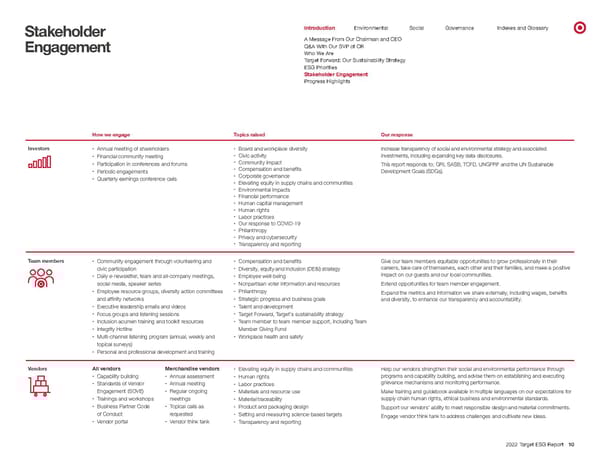
- 0 Introduction Environmental Social Governance Indexes and Glossary A Message From Our Chairman and CEO Progress Highlights Q&A With Our SVP of CR Who We Are Target Forward: Our Sustainability Strategy ESG Priorities Stakeholder Engagement Progress Highlights Committed to spend more than $2 billion with Black- owned businesses by the end of 2025. Recognized by CDP as a 2021 Supplier Engagement Leader for our partnership with our supply chain on climate action. Closed on our first-ever Program-Related Investment (PRI) through the Target Foundation to support the long-term recovery and growth of Minnesota small businesses in low- to moderate- income or underbanked communities. Made a $5 million incremental commitment to community- based NGOs advancing vaccine equity among diverse populations. Unveiled our first net zero energy store in March 2022, in support of our commitments to use more renewable energy and reduce our carbon footprint. The store, in Vista, California, is powered by more than 3,400 solar panels and lower emitting natural refrigerants for its grocery systems. Launched Target Zero in 2022 to help our guests find products with packaging designed to be refillable, reusable or compostable, or made from recycled content or alternatives to plastic such as aluminum, steel and glass. Enhanced our total rewards package to create greater equity and opportunity: • Set a new starting wage range of $15–$24/hour. • In 2022, we extended Target’s medical plan to hourly store team members who work a minimum average of 25 hours a week (down from 30 hours per week). • Launched Dream to Be, our debt-free education program for the 340,000 team members in our U.S. network, as part of a $200 million investment over the next four years . Expanded our pro bono support for Black-owned small businesses beyond the Twin Cities into Atlanta, Chicago and the Bay Area in April 2022. Contributed nearly 900,000 hours of volunteering, despite the unique challenges of COVID-19. To support historically Black colleges and universities (HBCUs): • Introduced our Target Scholars Program , which will provide 1,000 first-year students with $5,000 scholarships, mentoring, internships and networking opportunities. • Became a founding supporter of the Pensole Lewis College of Business & Design , the nation’s first reopened historically Black college. Publicly shared our voting rights principles and joined 250 other organizations in signing on to the Business for Voting Rights Coalition , which would prohibit racial discrimination in voting laws, ensuring equal access to the democratic process. Confirmed through our adjusted pay analyses that women were paid 100% of the pay for men , and BIPOC were paid 100% of the pay for white team members . 2022 Target ESG Report 11
0 Introduction Environmental Social Governance Indexes and Glossary Environmental Overview Inside Environmental Investing in Circularity Climate Action Responsible Resource Use Environmental 2022 Target ESG Report 12
Introduction Environmental Social Governance Indexes and Glossary Environmental Overview Environmental Overview Inside Environmental Caring for our planet We recognize the impact our actions and business operations have on the planet. Our focus is on leveraging our size and scale to enable positive change so that future generations may thrive in a world fueled by a zero-carbon, responsibly sourced and circular economy. By partnering and innovating throughout our supply chain, and keeping inclusivity at the center of what we do, we’re striving to address the most pressing environmental challenges of our time. Our work contributes to the following SDGs : 6 ~~~~~~ 2:iGEJI m ~ 7~~D ,,, .:-e~ ,,, 15 ::...., I 12=. """""""" CX) 17::'J:':'::: @ 13: ~ 14 :nwwATIH ........... ........... Frameworks reported on: GRI SASB TCFD G G G 9 ,. --- •-:: • • 0 Total 5 renewable energy consumption 34+18+48+ 52% FY2021 RECs 34% Grid electricity 18% Percentage of owned brand 6 paper-based packaging sourced from sustainably managed forests 7 86% FY2020: 63% FY2019: 51% Waste diverted from landfill 80.8% FY2020: 80.1% FY2019: 77.5% Investing in Circularity Climate Action Responsible Resource Use Change in market-based scope 1 and 2 emissions (versus a 2017 baseline) Target has committed to being a -32.0% net zero FY2020: -26.7% FY2019: -10.5% enterprise 8 by 2040 Percentage of supplier factories that have completed the Higg Facility Environmental Module (FEM) self-assessment (or equivalent environmental data assessment) Tier 1 Tier 2 Apparel factories Fabric mills, packaging factories and trim factories 98++2 90+10+ Recognition for ESG performance CEBA U.S. EPA Green Power Partnership No. 8 Top 10 U.S. Energy No. 1 National Top 100 No. 3 Top 30 Onsite Solar Generation Buyers 2021 No. 2 Top 30 Retail No. 14 Fortune 500 2022 ESG: metrics for renewable energy consumption and scope 1 and 2 is for domestic (U.S.) operations that we have operational control under The Climate Registry General Reporting Protocol. Does not include any metrics related to Shipt. 6 Brand we own, source and sell. 7 We utilize credible independent third-party certifications to ensure sustainable sourcing of forest products 8 By 2040, Target commits to being a net zero enterprise: zero waste to landfill in its U.S. operations and net zero emissions across both its operations and supply chain, inclusive of scopes 1, 2 and 3. 2022 Target ESG Report 13 34+ 98+ 18+48+G 2+G 90+10+G 52% FY2021 90% FY2020: 56% FY2019: 48% 98% 98% 90% FY2020: 85% FY2020: 85% FY2020: 56% FY2019: 78% FY2019: 78% FY2019: 48% 5
0 Net zero Introduction Environmental Social Governance Indexes and Glossary Environmental Overview Inside Environmental Inside Environmental Investing in Circularity Climate Action Responsible Resource Use Investing in Circularity Circular design is a critical part of how we will deliver our Target Forward goal to design and elevate sustainable brands 9 that are affordable, inclusive and inspirational, and essential to our ambition to innovate to eliminate waste. We are partnering across our supply chain to design solutions within our products, packaging and operations that use fewer materials, remain in use longer, and make reuse and recycling easier, while continuing to provide ease and convenience for our guests. Our inclusive design approach, Design for All , supports our evolution toward circularity and maintains our focus on providing joyful experiences for our guests. Climate Action The impacts of climate change are profound and increasingly being felt by people across the world, particularly society’s most marginalized groups. As a trusted, leading brand, Target knows that urgent action is needed. That’s why we have committed to being a net zero enterprise 10 by 2040. To meet the challenge of climate change, we’re increasing energy efficiency, using more renewable energy and implementing new practices across our value chain to reduce our carbon footprint. We are also using scenario analysis as a tool to assess the potential implications of climate-related risks. By collaborating with key partners across our value chain and joining climate coalitions, we are accelerating decarbonization at an industrywide scale. Responsible Resource Use Our planet provides the raw materials needed for our products. It is our responsibility to work to protect nature, the people who produce materials and the communities in which they live. Because many impacts associated with our products originate in our supply chains, we collaborate with suppliers to create shared positive impact and enhance transparency, leveraging our internal policies to uphold robust raw material sourcing standards. We have commitments for the responsible sourcing of forest products , chemicals , cotton , animal welfare , palm oil and seafood , with efforts aimed at nurturing biodiversity, advancing water stewardship and driving best practices in chemicals use. Our diligence to source responsibly is part of our Target Forward commitment to fostering a sustainable and inclusive supply chain that is just and equitable for all workers. 9 Brands or manufacturers with industry-leading products or services that have context-specific environmental and/or socially beneficial features, backed by credible standards or impact metrics. 10 , as defined, is achieved when a company’s scope 1, 2 and 3 emissions are reduced to a level that is consistent with a 1.5°C pathway, and any residual emissions are removed from the atmosphere through either nature- based or technological carbon removal solutions (e.g., forestry, regenerative agriculture, carbon capture technology), by no later than 2050. Target has committed to being a net zero enterprise by 2040 — zero waste to landfill in U.S. operations and net zero emissions across both our operations and supply chain, inclusive of scopes 1, 2 and 3. 2022 Target ESG Report 14
0 G)ze Investing in Circularity Product and packaging design We are enhancing the environmental performance of our products and packaging, leveraging our size and scale to innovate lower- impact solutions, including alternatives to plastic. We have plans for 100% of our owned brand products to be designed for a circular future by 2040. We also plan to: • Offer two circular owned brands by 2025. • Reduce annual total virgin plastic by 20% in our owned brand Food, Beauty and Essentials businesses by 2025, measured against our total plastic packaging baseline volume in these categories in 2020. • Have 100% of our owned brand plastic packaging be recyclable, compostable or reusable by 2025, eliminating problematic plastics in owned brand packaging. • Make owned brand packaging with 20% post- consumer recycled (PCR) plastic content. We look to embed closed loop principles right from the design stage. This means prioritizing the use of regenerative, recycled and sustainably sourced materials , and creating products that are durable, recyclable and easily repaired or have modular component parts. Promoting circular design To harness the power of our team, we created and implemented a Circular Design Guide — a web-based training hub for team members to learn about circular design and its impact. In addition, our Circular Design Calculator helps team members determine key factors when choosing materials. The tool was leveraged in 2021 to help our supply chain team create a baseline of the water and greenhouse gas (GHG) impacts of its shipping materials. These resources have supported our work across various areas, including: • Our Universal Thread line, where we are developing denim jeans to contribute to a closed loop model, using materials such as recycled cotton and recycled polyester. • The rethinking of Guest Service GiftCards (GiftCard with Purchase & Merchandise Return) designed by our prepaid team, replacing single-use plastic with a durable, paper-based alternative. The revamped GiftCards launched in select stores in March 2022. • The fixtures used for the launch of Ulta Beauty at Target . Steel, aluminum and UV-stable plastics were selected for their reusability, and component sections were made easy to separate to aid repair or replacement. Introduction Environmental Social Environmental Overview Inside Environmental Investing in Circularity Climate Action Responsible Resource Use As a stakeholder in the CircularID Initiative and the development of the Circular Product Data Protocol , we conducted an early feasibility test using digital identities, in partnership with EON in 2021. The test, using Target’s owned brand Wild Fable, enabled us to understand the process and explore future scalability and key performance indicators (KPIs) for the use of digital identities for Target products. Read more about our circular design principles . Alternative materials and recyclable plastic packaging To address concerns about plastic packaging impacts, we’re working to reduce virgin plastic use. Key to our progress is pre-competitive collaboration across the supply chain, as well as exploration of alternative materials that considers the full environmental implications of substitutes. Governance Indexes and Glossary Target in action Target Zero In February 2022, we launched Target Zero , an initiative to help guests find products in more sustainable packaging. The collection features products with packaging designed to be refillable, reusable or compostable, or made from recycled content or materials like aluminum, steel or glass. The initiative launched with 10 Beauty brands and 65 products in stores, as well as several hundred items across Beauty, Personal Care and Household Essentials on Target.com . The momentum was maintained in April, with new products across our owned brand Everspring, including concentrated items in minimal packaging. 2022 Target ESG Report 15
ecy yd ar l rseat fi 1 0li _J 2do/a , off l h/ ~ select baby gear with G)circle. 0 - - Introduction Environmental Social Governance Indexes and Glossary Product and packaging design Environmental Overview Inside Environmental Investing in Circularity Climate Action Responsible Resource Use As members of the Ellen MacArthur Foundation and a signatory of the New Plastics Economy and the U.S. Plastics Pact , we look to eliminate problematic and unnecessary plastic waste through reduction and innovation. We have made 2025 commitments to: • Eliminate problematic plastics in owned brand packaging. • Make owned brand packaging with 20% PCR plastic content . 11 • Design 100% of owned brand packaging to be recyclable, compostable or reusable. Progress against our goal to reduce the total volume of virgin plastic packaging in our owned brand Food, Beauty and Essentials businesses by 20% by 2025 will be measured against our total plastic packaging baseline volume in these categories for 2020 (45.1 metric tonnes) by 2025. To enhance our efforts, Target became a supporting partner of the Closed Loop Partners Composting Consortium in 2021. The initiative aims to advance recovery of compostable packaging, convening a cross-industry working group to create a framework for strengthening U.S. composting infrastructure and systems. We also joined the Roundtable on Sustainable Biomaterials to gain access to educational information on biomaterials. As digital sales continue to grow, we are also improving our transit packaging materials, including replacing bubble wrap with a 100% recyclable expanded paper cushioning wrap for all products shipped from stores starting in 2020. In November 2021, our packaging team identified an opportunity to replace unrecyclable PET trays and packaging used for our Wondershop ornaments with recyclable corrugate material. This change is expected to impact our 2022 Winter Holiday assortment, eliminating over 200 metric tonnes of plastic. Guest and supplier engagement Achieving a more circular economy requires collaboration, and we maintain several channels for engaging guests and suppliers in sustainability efforts. As a founding partner of the Consortium to Reinvent the Retail Bag , in 2021 we launched pilots of several innovations to replace single-use plastic bags in three Target stores across Northern California. Working alongside the Consortium’s two other founding partners — CVS Health and Walmart — the pilots sought to refine four of nine winning solutions from the Consortium’s global Beyond the Bag innovation challenge. The findings will inform future work to eliminate and replace single-use plastic bags with reusable alternatives. We continue to use the How2Recycle label on our owned brand packaging to make recycling options clearer for guests. Circular economy Metric FY2021 FY2020 FY2019 Framework Cumulative number of team members we trained on circular design since 2018 3,106 2,422 1,632 Recycled polyester used to manufacture primary products (metric tonnes) 63,600 38,700 34,800 301-2 Apparel and accessories 41,700 23,100 20,300 Home and hardlines 21,900 15,600 14,500 Annual amount of waste recycled from car seat recycling program (million pounds) 7.7 3.3 7.0 301-3 GRI GRI 11 We set our commitment to PCR in 2019 but acknowledge that some states will have higher thresholds for PCR content by 2025. 2022 Target ESG Report 16
0 Introduction Environmental Social Governance Indexes and Glossary Environmental Overview Waste elimination and reduction Inside Environmental Investing in Circularity Climate Action Responsible Resource Use We seek to reduce operational waste, to partner with upstream suppliers on similar commitments and to activate efforts throughout our value chain. As part of our Target Forward journey, we aim to achieve zero waste to landfill in our U.S. operations by 2030, striving to adopt an approach of “innovate to eliminate.” By 2030, Target plans to divert 90% of waste from landfill through reuse, recycling, donation and reduction strategies. Zero waste involves the conservation of all resources by means of responsible production, consumption, reuse and recovery of products, packaging and materials without burning and with no discharges to land, water or air that threaten the environment or human health, as established by the Zero Waste International Alliance . The threshold to be considered “zero waste” is normally set at a minimum of 90% diversion rate. By 2025, we plan to have 50% of owned brand apparel, footwear, home and hardlines suppliers by spend achieve zero manufacturing waste to landfill ( ZMWL ). 12 Waste elimination and reduction strategies Vendor partnerships Robust vendor partnerships help enhance our waste reduction, recycling and reuse programs. Currently, 71.4% of reverse-stream material that comes back to Target is in apparel and home. Work toward our ambition for key suppliers to achieve ZMWL is already ongoing in owned brand footwear. In 2019 and 2020, we co- created the Shoe Waste Factory program with the Footwear Distributors & Retailers of America to drive continuous improvement in establishing waste management systems and divert waste from landfill. In 2021, 25 factories participated in the program, with 21 of those factories achieving zero waste to landfill 12 — collectively diverting 5,602 tons of waste. We will continue to work with participating factories to support their ongoing success, look to add additional factories to the program in the future and explore ways to use the footwear model to reduce waste across other owned brand categories. We have service providers who manage 100% of our electronics waste domestically — no materials are exported — while batteries are recycled by our hazardous waste vendors. We engage companies, including Novolex , Fresh Pak , Potential Industries and Waste Management , to recycle our packaging film. We are also continuing to pilot a textile-to-textile recycling project with Circ , converting end-of-season, overstock and end-of-life textiles into new raw materials. Our test project is turning the recycled raw material into Target-branded T-shirts for team member volunteering events. While mannequins in our stores are currently made with polyurethane, a nonrecyclable virgin plastic, we are expanding our vendor capabilities in North America to use recyclable plastic and recycled content. Additionally, we have partnered with mannequin manufacturers closer to our stores to reduce shipping distance and set up reclamation and recycling processes at these facilities to create a circular waste stream. Take-back programs Select take-back programs make recycling products and packaging simpler and more convenient for guests. In the majority of our stores, we offer front-of- store recycling for plastic bags and some electronics, and hold twice-yearly child car seat recycling events . Read more about our approach to take-back programs as part of our circularity strategy . Eliminating food waste Aligned with our Target Forward goal to achieve zero waste to landfill 12 in our U.S. operations by 2030, we plan to reduce operational food waste by 50% by 2025. So far, we have improved our forecasting and replenishment strategy, and enhanced reporting and processes. With the support of our partner Anthesis, we have also established our food waste footprint and baseline year (2017), utilizing the World Resources Institute (WRI) Food Loss & Waste Protocol . We can now start to measure, track and address our food waste “hot spots.” Should any of our stores and supply chain facilities have surplus food, they can donate eligible safe- for-consumption products to their local Feeding America member food bank. This partnership allows us to support the communities we serve while reducing our environmental impact. In 2021, we donated 106 million pounds of food, which is equivalent to 88 million meals. For food that cannot be donated, organics recycling or composting programs are currently available at 712 facilities. To continue to support our zero waste to landfill 12 goal, in 2022, we will also launch an additional 700 stores on an organics recycling program with our partner Divert Inc . Read more about our vendor partnerships, take- back programs and food waste reduction efforts as part of our circularity strategy . 12 The conservation of all resources by means of responsible production, consumption, reuse and recovery of products, packaging and materials without burning and with no discharges to land, water or air that threaten the environment or human health, as established by the Zero Waste International Alliance . The threshold to be considered “zero waste” is normally set at a minimum of 90% diversion rate. 2022 Target ESG Report 17
0 - - - - - - - - - - - - Waste elimination and reduction Responsible waste disposal When we can’t eliminate waste, we try to divert it from landfill. In 2021, 68.2% of construction waste and 80.8% of operational waste was diverted from retail operations. Our properties team has been recycling eligible roof membrane from reroofing projects since 2007, and in 2021, this amounted to 1,189 tons of material. Responsible disposal of waste Target is piloting an innovation project in four locations that involves placing a camera in compactors and using artificial intelligence (AI) technology to detect recyclable materials. From this data, we can provide store-level reporting to drive process improvements. If this pilot is successful, we plan to roll out the technology enterprise-wide to detect other recyclable materials. Metric FY2021 FY2020 FY2019 Framework Weight of operational waste generated (tons) 306-2 Non-hazardous 1,111,107 1,008,746 966,362 Hazardous 2,459 1,534 1,219 Percentage of waste diverted from landfill Operational waste 80.8% 80.1% 77.5% Construction waste 68.2% N/A 13 60.2% Weight of material diverted from landfill (tons) Operational material 900,100 808,860 749,648 Construction material 1,189 N/A 5,871 Weight of non-hazardous operational waste reused (tons) 201,700 168,606 175,879 306-2 Plastic hangers 14,385 10,387 4,996 Donations 60,243 53,720 52,442 Salvage 127,072 104,499 118,441 Weight of non-hazardous operational waste recycled (tons) 690,694 633,945 568,407 306-2 Cardboard 633,056 573,633 514,564 Plastic bags and shrink wrap 12,370 11,538 10,282 Plastic, glass and aluminum cans and bottles 3,771 4,673 4,480 Electronics 11,259 9,706 2,859 Metal 10,099 13,552 14,921 Paper 1,793 2,794 3,121 Used cooking oil 182 165 168 Other 18,164 17,884 18,012 13 In 2020, Target generated no construction waste due to project cancellations and a shift to special project work. 14 Target does not ship waste internationally. GRI GRI GRI Introduction Environmental Social Governance Indexes and Glossary Environmental Overview Inside Environmental Investing in Circularity Climate Action Responsible Resource Use Metric FY2021 FY2020 FY2019 Framework Weight of non-hazardous operational waste disposed of by: 306-2 Composting (tons) 7,601 7,133 5,345 Recovery, including energy recovery (tons) 0.3 0.4 1.2 FB-FR-150a.1 Incineration (mass burn) (tons) 131 273 151 Landfill (tons) 210,921 199,590 216,546 Weight of non-hazardous operational waste disposed of by other means (tons) 21.52 332.22 0 306-2 Material release and container recycling (i.e., helium) 0 0 0 Wastewater treatment 38 42 33 W eight of hazardous operational waste disposed of by: 306-2 Recycling (tons) 87 14 12 Recovery, including energy recovery (tons) 18 3 3 Incineration (mass burn) (tons) 1,753 1,513 1,191 Landfill (tons) 587 0 0.5 Weight of hazardous operational waste disposed of by other means (tons) 3.3 3 12 306-2 Material release and container recycling (i.e., helium) 0 0 0 Wastewater treatment 11 3 12 Weight of hazardous operational waste that was transported (tons) 2,459 1,534 1,219 306-2 Percentage of hazardous operational waste shipped internationally 0 0 0 14 306-4 Number of Target locations with organics recycling 712 537 343 306-2 Number and volume of recorded spills None None None 306-3 GRI SASB GRI GRI GRI GRI GRI GRI GRI 2022 Target ESG Report 18
0 2019 2021 2022 2023 2025 2030 2040 Achieve net zero GHG emissions 15 across all scopes by 2040 (10 years ahead of the Paris Agreement). Climate Action Introduction Environmental Social Governance Indexes and Glossary Environmental Overview Net zero emissions target and reduction strategy Inside Environmental Investing in Circularity Climate Action Responsible Resource Use Our emissions commitments are ambitious, and we recognize the challenge ahead in reducing our impact while still growing our business. But this does not deter us from our work to avoid, reduce and remove emissions from the value chain. Through Target Forward, we are adopting sustainable practices such as increasing our use of renewable energy and driving energy efficiency. We have joined the Business Ambition for 1.5 ° C The timeline shows how we have ramped up our ambition, starting in 2019, and how we are looking to achieve net zero GHG emissions 15 across scopes 1, 2 and 3, by 2040 (10 years ahead of the Paris Agreement). We are committed to avoiding, reducing and removing emissions as we work toward a target of net zero. 15 and Race to Zero campaigns so that our emissions contribute to no more than 1.5°C warming, as outlined by the Intergovernmental Panel on Climate Change (IPCC) , and drive meaningful change across our sector. • Set our Science Based Targets initiative (SBT i)-approved goal to reduce absolute scope 1 and 2 emissions and scope 3 GHG emissions from retail purchased goods and services (PGS) 30% by 2030 from a 2017 baseline. • Unveiled Target For ward. • Achieved 30% absolute reduction in emissions (scopes 1 and 2) from a 2017 baseline. Scope 3: Scope 1: Scope 1 and 2: • Aim for 80% of suppliers by spend — covering all PGS — to set science-based reduction targets for scope 1 and 2 GHG emissions by 2023. • Aim to source 60% of our electricity from renewable sources for our operations. • Aim to source 100% of our electricity from renewable sources for our global oper ations. • Announced our goal of net zero GHG emissions by 2040. 15 • Updated scope 1 and 2 emissions reduction goal to 50% by 2030 from a 2017 baseline. • Joined the Business Ambition for 1.5°C and Race to Zero campaigns . Scope 3: • Engage suppliers to prioritize renewable energy and collaborate on solutions that protect, sustain and restore nature. • Aim to have at least 50% of the energy used in strategic and joint business partner owned operations come from renewables. • Aim to achieve 50% absolute reduction in operations emissions (scopes 1 and 2) from a 2017 baseline. Scope 3: • Aim to achieve 30% absolute reduction in supply chain emissions (scope 3) covering retail PGS from a 2017 baseline. 15 Net zero , as defined, is achieved when a company’s scope 1, 2 and 3 emissions are reduced to a level that is consistent with a 1.5 ° C pathway, and any residual emissions are removed from the atmosphere through either nature-based or technological carbon removal solutions (e.g., forestry, regenerative agriculture, carbon capture technology), by no later than 2050. Target has committed to being a net zero enterprise by 2040 — zero waste to landfill in U.S. operations and net zero emissions across both our operations and supply chain, inclusive of scopes 1, 2 and 3. 2022 Target ESG Report 19 2040
0 Introduction Environmental Social Governance Indexes and Glossary Environmental Overview Greenhouse gas emissions Inside Environmental Investing in Circularity Climate Action Responsible Resource Use We continuously strive to reduce the carbon footprint of our direct operations and supply chain, and have developed an approach to reducing emissions across our enterprise. Partnering with suppliers on emissions reduction strategies We have been working for many years with various third-party partners on initiatives to reduce scope 3 emissions and track progress against our goals. The production, distribution, use and disposal of products are responsible for most of our GHG emissions, so we have set several targets to reduce emissions across our supply chain. Through our climate supplier engagement program, we continue to support suppliers as they calculate their carbon footprint, set science-based emission reduction targets, track progress and drive collaborative action. Around 32% of our top 80% of suppliers by spend had set emissions reduction targets by end of 2021. Our emissions impacts Scope Definition Our impact 1 Direct emissions Target operates a variety of stores, offices, supply chain facilities, data centers and off-site warehouses. These sites create direct emissions through the activities under their control. They also consume electricity, which generates indirect emissions during its production. Together, scope 1 and 2 emissions account for approximately 3% of our emissions footprint. 2 Indirect emissions 3 Indirect emissions (upstream and downstream value chain) Our upstream and downstream value chain activities cover manufacturing, product distribution, business travel, guests using our products and other indirect sources. These types of indirect emissions account for around 97% of our GHG emissions. Specifically, goods and services that we purchase account for approximately 47% of our scope 3 emissions, and the remaining 53% of scope 3 emissions come from use of sold products, transportation and other activities. To date, our suppliers have reported net reductions in their scope 1 and 2 emissions equivalent to 5.3% of the baseline established in 2017. We use the Higg Facility Environmental Module (FEM) and CDP to capture allocated emissions reductions from our suppliers, and these reductions were reported from third-party verified datasets or were validated internally by Target. In 2020, the number of suppliers reporting on their 2019 reductions increased by over 70%. Our suppliers are in the process of completing their 2021 data submissions. The business environment in 2021 impacted our growth and therefore our emissions. Total sales increased by $12.2 billion, from $92.4 billion in 2020 to $104.61 billion in 2021, which contributed to a 4.5% rise year-over-year in scope 3 emissions. As we work on our ambitious climate goals and partner with our suppliers to make reductions, we expect to see those efforts reflected in our future emissions performance over the medium and long term. Key upstream and downstream interventions • Regenerative agriculture: We co-funded a five-year, $8.5 million project with Cargill, McDonald’s and the U.S. Department of Agriculture to help Nebraska farmers advance soil health. • Responsible sourcing: With multiple partners and stakeholders, Target is working to meet responsible sourcing and climate change commitments for palm oil, forest products, cotton, coffee and seafood. • Sustainable logistics: We seek opportunities to work with third-party logistics providers to improve the efficiency with which they move our products. • Packaging: In 2020, we announced ambitious 2025 commitments to eliminate problematic plastics in packaging with the potential to reduce energy use and GHG emissions. • Guest engagement: The use of sold products accounts for approximately 35% of our scope 3 carbon emissions — we have an opportunity to educate our guests on reducing emissions, such as through the purchase of ENERGY STAR- certified products. Read more about our investments into supply chain improvements . 2022 Target ESG Report 20
0 - - - - - - - - - - - - Introduction Environmental Social Governance Indexes and Glossary Greenhouse Environmental Overview Inside Environmental gas emissions Investing in Circularity Climate Action Responsible Resource Use GHG emissions Metric FY2021 FY2020 FY2019 Framework Metric FY2021 FY2020 FY2019 Framework Scope 1 and 2 GHG emissions (mtCO 2 e) Location-based Market-based 2,159,457 1,746,742 1,883,429 2,192,085 2,298,450 2,433,234 GRI 305-1 TCFD Percentage of suppliers, by spend, having set science-based r eduction targets for scope 1 and 2 GHG emissions Change in scope 3 GHG emissions from 2017 baseline 32% 19.9% 17 23% 12.0% 18 17% -1.6% Target goal (2023: 80%) Target goal (2030: -30%) Change in scope 1 and 2 GHG emissions from 2017 baseline (mark et-based) -32.0% -26.7% -10.5% Target goal (2030: -50%) Change in retail PGS from 2017 baseline 26.2% 19 11.0% 20 -2.6% Target goal (2030: -30%) GHG emissions intensity (scope 1 and 2, market-based) 0.00570 0.00620 0.00763 GRI Quantity of gross other indirect (scope 3) GHG emissions by GHG P rotocol category (mtCO 2 e) 60,664,000 56,645,000 49,754,000 GRI 305-3 (mtCO 2 e/sq. ft.) 305-4 TCFD 1 – PGS 30,756,000 27,108,000 21 23,832,000 TCFD Gross quantity of direct (scope 1) GHG emissions (mtCO 2 e) 734,799 699,877 752,552 GRI 2 – Capital goods 1,015,000 790,000 866,000 Natural gas Propane 274,862 1,988 251,325 1,776 238,899 1,758 305-1 SASB FB-FR-110b.1 3 – Fuel- and energy-related activities 4 – Upstream transportation and distribution 22 587,000 1,778,000 397,000 1,453,000 453,000 1,095,000 Stationary diesel 1,363 1,664 1,955 TCFD 5 – Waste generated in operations 227,000 189,000 185,000 Mobile (diesel, gasoline, jet fuel) 29,699 22,554 41,470 6 – Business travel 5,000 4,000 22,000 Refrigerants 426,887 422,558 468,470 7 – Employee commuting 404,000 373,000 347,000 Quantity of scope 1 biogenic CO 2 emissions (mtCO 2 e) 0 0 0 GRI 9 – Downstream transportation and distribution 4,931,000 4,390,000 4,863,000 Corporate emissions rate for EPA 16 -applicable refrigeration systems (greater than 50 lbs) 12.8% 13.3% 15.4% 305-1 GreenChill P artnership 11 – Use of sold products 12 – End-of-life treatment of sold products 19,553,000 1,408,000 20,554,000 1,387,000 17,123,000 968,000 Pounds of ODS R-22 refrigerant removed and replaced with lower Global W arming Potential alternatives 17,575 19,712 27,243 GreenChill P artnership Quantity of GHG emissions from commercial air business tr avel (mtCO 2 e) 1,687 1,623 23 17,511 GRI 305-3 Gross quantity of indirect (scope 2) GHG emissions (mtCO 2 e) GRI 305-2 Quantity of biogenic scope 3 CO 2 emissions (mtCO 2 e) 0 0 0 GRI 305-3 Scope 2 total (location-based) 1,424,658 1,492,208 1,680,682 TCFD Scope 2 total (market-based) 1,011,943 1,183,552 1,545,898 Electric (location) 1,420,075 1,488,213 1,676,067 Electric (market) 1,007,360 1,179,557 1,541,283 Steam 2,648 2,605 2,852 Chilled water 1,935 1,390 1,762 16 U.S. Environmental Protection Agency. 17 Target sales increased in 2021, resulting in an associated increase in scope 3 emissions. However, sales increased at a higher rate than emissions during this period, showing a relative slowdown of supplier emissions compared to sales growth. 18 2020 total scope 3 figure has been restated to 12.0% from the 16.5% reported last year. This restatement is due to: the application of The Emissions & Generation Resource Integrated Database (eGRID) factors by year to the Use of Sold Product category; U.S. EPA WARM fact or decreases in End of Life; and an adjustment to remove emissions Target is already accounting for in the PGS category. 19 Changes in sales from 2017 to 2021 drove a 26.2% increase in retail PGS emissions. Supplier-reported emission reductions, which are part of our net emissions calculations, were not yet reported for 2021 at the time of publication and are not reflected in this figure. 20 Supplier-reported emission reductions and greening of the electricity grid accounted for a 5.3% reduction in emissions in 2020. In 2020, suppliers reported 2019 scope 1 and 2 reductions through CDP and Higg FEM increased by over 70%. 21 PGS was restated from 29,177,000 mtCO 2 e when the footprint was re-run this year. This includes reductions from greening of the grid and supplier reported reductions. Major drivers of change include LCA emission factor updates and more precise weight calculations. 22 Upstream transportation does not currently include the emissions associated with chilled, temperate or frozen truck movements, which is conservatively estimated to be less than 7% of Target’s annual sales. Target has taken action to address this gap in measurement. 23 Our business travel emissions estimate includes passenger miles on commercial airlines. We used emissions factors from the U.S. EPA Climate Leaders Business Module. Global warming potentials are fr om the IPCC’s Second Assessment Report. We did not apply a radiative forcing adjustment to the verified airline travel emissions. Corporate jet emissions are included as part of our scope 1 calculations. 2022 Target ESG Report 21
0 - - Introduction Environmental Social Governance Indexes and Glossary Environmental Overview Efficiency and energy management Inside Environmental Investing in Circularity Climate Action Responsible Resource Use We’re working to manage energy use, improve efficiency and transition to renewable energy to help reduce the impact of our operations and our suppliers’ facilities. Our internal Sustainable Building Council, a cross- functional team within Target Properties, coordinates sustainability strategies and helps develop priorities and roadmaps to meet our long-term goals. Renewable energy We plan to obtain 100% of the electricity needed for our operations from renewable sources by 2030 and have set an interim goal of 60% by 2025. We commit to contracts for off-site renewable energy and rooftop solar projects at our facilities. By the end of 2021, we had installed solar at 560 sites. In 2021, we signed several renewable power purchase agreements, including a wind energy project in Texas (140 MW) and a solar energy project in Ohio (100 MW). Our portions of several contracted projects in Texas, Florida and Nebraska began producing renewable energy for commercial operation. All these projects now contribute toward Target’s renewable energy portfolio. We are also engaging supply chain partners in our efforts and, by 2025, aim to have at least 50% of the energy used in strategic and joint business partner owned operations come from renewables. Electric vehicles We are also helping fight climate change through our electric vehicle (EV) charging 24 program. Many of our guests want to switch to EVs but worry about finding places to charge. By collaborating with organizations such as Tesla , Electrify America , EVgo and ChargePoint , almost 1,400 charging spaces are now available across 159 Target sites as of year-end 2021. Stores and refrigeration We remain committed to HFC-free refrigeration systems whenever technically feasible, with a long- term strategy to have all stores converted to natural refrigerants 25 by 2040, aiming to reduce our direct operations’ emissions by an expected 20%. We are also building a portfolio of highly energy- efficient stores by continually adopting new technologies and operating procedures. Target has earned ENERGY STAR certification for more than 1,550 facilities and was recognized as an ENERGY STAR Partner of the Year in 2022, the seventh straight year we have received this accolade. Target in action Target’s first net zero energy store In support of our commitments to use more renewable energy and reduce our carbon footprint, we unveiled our first-ever net zero energy store 26 in March 2022. The retrofitted site, in Vista, California, was designed to generate more renewable energy than it uses, and to transmit that surplus back to the local grid. More than 3,400 solar panels across its roofs and carport canopies will power the store and its heating, ventilation and air conditioning system, while CO 2 will now be used as a natural refrigerant. We intend to roll out this natural refrigerant 25 across our business by 2040, aiming to reduce our direct operations’ emissions by an expected 20%. Energy consumption Metric FY2021 FY2020 FY2019 Framework Total energy consumption (GJ) 20,153,181 19,454,429 20,040,246 CG-MR-130a.1. Energy intensity ratio (U.S. electricity) (kWh/sq. ft.) 12.79 12.80 13.42 (1) 302-3 SASB GRI Percentage of total energy that is renewable and for which we retire RECs 24% 14% 28 7% 27 SASB CG-MR-130a.1. (3) Total electricity consumption (GJ) 14,121,121 13,995,525 14,566,142 GRI 302-1 Percentage of total energy consumed that is grid electricity 29 47% 57% 65% CG-MR-130a.1. (2) SASB Percentage of global electricity consumption that is renewable 30 52% 38% 27% Target goal (2025: 60%; 2030: 100%) Covered by Target RECs 34% 21% 10% Grid-renewable portion 18% 17% 17% 24 Installation of EV charging stations is not factored into our GHG footprint. 25 100% CO 2 , a natural refrigerant with ultra-low global warming potential, significantly reduces our stores’ direct emissions impact. 26 The store meets the definition for zero energy certification from the International Living Future Institute , in that 100% of the building’s energy needs on a net annual basis are supplied by onsite renewable energy. No combustion is used to meet onsite energy demands. 27 Renewable electricity includes renewable energy credits (RECs) from Target’s onsite and off-site projects, as well as electricity that we receive from renewable energy generation serving the electric grids where Target facilities are located. Data sources include: Target’s 2021 fiscal year electricity consumption data; Target’s 2021 RECs; and the Center for Resource Solutions (CRS) Utility Grid Accounting methodology for renewable mix, published in the latest EEI Utility Electricity Mix Database. 28 The CRS Utility Grid Accounting methodology for renewable mix, adopted by CDP , The Climate Registry and RE100 , is a more granular method, applying a regional and utility-specific method as published in the latest Edison Electric Institute (EEI) Utility Electricity Mix Database versus the national data used previously. This results in a utility grid renewable mix of 17.7% in FY2021. 29 Excludes grid mix renewables. 30 The scope of this data is U.S. operations only, but international offices account for less than 1% of our overall electricity consumption. 2022 Target ESG Report 22
0 Introduction Environmental Social Governance Indexes and Glossary Environmental Overview Climate-related risks and opportunities Inside Environmental Investing in Circularity Climate Action Responsible Resource Use In addition to climate change mitigation efforts, we seek to fortify our business by addressing risks and building resilience. Target’s corporate responsibility, government affairs, properties, and responsible sourcing and sustainability teams coordinate our climate change strategy, identify key initiative areas, assess risks and opportunities, and implement the company’s response (see Governance ). Policy advocacy on climate We continue to urge the U.S. Government to address climate change, and directly engage with policymakers at federal, state and local levels to urge climate action, recognizing it as a threat to our business. Read more about our advocacy approach to climate-related issues . We track energy and carbon regulation, and related proposals, at the U.S. federal and state levels to identify opportunities for expanding our energy commitments and those of our suppliers. We use an Enterprise Risk Management (ERM) program to identify, prioritize and address a broad range of risks that could directly or indirectly impact our organization. Overseen by our Chief Legal and Risk Officer, ERM provides regular updates to senior leadership and our Board of Directors, and specifically the Audit & Risk Committee. We assess climate, forests, water and other natural resource-related risks according to the impact on our business, team members and guests. Each risk may impact factors such as sales, price stability, competitive advantage, stores, guests, communities and suppliers, and those impacts may vary in magnitude, duration or dependency. We also assess impact based on existing crisis preparedness or the ability to develop such contingency and resiliency plans. Climate adaptation As we build out our net zero 31 goal roadmap, we will continue to evaluate our climate-related risks and opportunities in line with the recommendations of the Task Force on Climate-related Financial Disclosures (TCFD) (see our TCFD Index ). The physical, financial and transitional risks and opportunities posed by climate change are factored into our management system, assessed for two time horizons (0–3 years and 3+ years), and prioritized based on impact and probability. Our sustainability team conducts periodic climate- related risk and opportunity assessments. Having identified climate risks using our initial 2019 TCFD findings, we engaged an independent third-party consultant to conduct an assessment in 2022 aligned to the TCFD risks and opportunities taxonomy. As such, a number of transition risks and physical risks were included as part of our assessment. Transition risks encompass what may occur as a result of a transition to a low- carbon economy, and physical risks include both acute and chronic risks, such as natural disasters (acute) and longer-term impacts of a shift toward a warming climate (chronic). Opportunities considered relate to Target’s efforts to mitigate and adapt to climate change. We disclose the impacts of climate-related risks and opportunities within our annual CDP Climate Response and leverage what we learn to advance our climate mitigation and resilience strategies. We will also continue to develop our own reporting based on best practice guidance. We continue to engage with policymakers to urge climate action, and work with NGOs and trade associations such as the Retail Industry Leaders Association (RILA) to increase access to renewable energy and reduce members’ carbon emissions. Target is also a member of Employers for Renewable Energy (ERE) , a cross-industry coalition co-founded by RILA. ERE helps businesses that support state policies enabling greater customer choice of renewable energy and competition among producers. The impact of unpredictable weather We operate in many communities that have been impacted by extreme weather events, including tornadoes and hurricanes, floods, winter storms and wildfires. The number of such events has risen from two in 2007 to 20 in 2021. Target tracks weather-related events and natural disasters that trigger an emergency response. These events can threaten the physical well- being of stores, employees and products but may also damage infrastructure, often leading to power outages that can spoil food and render our stores inoperable. Our Corporate Monitoring Center identifies man- made or natural disaster risks, enabling us to identify and develop responses to material threats. When climate-related events occur, our risk systems enable a quick response by accounting for team members using mass communications, ceasing operations where necessary and funneling resources and aid to the affected area. 2022 Target ESG Report 23
0 - - Responsible Resource Use Environmental impacts of products Introduction Environmental Social Environmental Overview Inside Environmental Investing in Circularity Climate Action Responsible Resource Use Environmental responsibility in the supply chain Governance Indexes and Glossary We are aware our products have some associated environmental impacts, but we take pride in our efforts to minimize these effects as much as possible. We also seek to use our scale to create new systems with far- reaching positive results. We put these approaches into practice by: • Designing more of our products and packaging for a circular economy . • Driving progress against goals to use lower impact materials in our products . • Partnering to minimize environmental releases of fiber fragments and microplastics . • Following internal and industry best practice standards regarding prohibiting use of unwanted chemicals . Audits and verifications Our Responsible Sourcing and Sustainability audit program monitors the locations that produce our owned and exclusive brands, as well as those that produce national brand products for which Target is the importer of record. Environmental management indicators include possession of the appropriate permits, proper waste management methods, safe chemical usage and responsible wastewater stewardship practices. To do business with us, Tier 1 and Tier 2 factories must complete an annual Higg Facility Environmental Module (FEM) self-assessment. Environmental standards outlined in our Standards of Vendor Engagement (SOVE) hold these factories accountable to environmental compliance and promote continuous improvement. 3,317 factories were audited in FY2021, and we did not have any Zero Tolerance Environmental SOVE principle violations. 32 If any issues are found during verification by a third party, we tailor our response to the circumstances. Some zero-tolerance violations could deactivate the factory from our list, while for other issues, we will work with the supplier to help them achieve compliance within an agreed- upon time frame. Read more about audits and continuous improvement . Metric Percentage of supplier factories that have completed the Higg FEM self-assessment (or equivalent environmental data assessment) FY2021 FY2020 FY2019 Framework CG-AA-430a.2 Tier 1 apparel factories 98% 85% 78% Tier 2 fabric mills, packaging factories and trim factories 90% 56% 48% Average number of environmental issues per audit China 0.6 0.6 1.5 308-2 Southeast Asia 0.6 0.8 1.7 The Americas 0.4 1.2 1.0 India, Bangladesh, Pakistan, Egypt and Turkey 0.5 0.7 2.0 Other 0.7 0.9 1.6 Percentage of new suppliers screened using environmental criteria 100% 100% 100% 308-1 SASB GRI GRI 2022 Target ESG Report 24 32 Target defines significant negative environmental impact as any violation that falls under the Environmental SOVE principle.
0 Introduction Environmental Social Governance Indexes and Glossary Environmental Overview Responsibly sourced commodities Inside Environmental Investing in Circularity Climate Action Responsible Resource Use We drive efforts internally and through our supply chain to source materials and commodities in increasingly responsible ways. Our standards, goals and commitments include: • By 2030, Target intends for the leading raw mat erials (e.g., forest products, cotton, etc.) that go into our owned brand products to be 100% recycled, regenerative or sustainably sourced. • Being committed to sourcing 100% of our cott on more sustainably for owned and exclusive brand products by 2022 by participating in programs designed to improve cotton growing practices and working conditions. 33 • Sourcing all owned brand paper-based retail packaging fr om sustainably managed forests by 2022. • Rolling out implementation of our Forest P roducts Policy to Threshold and Smith & Hawk en brands by the end of 2022. 34 • Our seafood sustainability commitment to include best pr actice requirements for the use of transshipment in tuna supply chains. • Implementing an animal welfare policy; moving t o source only cage-free shell eggs, pending available supply, by 2025; and by year-end 2022, aim to have 100% of Good & Gather brand fresh pork produced using open pen gestation systems. Good & Gather currently represents the vast majority of all fresh pork sold at Target. As we look to 2022 and beyond, we will continue t o encourage national brand pork suppliers to further reduce and eliminate the number of days sows are housed in gestation crates. Find updates related to this goal and other food animal welfar e commitments on our website. Standards and certifications Third-party standards help provide confidence in the practices used in our supply chain and help encourage positive change. To guide sourcing decisions for our owned brands, our suppliers utilize certifications including: • Forest Stewardship Council (FSC) • Marine Stewardship Council (MSC) • Aquaculture Stewardship Council (ASC) • Best Aquaculture Practices (BAP) • Roundtable on Sustainable Palm Oil (RSPO) • Fair Trade USA We communicate sustainability-related information of int erest to our guests using clear icons on product labels to highlight such certifications. Forestry products In our forestry supply chains, we use chain-of- cust ody certifications wherever possible to confirm that we source from well-managed forests. We prioritize FSC standards and currently have 1,500 FSC-certified owned brand items. We recently participated in a pilot study with auditing and risk mitigation or ganization Preferred by Natur e. The study aimed to identify ways t o minimize forest product risk where chain-of- custody wood supplies are not available. Read more about our Forest Products Policy . Palm oil Since 2019, our suppliers’ procurement of RSPO physically cer tified (Mass Balance, Segregated or Identity Preserved) palm oil, palm kernels and derivatives increased by 37%, and now spans 3,000 products in relevant owned brand categories. 35 We have set a goal of using RSPO physically certified palm oil, palm kernels and derivatives in relevant owned brand product categories, and aim to trace palm oil to mill level by end of 2022. Working closely with our partners at the Earthworm F oundation, we achieved traceability to the mill level for 76% of our palm oil supply in 2021 and ar e working to trace the remaining volumes by the end of 2022. Transparent supply chains With retailers increasingly keen to understand how and where products are made, Target is accelerating its implementation of traceability programs. We are initially focusing on cotton due to its prevalence in our assortment, the regulatory requirements surrounding cotton and our commitment to source cotton more sustainably for owned brand and exclusive national brand products by 2022. Eventually, we aim to achieve full visibility of where the cotton we use is grown, collaborating with farmers, brands, other retailers and organizations that share our commitment. We also intend to track and validate our progress. 33 Target does not accept products containing Turkmen cotton or cotton originating from the Xinjiang province of China, regardless of where they were produced. 34 2020 was a goal year for these two brands and while much was accomplished, the goal of 100% was not realized. However, pursuit of this goal did not end with the passing of the goal date. As of the end of 2021, the composite of these two br ands has reached 92%. 35 Owned brand food, household cleaning, personal care, baby care, beauty, cosmetics and candle products. 2022 Target ESG Report 25
0 - Introduction Environmental Social Governance Indexes and Glossary Responsibly Environmental Overview Inside Environmental sourced commodities Investing in Circularity Climate Action Responsible Resource Use To remain transparent about forest protection measures throughout our supply chain and owned brand product and packaging sourcing activities, we submit annual CDP Climate , Water and Forest Responses. standards in our supply chain, and our work to never knowingly purchase — or sell — products containing minerals linked to armed conflict . Materials Metric FY2021 FY2020 FY2019 Framework Palm oil Read more about responsibly sourcing commodities , environmental protection and social Read about how we support our business partner performance , including the launch of our new proprietary self-assessment program to help business partners evaluate their management systems. Amount of palm oil sourced (metric tonnes) Percentage of sourced palm oil certified through RSPO supply chains 7,542 7,095 4,526 CG-HP-430a.1 CG-HP-430a.1 Identity Preserved 10% 1% 0% Materials Segregated 1% 7% 1% CG-HP-430a.2 Mass Balance 72% 82% 45% Metric FY2021 FY2020 FY2019 Framework Book & Claim 17% 10% 54% Food & Beverage Percentage of palm volume traced to: Identity Preserved 18% 1% 0% Importer 87% 81% 79% Segregated 1% 16% 1% Mill 75% N/A N/A Mass Balance 78% 79% 50% Cotton Book & Claim 3% 4% 49% Cotton from sustainable cotton standards (metric tonnes) Essentials & Beauty Better Cotton Initiative (BCI) 167,425 109,131 79,776 CG-AA-440a.2 Identity Preserved 0% 0% 0% Cotton LEADS 11,125 3,805 3,600 Segregated 0% 1% 0% Recycled 767 N/A N/A Mass Balance 94% 87% 40% Organic 3,312 N/A N/A Book & Claim 6% 12% 60% Animal welfare Candles Percentage of shell eggs sold from cage-free sources (by revenue) 57% 50% 51% Identity Preserved 0% 0% 0% FB-FR-430a.2 (1) Segregated 0% 0% 0% Coffee Mass Balance 53% 70% 28% Percentage of SKUs 38 of Good & Gather coffee in bags and pods certified by Fair Trade USA 100% 100% 27% Book & Claim 47% 36 30% 72% CG-AA-440a.4 Wood/Pulp Seafood Percentage of owned brand paper-based packaging sourced from sustainably managed forests 86% 63% 51% Percentage by weight of seafood meeting our Sustainable Seafood Policy 37 CG-AA-440a.4 CG-AA-440a.4 Percentage of SKUs that conform to Target’s forest product policy in: Fresh and frozen 100% 100% 100% Spritz 99% 99% 99% Up&Up, Pillowfort and Cat & Jack 92% 64% 38% Threshold and Smith & Hawken 31% 24% 0% Percentage of rayon meeting CanopyStyle pledge 100% 100% N/A 36 In the candles category, our largest vendor used Book & Claim credits this year due to challenges sourcing physically certified supply. However, they are on track to be fully transitioned to physically certified sources of palm oil by the end of 2022 in keeping with Target’s commitment. 37 38 We utilize credible, independent third-party certifications to source forest products sustainably. Stock keeping unit. 2022 Target ESG Report 26 SASB SASB SASB SASB SASB SASB SASB SASB
0 Biodiversity Biodiversity is a critical component of Earth’s broader ecosystem, as it aids in Earth’s ability to regulate climate, provide food and medicine, and promote cultural significance in local communities. The Taskforce on Nature-related Financial Disclosures defines four “realms” of biodiversity: land, ocean, freshwater and atmosphere. This designation of biodiversity demonstrates that this topic encompasses all of our environmental and social initiatives. Protecting natural resources With our overarching goal to become both equitable and regenerative through our Target Forward strategy, we recognize our dependencies on natural resources to serve our guests, in both our general assortment and food product categories. Our current efforts to nurture and protect the four realms of biodiversity include promoting regenerative agriculture, becoming signatories of bio-economy 39 initiatives, and managing water with features like green roofs and rain gardens where possible. 39 New Plastics Economy and Ellen MacArthur Foundation . In support of our ambition to leverage soil health practices to improve at least one million acres of land by 2025, we are partnering with several suppliers on initiatives that promote regenerative agriculture . We are taking action to reduce the amount of water we use and to protect freshwater quality, quantity and access . To help preserve ocean habitats, we have sponsored research into microplastics, and work with suppliers that are green- or yellow-rated by the Monterey Bay Aquarium Seafood Watch program. Commitments and targets We have set commitments for responsibly sourcing raw materials to help preserve forests and the species that rely on them, and improve local communities and their livelihoods. Both our Forest Products Policy and Palm Oil Commitment explicitly exclude conversion of High Conservation Value or High Carbon Stock forest areas. In alignment with Target Forward, we are continuing conversations around our leading raw materials, building upon strong foundations to create biodiversity-specific commitments and targets using ongoing evidence-based strategies. We are currently undertaking benchmarking, learning and capacity building to develop a robust biodiversity commitment in line with our goals and key initiatives. Introduction Environmental Social Governance Indexes and Glossary Environmental Overview Inside Environmental Investing in Circularity Climate Action Responsible Resource Use Partnerships, initiatives and policies We are committed to relevant biodiversity partnerships, initiatives and disclosures. As we continue to build out further partnerships, we want to recognize our current collaborations that are closely related to biodiversity (see below). Partner Program Arvind Funding a program with our apparel supplier to help 500 cotton farmers in India adopt organic and regenerative farming practices over the next five years. BCI Farmers Helping train farmers to use water efficiently, reduce their use of harmful chemicals and commit to respecting worker rights and well-being. Cotton LEADS Purchasing LEADS-certified products, which address environmental impacts on land and soil, biodiversity and carbon footprint, and accountability throughout the supply chain. Earthworm Foundation Partnering on our palm oil sustainability work, including our aspiration of traceability to the mill level in our palm oil supply chain. Field to Market: The Alliance for Sustainable Agriculture Supporting continuous improvement in U.S. commodity agriculture as an Associate Member and a partner on a Continuous Improvement Accelerator Project. FishWise Partnering to monitor and continually improve the environmental sustainability, traceability and social impacts of farmed and wild-caught seafood. GreenBlue and its Sustainable Packaging Coalition Developing a guide to verify responsible sourcing. The Nature Conservancy Working as an implementation partner on initiatives to improve soil health and water stewardship. Sustainable Packaging Coalition and the American Forest Foundation Helping develop the Forests in Focus platform to engage with forest owners and identify risks in forest product supply chains. U.S. Roundtable for Sustainable Beef (USRSB) Representing the retail sector on the Board of the USRSB and helping develop goals, announced in April 2022, to make the U.S. beef industry more sustainable. 2022 Target ESG Report 27
0 Introduction Environmental Social Governance Indexes and Glossary Environmental Overview Water use and management Inside Environmental Investing in Circularity Climate Action Responsible Resource Use We’re finding new ways to manage water sustainably, putting the needs of people, communities and the planet at the heart of how we work to deliver on our Target Forward strategy. Water is essential to our agricultural materials for food, textile products and manufacturing, and in the operation of every Target facility. Access to clean water is also a fundamental need for guests and communities all along our value chain, and we are committed to help build water resiliency in the areas where we operate so this need can always be met. Identifying and managing water risks When developing our management strategy, we first identify water-related risks 40 that may have a financial or strategic impact on our business and/ or communities where we operate. We focus on addressing high-priority areas, products and processes to safeguard freshwater quality, quantity and access. In the U.S., this is particularly important along the West Coast — where water scarcity 41 is a significant issue — and in the Northeast where our greatest impacts relate to water quality. Since 2018, we have been guided by our freshwater stewardship approach . Annually, we use the WRI’s Aqueduct tool to understand water risk for both domestic and international facilities. One key finding from our latest assessment was that quantity and quality are issues we should continue to monitor and work to mitigate through increasingly robust measures. In domestic locations, we are using the insights from this assessment to inform our latest water goals and to accelerate efforts in the highest-risk watersheds, identifying priority areas of impact based on withdrawals in water-stressed 42 areas. This will help us focus efforts at facilities where there’s current and/or future potential for higher water risk. In our manufacturing supply chain, this information is incorporated into a hotspot mapping exercise, alongside Higg FEM data. This helps us assess their environmental footprint and prioritize which supply chain locations to focus on for programs like Apparel Impact Institute (Aii)’s Clean by Design. Advancing Target Forward through water security Securing water resources is a key consideration across both our sustainable brands and waste elimination pillars. Only by conserving water sources can we deliver sustainably sourced materials and operations that protect, sustain and restore nature. We draw on key partnerships to direct efforts and reduce our impact, with a strategic focus on: • Food and fiber in our raw material supply chain. • Textile and apparel factories in priority watersheds in our manufacturing supply chain. • Water risk reduction and stormwater management in direct operations, supporting resilience and collective water security 43 in the communities we serve. In identifying water risks and water-stressed regions where we operate, we will begin to set new value chain goals that reflect the context of our water stewardship approach, as well as our understanding of setting targets around the nexus between climate, water and biodiversity. Water use in our operations While we work on developing new science- based contextual water goals in connection with Target Forward, we continue to operate under the principles originally outlined in our Freshwater Stewardship Approach to guide our ongoing work. Direct operations Across our stores, supply chain facilities and headquarters locations, we’re acting to reduce water scarcity and improve water quality outcomes. Target is recognized for maintaining best practices in managing stormwater and the quality of water leaving our sites. Many of our facilities have stormwater management systems in place, and we partner with local organizations to improve infrastructure and benefit local watersheds. We are also refining our salt application practices to reduce the amount of chloride entering local water bodies. Target has many sites where salt is used to maintain safety during adverse weather conditions for guests and team members during the winter. To address any impacts the salt may have on local lakes and rivers, we refreshed our training at our stores, supply chain facilities and other sites that experience snow events. The training, which includes application techniques and disposal methods, is based on smart salting techniques developed by the Minnesota Pollution Control Agency . We will continue to evolve our approach as new practices, techniques and equipment are developed. 40 Water risk refers to the possibility of an entity experiencing a water-related challenge (e.g., water scarcity, water stress, flooding, infrastructure decay, drought). Source: CEO Water Mandate 41 Water scarcity refers to the volumetric abundance, or lack thereof, of freshwater resources. Source: CEO Water Mandate 42 Water stress refers to the ability, or lack thereof, to meet human and ecological demand for freshwater. It considers several aspects, including water availability, quality and accessibility. Source: CEO Water Mandate 43 Water security refers to the capacity of a population to safeguard sustainable access to adequate quantities of acceptable quality water for sustaining livelihoods, human well-being and socioeconomic development, for ensuring protection against water-borne pollution and water-related disasters, and for preserving ecosystems in a climate of peace and political stability. Source: IPCC WGII Sixth Assessment Report 2022 Target ESG Report 28
0 - - Introduction Environmental Social Governance Indexes and Glossary Water use and Environmental Overview Inside Environmental management Investing in Circularity Climate Action Responsible Resource Use Target closely monitors water use across our operations to quickly identify properties that may have possible leaks or need plumbing repairs. At many locations where landscapes are irrigated, we use HydroPoint smart controllers to water plants only when necessary, find underground leaks when they occur, and to pause irrigation when it’s raining or rainfall has been sufficient. We are now exploring new goals that align with our stewardship approach. As we develop the next phase of our strategy, water stress and other water risks will be incorporated to determine priority projects and areas. Products We are taking steps to reduce the impact of our product portfolio and production techniques on vulnerable water resources. Target is an associate member of The Microfibre Consortium , which facilitates development of practical solutions to minimize fiber fragmentation and environmental releases from textile manufacturing and the product life cycle. We have also supported OceanWise microplastics research by funding a cohort through the Outdoor Industry Association . Read more about our approach to water management . Supply chain programs and partnerships We maintain several initiatives and partnerships to enhance supply chain water use efficiency and stewardship. • In 2021, an estimated 20.9 billion gallons of water were saved thanks to our sourcing of Better Cotton . 44 • In addition to climate benefits, our regenerative agriculture work aims to protect local water sources by reducing agricultural run-off. • Our work with the Zero Discharge of Hazardous Chemicals (ZDHC) organization sets higher standards for factory wastewater discharge and reduces the presence of harmful chemicals in the manufacturing process for owned brand textiles. • Ongoing programs with Aii are improving water efficiency in home and apparel textiles. Beyond the fence line We strive to not only make a difference in water efficiency and stewardship of our direct and indirect operations, but to move beyond our own fence line to positively impact and give back to the communities where we extract from their water sources. As we evolve our beyond the fence line goals, we have made a concerted effort to make changes today. We support communities’ access to water and sanitation through Water.org . As of 2021, this partnership has resulted in more than 1.3 million people (88% of whom are female) being reached with lasting, reliable, household water and sanitation solutions. Water use Beyond our direct operations fence line, we are hard at work understanding and participating in community water projects across California , which is one of our greatest markets and also one of our greatest water-stressed areas of our operations. Metric FY2021 FY2020 FY2019 Framework Manufacturing Percentage of SKUs of garment-washed owned brand apparel utilizing water-saving design principles 57% 74% 49% CG-AA-430a.1 Denim 84% 95% 61% Non-denim 40% 53% 42% SASB Direct operations Total water withdrawn (ML) 11,399 10,571 10,986 303-3 CG-HP-140a.1(1) Percentage from municipal water utilities Percentage from water-stressed areas >99% 37.4% >99% 37.6% >99% CG-HP-140a.1(2) N/A Percentage change in water withdrawal since 2010 -11.3% -17.7% -14.5% GRI SASB SASB 44 BCI supports farmers in water efficiency to consume and pollute less water, thus achieving greater yields and building resilience to climate change while promoting the fair use and allocation of water resources among users beyond the farm, up to the watershed level. 2022 Target ESG Report 29
e 0 Introduction Environmental Social Governance Indexes and Glossary Environmental Overview Chemicals Inside Environmental Investing in Circularity Climate Action Responsible Resource Use Consumers are increasingly interested in the chemicals used in their products. 45 Our guests trust us to deliver products that are better for them, their families, their communities and the environment. With responsible chemical management forming an integral part of our Target Forward ambition to design and elevate sustainable brands, we are committed to advancing transparency, progressive chemical management and green chemistry innovation across our value chain. In 2017, we launched our comprehensive Chemicals Policy . The policy encompasses owned and national brand products we sell, as well as products used in our operations, such as cleaning supplies in stores. Supplemental Chemical Policy training for owned brand team members began in 2022. We have set goals to remove two categories of chemicals from owned brands and national brand exclusive textile products by the end of 2022: 45 U.S. study by Mintel . • Improve textile products by removing perfluorinated chemicals (PFCs), which are typically found in stain- and water- resistant coatings. • Improve textile products by removing added flame retardants that are potential carcinogens or pose harm to guests, workers or communities. Read more about our approach and progress on this goal . Knowing PFCs exist in other products beyond textiles, we launched a new goal that expands this to all owned brand categories. By 2025, we aim to remove intentionally added perfluorinated alkyl substances (PFAS) from owned brand products, including textiles, cosmetics, beauty and cookware items. We also plan for all our owned brand apparel textile facilities to comply with the ZDHC Progressive-level wastewater standard by 2025. Read about how we manage potential risks and hazards associated with chemicals using our policy to guide actions. Chemical use, management and innovation Textiles Within textiles, we have focused on our owned brand supply chain as we drive for sustainable brands and a circular future. For products, this is done through our Restricted Substances List (RSL), which applies to any owned brand product made with textiles 46 Black communities, Indigenous communities and other communities of color. (including apparel and non-apparel) and restricts the use of chemicals that are carcinogenic or that can cause reproductive issues from human contact. Compliance with our RSL is validated using a risk-based testing approach. In 2021, we had a compliance rate of 99%. For manufacturing, we joined ZDHC in 2018 and adopted its Manufacturing Restricted Substances List (MRSL), prohibiting the use of certain chemicals in the production of our owned brand products containing textiles. Having implemented the MRSL across apparel/clothing categories, we are starting to roll it out to accessories (non-clothing) vendors. We also held formal MRSL training for our team members in July and August 2021. Formulated essentials When we launched our Chemicals Policy, we established our first Unwanted Chemicals List (UCL) to address ingredients of concern in household cleaning and personal care products. Over the years, we have gained greater visibility and understanding of the chemicals in our formulated products. We have applied our learnings to evolve our approach for these product categories. As a result of our analysis, we updated the UCL and renamed it our Target Priority Chemical List (TPCL) in October 2021. We are also calculating our aggregate use of chemicals via the Chemical Footprint Project , of which we are a signatory and survey participant. Read about our Building Blocks for Better Products (B3P) initiative, through which we have helped 26 women- and BIPOC 46 -founded beauty and personal care businesses to phase out harmful or undesirable ingredients from their products. Innovations in green chemistry We are investing in innovative new green chemistry ideas and sharing our chemicals list and guidance publicly. We exceeded our goal to invest $5 million in green chemistry innovation by 2022, having spent over $5 million by the end of 2020. We also participate in multiple industrywide collaborations. As a member of the Green Chemistry & Commerce Council and Retailer Leadership Council , we discuss implementation tactics with other retailers to drive transparency around the chemicals used in consumer products. Target in action Target Clean We are also prioritizing and expanding programs like Target Clean, which incentivizes national brands and merchants to avoid using chemicals of concern. The Target Clean symbol, found in stores and online, also helps our guests easily identify more than 10,000 products formulated without specific ingredients. 2022 Target ESG Report 30
0 Introduction Environmental Social Governance Indexes and Glossary Social Overview Inside Social Supporting Our Team Members Board and Workplace Diversity Products and Guest Experiences Built on Fairness and Equity Serving and Strengthening Communities Social 2022 Target ESG Report 31
Introduction Environmental Social Governance Indexes and Glossary Social Overview Social Overview Inside Social Supporting Our Team Members Board and Workplace Diversity Products and Guest Experiences Built on Fairness and Equity Serving and Strengthening Communities People at the heart In everything we do, people are our priority. The success of our business depends on the vitality and resilience of our team members and guests, supply chain partners and communities we serve. By working to identify and resolve the inequities that create limits in our people-centric business, as well as celebrating and building on what makes our communities special, we further our purpose: to help all families discover the joy of everyday life. Our work contributes to the following SDGs: 1 ~Vlll1Y Mf+T m 10 ::"'- .... ◄ = ► 3 :m:.a~NC 17 ::""..::: @ 5 GINDER Wll.lllTY Cf a=~~~ Frameworks reported on: GRI SASB UNGPRF GG G G 2:::EII ., fff ... -- 4• • • • • • • • • • • • • • • • • • • 0 ++++1 ++++1 Approximate number of full-time, part-time and seasonal team members employed as of January 29, 2022. Number of team members New starting hourly wage range (2022) Pay equity (U.S.) 450,000 47 $15– $24 10 0% 10 0% FY2020: 409,000 FY2020: $15 gender pay race/color pay equity FY2019: 368,000 FY2019: $13 equity (adjusted) (adjusted) Spend with diverse suppliers (USD) 48 $3,266 million FY2020: $2,235 million FY2019: $2,942 million Diversity at Target Workforce composition by gender (global) 5644+ + 5743+ + Non-managers Managers Female 56% Female 57% Male 44% Male 43% Workforce composition by race/color (U.S. workforce) 46+ 16 5+2813+ Non-managers White 46% Black/African American 16% Hispanic/Latino 28% Asian 5% Native Hawaiian/Pacific Islander <1% American Indian/Alaska Native <1% Two or more races 3% 55+ 13 4+2313+ Managers White 56% Black/African American 13% Hispanic/Latino 23% Asian 4% Native Hawaiian/Pacific Islander <1% American Indian/Alaska Native <1% Two or more races 3% 47 48 Suppliers that are at least 51% owned, controlled and operated by women; Black, Indigenous and people of color; LGBTQIA+; veterans or persons with disabilities. 2022 Target ESG Report 32 57 + 43+G56 + 44+G 46+ 16 +28+5+1+1+3+G 55+ 13 +23+4+1+1+3+G
0 Introduction Environmental Social Governance Indexes and Glossary Social Overview Inside Social Inside Social Supporting Our Team Members Board and Workplace Diversity Products and Guest Experiences Built on Fairness and Equity Serving and Strengthening Communities Supporting Our Team Members We foster a culture in which we care for each other, invest in the growth of our people and win together as a team. Caring for our people helps us attract, retain and develop a diverse workforce, and create equitable and inclusive workplaces that accelerate opportunity. We offer our team members a robust pay and benefits package, as well as opportunities to grow professionally by providing a compelling work environment and abundant learning and career development opportunities. These enhance our position as one of the largest employers in the U.S., and contribute to our reputation for providing a workplace experience for our business to succeed and every team member has the opportunity to fulfill their potential. Board and Workplace Diversity We champion workplace diversity and an inclusive work environment with a focus on attracting, engaging, developing and advancing diverse talent. To deliver better results, we need to create welcoming work environments and continue to be a leader in diversity, equity, inclusion and belonging. Our teams must invite a variety of voices, experiences and viewpoints, and be safe places where team members feel included and supported to do their best work. Fostering diverse teams helps us mirror the communities we serve and offer inclusive products and experiences that make Target a destination for our guests. Products and Guest Experiences Built on Fairness and Equity We want Target guests to feel valued, regardless of age, gender, race, culture, physical abilities or sensitivities, shape or size. We’re committed to an inclusive assortment for all with our owned, national, exclusive and emerging sustainable brands that are affordable and inspirational. Our inclusive packaging design also provides an opportunity to address different dimensions of difference, feature bilingual and universal language, and allow for accessibility. Serving and Strengthening Communities Target locations are a source of prosperity through the employment we offer and our investment in local economic development. Our long-term success is interdependent with that of our local communities. That’s why one of our key Target Forward commitments is to enable the vitality and resilience of our team members and the communities we serve. We start by listening to and learning from our community stakeholders. Then we respond strategically, leveraging our capabilities and resources to build capacity, accelerate access and opportunity, and co-create community-driven solutions that drive real impact. 2022 Target ESG Report 33
0 - Supporting Our Team Members Introduction Environmental Social Governance Indexes and Glossary Social Overview Human capital management Inside Social Supporting Our Team Members Board and Workplace Diversity Products and Guest Experiences Built on Fairness and Equity Serving and Strengthening Communities Human capital management matters are overseen by our Board of Directors through the Compensation & Human Capital Management Committee, and are tied into our Target Forward sustainability and equity framework. Employment and labor practices In support of our Target Forward ambitions, to accelerate opportunity and equity, we aim to create an inclusive workforce and workplace, and to enable the vitality and resilience of our team. This requires a commitment to fair labor practices that work for and support our team members. Metric FY2021 FY2020 FY2019 Framework Number of team members (as of fiscal year-end) 450,000 49 409,000 368,000 GRI 102-8 Percentage of active workforce under collective bargaining agreements 0% 0% 0% SASB FB-FR-310a.2 Our Target Forward goals include a desire to empower all team members to create the employment experience of their choice through personalized scheduling, flexibility and above-market pay. By 2025, we plan to invest in technology and modern processes to empower team members to create the employment experience of their choice through personalized scheduling and leading pay for each market we operate in. 49 Approximate number of full-time, part-time and seasonal team members employed as of January 29, 2022. 2022 Target ESG Report 34
0 Introduction Environmental Social Governance Indexes and Glossary Social Overview Compensation and benefits Inside Social Supporting Our Team Members Board and Workplace Diversity Products and Guest Experiences Built on Fairness and Equity Serving and Strengthening Communities Target has played a leadership role in advancing equitable pay and benefits, coordinating with partners to remain at the forefront of our industry. We believe that all team members should be paid equitably, regardless of gender, race, ethnicity or other distinguishing characteristics. Our pay equity work is based on adjusted pay analyses, which measure whether team members are paid the same for doing the same or similar work. Compensation Our ongoing investments in our culture, competitive pay, meaningful work and opportunities for growth have been essential in supporting our thriving business and helping our team members build rewarding careers. Target announced in 2017 that we would raise star ting wages to $15 per hour, an industry- leading milestone we achieved nearly two years ago. In 2022, we announced a new starting wage range of $15 to $24, depending on the job and the local market. In 2021, we again measured whether team members wer e being paid the same for doing the same or similar work. Our adjusted pay equity analyses showed that, domestically, women were paid 100% of the pay for men, and BIPOC were paid 100% of the pay for white team members. We also analyzed median pay. Our median pay analyses ar e unadjusted, meaning they do not take into account whether the team members being compared are in the same or similar role, location or are otherwise comparable. Those unadjusted analyses show that, globally, women are paid 100% of the median pay for male team members and, domestically, BIPOC are paid 100% of the median pay for white team members. To maintain equity, we train recruiters and managers, and pr ovide tools to reduce the risk of bias in decisions about starting salaries and annual pay increases. We also prohibit questions about prior salary in most hiring situations, inform each team member of their pay range and regularly conduct pay audits. Employee well-being We offer our team members competitive benefits packages, whether they are in part-time, full-time or salaried positions. By 2023, T arget aims to eliminate complexity and barriers to entry, by offering easily accessible benefits and resources to all team members. These will focus on learning and career advancement, physical and mental health, family support and financial well-being. Compensation Metric FY2021 FY2020 FY2019 Framework Starting hourly wage (USD) $15.00 $15.00 $13.00 Average hourly wage of store and supply chain facility team members (not including over time) (USD) $16.97 $16.06 $14.48 CG-MR-310a.1 Percentage of store and supply chain facility team members earning locally applicable minimum wage 50 2.2% 5.6% 13.9% SASB And by 2025, we plan to increase access to quality, affordable healthcare for all team members and their families. Mental health We offer team members and their families free, confidential, 24/7 access t o trained clinicians through our employee assistance program, Team Member Life Resources. This is available by phone or online for five free sessions per issue per year. We also offer access to a substance use helpline and digital apps to help manage sleep and anxiety. Moreover, we invite industry experts to host workshops during our Mental Health Awareness Month (May). The “Mental Health for Leaders: Stopping the S tigma” eLearning module teaches leaders how not to stigmatize mental health, thereby supporting Target’s diversity and inclusion efforts. Additionally, the “Starting with Care” instructor- led sessions and resulting post-session self- serve guide help leaders demonstrate self-care, prioritize their own well-being and create a healthy environment for their teams to do the same. Physical health In early 2022, we extended the availability of our medical plan t o hourly store and distribution center team members who work a minimum average of 25 hours a week (down from 20 hours per week) and reduced the waiting period to become benefits eligible. We provide access to 24/7 virtual healthcare visits for all U .S.-based team members via the CirrusMD app, and all team members can access Gr okker, a free fitness and well- being platform. Team members receive an additional 20% wellness discount on fitness and wellness products at Target — such as fruits and vegetables, athletic apparel and tobacco- cessation products. A concierge service for team members enrolled in our nationwide medical plan explains care paths and treatment options, and provides links to support programs. We offer all team members access to a free well-being platform, suppor ting their physical and mental health with fitness, nutrition, meditation courses and more. 50 Percentage represents the number of team members with a base wage rate equal to the local applicable starting wage. 2022 Target ESG Report 35
0 - Introduction Environmental Social Governance Indexes and Glossary Compensation and benefits Social Overview Inside Social Supporting Our Team Members Board and Workplace Diversity Products and Guest Experiences Built on Fairness and Equity Serving and Strengthening Communities Target in action Debt-free education assistance Recognizing that financing can be a significant barrier to further education, in September 2021, we launched Dream to Be, a debt-free education assistance program for our U.S.-based part-time and full-time team members through education platform Guild . Created to further the impact of our Target Forward equity ambition, the program will enable team members to pursue undergraduate and associate degrees, certificates and bootcamp programs free of charge. Within the first year of the benefit, the debt- free offering will include more than 250 business-aligned programs from more than 40 schools, colleges and universities. Target will also cover other expenses such as textbooks and course fees. Over the next four years, we will invest $200 million in helping eliminate student debt for team members who engage in the Dream to Be benefit. Financial security Team member experience surveys to better understand key priorities (e.g., our hybrid working environment at headquarters) and experience measurement surveys to better understand the team member journey. Coupled with our Great Place to Work partnership, we put our Target team at the center as our most important asset. We offer DailyPay, a pay advance app that allows team members to request their earned but unpaid wages instantly or next day, while also providing tools to help with budgeting and savings. We continue to offer credit union membership, a 401(k) plan with matching contributions of up to 5% of eligible earnings, a 10% discount on merchandise, with an additional 20% discount on wellness items (on top of 5% for using a REDCard), and access to the Team Member Giving Fund. Our multi-channel listening program enables Target to gain additional insight into our team member experience, what’s driving the team’s engagement and how our team is experiencing our culture. More specifically, this program includes an annual census survey (Team Voice Annual), an “always on” weekly survey, topical Benefits Metric FY2021 FY2020 FY2019 Framework Number of team members eligible for a 401(k) 270,453 258,983 228,375 GRI 401-2 Number of team members participating in our 401(k) plan 129,458 122,903 115,384 Throughout 2021, we recognized the outstanding efforts of our team, who served our guests and kept our stores open during a difficult time, with more than $75 million in bonuses. The most recent of these was a $200 recognition bonus in July 2021, given to all frontline hourly team members in stores, supply chain facilities and U.S.-based headquarters hourly team members. Number of team members receiving full employer match in a 401(k) 117,034 103,000 88,234 Average team member percentage contribution to 401(k)s (for those who contribute, not including the 5% company match) 7.5% 6.1% 5.9% Number of team members receiving tuition reimbursement 2,142 1,783 1,823 Number of team members enrolled in debt-free education assistance 2,611 N/A 51 N/A 51 Number of people using Team Member Life Resources (TMLR) 29,833 52 N/A N/A Family Number of people using TMLR and Onsite Life Resources N/A 52 111,583 108,986 Our paid family leave policy provides four weeks of paid, job-protected leave for eligible part- time, full-time and salaried team members. We reimburse team members up to $10,000 for adoption (per child) or surrogacy fees (per attempt). Our backup care benefit includes an industry-leading 20 days per dependent of in- center childcare or in-home child or elder care, and Number of team members enrolled in Target Credit Union 20,111 20,328 19,616 Amount saved by team members using our wellness discount (USD) $11.3 million $11.5 million $10.6 million Team member experience Metric FY2021 FY2020 FY2019 Framework Total Target Team engagement score 77% N/A 53 76% our response to COVID-19 has included expanding eligibility to all U.S. team members. SASB CG-EC-330a.1 51 Debt-free student assistance program established in 2021. 52 Due to a change in vendor support, TMLR utilization numbers are calculated differently beginning in 2021, and will include only Employee Assistance Program utilization. 53 We did not perform an annual TeamVoice Listening program survey in 2020. 2022 Target ESG Report 36
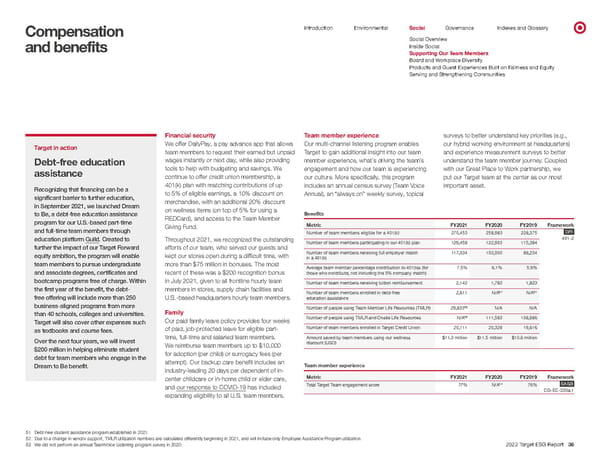

0 Introduction Environmental Social Governance Indexes and Glossary Social Overview Workplace health and safety Inside Social Supporting Our Team Members Board and Workplace Diversity Products and Guest Experiences Built on Fairness and Equity Serving and Strengthening Communities We strive to maintain a safe, healthy and secure working environment. We want our team members to follow laws, safety procedures and Occupational Safety and Health Administration (OSHA) standards, as well as be advocates for the safety of all team members. Our work is guided by our Safety Policy, which sets out high-level guidance on our safety requirements, as well as our Team Member Illness Policy and Disability Accommodation Policy. Safety and training Our goal is to prevent guest and team member incidents, injuries and illnesses, and to comply with all relevant safety and health standards. In both stores and our global logistics operations, we continue to prioritize safety in support of our commitment to being “the safest place to work and shop.” We expect team members to follow our health and safety programs and procedures closely, continuing to invest in our safety team. In 2022, we will have a dedicated Safety Manager in each supply chain facility. We require the use of PPE where applicable and the immediate reporting of incidents and near misses. We also encourage and empower team members to stop any unsafe action or condition that presents an imminent danger or risk, and assess and address that risk before resuming work. In addition, we have made substantial improvements and investments — for example, by establishing a risk assessment process to better align equipment and procedures with safety requirements. Target in action Our response to COVID-19 In response to the COVID-19 pandemic, we reinforced our well-established risk processes by setting up a Leadership Task Force. As part of our executive leadership team, this six-member group (including our CEO) oversees the way we handle crises, including scenario planning. Team member health and safety The health, safety and well-being of our team has always been a top priority, and this continues to be even more true as we manage the ongoing impact of COVID-19. Throughout the pandemic, we have focused on helping healthy team members get to work while taking care of those who were ill and unable to work. We responded quickly by rolling out health, well-being and safety programs. In addition to implementing enhanced cleaning routines and social distancing protocols, we: • Waived our absenteeism policy. • Provided free backup care for both children and adults when regular access to care was unreliable. • Offered paid leave for quarantine and confirmed illness, and for vulnerable team members. • Made personal protective equipment (PPE), thermometers and at-home health checks available to all team members. • Provided access to free 24/7 virtual healthcare visits for all U.S.-based team members via the CirrusMD app, and continued to offer mental health counseling for all team members via Team Member Life Resources. As vaccination programs were rolled out, we removed barriers to access by providing discounted Lyft rides 54 to and from appointments where needed, and up to six hours paid time off for hourly team members to receive vaccines. We also currently offer paid time off for anyone suffering an adverse reaction after their vaccine. Industry support As an essential business, we have continued to operate across all states since the COVID-19 pandemic started. To support other businesses as they reopened, we developed the SAFE Retail toolkit . Available to any business adapting to new operating circumstances, the toolkit details the processes and tools Target adopted to sustain operations, while prioritizing the health and safety of our guests, team members and communities. In addition to presenting our learnings to small businesses via various webinars, we have shared the SAFE Retail toolkit with governors’ offices, business organizations and local- and county-level officials across the country, and made the full toolkit freely available online. Community response Over the past couple of years, Target and the Target Foundation have provided flexible and responsive funding to help community partners adapt to the changing landscape brought on by COVID-19. More than $10 million was invested to support community safety and recovery efforts. In 2021, we made a $5 million incremental commitment to community-based NGOs working to advance vaccine equity among diverse populations. Learn more about our COVID-19 response on our website. 54 Free up to $15 each way. 2022 Target ESG Report 37
0 - - - Introduction Environmental Social Governance Indexes and Glossary Social Overview Talent and development Inside Social Supporting Our Team Members Board and Workplace Diversity Products and Guest Experiences Built on Fairness and Equity Serving and Strengthening Communities Through personalized, curated, immersive and experience-based training, we help team members gain the skills and experiences they need to fulfill their career ambitions, while delivering sustainable growth, driving our culture and achieving our company purpose. Our learning network covers onboarding, functional training, mentorship, leadership programs and tuition reimbursement. In 2021, Target invested payroll hours into building the functional skills, specialized skills and leadership abilities of our frontline team members. We are also investing in technology that increases the visibility of, and access to, opportunities for learning, mentoring and networking. We set goals and track the success of our talent and learning and development programs, and use team member listening sessions and surveys to gauge sentiment on training, development and career growth. Where possible, we also use business metrics to understand our return on investment. Career development resources We tailor our career development resources for different stages of the career journey at Target. Available to all • A consistent approach to assessing, reviewing and rewarding talent through performance and career development conversations. • Experience-based learning through stretch assignments. • An internal careers site to help team members navigate their careers at Target. • On-demand, curated learning resources delivered via Workday Learning and the Skillsoft learning catalog. • Access to industry research, trade publications and magazines via EBSCO . Available to specific audiences • An internal talent marketplace for short-term assignments where team members can apply their expertise and learn new skills. • Debt-free, capped and tuition reimbursement programs for job-related courses at accredited tech schools, colleges and/or universities, as well as costs associated with Graduate Equivalency Degree (GED) leadership and executive development programs and other resources for leaders. • Experience-based learning through short-term assignments, pro bono opportunities, business councils, leadership labs and volunteer events. Leadership training With the unprecedented challenges we have faced over the last two years, our leadership training has focused on building resilience, empathy, inclusion and agility. We quickly developed online learning content, resources and tools to equip senior leaders to drive business growth while acknowledging and supporting their teams through unique circumstances. • Our talent development team launched an Adaptive Leadership self-service website, containing curated content designed to help leaders navigate volatile and challenging environments. Learning and development • Our executive development teams facilitated more than 100 customized development sessions to help teams navigate pandemic- related challenges such as burnout and mental health. • Our Starting with Care instructor-led sessions and post-session guide help leaders demonstrate self-care, prioritize their own well-being and create a healthy environment for their teams. Due to COVID-19, we transitioned several instructor-led offerings for leaders to virtual learning experiences. Some of these programs will remain virtual, while others may return to in-person delivery. Metric FY2021 FY2020 FY2019 Framework Percentage of team members receiving training during the fiscal year GRI 404-2 Excluding onboarding and compliance 90% 98% 65% Including onboarding and compliance >99% 99% 97% Select training programs (hours) Onboarding (Target Welcome) 9,570,598 6,789,932 1,688,352 404-2 Diversity, equity and inclusion 253,264 67,500 350,426 Leadership development 56,257 27,332 74,148 Annual performance reviews Percentage of eligible team members receiving reviews 55 100% 100% 100% 404-3 Number of team members receiving reviews 351,400 301,000 316,000 GRI GRI 55 All team members are eligible for performance reviews except those on leave of absence for more than 305 days, those hired in Q4 and interns. 2022 Target ESG Report 38
0 Board and Workplace Diversity Workplace diversity We embrace diversity, strive to offer everyone equitable opportunities and celebrate our team members’ differences. Diversity, equity and inclusion (DE&I) isn’t just the responsibility of a single team at Target. Inclusivity is a core value for a reason. We all play a role in making our environment one where all can thrive and belong. Having clear DE&I goals and targets helps us measure and accelerate our efforts. In 2021, we continued to make progress against our 2019– 2021 goals, supported by our diversity action committees and employee resource groups. For example, we increased the promotion of women, including women of color, to senior leadership levels. To accelerate our progress and reinforce our commitment, we announced a new set of 2022–2024 DE&I goals in February 2022. Our Board of Directors has a long history of gender and racial/ethnic diversity. As of January 29, 2022, 38% of Board members were female, while 31% were racially or ethnically diverse. DE&I strategy For over 16 years, our DE&I strategy has guided efforts in four areas: • Creating an inclusive work environment. • Delivering an inclusive guest experience. • Advancing workforce diversity. • Leveraging our influence to drive positive impact on society. Today, DE&I is integrated throughout the business, guided by a process of continuously listening to — and learning from — stakeholders and collaborating with leading DE&I groups. Introduction Environmental Social Governance Indexes and Glossary Social Overview Inside Social Supporting Our Team Members Board and Workplace Diversity Products and Guest Experiences Built on Fairness and Equity Serving and Strengthening Communities A dedicated DE&I team leverages our dimensions of difference as one of Target’s greatest strengths, while diversity action committees embed our commitment in each business unit. Non-discrimination We respect cultural and individual differences and do not tolerate discrimination based on protected status or personal characteristics, including but not limited to: • Race, national origin or ancestry. • Color. • Sex (including pregnancy, childbirth and lactation status). • Gender, gender identity or gender expression. • Religion or religious creed. • Age. • Medical condition or disability. • Sexual orientation. • Citizenship status. • Military or veteran status. • Genetic information or characteristics (or those of a family member). Our stance is detailed in our Employee Information Report EEO-1 and Harassment-Free Workplace Policy, as well as our Code of Ethics, while our DE&I strategy shapes how we put our position into action every day. We monitor the representation of women and racially or ethnically diverse team members at different levels of the company, and disclose the composition of our team in our annual Workforce Diversity Report , which includes demographic information using the categories disclosed in our EEO-1 report . Target in action HBCU Design Challenge To foster inclusion and better serve our guests, Target teamed up with historically Black colleges and universities (HBCUs) for the inaugural HBCU Design Challenge in 2021 . Students were invited to submit designs for potential inclusion in Target’s Black History Month collection. As well as having their designs featured in the 2022 collection, the three winners also had the opportunity to learn about different aspects of production, from textile selection to placing the new products in stores. Read more about our winners and their designs . The Design Challenge is one of three HBCU competitions. Learn about the winners of our 2022 Technology and Future Leaders in Retail Challenges . 2022 Target ESG Report 39
0 Introduction Environmental Social Governance Indexes and Glossary Workplace Social Overview Inside Social diversity Supporting Our Team Members Board and Workplace Diversity Products and Guest Experiences Built on Fairness and Equity Serving and Strengthening Communities Increasing representation As part of our Target Forward goals, Target aims to build a team that equitably reflects the communities we serve by 2030. We actively seek to recruit, retain and advance women and people of color, especially in leadership and technical roles where they are historically underrepresented. In particular, Target aims to increase representation of Black team members across the company by 20%. By 2023, Target aims to increase the promotional rate of people of color and women while reducing the rate of turnover. To reach diverse talent pools, we have relationships with organizations including the African American Leadership Forum , the National Organization on Disability , the National Black MBA Association , Management Leadership for Tomorrow and others. We also work strategically with HBCUs to find meaningful ways to invest in students, such as our education assistance program , and actively recruit for roles at Target. We also push for more diverse representation through inclusive capability-building opportunities: • Our Engineering Manager Immersion Program provides on-the-job leadership training for groups typically underrepresented in technology, data and engineering. • Target Labs offer immersive professional development experiences aligned with Black, Asian American and Pacific Islander (AAPI), Hispanic, Pride, Military, Mental Health and Women’s history and heritage months, using training, talks and experiences to upskill communities and help attendees reach their professional aspirations. • Target Elevate’s 2021 virtual conference featured breakfast sessions with 18 speakers, self-paced learning opportunities and masterclasses with live Q&As to help grow the number of women in technology. • We participate in AnitaB.org’s annual conference — the Grace Hopper Celebration — to help more women in technical fields reach their full potential. While we still have more to do, we have increased representation for BIPOC in exempt roles by 30% and women of color in similar positions by 41% since 2019. By the end of 2021, we had achieved 56% female workforce representation and 45% female representation in senior leadership. In addition, there was a 16% increase in women promoted to senior leadership levels and a doubling of the promotion of women of color to senior leadership, while the promotion of people of color from the exempt entry level to midlevel rose by 62%. DE&I training To encourage our team members and leaders to consider all dimensions of difference and identities, we have continued to offer unconscious bias training in addition to anti-racism training. We also offer a year-long training series for HR business partners that promotes racial equity. Our Disabilities Awareness training focuses specifically on working with team members with disabilities, while a comprehensive disability toolkit assists HR partners and leaders in ensuring those with disabilities feel supported and included. Our internal Disability Accommodation Policy, last updated in early 2022, includes our commitments to inclusion and examples of the types of accommodations we provide. To enhance internal efforts, we collaborate with the National Organization on Disability and use its Disability Employment Tracker to benchmark our practices and policies. Target in action Advancing DE&I together In July 2021, we hosted the first “Growing the Circle: Championing a Diverse, Equitable & Inclusive Society, Together” forum. During the event, 1,500 Target leaders and external partners discussed how we can collaborate to deliver on our four DE&I focus areas. Cross-industry experts joined Target leaders in exploring how to scale up impact through shared accountability, data transparency and business resources. Content developed for the forum was shared on a dedicated DE&I Forum webpage to help other organizations accelerate their own DE&I journey. Additionally, in February 2021, we expanded our Ability Awareness Network to become the Disability & Mental Health Business Council . The cross-functional team fosters an inclusive culture around disability, mental health and neurodiversity through advocacy and education. Furthermore, Target held the first inaugural Twin Cities Asian Executive Leadership conference, which focused on investing in the development and community building of Asian talent, and we also established the Native American and Indigenous Network within our ERG community. This new groups will focus on amplifying the voices and experience of our Native American and Indigenous team members. 2022 Target ESG Report 40
0 Introduction Environmental Social Governance Indexes and Glossary Workplace Social Overview Inside Social diversity Supporting Our Team Members Board and Workplace Diversity Products and Guest Experiences Built on Fairness and Equity Serving and Strengthening Communities Target in action Racial Equity Action and Change (REACH) We have long worked to create an inclusive guest experience and work environment, by advancing workforce diversity, making our stores places of safety and inclusivity, and driving positive change in the communities we serve. But in 2020, when our hometown of Minneapolis was at the center of the racial justice protests that shook the United States and the world, we felt we had to elevate our approach further. That summer, we established the Racial Equity Action and Change (REACH) committee. Composed of six senior leaders from across our company, the committee was formed to advance racial equity and create more equitable experiences for Black team members and guests across our business and the communities we serve. The committee guided our REACH strategy, through which we committed to increase the representation of Black team members across the company by 20% by 2023, with a focus on advancement, retention and hiring in specific roles where we know we still have work to do. We have also pledged to invest $100 million through 2025 to fuel economic prosperity in Black communities across the country, and committed to spend more than $2 billion with Black-owned businesses by the end of 2025. REACH activities are focused across four pillars: • Team: Building an inclusive work environment for Black team members. • Guests: Creating an inclusive guest environment for Black Americans. • Communities: Supporting Black communities. • Public Policy & Civic Engagement: Convening partners to impact civic discussions. Our REACH strategy and goals were reinforced in 2021 as one aspect of our DE&I commitments, as well as being a key component in realizing our Target Forward vision to co-create an equitable and regenerative future. Read more about workplace diversity and the progress we are making across our areas of focus . 2022 Target ESG Report 41
0 - - - - - - - - Workplace diversity Diversity, equity and inclusion Metric FY2021 FY2020 FY2019 Framework Percentage of women in our global workforce CG-MR-330a.1 Total workforce 56% 58% 58% Managers 57% 56% 53% 405-1 Non-managers 56% 58% 59% Officers 44% 41% 40% Leadership team 46% 50% 42% Board of Directors 38% 31% 31% Percentage of people of color in our U.S. workforce CG-MR-330a.1 U.S. workforce 53% 50% 49% Managers 43% 40% 39% 405-1 Non-managers 54% 51% 51% Officers 33% 31% 28% Leadership team 23% 25% 25% Board of Directors 31% 46% 46% Percentage American Indian/Alaska Native in our U.S. workforce CG-MR-330a.1 U.S. workforce <1% <1% <1% 405-1 Managers <1% <1% <1% Non-managers <1% <1% <1% Officers 0% 0% 0% Leadership team 0% 0% 0% Board of Directors 0% 0% 0% Percentage Asian in our U.S. workforce CG-MR-330a.1 U.S. workforce 5% 5% 5% Managers 4% 4% 4% 405-1 Non-managers 5% 5% 5% Officers 10% 10% 10% Leadership team 8% 8% 8% Board of Directors 0% 0% 0% SASB GRI SASB GRI SASB GRI SASB GRI Introduction Environmental Social Governance Indexes and Glossary Social Overview Inside Social Supporting Our Team Members Board and Workplace Diversity Products and Guest Experiences Built on Fairness and Equity Serving and Strengthening Communities Metric Percentage Black/African American in our U.S. workforce U.S. workforce Managers Non-managers Officers Leadership team Board of Directors Percentage Hispanic/Latino in our U.S. workforce U.S. workforce Managers Non-managers Officers Leadership team Board of Directors Percentage Native Hawaiian/Pacific Islander in our U.S. workforce U.S. workforce Managers Non-managers Officers Leadership team Board of Directors Percentage two or more races in our U.S. workforce U.S. workforce Managers Non-managers Officers Leadership team Board of Directors FY2021 16% 13% 16% 10% 8% 15% 28% 23% 28% 10% 8% 15% <1% <1% <1% <1% 0% 0% 3% 3% 3% 2% 0% 0% FY2020 FY2019 Framework CG-MR-330a.1 15% 15% 12% 12% 405-1 15% 16% 9% 5% 8% 8% 23% 15% CG-MR-330a.1 26% 25% 21% 20% 405-1 27% 25% 10% 11% 8% 8% 23% 31% CG-MR-330a.1 <1% <1% 405-1 <1% <1% <1% <1% 0% 0% 0% 0% 0% 0% CG-MR-330a.1 3% 2% 2% 3% 405-1 3% 3% 2% 1% 0% 0% 0% 0% 2022 Target ESG Report 42 SASB GRI SASB GRI SASB GRI SASB GRI
0 Products and Guest Experiences Built on Fairness and Equity Introduction Environmental Social Governance Indexes and Glossary Social Overview Product quality and safety Inside Social Supporting Our Team Members Board and Workplace Diversity Products and Guest Experiences Built on Fairness and Equity Serving and Strengthening Communities The safety and quality of our products are the foundation of the trust our guests place in our business, and we are committed to offering brands meeting Target’s quality and compliance expectations. By 2025, we plan for 100% of our owned brands — in addition to our owned brand limited-edition and brand partnerships — to adhere to Target’s already established sustainability standards. Key enablers for overall progress toward this goal include our food safety, quality and regulatory (FSQR) teams, which oversee food and essentials. All products must meet regulatory, safety and quality standards. Our product safety and quality assurance (PSQA) team manages non-food quality and safety, with a focus on regulatory compliance and performance requirements. As a company, we are active members of the Retail Industry Leaders Association (RILA) , the National Retail Federation (NRF) , The Toy Association and other product-specific groups for non-food products, while food compliance team members have membership of the National Environmental Health Association (NEHA) , the Food Industry Association (FMI), the Consumer Brands Association (CBA) and the International Association for Food Protection (IAFP). General merchandise Target’s PSQA team helps protect our guests by requiring that our owned brand products meet mandatory safety standards, and we frequently require owned brand vendors to exceed regulatory requirements and support our responsible sourcing efforts by validating compliance to our Restricted Substances List. PSQA is also responsible for ensuring federal regulatory compliance of national brand products where Target is the importer of record. We expect our vendors of owned and national brand products to comply with our manufacturing and quality processes. Our product safety and quality program is incorporated at every stage of the product life cycle of our owned brand products. These products must pass all testing before they are approved for shipment. Food Product recalls We monitor the safety and quality of our food products through holistic food safety and quality management, from auditing vendor factories and fields to inspecting our supply chain facilities and stores. When we learn about a concern with one of our products, we investigate and, when necessary, remove it from sale. If a product is recalled, our processes require the in-store and online product to be locked and not to be sold. Multiple communication methods are in place to directly contact consumers about a recall. Read more about food, safety, quality and compliance on our website. Product quality and safety Metric FY2021 FY2020 FY2019 Number of vendor factories (countries) producing owned brand foods Number of Global Food Safety Initiative-certified food factories 980 (29) 925 (27) 821 (23) Number of factories (countries) producing owned brand non-food products 1,704 (30) 1,601 (37) 1,990 (35) Number of factory evaluations Target conducted Food 1,487 1,505 1,201 Non-food 1,480 758 1,649 Number of product test reports for owned brand products conducted by independent third-party labs 31,627 29,750 32,633 Number of product inspections of owned brand products conducted by Target team members and independent third parties 33,527 40,093 43,899 2022 Target ESG Report 43
0 Introduction Environmental Social Governance Indexes and Glossary Social Overview Access to products and services Inside Social Supporting Our Team Members Board and Workplace Diversity Products and Guest Experiences Built on Fairness and Equity Serving and Strengthening Communities Going beyond the need for safe, high-quality products, we also want our guests to feel represented and reflected in all aspects of product, packaging, fit and accessibility. By 2030, Target aims to be the market leader for creating and curating inclusive, sustainable brands and experiences. To help us, our Inclusive Design Council seeks to guide relevant owned brand teams in making our products even more inclusive from the design stage. In addition, our Inclusive Merchandising Council reviews products sold by Target to check they are inclusive and representative of our guests and team members. Our Director of Inclusive Products is responsible for advancing social sustainability within our owned brands, working with internal teams as well as brands, trade groups, certification bodies, diversity organizations, and medical and academic institutions, to map social strategies to business priorities. Target in action Advancing Design Diversity The mission of our Advancing Design Diversity (ADD) initiative is to deliver long-term impact to American design diversity, with a focus on advancing Black talent. We recognize the lack of exposure, access and preparation that Black communities, Indigenous communities and other communities of color (BIPOC) face in the design industry. Young aspiring designers are unaware of the range of possibilities open to them and there are many hurdles to pursuing design studies. To help address this inequity, we are setting up mentorship relationships with students to increase exposure to opportunities, supporting aspiring design students on the path toward professional careers and/or post-secondary study and develop their skills outside of the traditional college structure. We are also building relationships with professional Black designers to accelerate Black talent. Our high school mentoring program launched in fall 2021, in partnership with local school districts and leading design schools in three cities: the Fashion Institute of Technology in New York, Otis College of Art and Design in Los Angeles and the Savannah College of Art and Design . We funded workshops, events and scholarships for both school year and summer pre-college programming for participants and other BIPOC high school students, and plan to extend the ADD program into Minneapolis and Detroit in 2022. In 2021, Target also became a founding supporter of the Pensole Lewis College of Business & Design (PLC) , the first historically Black college in the U.S. to be focused on design. 2022 Target ESG Report 44
0 Introduction Environmental Social Governance Indexes and Glossary Access to products Social Overview Inside Social and services Supporting Our Team Members Board and Workplace Diversity Products and Guest Experiences Built on Fairness and Equity Serving and Strengthening Communities Inclusive experiences and responsible marketing We sell thousands of curated items, including owned brand products, that give typically underserved guests the shopping experience they deserve. Our merchandising team works to reflect the diversity of our guests in the assortment we offer, including beauty and cosmetics, food, and dolls designed for diverse audiences. As the conversation around social justice and racial equity grows, more guests are searching for Black-owned and Black-founded brands. To make it easier for guests to find such products, we have added new icons in the “details” section of our products pages to highlight not only Black-, but also Latino-, Asian- and woman- owned suppliers. Partnering with peers, nonprofits and vendors from the communities we are addressing, 87% of our Black History Month assortment for 2022 was designed with and by Black creators and brands, while 59% of our Pride assortment was designed with and by LGBTQIA+ creators and brands. We also ran team member training for Black History Month, providing background on the current assortment and the collection’s history. We launched our Racism Untaught training workshops, which assist in identifying and addressing racialized design approaches by reimagining products, systems and experiences that help avoid micro-aggressions, implicit bias and systemic forms of racism. The training covers 762 owned brand team members, and we are extending the training to our enterprise and vendor partners. Our Inclusive Marketing Council is a cross- functional group that serves as a crucial source of guidance, helping teams gain a diverse cultural perspective and advocating for cultural literacy so that all guests feel heard, accepted and celebrated. For example, when it comes to our advertising, our swimwear campaigns celebrate people of all sizes, body types, abilities and skin tones, free of airbrushing. Target in action Improving the experience for guests with disabilities Exemplifying our Design For All approach, our Cat & Jack, Pillowfort, Universal Thread, Hyde & EEK! and Goodfellow & Co owned brands offer a selection of stylish and affordable sensory-friendly pieces, as well as adaptive apparel made specially for adults and children living with disabilities. Our internal design team incorporated features like sensory-friendly fabrics (or huggable furniture) and flat seams to help minimize discomfort and help make getting dressed and everyday life moments easier for everyone. We are also making guest-facing digital experiences fully accessible to all guests, including those who use assistive technology. Our digital accessibility team includes team members who represent both visible and invisible disabilities, and their perspectives and experiences are invaluable in informing the enhanced experiences we are developing. Reflecting our commitment to accessibility for all, Target scored 100% in the Disability:IN Disability Equality Index survey, and we are a Strategic Nonvisual Accessibility Partner of the National Federation of the Blind . 2022 Target ESG Report 45
0 Serving and Strengthening Communities Introduction Environmental Social Governance Indexes and Glossary Social Overview Community impact Inside Social Supporting Our Team Members Board and Workplace Diversity Products and Guest Experiences Built on Fairness and Equity Serving and Strengthening Communities Our success is interdependent with that of the communities we serve. Through Target Forward, we are committed to engaging with communities to build and implement solutions that drive positive impact and accelerate progress toward achieving our sustainability commitments and goals. Our community engagement strategy focuses on: • Corporate citizenship: Building trust and credibility among the partners and communities we serve. • Community vitality: Enabling the vitality and resilience of our team members and the communities we serve by unlocking aligned and integrated community-driven solutions and philanthropic strategies. • Target Foundation: Deploying leading-edge philanthropy that serves as a learning lab to transform the systems that create greater equity and opportunity. Corporate citizenship Target strives to be a trusted partner and responsible corporate citizen. Our corporate citizenship work is rooted in reinforcing our company’s purpose — to help all families discover the joy of everyday life — by supporting the communities we serve in a relevant, responsive and authentic way that builds brand love and enhances our license to operate. Our corporate citizenship team fulfills this role every day in how we show up for all families in times of crisis and moments of need, as we work to make meaningful, positive impact through philanthropic investments in our hometown and national communities. As a priority market, we proudly give back in the Twin Cities metro area by supporting civic, social and environmental concerns that align with our giving approach and that matter to the local community. In times of crisis, we provide supplies, volunteers and distribution networks through relief organizations. With a global supply chain, we are well positioned to move quickly to support our stores and guests, as well as providing year-round donations and funding to relief partner organizations. Throughout 2021, we contributed more than $7 million in support for Afghan refugees and relief in the aftermath of Hurricane Ida, storm Uri in Texas and other disasters across the U.S. In 2021, we made a $5 million incremental commitment to community-based NGOs working to advance vaccine equity among diverse populations. For example, as COVID-19 cases soared across India, a $500,000 donation in April 2021 boosted countrywide access to oxygen treatment and more accurate testing. Additional donations were made to local nonprofits delivering vital aid across the country, including Minnesota Council on Foundations , the Minnesota Department of Health Equity Fund and Phyllis Wheatley Community Center Vaccine for Life program . We continued to support our team members in India with additional paid sick leave, time off and family care resources, and we limited local business hours so that people had the flexibility they needed to put their health, and that of their families, first. Our hometown work focused on rebuilding and equity in 2021. Our efforts to listen and convene community and local business partners together to support our community came to fruition through our participation in many collaborative programs. These included the Minneapolis Downtown Council’s Small Business grant program that provided 102 awards for downtown small businesses through the pandemic; the Minneapolis Foundation’s Restore, Rebuild and Reimagine Fund that helped more than 44 properties with small businesses on critical cultural and commercial corridors to build back stronger following the civil unrest of 2020; as well as public safety grants, product and food donations, and support of the newly formed George Floyd Memorial Foundation . Team member giving We empower our team members to extend a helping hand to each other. The Target Team Member Giving Fund was created to help colleagues who are facing financial hardship after a natural disaster or unforeseen personal events. The fund relies primarily on contributions from Target, with support from individual donations. Team members across the U.S. and India can apply for a grant up to $2,000 to help in times of hardship. During 2021, $1.2 million was contributed by team members, and nearly $3.1 million in direct support was granted to 3,920 team members. Holiday Great Gifttogether Our store and supply chain facilities built partnerships with local nonprofits to bring joy to nearly 3,500 families in need during the holiday season. The program was designed be national in scale but locally relevant. The Target team responded by volunteering their time to purchase, wrap and deliver gifts and essential items in over 1,700 communities nationwide. Target Circle Guests in our Target Circle loyalty program can use the votes they gain with every purchase to direct our funding toward nonprofits, such as food banks, pet shelters and youth programs. In 2021, guests cast 167 million votes to help direct $7 million in grant funding, supporting national scholarship organizations such as the Thurgood Marshall College Fund as well as local community nonprofits. Community vitality With stores, supply chain facilities and headquarter offices in over 2,000 communities across the country and world, Target’s community vitality team is dedicated to enabling the vitality and resilience of those communities. By 2030, engage and elevate community voices as we seek to build and implement community-driven solutions. The community vitality team works at the local level in three distinct ways: community-based philanthropy, team member engagement and collaboration across the enterprise. 2022 Target ESG Report 46
0 Introduction Environmental Social Governance Indexes and Glossary Community Social Overview Inside Social impact Supporting Our Team Members Board and Workplace Diversity Products and Guest Experiences Built on Fairness and Equity Serving and Strengthening Communities Community-based philanthropy We provide access to philanthropic support to nonprofits across all communities where we have stores and supply chain facilities, and focus investment in key markets where the majority of our team members and guests live and work. For example, in California, we have partnered with the United Way of Greater Los Angeles (UWGLA) to support its cutting-edge, collaborative programs, impacting the lives of thousands of Angelenos experiencing homelessness each year by building faster and more cost-effectively. Through the Affordable Housing Initiative (AHI), the UWGLA aims to increase access to affordable rental units for those experiencing being at risk of homelessness. All of the properties developed will have a service partner to provide case management and stabilizing services such as mental health services, financial literacy, drug treatment, childcare or workforce training programs. Our local team members often know the needs of their own communities best; we work directly with our store and supply chain leaders to empower them with the resources and tools to make a local impact. Through our Community Engagement Funds and GiftCard programs, store and supply chain leaders can directly support local initiatives, nonprofits and organizations that are addressing critical needs in their neighborhoods ranging from social justice to workforce development. Team member engagement Our local teams are empowered to drive community impact through volunteerism and pro bono efforts. Our team members are committed to making our communities a better place and typically donate around one million hours of volunteer service every year, supporting the local causes they care about. Even with the unique challenges to in-person volunteering posed by COVID-19, we were still able to contribute almost 900,000 hours of in-person volunteering in 2021. Team members served as election judges, participated in our pop-up food and essential giveaway events in response to civil unrest and took part in a variety of virtual opportunities. Our team members are generous with their time throughout the year, but they make a particular difference at key awareness events such as Earth Month, National Volunteer Week, 9/11 Day of Service, our Annual Giving Campaign and Martin Luther King, Jr. Day of Service. To empower team members to use their skills and talents to address unmet needs in the community — and help with rebuilding efforts following the murder of George Floyd — we launched a pro bono consulting service for BIPOC-owned small businesses in the Twin Cities. In less than one year, we delivered more than 10,000 hours of pro bono support, and in 2021, the program was extended to Atlanta, Chicago and the Bay Area. Looking ahead, we plan to deliver at least 10,000 hours of pro bono support every year. Finally, our headquarters-based legal team provides hundreds of hours of pro bono legal advice to individuals and organizations, offering guidance on housing law and immigration, and helping low- income individuals to start businesses. In 2021, at least half of our legal professionals participated in pro bono activities. Cross-enterprise collaboration Going beyond philanthropy and team member engagement, our community vitality team works closely with other teams across the enterprise — from real estate and assets protection to government affairs — to support community impact. Target in action Engaging with and listening to Black communities We’ve long been proactive when it comes to engaging with Black communities across the country, but in the wake of George Floyd’s murder, the corporate responsibility and guest insights teams sought additional feedback to identify what more we could do. In partnership with store team members of color in markets including Atlanta, Chicago, Los Angeles, Oakland and Washington, D.C., we have: • Focused our work in predominantly Black communities that have not just been acutely impacted by recent traumas but by decades, even centuries, of social injustice. • Listened to more than 500 individuals in one-on-one meetings and small groups, and via feedback from surveys. For example, when we open a new store, the team engages with local stakeholders to identify ways that we can support the neighborhood, such as local hiring events and celebrating what’s unique in the community. • Built trust with stakeholders critical to our business success in these markets, including guests, team members, government officials, small businesses and community organizations working to undo systemic racism and its impacts on Black Americans. • Identified the needs of these communities, from meeting basic needs to supporting the vitality of small businesses to supporting the pipeline of Black team members. • Made investments and developed programs and partnerships based on our community engagement and understanding of what the community thinks Target’s role at the local level should be. By taking time to listen closely to these communities, we were able to identify trusted community partners to support philanthropically and drive team member engagement. 2022 Target ESG Report 47
0 Introduction Environmental Social Governance Indexes and Glossary Community Social Overview Inside Social impact Supporting Our Team Members Board and Workplace Diversity Products and Guest Experiences Built on Fairness and Equity Serving and Strengthening Communities Target Foundation We envision a world where all families and communities have the resources they need to determine and realize their own joy in life. Through the Target Foundation, we enable shared prosperity and opportunity by upholding equity and inclusion in our hometown, across the country and around the world. Guided by our commitment to community, we invest in leaders, organizations, coalitions and networks that expand economic opportunity equitably, enabling communities to determine their own futures. By 2025, Target and Target Foundation plan to evolve our philanthropic practices and place- based solutions to invite participation from communities. The Target Foundation is leaning into trust-based philanthropy to drive systems change, with values rooted in advancing equity, shifting power and building mutually accountable relationships. The Foundation’s capabilities allow it to work toward long-term solutions across complex and interconnected economic issues, grounded in the voices of BIPOC as well as Global South communities and organizations. The Target Foundation also closed on its first- ever Program-Related Investment (PRI) to the Minnesota Inclusive Growth Fund (MIGF) . MIGF launched late last year to serve as a recovery aid for small businesses in Minnesota that have experienced direct economic hardship as a result of the COVID-19 pandemic and the civil unrest following the murder of George Floyd. The goal of MIGF is to connect small businesses to affordable, flexible working capital loans to rebuild and reinvest in their businesses. Our Target Foundation work supports three focus areas: Focus area Engagement highlights Hometown: Advancing racial equity and shared prosperity in the Twin Cities of Minneapolis and St. Paul National: Building financial stability and economic opportunity for working people and their families in a rapidly changing economy Global: Improving economic opportunities for families in emerging economies to sustain themselves and their communities for the long term The Mni Sota Fund is an Urban Native Community Development Financial Institution that provides training and access to capital to promote homeownership, entrepreneurship and financial capabilities among American Indian men and women throughout Minnesota. Founded in 2012, the Mni Sota Fund was created in response to community conversations about key tools missing from the Native community development ecosystem in the Twin Cities. Target Foundation’s grant helps the Fund in creating a thriving ecosystem of American Indian entrepreneurs throughout the Twin Cities with a vibrant Native-business district on the American Indian Cultural Corridor, as well as widespread American Indian homeownership and financial empowerment. We support the work of National Coalition for Asian Pacific American Community Development (National CAPACD) , a group of local community organizations that advocate for low-income Asian American and Pacific Islander (AAPI) communities and neighborhoods. The organization strengthens and mobilizes its members to build economic power and further its vision of economic and social justice for all. Target Foundation’s funding supports National CAPACD in a number of areas, including building capacity; supporting local community-based organizations (CBOs) to foster financial stabilization and well-being for low- to moderate-income AAPIs; and building the capacity of CBOs to engage in broader systems change work. We’re proud to support the work of Friendship Bridge , a nonprofit social enterprise creating opportunities that empower Guatemalan women to build a better life. Target Foundation’s grant supports its Bridge to Success program , which delivers intensive business development training and specialized financial services to women entrepreneurs with the goals of increasing resilience, empowerment and community leadership, and accelerating economic opportunities for the participants and their communities. Photo credit: Friendship Bridge, Target Foundation partner 2022 Target ESG Report 48
0 Introduction Environmental Social Governance Indexes and Glossary Community Social Overview Inside Social impact Supporting Our Team Members Board and Workplace Diversity Products and Guest Experiences Built on Fairness and Equity Serving and Strengthening Communities Volunteerism and philanthropy Metric FY2021 FY2020 FY2019 Scope Number of hours volunteered 870,064 496,260 1,064,215 Target team members Regular volunteer hours 853,950 494,098 1,064,215 (not necessarily during Pro bono hours 16,114 2,162 N/A paid working hours) Amount donated through Target and Target Foundation (USD) $274 million $245 million $225 million Cash $80 million $70 million $68 million In kind $194 million $175 million $157 million Amount donated through Target and Target Foundation (USD) to: Target + Target Foundation Organizations that support underrepresented communities in the U.S. $144 million $124 million $105 million Local community programs and organizations $257 million $231 million $199 million Disaster preparedness and response $8 million $12 million $1.3 million Amount of food donated 56 By weight (pounds) 106.0 million 94.5 million 93.9 million Target By number of meals 88.3 million 78.7 million 78.2 million Guest-directed giving through Target Circle Number of guests engaged 5.0 million 4.8 million 2.3 million Target Number of grants distributed 1,675 2,527 972 Value of grants distributed (USD) $7.0 million $7.0 million $2.4 million Team member giving Percentage of team members participating in the Team Member Giving Campaign 57 92% 90% 94% Target team members Amount donated by team members through our annual giving campaign (USD) $9.1 million $9.6 million $10.4 million 56 In 2020, we updated our meals calculation to mirror industry best practice, which we did by removing non-food donations and pet food from the meals calculation. The figures in the metrics reflect these changes. 57 Overall engagement with the Team Member Giving Campaign, including cash donations. 2022 Target ESG Report 49
0 Introduction Environmental Social Governance Indexes and Glossary Social Overview Our economic opportunity to serve communities Inside Social Supporting Our Team Members Board and Workplace Diversity Products and Guest Experiences Built on Fairness and Equity Serving and Strengthening Communities To drive economic mobility and inclusion in society, we seek to reduce barriers and enable people to gain skills, find and secure enhanced opportunities, and ultimately improve their economic well-being. To create an equitable future for all, in October 2021, we committed to invest $100 million by 2025 to fuel economic prosperity in Black communities, as part of our REACH commitments . The funding will build on the $10 million we pledged to social justice causes in 2020, and complements our 2021 plan to significantly invest in Black-owned businesses. Funding will also go to helping Black-led nonprofits advancing racial equity and creating economic opportunity in Black communities. For example, the Minnesota Holistic Black-Led Movement Fund — part of the Philanthropic Collective to Combat Anti-Blackness & Realize Racial Justice — provides grants for transformative solutions that drive racial equity and justice. Education Our approach encompasses financial assistance to help students continue their education, as well as scholarships, internships, mentoring and other support. Target Scholars Program As part of this investment, we introduced our Target Scholars Program in April 2021. In partnership with the United Negro College Fund (UNCF) , the program provides 1,000 first-year students from HBCUs with $5,000 scholarships and access to mentoring, internship and networking opportunities. Target Scholars studying technology, design and leadership are supported with four years of college and career counseling, access to Target’s HBCU design challenges and early exposure to explore internships. We continue to listen and learn from the UNCF, HBCU alumni and Target Scholars so that we can best support scholars through their full college experience, and have announced plans for how we can maintain that support past their freshman year. Pensole Lewis College In 2021, Target became a founding supporter of the Pensole Lewis College of Business & Design (PLC) , which is the first historically Black college in the U.S. to be reopened and the first to focus on design. Target will support Pensole’s mission in providing free tuition for aspiring Black designers, engineers and business leaders. Employment We’re proud to have launched and sustained millions of careers over our 100-year history. As we’ve grown, we’ve taken care to maintain high standards for rewarding employment to new members of the workforce. We strive to build and retain a team that reflects the communities we serve. Target uses a variety of recruiting resources and partnerships through which we can source from diverse talent pools. We have also made commitments with organizations such as OneTen , which is focused on hiring, promoting and advancing one million Black individuals without a four-year degree into family-sustaining careers over the next 10 years, to help close opportunity gaps across the U.S. We are proud to be a part of the coalition that plans to train, hire and advance one million Black Americans in the Twin Cities. Learn more about careers at Target online. 2022 Target ESG Report 50
0 Introduction Environmental Social Governance Indexes and Glossary Social Overview Elevating equity in supply chains and communities Inside Social Supporting Our Team Members Board and Workplace Diversity Products and Guest Experiences Built on Fairness and Equity Serving and Strengthening Communities We’ve been building strong partnerships with diverse suppliers and underrepresented businesses for decades, leveraging our scale as a purchaser to support economic development and enhance our guests’ shopping experiences. Propelled by our new Target Forward strategy, which focuses on creating an equitable and regenerative future, we’re advancing equity beyond the Board and workplace to our supply chain, as well as the communities we serve . By 2025, we plan for 100% of our suppliers to have policies and programs to advance gender equity in supply chains, and for owned brand suppliers to pay workers digitally. Our commitment to supplier diversity Every year, we work hard to find, attract and retain more diverse-owned suppliers . We are proud to work with an ever-growing roster of suppliers that are at least 51% owned, controlled and operated by women, BIPOC, LGBTQIA+, veterans or people with disabilities. In April 2021, as part of our REACH commitments , we launched our plan to spend more than $2 billion with Black-owned businesses by the end of 2025. This commitment involves: • Increasing the number of products from Black- owned businesses to more than 500 across our stores and online. • Spending more with Black-owned companies, including marketing agencies, construction companies, facilities maintenance providers and others. • Establishing new resources to engage with early-stage historically under-resourced entrepreneurs to provide education on scaling for mass retail. To that end, we build relationships with such suppliers through multiple national business groups, including the National Minority Supplier Development Council and National LGBT Chamber of Commerce . In addition, together with the Women’s Business Enterprise National Council (WBENC) , we are a founding partner and premier sponsor of Women Owned in Retail , a program designed to help women-owned consumer goods businesses thrive in the retail space. We also host onsite and virtual summits to introduce Target merchants and others to potential new, diverse partners. Globally, we are working to extend supplier diversity within our international supply chain. We have identified three priorities — women, people with disabilities and other underrepresented groups — and have connected with WeConnect (the global women’s partner to WBENC, an entity with operations in the U.S. only) and Disability:IN to support this work. Elevating worker well-being in the supply chain We engage with strategic stakeholders to address issues that matter to supply chain workers. By the end of fiscal year 2021, our collaborative projects related to worker well-being impacted the lives of more than 3.7 million people. Throughout 2021, we pivoted our worker well- being approach toward our 2025 goals, which focus on gender equity and the digitization of wages for workers in our owned brand supply chain. We began working to align our strategies with external organizations that enable thought partnership and future progress. Below are examples of partnerships that exemplify this approach. • Better Than Cash Alliance (BTCA) : We became a member of this UN-based alliance in 2022 to Accelerators support our commitment that all owned brand suppliers pay workers digitally by 2025, following responsible practices. • CARE : Target continues to partner with CARE International, designing strategies to drive gender equity throughout our sourcing practices and extended supply chain. • BSR : Target supports BSR’s HERproject to empower female supply chain workers through workplace-based health, financial inclusion and gender equality interventions. • International Center for Research on Women (ICRW) : Through our partnership with the center’s advisory arm, ICRW Advisors, Target is contributing to the further development of ICRW’s Self-Diagnostic Tool . This industry- aligned resource helps factories assess their gender equity policies and processes and generates a customized scorecard on existing gender integration policies and practices to encourage continuous improvement. Metric FY2021 FY2020 FY2019 Number of companies supported by Target Accelerators during the fiscal year Target Takeoff 31 25 17 Target Incubator 0 8 8 Target Technology Accelerator 0 10 9 Target Accelerator Program India 5 10 10 Number of products on shelves in Target stores from graduates of Target Accelerators (SKUs) 220 123 59 2022 Target ESG Report 51
0 Introduction Environmental Social Governance Indexes and Glossary Elevating equity in supply Social Overview Inside Social chains and communities Supporting Our Team Members Board and Workplace Diversity Products and Guest Experiences Built on Fairness and Equity Serving and Strengthening Communities Prioritizing health and safety Providing a safe and healthy working environment for workers is a key expectation for our vendors. The Responsible Sourcing and Sustainability audit program focuses on health and safety violations to minimize safety risks. Target collaborates with industry-led initiatives like Nirapon and Life and Building Safety (LABS) to enhance worker safety and create a culture of minimizing occupational hazards in our supply chain. As a founding member of LABS, a global collaborative initiative of apparel brands and retailers, Target is working to assess safety risks related to structure, electricity, fire safety and evacuation preparedness, and remediates them in line with global best practices in our apparel and footwear factories. Through Nirapon’s Safety Management program, we are committed to driving safety requirements in Bangladesh factories, along with worker training and helpline support. Product suppliers Accelerator programs Our portfolio of Target Accelerator programs offers investment, access, expertise and mentoring, equipping historically under-resourced founders and entrepreneurs to drive innovation, instigate change and build their businesses. In 2021, 45% of the applications we received came from Black- owned brands. One of our accelerators, Target Takeoff , is a five- week program that supports startups. In 2021, we ran three Takeoff cohorts, covering Beauty, Food and Beverage, and Pets, and 30% of the cohort participants were Black-owned brands. Thirteen brands that have graduated from Takeoff in previous years launched at Target, and overall, 40% of Takeoff alumni have received a Target business award. Takeoff Beauty, our longest-running accelerator program, saw a 79% increase in applications from 2020 to 2021, and 52% of the applicants were from Black-owned beauty businesses. In 2020, Cora Miller, founder of the Black-owned Young King Haircare , participated in the program and her business has since launched in 365 Target stores. We aim to elevate more entrepreneurs like Cora, who is among a group of fewer than 100 Black female entrepreneurs to raise more than $1 million in venture funds. Forward Founders Building off the success of our accelerator programs, we co-created Forward Founders with Black entrepreneurs from our Entrepreneurship Advisory Council . The Forward Founders program engages Black-owned retail businesses earlier in their startup journey, giving them access to subject matter experts and educational workshops. This program is designed to help them navigate the critical stages of ideation, product development and scaling up, and increase their potential for long-term success. The inaugural Forward Founders program received 3,100 applications, 73% of which came from Black-owned businesses. We also launched a six-part Retail Knowledge Speaker Series for those Forward Founder applicants who were not chosen to participate in the program, giving them support on their entrepreneurial journey. The series had more than 1,900 attendees and received an average Net Promoter Score of 73. Bet on Black As part of our multimillion-dollar investment in the Black-owned multimedia platform REVOLT , we’ve co-created a new project to help us more innovatively connect with Black guests. Bet on Black is a new pitch-style competition series highlighting 12 Black-owned startups — which continue to be underrepresented in venture funding — with innovative ideas for revolutionizing their industries. Target is providing $500,000 in funding for the startups without requiring any equity stake so each company can retain full ownership and control of their business. Diverse and local suppliers Property suppliers In addition to supporting growth in the diversity of our product suppliers, we’re also actively engaging BIPOC-owned businesses to service our properties. In 2019, Target Properties developed an internal mentor program to help BIPOC-owned businesses navigate the process of becoming active Target suppliers, and our first cohort of mentees started in 2020. We searched the country for potential suppliers to support our heating, ventilation and air conditioning (HVAC) business. Currently, there are seven Black-owned HVAC businesses that are learning how Target does business, to prepare them to participate in active projects. Through 2021 and beyond, we are seeking more mentor cohorts to cover more product categories. Metric FY2021 FY2020 FY2019 Number of diverse suppliers Total 1,279 702 442 New 467 297 81 Amount of spending with diverse suppliers Tier 1 (USD) $2,483 million $1,471 million $1,043 million Tier 2 (USD) $783 million $764 million $1,899 million Percentage change in Tier 1 spending with diverse suppliers year-over-year Percentage of diverse supplier bid inclusion Percentage of the procurement budget spent on suppliers local to Minnesota and three counties in Western Wisconsin (Polk, St. Croix and Pierce) 69% 52% 2% 41% 52% 4% -26% 46% 5% 2022 Target ESG Report 52
0 Introduction Environmental Social Governance Indexes and Glossary Governance Overview Inside Governance Operating Ethically Promoting and Protecting Human Rights Governance 2022 Target ESG Report 53
Introduction Environmental Social Governance Indexes and Glossary Governance Overview Inside Governance Operating Ethically Promoting and Protecting Human Rights Governance Overview Built on ethics We are responsible for establishing and abiding by strong, ethical corporate governance practices and policies that reflect our core values. Our commitment requires that we hold ourselves accountable to setting and working toward measurable goals, and to regularly report on our performance across our ESG priority issues in a manner that informs, engages and is transparent to all stakeholders. Our work contributes to the following SDGs: I ., , ' " Frameworks reported on: GRI SASB SDG TCFD UNGPRF 0 1111 ., ---- Patents awarded to our cybersecurity team to date 20+ Responsible Sourcing and Sustainability training programs delivered 17 We’ve been sharing corporate responsibility efforts since Target first published a Community Involvement Report in 1969 Recognition for ESG performance ISS Maintained ESG Prime status Internal team members and suppliers trained on Responsible Sourcing and Sustainability 3,155 Percentage of workforce eligible to receive paid time off to vote 100% CDP Recognized on the CDP’s Supplier Engagement Rating Leaderboard 2021 Total Responsible Sourcing and Sustainability training hours 6,500+ 2022 Target ESG Report 54
0 Introduction Environmental Social Governance Indexes and Glossary Governance Overview Inside Governance Oper ating E thically P r omoting and Protecting Human Rights Inside Governance Operating Ethically For our business to be successful while delivering social and environmental benefits, we must maintain a foundation of integrity, transparency and ethical practices. We’ve identified leads and teams in the areas necessary to effectively execute against these values, and distributed oversight responsibilities across our Board of Directors and its committees, while providing team members and suppliers with the resources needed for compliance. We employ industry- leading tools and partnerships to stay ahead — whether that be addressing cybersecurity threats or implementing new approaches to traceability. Measuring and reporting on our progress through best-in-class ESG frameworks guides our business and builds trust. Our practices reflect the rights, roles and responsibilities of our Board and management to effectively serve all our stakeholders, including team members, guests, shareholders, vendors and the communities in which we operate. Promoting and Protecting Human Rights Target is committed to a sustainable and inclusive supply chain that is just and equitable for all workers. We advocate for human rights to create safe, thriving communities through an approach aligned with leading international standards, including the Universal Declaration of Human Rights , the International Labour Organization Core Conventions and the UN Guiding Principles on Business and Human Rights . We also participate in Business for Social Responsibility (BSR)’s Human Rights Working Group , which provides a platform where global companies across industries come together to share actionable guidance, challenges and lessons learned. 2022 Target ESG Report 55
0 Introduction Environmental Social Governance Indexes and Glossary Governance Overview Inside Governance Operating Ethically Promoting and Protecting Human Rights Operating Ethically Managing ESG issues At the management level, our ESG-related activities are led and coordinated by our Senior Vice President, Corporate Responsibility, who regularly engages with our Board of Directors and its Governance & Sustainability Committee. The Senior Vice President, Corporate Responsibility, is responsible for: • Conducting regular priority assessments to determine the topics of most significance to our stakeholders. • Collaborating with other members of management to instill ESG-related priorities into our business operations, including product design and development, sourcing and supply chain operations, human capital management and our new store development. • Developing ESG-related goals and managing our ESG data, measurement and reporting. In September 2021, the Board revised its committee structure and charters to clarify and enhance its approach to oversight of risk and ESG matters by reallocating to its committees oversight responsibility for those topics that fall within their respective functions and related responsibilities. The revised structure and charters for the committees were guided by our prior Board and committee self-evaluations, the evolving needs of our business and consideration of external trends in corporate governance. In addition, we believe the changes appropriately reflect how companies are adjusting to current expectations of Board oversight of ESG matters. In 2022, we continued to invest resources into growing our transparency and reporting around ESG matters through the creation of an ESG team within corporate responsibility. Board composition and diversity The criteria the Board follows in determining the composition of the Board are as follows: • Directors are to have broad perspective, experience, knowledge and independent judgment. • The Board as a whole should consist predominantly of persons with strong business backgrounds that span multiple industries. • The Board does not have a specific policy regarding consideration of gender, ethnic or other diversity criteria in identifying director candidates, but understands the value of diversity, equity and inclusion (DE&I) and has a strong history of gender and racial/ethnic diversity on the Board. Responsible party Oversight areas for ESG matters Board • Sustainability and ESG strategy (through oversight of our business strategy and annual strategic priorities) • Top ESG risks • Reputation management • Crisis management and response • Organizational team health Audit & Risk Committee • Compliance and ethics • Supply chain ESG, including vendor human capital and responsible sourcing practices • Cybersecurity and information security • Privacy • Product and food safety Governance & Sustainability Committee Compensation & Human Capital Management Committee • Overall approach to significant sustainability and ESG matters (including strategy, prioritization, monitoring and external reporting) • Environmental stewardship practices (including climate and energy, waste, natural resources and chemicals) • Social and political issues and risks not allocated to other committees • Philanthropy and community engagement • Policies and practices regarding public policy and political activities • DE&I • Culture and employee engagement • Pay equity • Broad-based compensation and benefits • Growth and development • Purpose and values As of January 29, 2022, 38% of Board members were female, while 31% were racially or ethnically diverse. Read more about the gender and racial/ethnic diversity of our workforce, managers and Board of Directors online. Find out more about our corporate governance practices and our Board of Directors in our 2022 Proxy Statement . 2022 Target ESG Report 56
0 Introduction Environmental Social Governance Indexes and Glossary Governance Overview Inside Governance Oper ating E thically Promoting and Protecting Human Rights Ethical business Ethical business decisions not only comply with laws, regulations and standards that govern our business but also uphold our values, strengthen our brand, build trust and maintain connections with our team members, guests and communities. Our compliance and ethics team oversees our Ethics program. Target team members are expected to do what’s right for our business, their colleagues and our guests, modeling a strong ethical culture through their everyday decisions and actions. Code of Ethics Team members are required to follow applicable laws, Target policies and our Code of Ethics . They are expected to report any actual or suspected violations, to which Target will respond promptly and appropriately. The Code of Ethics outlines team members’ duty to also report any conflicts of interest immediately if they arise, and select team members must complete Target’s Conflicts of Interest Statement annually. Our Board members have a separate Code of Ethics, contained within our Corporate Governance Guidelines , which is tailored to their unique role. New members participate in an orientation program that covers different business aspects, including ESG-related activities. Business Partner Code of Conduct Because the actions of our suppliers and business partners reflect directly on Target, we expect them to share our commitment to the fundamental principles of respect for human rights and environmental stewardship. Our Business Partner Code of Conduct (formerly Vendor Code of Conduct) communicates this expectation and, in 2021, we updated it to include equity and inclusion initiatives. Suppliers must conduct their business with a high level of integrity and maintain transparent and accurate records. Violations of the Business Partner Code of Conduct could result in an end to the business relationship with Target. Ethics and compliance training We provide team members with guidance on ethics and compliance responsibilities relevant to their roles. Mandatory training is delivered during onboarding and then annually to reinforce these responsibilities. We offer trainings covering key topics like anti-bribery, conflicts of interest, government interactions, anti-competitive behavior, environment, food safety and privacy. We also hold trainings on employment compliance, tailored to specific operations and team functions. Anti-hate, anti-violence and anti-racism In recent years, we have witnessed a rise in societal incidences of hate-based violence and racism against groups and communities, including women, people of particular faiths, people with disabilities and people in the BIPOC and LGBTQIA+ communities. We condemn all hate, racism and violence, and have introduced anti- racism experiences, immersions and trainings for all team members. Anti-bribery and corruption We do not tolerate unethical or illegal business practices. Our Code of Ethics and Anti-Bribery Policy provide guidance that all team members must understand and follow. We strive to comply with all applicable anti-bribery laws, including the U.S. Foreign Corrupt Practices Act, and require similar compliance from vendors, suppliers, contractors, subcontractors and their agents. Team members who interact with government officials receive additional training to reinforce our anti-bribery policies and practices. Anti-competitive behavior We believe that, by complying with competition and antitrust laws, we support free and fair competition between companies. Our Antitrust Policy requires team members to comply with applicable laws and prohibits them from making agreements that restrain competition. Transparency and reporting To achieve transformative change, we believe Target must carefully manage and measure our performance against tangible goals and publicly report on our progress. Staying accountable for impacts and actions is how we maintain the trust of our suppliers, guests, team members, shareholders and partners. All Target stakeholders are engaged and involved in our ESG commitments and responsibilities. We have been sharing our corporate responsibility efforts since 1969, when we published our first Community Involvement Report. Starting in 2010, we began publishing comprehensive corporate responsibility activities and information online. We leverage several globally recognized ESG frameworks for monitoring, measuring and disclosing annual progress, including: • Global Reporting Initiative (GRI) • Sustainability Accounting Standards Board (SASB) • UN Sustainability Development Goals (UN SDGs) • Task Force on Climate-related Financial Disclosures (TCFD) • UN Guiding Principles Reporting Framework (UNGPRF) 2022 Target ESG Report 57
0 Introduction Environmental Social Governance Indexes and Glossary Governance Overview Inside Governance Oper ating E thically P r omoting and P r ot ecting Human Rights Purchasing practices We are committed to pursuing responsible purchasing practices that help us act as a fair business partner. We have therefore set a goal to formally evaluate the way we do business with those who manufacture our products. Through our partnership with Better Buying , a nonprofit organization focused on improving purchasing practices throughout the global supply chain, we annually assess the impact of our purchasing practices on supplier sustainability through a financial, environmental and social lens. We leverage this assessment to better understand how our day-to-day purchasing practices are affecting our suppliers, their workers and the environment. In partnership with Better Buying, we rolled out a new educational training course to help commercial teams understand what purchasing practices are, why they are essential and how decisions can impact workers worldwide. In the year ahead, we will continue to deepen our relationships with new and existing partners to achieve our ambitions. Learn more about our focus areas for this work at target.com/ targetforward . Traceability and sustainability In support of our Target Forward strategy, as well as advancing our material strategies, Target is implementing traceability programs . Read more about responsibly sourced commodities , environmental protection and social standards in our supply chain, and our work to limit the use of conflict minerals in our owned brand products. Social responsibility in the supply chain We are dedicated to using our reach and influence to protect people and uphold social responsibility standards throughout our global supply chain. All our vendor relationships are guided by the Business Partner Code of Conduct . This includes our Standards of Vendor Engagement (SOVE) , which outlines our expectations for vendors and serves as the anchor for embedding human rights throughout our supply chain, alongside our labor and human rights policies . These core documents define the scope of our vendors’ ethical operations obligations. Additionally, Applying Target’s SOVE is a detailed guidebook on Target’s expectations for supply chain human rights, as well as environmental standards we expect from suppliers, and has been made available to vendors in 10 different languages. We expect all our domestic and international business partners to respect human rights, and to comply with Target’s SOVE and all applicable laws pertaining to human rights, including, without limitation, all laws applicable to workplace health, safety, labor and employment. Grievances We are committed to providing Target team members and workers in our supply chain with access to effective grievance mechanisms. We expect our business partners to share any concerns of potential misconduct so that we can investigate and address concerns promptly. In 2022, we partnered with human rights consultancy Article One to create an in- depth training experience for our sourcing team members worldwide. This is intended to deepen their understanding of human rights issues and to recognize the importance of having effective grievance mechanisms in place for all workers in our supply chain. Our ethics and responsible sourcing and sustainability teams conduct ethics training with business partners in many parts of the world. The training promotes the Target Integrity Hotline , a channel available to all team members and supplier workers for confidentially reporting issues related to our SOVE; the call is free and handled by an independent third party, and local language interpreters are available. We do not share or publish specific grievances or specific issues raised and do not tolerate any retaliation against any team member who reports in good faith. Our suppliers should also maintain effective grievance mechanisms for workers, aligned with the UN Guiding Principles on Business and Human Rights. During 2021, we distributed information on accessing and engaging with Target’s Integrity Hotline to all factory and supplier locations. Target continues to explore opportunities to increase accessibility to reporting options and drive comfort in using the reporting options provided. In the event that a grievance is raised, Target will thoroughly investigate all issues and manage them to closure through our Sensitive Case Program. 2022 Target ESG Report 58
0 - - - - - - - - - Introduction Environmental Social Governance Indexes and Glossary Purchasing practices Governance Overview Inside Governance Operating Ethically Promoting and Protecting Human Rights In the event that a grievance is considered to be founded, Target will engage with its business partners to aim to remediate adverse human rights impacts. In some cases, we will partner with globally recognized nonprofit organizations such as Verité , Impactt and The Centre for Child Rights and Business to support capability building and remediation of complex workplace human rights issues, to be sure that we are providing the most effective solution. We support suppliers in collecting data on grievance types, resolution and mechanism channels, and through third-party helplines associated with our audit program partners, enhancing effectiveness and worker engagement. Our Responsible Sourcing Advisory Program leverages tools from the Better Work Academy and advises suppliers on establishing and executing grievance mechanisms and monitoring performance. Metric FY2021 FY2020 FY2019 Framework Percentage of audits with acceptable 60 results by country/region 414-2 China 83% 83% 47% Southeast Asia 83% 81% 44% The Americas 76% 78% 67% India, Bangladesh, Pakistan, Egypt and Turkey 81% 86% 47% Other 88% 69% 63% Average number of health and safety issues per audit 414-2 China 1.1 1.3 3.8 Social responsibility in the supply chain Southeast Asia 1.4 1.6 4.0 The Americas 1.2 2.2 2.3 Metric FY2021 FY2020 FY2019 Framework Number of registered manufacturing facilities 58 4,114 3,965 3,696 India, Bangladesh, Pakistan, Egypt and Turkey 2.0 1.7 4.7 China 2,247 2,188 2,165 102-9 Other 1.5 1.6 3.6 Southeast Asia 444 398 322 CG-HP-000.B Average number of wage issues per audit 414-2 The Americas 1,064 1,084 970 China 0.9 0.9 1.2 India, Bangladesh, Pakistan, Egypt and Turkey 222 178 159 Southeast Asia 0.3 0.3 0.6 Other 137 117 80 The Americas 0.1 0.2 0.1 Number of countries in which we have registered 54 49 49 India, Bangladesh, Pakistan, Egypt and Turkey 0.4 0.1 0.4 manufacturing facilities 102-9 Other 0.1 0.2 0.3 Number of countries in which we conducted audits 44 29 26 412-1 Average number of working hours and time-off issues per audit 414-2 Percentage of supplier facilities that were audited to a labor code of conduct 59 CG-AA-430b.1 China 0.4 0.4 1.0 Tier 1 70% 39% 49% (1) & (2) Southeast Asia 0.5 0.4 0.8 Tier 2 42% 23% 0% The Americas 0.4 0.2 0.3 Tier 1 audit penetration rate 70% 42% 41% India, Bangladesh, Pakistan, Egypt and Turkey 0.3 0.3 0.5 412-1 and 414-2 Other 0.2 0.2 0.1 Percentage of total audits conducted by a third-party auditor >99% 89% 0% CG-AA-430b.1 Percentage of new suppliers screened using social criteria 100% 100% 100% (3) 414-1 GRI GRI GRI SASB GRI GRI GRI GRI SASB GRI SASB GRI 58 Primary Tier 1 factories. 59 Travel and factory restrictions, as well as office closures related to COVID-19, decreased the ability for onsite audits to be conducted in certain areas. 60 “ Acceptable” is defined as the percentage of “Outstanding” and “Acceptable” audit results. This is not broken down by social and environmental categories, but is an overall rating that is inclusive of everything that makes up our SOVE. 2022 Target ESG Report 59
0 Introduction Environmental Social Governance Indexes and Glossary Governance Overview Information security, cybersecurity and data privacy Inside Governance Operating Ethically Promoting and Protecting Human Rights Securing our systems, networks, information about our business and information we have about our guests, team members, vendors and other third parties is important to us. When handling personal information, we follow laws, policies and processes that help us collect, use and share the information appropriately while still allowing us to serve our guests and run our business operations. Management and oversight While every Target team member plays a part in information security, cybersecurity and data privacy, oversight responsibility is shared by the Board of Directors, its committees and management. Management provides regular updates to the Board and/or Audit & Risk Committee on these topics throughout the year. In addition, at least annually, the Chief Information Security Officer provides an information security program review and the Chief Compliance Officer (CCO) provides a privacy program update to the Audit & Risk Committee. Responsible party Oversight area Board Oversight of information security, cybersecurity and data privacy within Target’s overall risks. Audit & Risk Committee Primary oversight responsibility for information security, cybersecurity and data privacy, including internal controls designed to mitigate risks related to these topics. Management Our Chief Information Officer, Chief Legal & Risk Officer, Chief Information Security Officer, CCO and senior members of our cybersecurity, compliance and ethics teams are responsible for identifying and managing risks related to these topics, and reporting to the Audit & Risk Committee and/or the full Board. Information security and cybersecurity Our cybersecurity team is responsible for designing and implementing Target’s information security and cybersecurity program, including governance, policy, risk assessment, monitoring and training. We use a combination of industry- leading tools and in-house technologies to protect Target and our guests, operate a proactive threat intelligence program to identify and assess risk, and run a Cyber Fusion Center to investigate and respond to threats in real time. Our cyber threat intelligence team works to understand evolving threats and industry trends, and our vendor security team monitors and assesses risk with our suppliers. We also offer ongoing practice and education for team members to recognize and report suspicious activity. We invest in building and developing cybersecurity talent and engineering expertise in-house, and offer educational courses through our Cyber Plus Institute, a security training curriculum leveraging internal expertise as well as curated resources. We also engage with leading security and technology vendors to evaluate our information security and cybersecurity program and test our technical capabilities. To date, our team has more than 20 patents, with more pending, and we actively share, and contribute to, open source solutions. One solution, Merry Maker — designed to protect Target.com from “digital skimming” 61 — has been open sourced to help other cybersecurity teams develop their own defense systems. We also seek to be a leader in cybersecurity and have been recognized for our commitment to cross-industry information sharing and collaboration with organizations. Target leaders serve on the boards of the Retail & Hospitality Information Sharing and Analysis Center , the Financial Services Information Sharing Analysis Center , the Aspen Cybersecurity Group and the Payment Card Industry Security Standards Council Board of Advisors. To complement our DE&I strategy, we partner with organizations — including the Executive Women’s Forum , Women in CyberSecurity and Cyversity — to strengthen support networks for team members and build a more diverse talent pipeline. Data privacy Our privacy compliance team is responsible for designing and implementing Target’s privacy program, including governance, policy, risk assessment, monitoring and training. The team identifies and manages privacy risks, elevating them to our CCO and Chief Legal & Risk Officer. The team’s work to design privacy controls into operations is supported with continual learning and professional certification opportunities, including Certified Information Privacy Professional designations. Our retail Privacy Policy details how we collect, use and share guest personal information. It also informs guests of their options for limiting marketing or other uses of their data. In addition, the policy expressly states that Target does not knowingly collect personal information online from children aged under 13. Everyone at Target who works with personal information must comply with our internal Privacy Compliance Policy. Team members receive annual training to understand the requirements around collecting, using and sharing personal information. Third parties that handle personal information must also follow applicable laws, regulations and contractual obligations. We conduct external cross-industry benchmarking to understand privacy best practices and industry trends and actively contribute to the Retail Industry Leaders Association’s Privacy Leaders Council and the National Retail Federation’s Privacy Working Group . 61 Malicious code covertly inserted into websites to steal credit card information. 2022 Target ESG Report 60
0 Introduction Environmental Social Governance Indexes and Glossary Governance Overview Inside Governance Operating Ethically Promoting and Protecting Human Rights Government advocacy As one of the largest employers in the U.S., we believe we have a constructive role to play in discussions on relevant public policy issues. We engage with elected officials of all major political parties at all levels of government to formulate equitable, effective public policies for our business and industry, our team members, guests and communities. The Governance & Sustainability Committee of our Board is charged with overseeing our policies and practices regarding public policy advocacy and political activities. Read more on our website about the top issues , such as investing in our team and protecting privacy, that we explored last year. Team members are guided by our Political Activities, Lobbying and Government Ethics Policy, and must comply with all campaign finance, lobbying and government ethics laws and regulations. In addition to our own policies and disclosure practices, we adhere to applicable laws that govern interactions with public officials. Promoting civic engagement We proudly stand in support of democracy, providing meaningful opportunities for civic participation for our team members and guests, including supporting their right to vote. Team members can join our Citizens@Target network, a resource for promoting informed civic engagement. The network hosts information sessions and provides nonpartisan information to help team members get involved in the community in ways that matter to them. We have long offered paid time off to vote and, in 2020, expanded paid time off to work as an election judge. In 2021, we increased our support, providing additional nonpartisan tools and resources to encourage all team members to participate in state and local elections. We also offer team members a discounted trip 62 to their polling place on Election Day through a partnership with Lyft . We also remain committed to ensuring guests and communities can safely and freely cast their ballots, partnering with various national organizations to enhance access to voting. Most recently, we joined 250 businesses as members of the Business for Voting Rights coalition and called on Congress to pass the John Lewis Voting Rights Advancement Act. The coalition seeks to prohibit racial discrimination in voting laws, ensuring equal access to the democratic process. During 2021, we publicly shared our voting rights principles and advocated for federal legislation in alignment with those principles. Target in action Our REACH aims for civic engagement and public policy As part of our Racial Equity Action and Change (REACH) commitments, Target is committed to working with policymakers to address key issues such as advancing education and economic opportunities for Black Americans, reducing barriers to voting for Black Americans, safety and police reform. We recognize that we’re coming into this work without having all the answers. While our approach focuses on Black team members, guests and communities, we are committed to maintaining an open mind and collaborating with multiple community voices. Read more about our REACH commitments . 62 Up to $15 each way. 2022 Target ESG Report 61
0 Introduction Environmental Social Governance Indexes and Glossary Governance Overview Inside Governance Operating Ethically Promoting and Protecting Human Rights Government advocacy Our political advocacy As a retailer and employer of approximately 450,000 team members, 63 we have a role to play in informing policymakers on legislative issues. Together with trade associations and policy-based organizations, we advocate at all levels of government to enhance understanding of the impact of legislative and regulatory issues on our business, industry, team members and communities. One way we connect with elected officials is through contributions from our TargetCitizens Political Action Committee (PAC) . TargetCitizens PAC is funded by voluntary contributions from eligible team members and contributes in a bipartisan manner to federal candidates and organizations. PAC contributions are based on policy and business priorities. Given the diversity of interests, viewpoints and the broad membership represented by candidates and organizations, the positions they take do not always reflect Target’s purpose and beliefs. Target corporate political contributions January 1 – December 31, 2021 The following is a list of contributions of general corporate funds in the amount of $5,000 or more to support or oppose the election of candidates for office or ballot initiatives. Organization Contribution Illinois Merchants Political Action Committee Team $22,000 Women in Power PAC $15,000 California Legislative Black Caucus $15,000 Florida Retail Federation PAC $13,000 California Chamber of Commerce PAC $7,200 California Retailers Association (CalRetailers) $7,200 New York Senate Republican Caucus $5,000 New York Assembly Democratic Caucus $5,000 New York Senate Democratic Caucus $5,000 New York Assembly Republican Caucus $5,000 New York Retailers for Effective Government $5,000 LGBT Caucus Leadership Fund $5,000 California Business Properties Association $5,000 Target is also a member of national organizations. Our team members attend events hosted by these organizations to learn about elected officials’ policy priorities and initiatives, and to share a retail perspective. Target expressly requires that our funds only support educational and association management activities and are not used as campaign contributions. Because these organizations also engage in political efforts, we disclose our memberships as political contributions. Organization Contribution Congressional Black Caucus Foundation $100,000 National Governors Association $60,000 Attorney General Alliance $50,000 US Conference of Mayors $50,000 National Conference of State Legislatures $27,500 Western Governors’ Association $15,000 National Black Caucus of State Legislators $15,000 National Hispanic Caucus of State Legislators $15,000 Organization Contribution National Lieutenant Governors Association $10,000 Council of State Governments $10,000 National Foundation for Women Legislators $10,000 State Government Affairs Council $6,500 63 Approximate number of full-time, part-time and seasonal team members employed as of January 29, 2022. 2022 Target ESG Report 62
0 Promoting and Protecting Human Rights Human rights We use contracts, audits, policies, specialized programming and other measures to help us respect the rights of the people and communities who make our products. Our due diligence involves efforts to avoid adverse human rights impacts from our business activities and mitigate salient risks. It also includes our work to address any issues identified, as well as opportunities for making a positive impact that uplifts people and communities. While executive oversight sits with our Senior Vice President, Corporate Responsibility, daily efforts are led by multiple teams, with support from a cross-functional task force that reviews and addresses emerging issues. Read more about human rights oversight in our 2022 Proxy Statement and our Human Rights Statement . Identifying human rights impacts In 2022, Target partnered with Article One , an expert business and human rights consultancy, to conduct an updated human rights impact assessment (HRIA) for our operations, supply chain and business relationships. Initially performed in 2019 and informed by stakeholders, the HRIA uncovered key salient risk areas such as wages and working hours. In response, we expanded team member benefits, increased our starting wage rate and offered more flexible work options. Once a refresh is complete, the HRIA will once again identify salient human rights risks relevant to Target, our team members, guests, supply chain workers and communities. Additionally, it will inform our human rights strategy moving forward, including the specific issues addressed in our Human Rights Statement. Salient human rights impact areas Stakeholders Key salient risk aspects Our team members • Safe working environments • Professional development • DE&I Our guests • Diverse and inclusive merchandise assortment and marketing promotions Workers in our supply chain • No forced labor • Respecting human rights for all workers in our supply chain, specifically at-risk groups such as women, young workers and foreign contract workers • Safe and healthy working environments, including access to clean water Our communities • Economic development • Diverse workforce and equitable hiring and development practices Introduction Environmental Social Combating forced labor We are committed to working with supply chain partners and industry experts to prevent, identify and eradicate forced labor in our global manufacturing supply chains. Our SOVE condemns and prohibits forced, trafficked or incarcerated labor in any supply chain activities. We pay particular attention to, and perform additional due diligence around, indicators of forced labor in relation to higher-risk commodities (e.g., cotton and seafood) and higher-risk demographic groups such as foreign contract workers. Partnerships and collaborations As well as identifying risks through our responsible sourcing audit process, we leverage partnerships with experts, including the following organizations: • ELEVATE : Supports sensitive case investigations and oversight within our Responsible Sourcing and Sustainability audit program. • Impactt : Aids ethical assessments, sensitive cases and issues related to our Responsible Sourcing and Sustainability audit program. • Leadership Group for Responsible Recruitment : An Institute for Human Rights and Business initiative that supports the Employer Pays Principle. We have helped return significant sums to workers through our Governance Indexes and Glossary Governance Overview Inside Governance Operating Ethically Promoting and Protecting Human Rights business partners by having them reimburse recruitment expenses, and continue to help workers avoid paying fees to secure jobs. • The Responsible Labor Initiative : A multi- stakeholder initiative that promotes the rights of workers vulnerable to forced labor. • Stronger Together : An organization committed to tackling modern slavery in supply chains. • Verité : Our primary partner on in-depth foreign contract worker assessments at all factories that employ foreign contract workers. Preventing the use of underage labor Our SOVE explicitly details our zero tolerance policy for underage labor. Target is a member of The Centre for Child Rights and Business (CRIB) Working Group, which is advancing industry efforts to eliminate underage labor. We are working with CRIB on child labor prevention and remediation; when underage workers are identified, we collectively assess and address the noncompliance. We also provide long-term support to affected individuals to prevent a return to underage work. Since 2015, we have also worked with GoodWeave to combat underage labor in the Indian handwoven goods industry. GoodWeave- certified rugs are woven by adult artisans and help support education for thousands of at-risk children who might otherwise need to work. All owned brand rugs that are handwoven or tufted in India must be GoodWeave-certified. 2022 Target ESG Report 63
0 Introduction Environmental Social Governance Indexes and Glossary Human rights Governance Overview Inside Governance Operating Ethically Promoting and Protecting Human Rights Abiding by conflict minerals rules Our conflict minerals compliance program is part of our overall effort to reduce the risk of human rights abuse in our supply chain. We encourage our vendors to use smelters and refiners that are certified as compliant with established conflict minerals standards. Target supports the humanitarian goals of the conflict minerals rules, 64 and annually conducts a country of origin inquiry covering all product categories for owned brands or exclusive brands that we believe could contain tantalum, tin, tungsten and gold (collectively known as “3TG”). In 2021, the product categories we surveyed included: • Apparel and Home Textiles. • Electronics, Lighting, Kitchenware and Small Appliances. • Home Improvement and Automotive. • Footwear and Luggage. • Accessories, Jewelry and Watches. • Furniture, Home Décor, Bath and Seasonal Merchandise. • Lawn and Garden. • Health and Beauty Products. • Toys, Sporting Goods and Pet Supplies. • Paper, Office, Stationery and Scrapbooking. As outlined in our Conflict Minerals Policy , Target will not knowingly purchase or sell any owned or exclusive brand product containing 3TG that finances armed conflict in the Democratic Republic of Congo (DRC) and its adjoining regions. Our vendors must adopt a 3TG sourcing policy that is consistent with ours and with guidance from the Organisation for Economic Co-operation and Development (OECD) . We also require that vendors report on the standard form developed by the Responsible Minerals Initiative (RMI) . Target maintains the right to audit suppliers on responsible 3TG sourcing. In 2021, we surveyed 569 vendors of owned and exclusive brand products in categories that might contain 3TG, receiving responses from 100% of them. We encourage vendors to identify and source from smelters and refiners certified by the RMI as “Conformant.” 215 of the 226 smelters and refiners identified by surveyed vendors that provided product-level information met this status. Target could only determine the smelters and refiners that processed a portion of the 3TG contained in its potentially in-scope products. As such, while none of the necessary 3TG within in-scope products was determined to directly or indirectly finance or benefit armed groups in the DRC and its adjoining countries, we have not determined that any of our potentially in-scope products are “DRC conflict free.” Audits and continuous improvement Because we believe in making a collective impact, we value common or shared audit programs, addressing issues that are too big for any one company to tackle alone through collaboration with others. Our Responsible Sourcing and Sustainability audit program covers all facilities 65 that manufacture or convert raw materials into: • Target owned brand products and packaging. • Target exclusive products and packaging. • Target-distributed products and/or nationally branded products and packaging for which Target is the importer of record. Our risk-based audit program assesses facility conditions, worker treatment and compensation, hiring processes, environmental practices and compliance with applicable laws and Target’s SOVE. All disclosed manufacturing locations must conduct regular audits and have them approved by our industry-aligned audit protocol. In 2020 and 2021, the coronavirus pandemic, travel and factory restrictions, and office closures related to COVID-19 decreased the ability for onsite audits to be conducted in many regions globally. Reflective of the changing industry landscape, Target is further evolving its oversight approach to go beyond compliance, including implementing an industry-converged approach to assessment, and introducing more direct worker reporting channels and other real-time insights to understand emerging business and human rights risk. Target has also increased our disclosure requirements further back in the supply chain, including requirements about facility disclosure. Target maintains the right to conduct unannounced audits of any disclosed locations. In 2021, our team delivered 17 training programs on this industry-converged approach to 3,155 internal team members and suppliers — more than 6,500 training hours in total. The feedback we received from suppliers is that, by accepting several audit programs, suppliers’ facilities are more proactive in identifying root causes of issues and making improvements that benefit workers. Learn more about our auditing process and programs on our website. We prioritize remediation and continuous improvement but, in some cases, noncompliant audits may result in the cancellation of purchase orders and the termination of business relationships. Target will not allow a vendor to use a previously noncompliant factory until the deactivation period has expired and the factory has demonstrated compliance with Target’s SOVE and applicable laws. In 2022, we rolled out our first human rights training to key business areas, including merchandising, owned brands, sourcing and corporate responsibility. The training covered an overview of business and human rights and Target’s approach, including our human rights statement and business operations and supply chain due diligence efforts. 64 Rule 13p-1 of the Securities Exchange Act of 1934. 65 Our Global Factory List , including Tier 1 factories and Tier 2 apparel wet-processing factories, is updated quarterly. 2022 Target ESG Report 64
0 Introduction Environmental Social Governance Indexes and Glossary About This Report GRI Index SASB Index SDG Index TCFD Index UNGPRF Index Glossary Indexes and Glossary 2022 Target ESG Report 65
0 Introduction Environmental Social Governance Indexes and Glossary About This Report About This Report GRI Index We report on a range of environmental, social and governance (ESG) topics, in line with the criteria required by a number of leading international ESG reporting frameworks. These standards inform our disclosures and reflect our commitment to giving investors and other stakeholders a detailed, transparent and holistic account of our approach, performance and progress. The responses in the following indexes include links to further information where relevant. Scope This report — Target’s 2022 ESG Report — was published in July 2022 and reflects activities and initiatives in our fiscal year (FY) 2021 (January 31, 2021 – January 29, 2022). It also covers certain subsequent events and initiatives that occurred after the end of FY2021 and prior to publication, which we have endeavored to note as such. All quantitative goals and company data, unless otherwise stated, reflect FY2021. Unless noted, goals and other data in the report reflect our U.S. operations and/or owned brand portfolio, as relevant. Our last report, the 2021 Target Corporate Responsibility Report , was published in August 2021. Report structure Having initially conducted an assessment in 2018–2019, we refreshed the analysis of our ESG priorities in 2021 to meet the expectations of our stakeholders, maintain business strategy, investments, internal and external engagements, and reporting centered around Target Forward and the most important ESG topics across our value chain. We worked with a third-party expert to examine a number of sources, including leading ESG frameworks, industry reports, peer benchmarking, and stakeholder data and insights. Some issues deemed priority for the purposes of this report are not considered material for U.S. Securities and Exchange Commission (SEC) reporting purposes. This report has been written for a broad range of stakeholders, including but not limited to our team members, guests, suppliers, investors and nonprofits. To improve ease of use and comparability with peers, we index our reporting against frameworks from the Global Reporting Initiative (GRI), Sustainability Accounting Standards Board (SASB), United Nations Sustainable Development Goals (UN SDGs), Task Force on Climate-related Financial Disclosures (TCFD) and the UN Guiding Principles Reporting Framework (UNGPRF), where applicable. Icons in relevant sections clearly indicate what reporting framework the content responds to. Throughout the report, policies that do not have links are references to Target’s internal policies that are not publicly available. Forward-looking statements This report contains forward-looking statements based on our current assumptions and expectations. These statements are typically accompanied by the words “expect,” “may,” “could,” “believe,” “would,” “might,” “anticipates” or similar words. The principal forward-looking statements in this report include: • Our sustainability goals, commitments and programs. • Our business plans, initiatives and objectives. • Our assumptions and expectations. • The scope and impact of ESG risks and opportunities. • Standards and expectations of third parties. All such forward-looking statements are intended to enjoy the protection of the safe harbor for forward-looking statements contained in the Private Securities Litigation Reform Act of 1995, as amended. Although we believe there is a reasonable basis for the forward- looking statements, our actual results could be significantly different. The most important factors that could cause our actual results to differ from our forward-looking statements are set forth in our description of risk factors included in Part I, Item 1A, Risk Factors of our Form 10-K for the fiscal year ended January 29, 2022, which SASB Index SDG Index TCFD Index UNGPRF Index Glossary should be read in conjunction with the forward- looking statements in this report. Forward-looking statements speak only as of the date they are made, and we do not undertake any obligation to update any forward-looking statement. Disclaimer Our goals and commitments include specific achievements we seek to accomplish, and they have aspirational components that may take years or decades to achieve. Our goals and commitments may be based upon certain assumptions and circumstances that may shift or evolve over time, possibly affecting our achievements, goals and commitments. We welcome your feedback on this report. For more information or to provide comments, please contact us at: CorporateResponsibility@Target.com . 2022 Target ESG Report 66
0 Introduction Environmental Social Governance Indexes and Glossary About This Report GRI Index GRI Index SASB Index SDG Index TCFD Index UNGPRF Index Glossary We continue to report against the Global Reporting Initiative (GRI) Standards, the most widely used framework for reporting on ESG issues. The report has been prepared with references to 2016 and 2018 GRI Standards. GRI Standard Disclosure Title Disclosure Number Target Response General Disclosures Organizational Profile GRI 102: General Disclosures 2016 Name of the organization 102-1 Target Corporation 2021 Form 10-K: Cover Activities, brands, products and services 102-2 2021 Form 10-K: part I. Item 1. Business Target does not intentionally sell items that are banned in certain markets. Location of headquarters 102-3 2021 Form 10-K: part I. Item 2. Properties Location of operations 102-4 2021 Form 10-K: part I. Item 2. Properties Responsible Sourcing: See Global Factory List Ownership and legal form 102-5 2021 Form 10-K: part I. Item 1. Business Markets served 102-6 2021 Form 10-K: part I. Item 1. Business 2021 Form 10-K: part I. Item 2. Properties Scale of the organization 102-7 2021 Form 10-K: part I. Item 1. Business 2021 Form 10-K: part I. Item 2. Properties 2021 Form 10-K: Organization Information on employees and other workers 102-8 Social Overview p. 32–33 Supporting Our Team Members, p. 34–38 2021 Form 10-K: part I. Item 1. Business Supply chain 102-9 Purchasing practices p. 58–59 Responsible Resource Use p. 24–30 2021 Form 10-K: part I. Item 1. Business Standards of Vendor Engagement Significant changes to the organization and its supply chain 102-10 There have been no significant changes to the organization or its supply chain. Precautionary Principle or approach 102-11 Target does not have an official policy as it pertains to the Precautionary Principle. External initiatives 102-12 Target incorporates a number of external standards into our work. These may be found referenced throughout the ESG report and on our website, including in our goals and within our policies. Membership of associations 102-13 Target partners with numerous organizations to bring our corporate responsibility vision to life through our business operations, within our industry and across communities. Our trade association and policy-based organization support can be found on our corporate website. Strategy GRI 102: Statement from senior decision-maker 102-14 A Message From Our Chairman and CEO p. 3 General Disclosures 2016 Key impacts, risks and opportunities 102-15 ESG Priorities p. 8 2021 Form 10-K: part I. Item 1A. Risk Factors 2022 Target ESG Report 67
0 Introduction Environmental Social Governance Indexes and Glossary GRI Index About This Report GRI Index SASB Index SDG Index TCFD Index UNGPRF Index Glossary GRI Standard Disclosure Title Disclosure Number Target Response Ethics and Integrity GRI 102: Gener al Disclosures 2016 Values, principles, standards and norms of behavior Mechanisms for advice and concerns about ethics 102-16 102-17 Ethical business p. 57 Our Purpose & History Code of Ethics Corporate Governance Guidelines (includes Director Code of Ethics) p. 9–10 Standards of Vendor Engagement Ethical business p. 57 Code of Ethics Corporate Governance Guidelines (includes Director Code of Ethics) p. 9–10 Target Integrity Hotline Governance GRI 102: Gener al Disclosures 2016 Governance structure Delegating authority Executive-level responsibility for economic, environmental and social t opics Consulting stakeholders on economic, environmental and social t opics Composition of the highest governance body and its committ ees 102-18 102-19 102-20 102-21 102-22 Managing ESG issues p. 56 Board of Directors & Management Board Committees Board Committees & Charters Corporate Governance Guidelines (includes Director Code of Ethics) p. 9–10 2022 Proxy Statement: Corporate governance highlights p. 8–9 2022 Proxy Statement: Our directors p. 9 2022 Proxy Statement: Board leadership structure p. 10 2022 Proxy Statement: Committees p. 11–13 2022 Proxy Statement: Core functions of the Board p. 13–17 2022 Proxy Statement: Director independence p. 17 Managing ESG issues p. 56 2022 Proxy Statement: Core functions of the Board p. 15–16 Governance & Sustainability Committee Charter Managing ESG issues p. 56 2022 Proxy Statement: Shareholder engagement p. 18 Stakeholder Engagement p. 9–10 2022 Proxy Statement: Shareholder engagement p. 18 ESG Priorities & Stakeholder Engagement 2022 Proxy Statement: Our directors p. 9 2022 Proxy Statement: Board leadership structure p. 10 2022 Proxy Statement: Committees p. 11–13 2022 Proxy Statement: Board refreshment and composition p. 20 Board of Directors & Management Board Committees Chair of the highest governance body Nominating and selecting the highest governance body 102-23 102-24 2022 Proxy Statement: Board leadership structure p. 10 2021 Form 10-K: part I. Item 4A. Executive Officers 2022 Proxy Statement: Election and nomination process p. 19 2022 Target ESG Report 68
0 Introduction Environmental Social Governance Indexes and Glossary GRI Index About This Report GRI Index SASB Index SDG Index TCFD Index UNGPRF Index Glossary GRI Standard Disclosure Title Disclosure Number Target Response GRI 102: General Disclosures 2016 Conflicts of interest 102-25 2022 Proxy Statement: Director independence p.17 2022 Proxy Statement: Policy on transactions with related persons p. 17 2022 Proxy Statement: Business ethics and conduct p. 18 Code of Ethics Corporate Governance Guidelines (includes Director Code of Ethics) p. 9–10 Role of highest governance body in setting purpose, values and str ategy 102-26 Ethical business p. 57 2022 Proxy Statement: Core functions of the Board p. 14–16 Governance & Sustainability Committee Charter Collective knowledge of highest governance body 102-27 2022 Proxy Statement: 2022 nominees for director p. 23–28 Board of Directors & Management Evaluating the highest governance body's performance 102-28 2022 Proxy Statement: Board and Committee evaluations p. 20 Corporate Governance Guidelines (includes Director Code of Ethics): Board Recruitment, Evaluations and Refreshment p. 6–8 Identifying and managing economic, environmental and social impacts 102-29 Ethical business p. 57 ESG Priorities p. 8 ESG Priorities & Stakeholder Engagement Stakeholder Engagement p. 9–10 2022 Proxy Statement: Shareholder engagement p. 18 Effectiveness of risk management processes 102-30 2022 Proxy Statement: Committees p. 11–13 2022 Proxy Statement: Core functions of the Board p. 14–16 2022 Proxy Statement: Shareholder engagement p. 18 Review of economic, environmental and social topics 102-31 Ethical business p. 57 2022 Proxy Statement: Core functions of the Board p. 14–16 Governance & Sustainability Committee Charter Highest governance body’s role in sustainability reporting 102-32 Ethical business p. 57 2022 Proxy Statement: Core functions of the Board p. 14–16 Information security, cybersecurity and data privacy p. 60 Promoting and Protecting Human Rights p. 63–64 About This Report p. 66 Communicating critical concerns 102-33 2022 Proxy Statement: Our directors p. 9 2022 Proxy Statement: Board leadership structure p. 10 2022 Proxy Statement: Committees p. 11–13 Corporate Governance Guidelines (includes Director Code of Ethics) Code of Ethics Communicating with our Board of Directors Remuneration policies 102-35 2022 Proxy Statement: Compensation governance p. 49 Process for determining remuneration 102-36 2022 Proxy Statement: Our framework for executive compensation p. 40 Stakeholders’ involvement in remuneration 102-37 2022 Proxy Statement: Our framework for executive compensation p. 40–52 2022 Proxy Statement: Shareholder engagement p. 18 2022 Proxy Statement: Advisory approval of executive compensation (Say on Pay) p. 67 Annual total compensation ratio 102-38 2022 Proxy Statement: Summary compensation table p. 53–54 2022 Target ESG Report 69 Governance
0 Introduction Environmental Social Governance Indexes and Glossary GRI Index About This Report GRI Index SASB Index SDG Index TCFD Index UNGPRF Index Glossary GRI Standard Disclosure Title Disclosure Number Target Response Stakeholder Engagement GRI 102: General Disclosures 2016 List of stakeholder groups 102-40 Stakeholder Engagement p. 9–10 ESG Priorities & Stakeholder Engagement Collective bargaining agreements 102-41 None of our active workforce is covered under collective bargaining agreements. Identifying and selecting stakeholders 102-42 Stakeholder Engagement p. 9–10 ESG Priorities & Stakeholder Engagement 2022 Proxy Statement: Shareholder engagement p.18 Approach to stakeholder engagement 102-43 Stakeholder Engagement p. 9–10 ESG Priorities & Stakeholder Engagement 2022 Proxy Statement: Shareholder engagement p.18 Key topics and concerns raised 102-44 Stakeholder Engagement p. 9–10 ESG Priorities & Stakeholder Engagement 2022 Proxy Statement: Shareholder engagement p.18 Reporting Practice GRI 102: General Disclosures 2016 Entities included in the consolidated financial statements 102-45 2021 Form 10-K: part IV: Item 15. Exhibits, Financial Statement Schedules (21) List of Subsidiaries Unless specifically noted, the scope of this report does not include subsidiary Shipt, or former subsidiary Dermstore. Defining report content and topic Boundaries 102-46 About This Report p. 66 ESG Priorities p. 8 List of material topics 102-47 ESG Priorities p. 8 ESG Priorities & Stakeholder Engagement Restatements of information 102-48 Target has no restatements of information to report for 2021. Changes in reporting 102-49 There have been no changes since our previous report unless otherwise noted. Reporting period 102-50 About This Report p. 66 Date of most recent report 102-51 About This Report p. 66 Reporting cycle 102-52 About This Report p. 66 Contact point for questions regarding the report 102-53 CorporateResponsibility@Target.com Claims of reporting in accordance with the GRI Standards 102-54 The report is in reference to the GRI Standards. GRI Content Index 102-55 GRI Index p. 67–83 External assurance 102-56 Some of our climate and energy data are independently verified to a limited level of assurance. We did not seek external assurance for the remainder of this report. 2022 Target ESG Report 70
0 Introduction Environmental Social Governance Indexes and Glossary GRI Index About This Report GRI Index SASB Index SDG Index TCFD Index UNGPRF Index Glossary GRI Standard Disclosure Title Disclosure Number Target Response Economic Performance GRI 201 Economic P erformance 2016 Management approach 103-1, 103-2, 103-3 Ethical business p. 57 2022 Proxy Statement: Core functions of the Board p. 13–17 2021 Form 10-K: part II. Item 7. Management’s Discussion and Analysis of Financial Condition and Results of Operations; part I. Item 1A. Risk Factors Infrastructure & Finance Committee Charter p. 1 Direct economic value generated and distributed 201-1 2021 Form 10-K: part II. Item 8. Financial Statements and Supplementary Data. Financial implications and other risks and opportunities due to climat e change 201-2 Climate & Energy CDP Climate Response Defined benefit plan obligations and other retirement plans 201-3 2021 Form 10-K: Defined Contribution Plans and Pension Plans p. 58–62 Financial assistance received from government 201-4 Data is unavailable. Indirect Economic Impacts GRI 203: Indir ect Economic Impacts 2016 Management approach 103-1, 103-2, 103-3 Managing ESG issues p. 56 2022 Proxy Statement: Core functions of the Board p. 13–17 Serving and Strengthening Communities p. 46–49 Elevating equity in supply chains and communities p. 51–52 Governance & Sustainability Committee Charter p. 1 Infrastructure investments and services supported 203-1 Serving and Strengthening Communities p. 46–49 Significant indirect economic impacts 203-2 Serving and Strengthening Communities p. 46–49 Elevating equity in supply chains and communities p. 51–52 Governance & Sustainability Committee Charter p. 1 Procurement Practices GRI 204: P rocurement Practices 2016 Management approach 103-1, 103-2, 103-3 Managing ESG issues p. 56 Elevating equity in supply chains and communities p. 51–52 Responsible Sourcing and Sustainability audit program Supplier Diversity 2022 Proxy Statement: Core functions of the Board p. 13–17 Purchasing practices p. 58–59 Responsibly sourced commodities p. 25–26 Proportion of spending on local suppliers 204-1 5.0% of our procurement came from Minnesota and three counties in Western Wisconsin (Polk, St. Croix and Pierce counties). Elevating equity in supply chains and communities p. 51–52 2022 Target ESG Report 71
0 Introduction Environmental Social Governance Indexes and Glossary GRI Index About This Report GRI Index SASB Index SDG Index TCFD Index UNGPRF Index Glossary GRI Standard Disclosure Title Disclosure Number Target Response Anti-Corruption GRI 205: Anti-Corruption 2016 Management approach 103-1, 103-2, 103-3 Managing ESG issues p. 56 2022 Proxy Statement: Core functions of the Board p. 13–17 Ethical business p. 57 Operations assessed for risks related to corruption 205-1 Code of Ethics p. 23 and throughout Communication and training about anti-corruption policies and procedures 205-2 Ethical business p. 57 Materials GRI 301: Materials 2016 Management approach 103-1, 103-2, 103-3 Managing ESG issues p. 56 Materials & Deforestation 2022 Proxy Statement: Core functions of the Board p. 13–17 Responsibly sourced commodities p. 25–26 Investing in Circularity p. 15–18 Governance & Sustainability Committee Charter p. 1 Recycled input materials used 301-2 Investing in Circularity p. 15–18 Reclaimed products and their packaging materials 301-3 Investing in Circularity p. 15–18 2022 Target ESG Report 72
0 Introduction Environmental Social Governance Indexes and Glossary GRI Index About This Report GRI Index SASB Index SDG Index TCFD Index UNGPRF Index Glossary GRI Standard Disclosure Title Disclosure Number Target Response Energy GRI 302: Energy 2016 Management approach 103-1, 103-2, 103-3 Managing ESG issues p. 56 2022 Proxy Statement: Core functions of the Board p. 13–17 Efficiency and energy management p. 22 GRI 302: Energy 2016 Energy consumption within the organization 302-1 Energy data reported in different units were converted into gigajoules (GJ) using http://www.onlineconversion.com/energy.htm . Percentage of renewable on electricity grid is 17.7% using the CRS Utility Grid Accounting methodology for renewable mix, adopted by CDP, the Climate Registry and RE100. Indirect energy use Nonrenewable Grid electricity * 2,159,727 2,556,860 2,957,128 MWh 3.600 7,775,018 9,204,695 10,645,662 FY2021 FY2020 FY2019 Units Conversion factor GJ (FY2021) GJ (FY2020) GJ (FY2019) Cooling (chilled water) * Steam * 39,875 39,226 53,700 MMBtu 1.055 42,069 41,383 56,654 13,358 14,586 15,496 MWh 3.600 48,090 52,509 55,784 Nonrenewable total * 7,865,177 9,298,588 10,758,099 Renewable Onsite solar (RECs) * 144,283 124,349 114,514 MWh 3.600 519,418 447,658 412,250 Off-site renewable (RECs) * 1,143,473 686,449 298,801 MWh 3.600 4,116,503 2,471,218 1,075,684 Grid electricity * 475,050 519,987 675,707 MWh 3.600 1,710,182 1,871,954 2,432,547 Renewable total * 6,346,103 4,790,830 3,920,481 Indirect energy use total * 14,211,280 14,089,417 14,678,580 Conversion factors for MWh to GJ: 3.600 and MMBtu to GJ: 1.055. Efficiency and energy management p. 22 * Data have been independently verified, or calculated using independently verified data. 2022 Target ESG Report 73
0 Introduction Environmental Social Governance Indexes and Glossary GRI Index About This Report GRI Index SASB Index SDG Index TCFD Index UNGPRF Index Glossary GRI Standard Disclosure Title Disclosure Number Target Response GRI 302: Energy 2016 Energy intensity 302-3 FY2021 FY2020 FY2019 Energy intensity ratio (kWh/SF)* 12.79 12.80 13.42 The energy intensity ratio above is calculated using electricity consumption in the U.S., divided by the square footage of our U.S. properties. Efficiency and energy management p. 22 Reduction of energy consumption 302-4 2021 energy efficiency and conservation projects (U.S.) Improvement First-year energy savings (MWh) Conversion factor GJ Exterior LED (554 stores) 1,124 3.600 4,047 Backroom/Downlight LED (554 stores) 41,656 3.600 149,960 Total energy consumption reduction 42,780 154,007 2020 energy efficiency and conservation projects (U.S.) Improvement First-year energy savings (MWh) Conversion factor GJ Parking Lot LED (549 stores) 25,746 3.600 92,686 Backroom/Downlight LED (521 stores) 38,129 3.600 137,265 Eco-Blades (281 stores) 1,802 3.600 6,486 Total energy consumption reduction 65,677 236,436 Amount of reductions in energy consumption achieved as a direct result of conservation and efficiency initiatives: 236,436 GJ. Types of energy included in the reductions: electric, heating, cooling. Basis for calculating reductions in energy consumption such as baseline year or baseline: Annual Value (2020 Fiscal Year). Engineering calculations based on MWh reductions converted into GJ. 2019 energy efficiency and conservation projects (U.S.) Improvement First-year energy savings (MWh) Conversion factor GJ Sales Floor LED (54 stores) 12,148 3.600 43,733 Parking Lot LED (333 stores) 20,849 3.600 75,056 Backroom LED (208 stores) 13,810 3.600 49,716 Downlight LED (286 stores) 3,027 3.600 10,897 Total energy consumption reduction 49,834 179,402 Efficiency and energy management p. 22 *Data have been independently verified, or calculated using independently verified data. 2022 Target ESG Report 74 Energy
0 Introduction Environmental Social Governance Indexes and Glossary GRI Index About This Report GRI Index SASB Index SDG Index TCFD Index UNGPRF Index Glossary GRI Standard Disclosure Title Disclosure Number Target Response Water and Effluents GRI 303: W ater and Effluents 2018 Management approach 103-1, 103-2, 103-3 Managing ESG issues p. 56 2022 Proxy Statement: Core functions of the Board p. 13–17 Water use and management p. 28–29 Environmental impacts of products p. 24 Water Governance & Sustainability Committee Charter p. 1 Interactions with water as a shared resource 303-1 Water use and management p. 28–29 Management of water discharge-related impacts 303-2 Water use and management p. 28–29 Water withdrawal 303-3 Water use and management p. 28–29 Water discharge 303-4 Our withdrawn water is discharged to municipal systems for treatment. At this time, Target does not track the amount of water discharged. Water consumption 303-5 At this time, Target does not track the amount of water discharged, and thus cannot quantify the water consumed in our direct operations. However, most of our water withdrawn from municipal systems is discharged back to the system with the exception of some water used for food/beverage production in our café, bakeries, and Starbucks and irrigation. Biodiversity GRI 304: Biodiversity 2016 Management approach 103-1, 103-2, 103-3 Efficiency and energy management p. 22 2022 Proxy Statement: Core functions of the Board p. 13–17 Significant impacts of activities, products, and services 304-2 Efficiency and energy management p. 22 on biodiversity Materials & Deforestation Emissions GRI 305: Emissions 2016 Management approach 103-1, 103-2, 103-3 Efficiency and energy management p. 22 2022 Proxy Statement: Core functions of the Board p. 13–17 Governance & Sustainability Committee Charter p. 1 Direct (Scope 1) GHG emissions 305-1 Domestic GHG emissions: scope 1 — direct emissions (mtCO 2 e) FY2021 FY2020 FY2019 Natural gas* 274,862 251,325 238,899 Propane* 1,988 1,776 1,758 Stationary diesel* 1,363 1,664 1,955 Mobile (diesel, gasoline, jet fuel)* 29,699 22,554 41,470 Refrigerants* 426,887 422,558 468,470 Total emissions (scope 1)* 734,799 699,877 752,552 Gases included in the calculation: CO 2 , CH 4 , N 2 O and HFCs. Biogenic CO 2 emissions: 0 mtCO 2 e . Source of the emission factors and the global warming potential (GWP) rate used: AR4 Emission Factors; 2020-TCR-Default-EF- Mar ch-2020; 2021-EPA-CCL Emissions-Factors-GHG-Inventories-April-2021. Chosen consolidation approach for emissions: Operational Control Standards, methodologies and assumptions used: AR4 Emission Factors; 2020-TCR-Default-EF-March-2020; 2021-EPA-CCL Emissions-Factors-GHG-Inventories-April-2021. Greenhouse gas emissions p. 21 *Data have been independently verified, or calculated using independently verified data. 2022 Target ESG Report 75
0 Introduction Environmental Social Governance Indexes and Glossary GRI Index About This Report GRI Index SASB Index SDG Index TCFD Index UNGPRF Index Glossary GRI Standard Disclosure Title Disclosure Number Target Response GRI 305: Emissions 2016 Indirect (Scope 2) GHG emissions 305-2 Domestic GHG emissions: scope 2 — indirect emissions (mtCO 2 e) Electric (market)* 1,007,360 1,179,557 1,541,283 Electric (location)* 1,420,075 1,488,213 1,676,067 Steam* 2,648 2,605 2,852 Chilled water* 1,935 1,390 1,762 Total (market—scope 2)* 1,011,943 1,183,552 1,545,898 Total (location—scope 2)* 1,424,658 1,492,208 1,680,682 FY2021 FY2020 FY2019 Total emissions (market—scope 1 and 2)* 1,746,742 1,883,429 2,298,450 Total emissions (location—scope 1 and 2)* 2,159,457 2,192,085 2,433,234 Gases included in the calculation: CO 2 , CH 4 , N 2 O and HFCs. Source of the emission factors and the global warming potential (GWP) rate used: AR4 Emission Factors; 2020-TCR-Default-EF- Mar ch-2020; 2021-EPA-CCL Emissions-Factors-GHG-Inventories-April-2021. Chosen consolidation approach for emissions: Operational Control. Our international electricity consumption is not included in the tables above, but accounts for less than 1% of total electricity consumption annually . Greenhouse gas emissions p. 21 *Data have been independently verified, or calculated using independently verified data. 2022 Target ESG Report 76 Emissions
0 Introduction Environmental Social Governance Indexes and Glossary GRI Index About This Report GRI Index SASB Index SDG Index TCFD Index UNGPRF Index Glossary GRI Standard Disclosure Title Disclosure Number Target Response GRI 305: Emissions 2016 Other indirect (Scope 3) GHG emissions 305-3 GHG emissions: scope 3 — Indirect emissions by GHG Protocol category (mtCO 2 e) FY2021 FY2020 FY2019 1 – PGS 30,756,000 27,108,000 23,832,000 2 – Capital goods 1,015,000 790,000 866,000 3 – Fuel- and energy-related emissions 587,000 397,000 453,000 4 – Upstream transportation and distribution 1,778,000 1,453,000 1,095,000 5 – Waste generated in operations 227,000 189,000 185,000 6 – Business travel 5,000 4,000 22,000 7 – Employee commuting 404,000 373,000 347,000 8 – Upstream leased assets Not relevant Not relevant Not relevant 9 – Downstream transportation and distribution 4,931,000 4,390,000 4,863,000 10 – Processing of sold products Not relevant Not relevant Not relevant 11 – Use of sold products 19,553,000 20,554,000 17,123,000 12 – End-of-life treatment of sold products 1,408,000 1,387,000 968,000 13 – Downstream leased assets Not relevant Not relevant Not relevant 14 – Franchises Not relevant Not relevant Not relevant 15 – Investments Not relevant Not relevant Not relevant Total 60,664,000 56,645,000 49,754,000 Our business travel emissions estimate includes passenger miles on commercial airlines. We used emissions factors from the U.S. EPA Climat e Leaders Business Module Updated April-2021. GWPs are from the Intergovernmental Panel on Climate Change (IPCC) Fourth Assessment Report (AR4). We did not apply a radiative forcing adjustment to the airline travel emissions. Category 6 above includes travel by commercial airlines, cars and rail. Of that figure, commercial air travel has been calculated based on independently assur ed data. Gases included in the calculation: CO 2 , CH 4 and N 2 O. Independently verified components of scope 3 indirect emissions (mtCO 2 e) FY2021 FY2020 FY2019 Commercial air travel* 1,687 1,623 17,511 Greenhouse gas emissions p. 21 Our business travel emissions estimate includes passenger miles on commercial airlines. We used emissions factors from the U.S. EPA Climat e Leaders Business Module Updated April-2021. GWPs are from the Intergovernmental Panel on Climate Change (IPCC) Fourth Assessment Report (AR4). We did not apply a radiative forcing adjustment to the airline travel emissions. *Data have been independently verified, or calculated using independently verified data. 2022 Target ESG Report 77 Emissions
0 Introduction Environmental Social Governance Indexes and Glossary GRI Index About This Report GRI Index SASB Index SDG Index TCFD Index UNGPRF Index Glossary GRI Standard Disclosure Title Disclosure Number Target Response GRI 305: Emissions 2016 GHG emissions intensity 305-4 FY2021 FY2020 FY2019 GHG emissions intensity ratio (mtCO 2 e/SF)* 0.00570 0.00620 0.00763 Type of GHG emissions included in the intensity ratio: Direct (scope 1) and market-based indirect (scope 2) divided by the square footage of our U .S. properties. Gases included in the calculation: CO 2 , CH 4 , N 2 O and HFCs. Greenhouse gas emissions p. 21 Reduction of GHG emissions 305-5 2021 GHG emissions reduction projects (U.S.) Improvement First-Year Energy Savings (MWh) Conversion Factor mtCO 2 e Exterior LED (554 stores) 1,124 0.3823 431 Backroom/Downlight (554 stores) 41,656 0.3823 15,956 Total reduction 42,780 16,387 2020 GHG emissions reduction projects (U.S.) Improvement First-Year Energy Savings (MWh) Conversion Factor mtCO 2 e Exterior LED (549 stores) 25,746 0.3834 9,870 Backroom/Downlight (521 stores) 38,129 0.3834 14,617 Eco-Blades (281 stores) 1,802 0.3834 691 Total reduction 65,677 25,178 Gases included in the calculation: CO 2 , CH 4 , N 2 O and HFCs. Chosen base year or baseline: Annual Value (2020 Fiscal Year). Engineering calculations based on MWh reductions converted into mtCO 2 e. The reductions in GHG emissions occurred in direct (scope 1) and indir ect (scope 2) emissions. 2019 GHG emissions reduction projects (U.S.) Improvement First-Year Energy Savings (MWh) Conversion Factor mtCO 2 e Sales Floor LED (54 stores) 12,148 0.4243 5,154 Parking Lot LED (333 stores) 20,849 0.4243 8,846 Backroom LED (208 stores) 13,810 0.4243 5,859 Downlight LED (286 stores) 3,027 0.4243 1,284 Total reduction 49,834 21,143 Greenhouse gas emissions p. 21 *Data have been independently verified, or calculated using independently verified data. 2022 Target ESG Report 78 Emissions
0 Introduction Environmental Social Governance Indexes and Glossary GRI Index About This Report GRI Index SASB Index SDG Index TCFD Index UNGPRF Index Glossary GRI Standard Disclosure Title Disclosure Number Target Response Effluents and Waste GRI 306: Effluents and W aste 2016 Management approach 103-1, 103-2, 103-3 Managing ESG issues p. 56 2022 Proxy Statement: Core functions of the Board p. 13–17 Waste & Circular Economy Waste elimination and reduction p. 17–18 Governance & Sustainability Committee Charter p. 1 Waste by type and disposal method 306-2 Waste elimination and reduction p. 17–18 Significant spills 306-3 Waste elimination and reduction p. 17–18 Percentage of hazardous operational waste shipped int ernationally 306-4 Target does not ship hazardous waste internationally. Supplier Environmental Assessment GRI 308: Supplier Envir onmental Assessment 2016 Management approach 103-1, 103-2, 103-3 Managing ESG issues p. 56 2022 Proxy Statement: Core functions of the Board p. 13–17 Responsible Resource Use p. 24–30 Business Partner Code of Conduct Audit & Risk Committee Charter p. 1 New suppliers that were screened using environmental criteria 308-1 Responsible Resource Use p. 24–30 Negative environmental impacts in the supply chain and actions tak en 308-2 Responsible Resource Use p. 24–30 Chemicals p. 30 Purchasing practices: Grievances p. 58 Employment GRI 401: Employment 2016 Management approach 103-1, 103-2, 103-3 Managing ESG issues p. 56 Compensation & Human Capital Management Committee Charter 2022 Proxy Statement: Core functions of the Board p. 13–17 Supporting Our Team Members p. 34–35 Benefits provided to full-time employees that are not provided t o temporary or part-time employees 401-2 Supporting Our Team Members p. 34–35 Benefits Parental leave 401-3 Compensation and benefits p. 36 2022 Target ESG Report 79
0 Introduction Environmental Social Governance Indexes and Glossary GRI Index About This Report GRI Index SASB Index SDG Index TCFD Index UNGPRF Index Glossary GRI Standard Disclosure Title Disclosure Number Target Response Occupational Health and Safety GRI 403 Occupational Health and Safety 2018 Management approach 103-1, 103-2, 103-3 Managing ESG issues p. 56 Target’s Coronavirus Response Team Target News Considerations for Retail Operations Post COVID-19 Food Safety Quality & Regulatory Compliance Tools and Processes 2022 Proxy Statement: Core functions of the Board p. 13–17 Workplace health and safety p. 37 Compensation & Human Capital Management Committee Charter p. 1 Hazard identification, risk assessment, and incident investigation 403-2 Workplace health and safety p. 37 Worker training on occupational health and safety 403-5 Workplace health and safety p. 37 Promotion of worker health 403-6 Workplace health and safety p. 37 Compensation and benefits p. 35 Elevating equity in supply chains and communities p. 51–52 Prevention and mitigation of occupational health and safety impacts directly linked by business relationships 403-7 Elevating equity in supply chains and communities p. 51–52 Training and Education GRI 404: Training and Education 2016 Management approach 103-1, 103-2, 103-3 Managing ESG issues p. 56 2022 Proxy Statement: Core functions of the Board p. 13–17 Talent and development p. 38 Compensation & Human Capital Management Committee Charter p. 1 Average hours of training per year per employee 404-1 Talent and development p. 38 Programs for upgrading employee skills and transition- assistance programs 404-2 Talent and development p. 38 Percentage of employees receiving regular performance and career development reviews 404-3 Talent and development p. 38 Diversity and Equal Opportunity GRI 405: Diversity and Equal Opportunity 2016 Management approach 103-1, 103-2, 103-3 Managing ESG issues p. 58 Growing the Circle: DE&I Forum Diversity, Equity and Inclusion Guardrails for Inclusion & Empathy Racial Equity Action and Climate 2022 Proxy Statement: Core functions of the Board p. 13–17 Board and Workplace Diversity p. 39–42 Compensation & Human Capital Management Committee Charter p. 2 Diversity of governance bodies and employees 405-1 Board and Workplace Diversity p. 39–42 2022 Target ESG Report 80
0 Introduction Environmental Social Governance Indexes and Glossary GRI Index About This Report GRI Index SASB Index SDG Index TCFD Index UNGPRF Index Glossary GRI Standard Disclosure Title Disclosure Number Target Response Non-discrimination GRI 406: Non-discrimination 2016 Management approach 103-1, 103-2, 103-3 Managing ESG issues p. 56 Code of Ethics Ethics at Target 2022 Proxy Statement: Core functions of the Board p. 13–17 Purchasing practices: Social responsibility in the supply chain p. 58 Workplace diversity: Non-discrimination p. 39 Compensation & Human Capital Management Committee Charter p. 2 Child Labor GRI 408: Child Labor 2016 Management approach Operations and suppliers at significant risk for incidents of child labor 103-1, 103-2, 103-3 408-1 Managing ESG issues p. 56 Code of Ethics 2022 Proxy Statement: Core functions of the Board p. 13–17 Human rights: Combating forced labor p. 63 Human rights p. 63–64 Audit & Risk Committee Charter p. 5 Human rights: Combating forced labor p. 63 Human rights: Audits and continuous improvement p. 64 Forced or Compulsory Labor GRI 409: F orced or Compulsory Labor 2016 Management approach Operations and suppliers at significant risk for incidents of for ced or compulsory labor 103-1, 103-2, 103-3 409-1 Purchasing practices: Social responsibility in the supply chain p. 58 Standards of Vendor Engagement 2022 Proxy Statement: Core functions of the Board p. 13–17 Human rights: Combating forced labor p. 63 Human rights: Audits and continuous improvement p. 64 Audit & Risk Committee Charter p. 5 Human rights: Combating forced labor p. 63 Human rights: Audits and continuous improvement p. 64 2022 Target ESG Report 81
0 Introduction Environmental Social Governance Indexes and Glossary GRI Index About This Report GRI Index SASB Index SDG Index TCFD Index UNGPRF Index Glossary GRI Standard Disclosure Title Disclosure Number Target Response Human Rights Assessment GRI 412: Human Rights Assessment 2016 Management approach 103-1, 103-2, 103-3 Managing ESG issues p. 56 Supply Chain Labor & Human Rights Policies 2022 Proxy Statement: Core functions of the Board p. 13–17 Human rights: Combating forced labor p. 63 Human rights: Identifying human rights impacts p. 63 Human rights: Audits and continuous improvement p. 64 Compensation & Human Capital Management Committee Charter p. 2 Operations that have been subject to human rights reviews or impact assessments 412-1 Human rights: Identifying human rights impacts p. 63 Human rights: Audits and continuous improvement p. 64 Employee training on human rights policies or procedures 412-2 Target’s global sourcing offices are subject to the same standards and policies as our domestic offices. Human rights considerations are made when exploring new countries for office locations. Ethical business p. 57 Human Rights Statement Significant investment agreements and contracts that include human rights clauses or that underwent human rights screening 412-3 Our merchandise vendors are contractually required to comply with our standards of vendor engagement. Standards of Vendor Engagement Human rights: Audits and continuous improvement p. 64 Local Communities GRI 413: Local communities 2016 Management approach 103-1, 103-2, 103-3 Managing ESG issues p. 56 2022 Proxy Statement: Core functions of the Board p. 13–17 Elevating equity in supply chains and communities p. 51–52 Serving and Strengthening Communities p. 46–49 Operations with local community engagement, impact assessments and development programs 413-1 Stakeholder Engagement p. 9–10 Community impact p. 46–49 Operations with significant actual and potential negative impacts on local communities 413-2 Human rights: Identifying human rights impacts p. 63–64 Community impact p. 46–49 Environmental impacts of products p. 24 Supplier Social Assessment GRI 414: Supplier Social Assessment 2016 Management approach 103-1, 103-2, 103-3 Managing ESG issues p. 56 2022 Proxy Statement: Core functions of the Board p. 13–17 Human rights: Audits and continuous improvement p. 64 New suppliers that were screened using social criteria 414-1 Human rights: Audits and continuous improvement p. 64 Negative social impacts in the supply chain and actions taken 414-2 Human rights: Audits and continuous improvement p. 64 Responsible Sourcing Responsible Sourcing and Sustainability audit program 2022 Target ESG Report 82
0 Introduction Environmental Social Governance Indexes and Glossary GRI Index About This Report GRI Index SASB Index SDG Index TCFD Index UNGPRF Index Glossary GRI Standard Disclosure Title Disclosure Number Target Response Public Policy GRI 415: Public P olicy 2016 Management approach Political contributions 103-1, 103-2, 103-3 415-1 Managing ESG issues p. 56 2022 Proxy Statement: Core functions of the Board p. 13–17 Government advocacy p. 61–62 Governance & Sustainability Committee Charter p. 1 Government advocacy p. 61–62 Political Engagement Public Policy & Civic Activity Customer Health and Safety GRI 416: Customer Health and Safety 2016 Management appr oach 103-1, 103-2, 103-3 Managing ESG issues p. 56 Food Safety Quality & Regulatory Compliance Tools and Processes 2022 Proxy Statement: Core functions of the Board p. 13–17 Product quality and safety p. 43 Audit & Risk Committee Charter p. 5 Incidents of noncompliance concerning the health and safety impacts of products and ser vices 416-2 Target has multiple processes to address product compliance and safety. In addition, Target has processes in place to meet its reporting obligations under federal and stat e laws. Marketing and Labeling GRI 417: Marketing and Labeling 2016 Management appr oach 103-1, 103-2, 103-3 Managing ESG issues p. 56 2022 Proxy Statement: Core functions of the Board p. 13–17 Access to products and services: Inclusive experiences and responsible marketing p. 45 Customer Privacy GRI 418: Customer P rivacy 2016 Management approach Substantiated complaints concerning breaches of customer privacy and losses of customer data 103-1, 103-2, 103-3 418-1 Managing ESG issues p. 56 2022 Proxy Statement: Core functions of the Board p. 13–17 Information security, cybersecurity and data privacy p. 60 Privacy Policy 2022 Proxy Statement: Information security, cybersecurity, and data privacy p. 16 Audit & Risk Committee Charter p. 5 Target has an Incident Response Program to address potential security and privacy incidents. The program includes processes to meet Tar get’s notification or other reporting obligations under federal and state laws. Information security, cybersecurity and data privacy p. 60 2021 Form 10-K: part I. Item 1A. Risk Factors 2022 Target ESG Report 83
0 Introduction Environmental Social Governance Indexes and Glossary About This Report SASB Index GRI Index SASB Index SDG Index TCFD Index UNGPRF Index Glossary The Sustainability Accounting Standards Board (SASB) is an independent standards-setting organization that promotes the disclosure of sustainability information to meet investor needs. The table below references select indicators from the SASB standards for the Multiline and Specialty Retailers & Distributors; Food Retailers & Distributors; Apparel, Accessories & Footwear; Household & Personal Products; and E-commerce industries. Given our unique business model — and in line with our ongoing commitment to transparency — we have chosen to go beyond the Multiline Retail SASB Standards. Topic SASB Accounting Metric Category Code Target 2021 Data Reference SASB Multiline and Specialty Retailers & Distributors Standard Energy Management in Retail & Distribution (1) Total energy consumed, (2) Percentage grid electricity, (3) Percentage renewable Quantitative CG-MR-130a.1 (1) 20,153,181 GJ * (2) 47% ** (3) 24% * Efficiency and energy management p. 22 Data Security Description of approach to identifying and addressing data security risks Discussion & Analysis CG-MR-230a.1 Information security, cybersecurity and data privacy p. 60 Code of Ethics p. 30–34 2022 Proxy Statement: Core functions of the Board p. 13–17 Labor Practices (1) Average hourly wage and (2) percentage of in-store employees earning minimum wage, by region Quantitative CG-MR-310a.1 (1) $16.97 per hour of store and supply chain facility employees (average wage of all hourly team members as of FY2021 year end; excludes overtime and benefits; includes full- and part-time team members). (2) 2.2% includes in-store and DC employees earning minimum wage. Compensation and benefits p. 35 Workforce Diversity, Equity, & Inclusion Percentage of gender and racial/ethnic group representation for (1) management and (2) all other employees Quantitative CG-MR-330a.1 (1) Management: 57% female in global workforce. 43% racially diverse in U.S. workforce (23% Hispanic/Latino, 13% Black/African American, 4% Asian, 3% Multiracial, <1% Native Hawaiian/Pacific Islander, <1% American Indian/Alaska Native). (2) Non-management: 56% female in global workforce. 54% racially diverse in U.S. workforce (28% Hispanic/ Latino, 16% Black/African American, 5% Asian, 3% Multiracial, <1% Native Hawaiian/Pacific Islander, <1% American Indian/Alaska Native). Workplace diversity p. 39–42 Workforce Diversity Report Product Sourcing, Packaging & Marketing Discussion of processes to assess and manage risks and/ or hazards associated with chemicals in products Discussion & Analysis CG-MR-410a.2 Chemicals p. 30 Chemicals Managing ESG issues p. 56 2022 Proxy Statement: Core functions of the Board p. 13–17 Sustainable Products Waste & Circular Economy Discussion of strategies to reduce the environmental impact of packaging Discussion & Analysis CG-MR-410a.3 Product and packaging design p. 15–16 Waste elimination and reduction p. 17–18 Responsibly sourced commodities p. 25–26 * Data have been independently verified, or calculated using independently verified data. ** Excludes grid mix renewables. 2022 Target ESG Report 84
0 Introduction Environmental Social Governance Indexes and Glossary SASB Index About This Report GRI Index SASB Index SDG Index TCFD Index UNGPRF Index Glossary Topic SASB Accounting Metric Category Code Target 2021 Data Reference Activity Metrics Number of (1) retail locations and (2) supply chain facilities Quantitative CG-MR-000.A (1) 1,926 stores (2) 48 supply chain facilities, also known as distribution cent ers 2021 Form 10-K: Item 2. Properties: p. 14 Total area of (1) retail space and (2) supply chain facilities Quantitative CG-MR-000.B (1) 243,284 million sq. ft. (22,601 million m 2 ) of retail space (2) 57.0 million sq. ft. (5.3 million m 2 ) 2021 Form 10-K: Item 2. Properties: p. 14 SASB Food Retailers & Distributors Standard Air Emissions fr om Refrigeration Gross global Scope 1 emissions from refrigerants Quantitative FB-FR-110b.1 426,887 mtCO 2 e GRI 305-1 p. 75 Percentage of refrigerants consumed with zero ozone- depleting pot ential Quantitative FB-FR-110b.2 99.28% of refrigerant emitted is non-ozone depleting. Average refrigerant emissions rate Quantitative FB-FR-110b.3 12.8% corporate emissions rate for EPA-applicable r efrigeration systems > 50 lbs. 99.28% of refrigerant emitted is non-ozone depleting. Greenhouse gas emissions p. 21 Food Waste Management Amount of food waste generated, percentage diverted fr om the waste stream Quantitative FB-FR-150a.1 Target donated 106 million pounds of food (42,864 metric t onnes), the equivalent of 88 million meals. We composted/sent to anaerobic digestion 7,601 tons (6,896 metric tonnes) of food waste. Waste elimination and reduction p. 49 Product Health & Nutrition Discussion of the process to identify and manage products and ingr edients related to nutritional and health concerns among consumers Discussion & Analysis FB-FR-260a.2 Product quality and safety p. 43 Good & Gather FAQs (brand & ingredient standards) Target wellness icons Managing ESG issues p. 56 2022 Proxy Statement: Core functions of the Board p. 13–17 Labor Practices Percentage of active workforce covered under collective bar gaining agreements Quantitative FB-FR-310a.2 None of our active workforce is covered under collective bar gaining agreements. GRI 102-41 p. 70 2022 Target ESG Report 85 SASB Multiline and Specialty Retailers & Distributors Standard
0 Introduction Environmental Social Governance Indexes and Glossary SASB Index About This Report GRI Index SASB Index SDG Index TCFD Index UNGPRF Index Glossary Topic SASB Accounting Metric Category Code Target 2021 Data Reference Management of Environmental & Social Impacts in the Supply Chain Percentage of revenue from (1) eggs that originated from a cage-free envir onment Discussion of strategy to manage environmental and social risks within the supply chain, including animal welfare Quantitative Discussion & Analysis FB-FR-430a.2 FB-FR-430a.3 (1) 57% of r evenue from shell eggs came from hens that were cage-fr ee. Responsibly sourced commodities p. 26 Climate-related risks and opportunities p. 23 Environmental impacts of products p. 24 Responsible Resource Use p. 24–26 Human rights p. 63–64 Responsible Sourcing Managing ESG issues p. 56 2022 Proxy Statement: Core functions of the Board p. 13–17 Animal Welfare Food Animal Welfare: Commitments Supply Chain Social Responsibility Animal-Derived Raw Material Product Standards SASB Apparel, Accessories & Footwear Standard Management of Chemicals in Pr oducts Discussion of processes to maintain compliance with restrict ed substances regulations Discussion & Analysis CG-AA-250a.1 Chemicals p. 30 Chemicals Managing ESG issues p. 56 2022 Proxy Statement: Core functions of the Board p. 13–17 Environmental Impacts in the Supply Chain Percentage of (1) Tier 1 supplier facilities and (2) supplier facilities beyond Tier 1 in compliance with wast ewater discharge permits and/or contractual agreement Quantitative CG-AA-430a.1 We expect suppliers that produce our owned and ex clusive brands, as well as those that produce nationally branded products for which Target is the importer of record, to participate in our Responsible Sourcing and Sustainability audit program. This includes complying with all applicable national and local laws as well as our Standards of Vendor Engagement (SOVE). The SOVE defines the scope of suppliers’ envir onmental obligations, including: – Environmental management and monitoring systems – Water stewardship – Waste reduction and disposal – Energy management – Air emissions Water use and management p. 28–29 Environmental impacts of products p. 24 Responsibly sourced commodities p. 25 Percentage of (1) Tier 1 supplier facilities and (2) supplier facilities beyond Tier 1 that have complet ed the Sustainable Apparel Coalition’s Higg Facility Environmental Module (Higg FEM) assessment or an equivalent environmental data assessment Quantitative CG-AA-430a.2 (1) 98% of Tier 1 apparel factories (2) 90% of Tier 2 fabric mills, packaging factories and trim factories Envir onmental impacts of products p. 24 2022 Target ESG Report 86 SASB Food Retailers & Distributors Standard
0 Introduction Environmental Social Governance Indexes and Glossary SASB Index About This Report GRI Index SASB Index SDG Index TCFD Index UNGPRF Index Glossary Topic SASB Accounting Metric Category Code Target 2021 Data Reference Labor Conditions in the Supply Chain Percentage of (1) Tier 1 supplier facilities and (2) supplier facilities beyond Tier 1 that have been audited t o a labor code of conduct, (3) percentage of total audits conducted by a third-party auditor Quantitative CG-AA-430b.1 (1) 70% Tier 1 supplier facilities audited. (2) 42% Tier 2 supplier facilities and beyond audited. (3) >99% of audits conducted by third-party auditor Target conduct ed 243 unannounced audits. Purchasing practices p. 58–59 Priority non-conformance rate and associated corrective action rate for suppliers’ labor code of conduct audits Quantitative CG-AA-430b.2 Of the <1% of our audits that yielded a noncompliant r esult, 100% of them were due t o severe violations. Target will only allow a vendor to use a previously noncompliant factory once the deactivation period has e xpired and provided the vendor can then satisfactorily demonstrate compliance with Target’s SOVE and applicable laws. The formal reinstatement process involves a review of the corrective actions undertaken and a reaudit to validate the issues have been satisfactorily remediated. Responsible Sourcing and Sustainability audit program Purchasing practices p. 58–59 Description of the greatest (1) labor and (2) environmental, health, and safety risks in the supply chain Discussion & Analysis CG-AA-430b.3 Human rights p. 63–64 Human rights: Combating forced labor p. 63 Environmental impacts of products p. 24 Responsible Sourcing Managing ESG issues p. 56 2022 Proxy Statement: Core functions of the Board p. 13–17 2021 Form 10-K: Item 1A. Risk Factors p. 7–13 Standards of Vendor Engagement Raw Materials Sourcing (1) List of priority raw materials; for each priority raw material: (2) environmental and/or social factor(s) most likely to threaten sour cing, (3) discussion on business risks and/or opportunities associated with environmental and/or social fact ors, and (4) management strategy for addressing business risks and opportunities Discussion & Analysis CG-AA-440a.3 Responsibly sourced commodities p. 25–26 Business P artner Code of Conduct CDP Forests 2021 Materials and Deforestation Managing ESG issues p. 56 2022 Proxy Statement: Core functions of the Board p. 13–17 2021 Form 10-K: Item 1A. Risk Factors p. 7–13 Cotton Commitment (1) Amount of priority raw materials purchased, by material, and (2) amount of each priority r aw material that is certified to a third-par ty environmental and/or social standard, by standard Quantitative CG-AA-440a.4 Palm oil: 100% of owned brand, specific categories only, is RSPO certified: 1% Segregat ed, 72% Mass Balance, 17% Book & Claim, 10% Identify Preserved. Coffee: 100% of Archer Farms and Good & Gather coffee SKUs (bags and pods) certified by F air Trade USA. Cotton: 167,425 metric tonnes BCI and 11,125 metric tonnes U.S. LEADS in owned br and products. Wood & pulp: 86% of owned brand paper-based packaging (by weight) sourced from mostly FSC-certified — and some PEFC- and SFI-certified — forests. Responsibly sourced commodities p. 25–26 Supply Chain Social Responsibility Activity Metric Number of (1) Tier 1 suppliers and (2) suppliers beyond Tier 1 Quantitative CG-AA-000.A Global Fact ory List 2022 Target ESG Report 87 SASB Apparel, Accessories & Footwear Standard
0 Introduction Environmental Social Governance Indexes and Glossary SASB Index About This Report GRI Index SASB Index SDG Index TCFD Index UNGPRF Index Glossary Topic SASB Accounting Metric Category Code Target 2021 Data Reference SASB E-Commerce Standard Data Privacy & Advertising Standar ds Description of policies and practices relating to behavioral advertising and user privacy Discussion & Analysis CG-EC-220a.2 Privacy Policy Information security, cybersecurity and data privacy p. 60 Code of Ethics p. 20 Managing ESG issues p. 56 2022 Proxy Statement: Core functions of the Board p. 13–17 Employee Recruitment, Inclusion, and Performance Employee engagement as a per centage Quantitative CG-EC-330a.1 77% of Target Team engaged with the Target TeamVoice annual census survey. Compensation and benefits p. 36 Activity Metric Entity-defined measure of user activity Quantitative CG-EC-000.A 18.9% of sales digitally originated. 2021 Form 10-K: Analysis of Results of Operations p. 20 SASB Household & Personal Products Standard Water Management (1) Total water withdrawn, (2) total water consumed, percentage of each in regions with High or Extr emely High Baseline Water Stress Quantitative CG-HP-140a.1 (1) Withdrew 11,399 ML of water (>99% from municipal water utilities), of which (2) 37.4% (4,261 ML) was from ar eas with World Resources Institute (WRI) baseline water-stress characterizations of high or extremely high. 2) Data unavailable. Water use and management p. 28–29 Description of water management risks and discussion of strategies and pr actices to mitigate those risks Discussion & Analysis CG-HP-140a.2 Water use and management p. 28–29 Water Managing ESG issues p. 56 2022 Proxy Statement: Core functions of the Board p. 13–17 Product Environmental, Health, and Safety Per formance Discussion of process to identify and manage emerging materials and chemicals of concern Discussion & Analysis CG-HP-250a.3 Chemicals p. 30 Chemicals Managing ESG issues p. 56 2022 Proxy Statement: Core functions of the Board p. 13–17 Packaging Lifecycle Management (1) Total weight of packaging, (2) percentage made from recycled and/or renewable mat erials, and (3) percentage that is recyclable, reusable, and/or compostable Quantitative CG-HP-410a.1 Total weight of plastic packaging: 56,300 metric tonnes. Recycled content (PCR): 3,500 metric tonnes. Plastic packaging consider ed recyclable: 24%. 86% of owned brand paper-based retail packaging was sourced from sustainably managed forests. Our plastic bags contain a minimum of 40% recycled content. Responsibly sourced commodities p. 25–26 Product and packaging design p. 15–16 Environmental & Social Impacts of Palm Oil Supply Chain Amount of palm oil sourced, per centage certified through the Roundtable on Sustainable Palm Oil (RSPO) supply chains as (a) Identity Pr eserved, (b) Segregated, (c) Mass Balance, or (d) Book & Claim Quantitative CG-HP-430a.1 7,542 metric tonnes of palm oil was consumed in Target’ s owned brand food, household cleaning, personal care, baby care, beauty, cosmetics and candle products, of which 100% was RSPO certified (10% Identity P reserved, 1% Segregated, 72% Mass Balance, 17% Book & Claim). We are currently able to trace 87% to the importer. Responsibly sourced commodities p. 25–26 Palm Oil Commitment Activity Metric Number of manufacturing facilities Quantitative CG-HP-000.B There are 4,114 registered manufacturing facilities in 54 countries across all categories of owned br ands and where Target is importer of record. There are 980 facilities in 29 countries producing Target- brand foods. There are 1,704 factories in 30 countries producing Target-brand non-food products. Purchasing practices p. 58 Global Factory List Product quality and safety p. 43 2022 Target ESG Report 88
0 II SDG Index Introduction Environmental Social Governance Indexes and Glossary About This Report GRI Index SASB Index SDG Index TCFD Index UNGPRF Index Glossary We recognize the importance of the United Nations 2030 Agenda for Sustainable Development. The UN Sustainable Development Goals (SDGs) call on governments, business and civil society organizations to address the most urgent problems facing our world today. The goals urge all sectors of society to drive greater participation and leadership, and invest more resources into solutions that reduce inequality and tackle the escalating climate emergency. We value the significant role the SDGs play in driving equitable, inclusive and sustainable development, and we’re proud to share how we’re contributing to those that most align with our ESG priorities. We also invit e our stakeholders and partners to join us in contributing toward this blueprint for a more sustainable future. With fewer than 10 years left to deliver the 2030 Agenda, it is more important than ever that local, national and global partners mobilize during what the UN has referred to as the “Decade of Action.” That’s why we have taken our disclosures one step further, aligning with the SDG Business Benchmarks developed by the UN Global Compact to make the global goals more relevant for business, and showing how we’re taking action. Target Forward Ambition key: Design and elevate sustainable brands Innovate to eliminate waste Accelerate opportunity and equity SDG Our Goals and Accomplishments Aligned Target Forwar d Ambition Who Is Impacted Aligned SDG Targets and Related SDGs 1. No Poverty End poverty in all its forms everywhere. Our Accomplishments: • We support Friendship Bridge, an organization empowering indigenous women in Guatemala and building relationships in rural communities where poverty rates are at their highest. By combining microfinance, skills-based education and pr eventive health services, paths are created to sustain empowerment, business development and reduced household vulnerability. • Our DailyPay advance pay app allows team members to request their earned but unpaid wages instantly or next day, providing tools to help with budgeting and savings. • Team members facing financial hardship after a natural disaster or unforeseen personal events can apply for up to a $2,000 grant through the Team Member Giving Fund. See chapters: Serving and Strengthening Communities , Supporting Our Team Members For more details: Community Engagement , Target Circle Community Giving , Corporate Giving , Global Foundation Programs , Grants , Hometown Foundation Progr ams , National Foundation Programs , Target Foundation , Target Foundation – Charter • Civil society organizations • Communities within our supply chain • Team members SDG Targets: 1.4, 1.5, 1.A Related SDG: 5 2. Zero Hunger End hunger, achieve food security and improved nutrition and promote sustainable agriculture. Our Accomplishments: • Target leverages several financial and in-kind resources to support disaster and hunger relief, including pop-up food and essentials giveaway events in response to civil unrest. • In support of our ambition to leverage soil health practices to improve at least one million acres of land by 2025, we are partnering with several suppliers on initiatives that promote regenerative agriculture. We also co-funded a five-year, $8.5 million project with Cargill, McDonald’s and the U.S. Department of Agriculture to help Nebraska farmers advance soil health. • Team members volunteer and provide food donations that help address food insecurities. We have partnered with Feeding America to donate our excess food, utilizing store tools and technology. In 2021, 106 million pounds of food were donated. See chapter: Serving and Strengthening Communities , Climate Action , Responsible Resource Use For more details: Community Engagement , Target Circle Community Giving , Corporate Giving , Global Foundation Programs , Grants , Hometown Foundation Programs , National Foundation Programs , Target Foundation , Target Foundation – Charter , Waste & Circular Economy • Civil society organizations • Communities where we operate • Communities within our supply chain • Team members SDG Targets: 2.1, 2.2, 2.4 Related SDGs: 8, 12 3. Good Health and Well-Being Ensure healthy lives and promote well-being for all at all ages. Our Goals: • By 2023, Target aims to eliminate complexity and barriers to entry by offering easily accessible benefits and r esources to all Target team members focused on learning and career advancement, physical and mental health, family support and financial well-being. • By 2025, Target plans to increase access to quality, affordable healthcare for all team members and families. Our Accomplishments: • Programs like Target Clean incentivize national brands and merchants to avoid using chemicals of concern. We use the Chemical Footprint Project to calculate our aggregate use of chemicals. Our Chemicals P olicy helps eliminate chemicals through transparent and progressive management. • We publish numerous lists for unwanted chemicals and restricted substances, ranging from household cleaning and personal care to owned brand clothing and non-clothing fabrics. We prohibit cer tain chemicals in manufacturing of owned brand products and have invested over $7 million in new green chemistry innovation since 2017. • Our Wellness icons for products enable guests to make informed decisions based on their individual needs (e.g., gluten-free, plant-based, vegan, non-GMO, nutritious, organic, bio-based, cruelty free, non-t oxic). • We offer team members schedules that promote work-life balance, while providing access to employee assistance programs that are free and confidential (e.g., clinicians, virtual care visits and fitness/well-being pr ograms). In 2021, Target launched a new debt-free education assistance benefit, giving all team members access to free undergraduate and associates degrees, certificates, bootcamp programs, textbooks, course fees and more with no out-of-pocket costs required. • Our product safety and quality program incorporates every stage of our owned brand product life cycle. All vendors must ensure products meet regulatory, safety and quality standards. We also monit or food products by auditing vendor factories and fields and inspecting supply chain facilities and stores. See chapters: Supporting Our Team Members , Products and Guest Experiences Built on Fairness and Equity , Responsible Resource Use , Target Forward For more details: Chemicals , Chemicals Policy , Community & Store Safety , Coronavirus Response , Disaster Preparedness & Response , Food Safety Quality & Regulatory Compliance Tools and Processes , Target Forward • Communities where we operate • Communities within our supply chain • Guests • Team members • Vendors SDG Targets: 3.4, 3.8, 3.9, 3.D Related SDG: 4 2022 Target ESG Report 89
0 m II n Introduction Environmental Social Governance Indexes and Glossary SDG Index About This Report GRI Index SASB Index SDG Index TCFD Index UNGPRF Index Glossary SDG Our Goals and Accomplishments Aligned Target F orward Ambition Who Is Impacted Aligned SDG T argets and Related SDGs 4. Quality Education Ensure inclusive and equitable quality education and promote lifelong learning opportunities for all. Our Goals: • By 2023, Target aims to eliminate complexity and barriers to entry by offering easily accessible benefits and resources to all Target team members focused on learning and car eer advancement, physical and mental health, family support and financial well-being. Our Accomplishments: • In 2021, Target launched a new debt-free education assistance benefit, giving team members access to free undergraduate and associated degrees, certificates, pr ograms, text books and course fees. • REACH invests $100 million in Black Communities, supporting students attending historically Black colleges and universities (HBCUs). The Target Scholars P rogram goal is to provide 1,000 first-year students with $5,000 scholarships and access to mentoring, internships and networking opportunities. We also partner with local school districts, funding workshops, events and scholarships. See chapters: Supporting Our Team Members, Target Forward For more details: Target Forward, Offering Debt-Free Degrees to More Than 340,000 Target Team Members? Now That’s a Smart Move , Go back to school. Target will pay for it!, Inside Target’s $100 Million Investment in Black Communities, Our Latest Effort in Our Commitment to Advancing Racial Equity • Civil society or ganizations • Communities where we oper ate • Communities within our supply chain SDG Targets: 4.1, 4.3, 4.4, 4.5, 4.7, 4.A, 4.B Related SDG: 3 5. Gender Equality Achieve gender equality and empower all women and girls. SDG Business Benchmark: Gender balance across all levels of management. Our Goals: • Internal goal: By 2025, Target plans for 100% of suppliers to have policies and programs to advance gender equity. • External goal: In March 2022, announced our new DE&I goals. Our Accomplishments: • CARE’s Dignified Work supports the empowerment and well-being of female factory workers in Bangladesh, Indonesia and Vietnam, where COVID-19 risks have been high. During CO VID-19, CARE pivoted to deliver emergency response activities to benefit more than 25,000 people in these areas, with support that included cash assistance and cash-for-work opportunities, distribution of hygiene kits and PPE, roving medical centers providing essential medical services and establishing safe spaces for women to access information and support services during the pandemic. • In our supply chain communities, we partnered with CARE in Indonesia and Bangladesh to provide cash-for-work and cash voucher assistance to members of their women’ s Empowerment, Knowledge and Transformative Action (EKATA) groups. This initiative aims to mitigate the immediate socioeconomic impacts of the pandemic. • We support empowerment of indigenous women in Guatemala through the Friendship Bridge organization. • We work with an ever-growing roster of suppliers; at least 51% are owned, controlled and operated by women, BIPOC, LGBTQIA+, veterans or people with disabilities. Our DE&I Efforts: • Women team members are paid 100% of the pay for men, and promotions of women to senior leadership levels increased by 16%. • We participate in numerous annual conferences (e.g., Target Elevate’s virtual conference and AnitaB.org’s annual conference) to help grow the number of women in t echnology and enable more women in technical fields to reach their full potential. • Increased female representation in Target India by 24%. See chapters: Supporting Our Team Members, Serving and Strengthening Communities For more details: Diversity, Equity & Inclusion, Guardrails for Inclusion & Empathy, Team Members and Guests (DE&I), Workforce Diversity Report, Supply Chain Labor & Human Rights P olicies, Dignified Work, Target’s 2019–2021 DE&I Journey, Target Forward, Human Rights • Communities within our supply chain • Team members • Vendors SDG Targets: 5.5, 5.B Related SDG: 10 6. Clean Water and Sanitation Ensure availability and sustainable management of water and sanitation for all. Our Accomplishments: • In identifying water risks and water-stressed regions where we operate, and in conjunction with Target Forward, we have started to set new value chain goals that r eflect the context of our water stewardship approach. We continue to operate under the principles originally outlined in our freshwater stewardship approach to guide our ongoing work. • Guided by our freshwater stewardship approach, we focus on safeguarding freshwater quality, quantity and access, tailoring our approach to manage impact in high-priority ar eas, products and processes. • Features across sites include rain gardens, green roofs and stormwater retention basins. • Best practice stormwater management systems are in place, with partnerships to improve stormwater infrastructure and benefit local watersheds. See chapter: Responsible Resource Use For more details: Sustainable Operations, 2022 CDP Response: Water , Target Forward, Supply Chain Environmental Responsibility, Chemicals, Here’s a First Look at T arget’s Fresh Approach to Sustainable Water Management • Civil society or ganizations • Communities where we oper ate • Communities within our supply chain • Environment • Vendors SDG Targets: 6.1, 6.4, 6.A, 6.B Related SDG: 14 2022 Target ESG Report 90
II 1111 DI _____ -_-_-_---- 0 Introduction Environmental Social Governance Indexes and Glossary SDG Index About This Report GRI Index SASB Index SDG Index TCFD Index UNGPRF Index Glossary SDG Our Goals and Accomplishments Aligned Target F orward Ambition Who Is Impacted Aligned SDG T argets and Related SDGs 7. Affordable and Clean Energy Ensure access to affordable, reliable, sustainable and modern energy for all. Our Goals: • By 2025, Target aims t o have at least 50% of the ener gy used in strategic and joint business partner owned operations come from renewables. Our Accomplishments: • Currently have projects and partnerships in place that, when complete, will result in our purchasing nearly 50% of our electricity from renewable sources, well on our way t o 100% by 2030. • In 2022, retrofitted our first net zero energy store, generating more energy than it needs to operate each year through renewable sources. • Over the last eight years, we have invested approximately $391 million in energy efficiency projects, many of which have a payback of fewer than three years. • 72 stores are currently certified to the U.S. Environmental Protection Agency (EPA)’s GreenChill standards. • We have achieved ENERGY STAR certification for over 1,550 facilities, as well as ENERGY STAR Partner of the Year for Excellence Energy Management in 2022 for the seventh year in a r ow. • We are investing in contracts for off-site renewable energy and rooftop solar projects. By fiscal year-end 2021, we had installed solar at 560 sites. See chapter: Climate Action For more details: Net Zero Energy Store, Climate & Energy, Target Forward, Climate Policy, These New Solar and Wind Projects Are Big Strides Toward Target’s Renewable Ener gy Goals, Sustainable Operations, Supply Chain Environmental Responsibility • Communities where we oper ate • Environment • Regulators and policymak ers • Team members SDG Targets: 7.2, 7.3, 7.A Related SDG: 13 8. Decent Work and Economic Growth Promote sustained, inclusive and sustainable economic growth, full and productive employment and decent work for all. SDG Business Benchmark: 100% of employees across the organization earn a living wage. Our Goals: • By 2030, Target aims to build a team that equitably reflects the communities we serve. Our Accomplishments: • We announced a new starting wage range, effective 2022, of $15 to $24, depending on the job and local market. • We build policies and programs, such as equitable systems for hiring and advancement, financial security for workers, effective anonymous channels for incident r eporting and access to gender-responsive health information and services for workers. • We are investing in team members through competitive compensation and benefits. • Economic opportunity is created through employment and contracts for goods and services, and we listen to community representatives to better understand their needs, and work t o offer our guests relevant and accessible products and experiences. • We leverage a range of financial and in-kind resources to support disaster and hunger relief, store community grant programs and local efforts to expand access to economic oppor tunity and resilience. • We support startups through Target Takeoff’s five-week program. • In 2021, we announced a $100 million investment through 2025 to help fuel economic prosperity in Black communities across the country. We’re doing so by suppor ting local, Black-led organizations to ensure that resources are specifically designed for the communities they serve. • We and CARE are partnering to empower garment workers in Bangladesh, Indonesia and Vietnam. CARE’s Dignified Work initiative aims to build confidence, trust, asser tiveness and leadership skills for female garment workers. See chapters: Supporting Our Team Members, Serving and Strengthening Communities For more details: Compensation & Human Capital Management Committee Charter , Culture, Events (Careers), Target Forward, Racial Equity Action and Change, Target’s 2021 Workforce Diversity Report, Target 2021 EE01 Report, Inside Target’s $100 Million Investment in Black Communities, Our Latest Effort in Our Commitment t o Advancing Racial Equity, Target Takeoff, Target Foundation , Community Engagement • Civil society organizations • Communities within our supply chain • Team members • Vendors SDG Targets: 8.3, 8.4, 8.5, 8.7, 8.8 Related SDG: 2 9. Industry, Innovation and Infrastructure Build resilient infrastructure, promote inclusive and sustainable industrialization and foster innovation. Our Goals: • By 2025, we plan to invest in technology and modern processes to empower team members to create the employment experience of their choice through personaliz ed scheduling and leading pay for each market we operate in. Our Accomplishments: • In March 2022, we completed the conversion of our Vista, California, store to become Target’s first net zero energy store – furthering our journey toward net zero gr eenhouse gas emissions by 2040. • The Sustainable Building Council coordinates sustainability strategies and develops priorities, milestones and roadmaps. • We are building a portfolio of highly energy-efficient stores by continually adopting new technologies and operating procedures, with 1,550 facilities earning ENERGY STAR certification. See chapter: Climate Action For more details: Target Zero, Climate & Energy, Target Forward, Go Behind the Scenes at Target’s First Net Zero Energy Store — Our Most Sustainable Facility Yet , Sustainable Operations • Communities where we oper ate SDG Targets: 9.1, 9.4 • Communities within the supply chain Related SDGs: Guests 7, 13 • • Vendors 2022 Target ESG Report 91
' II 1111 lllll 0 Introduction Environmental Social Governance Indexes and Glossary SDG Index About This Report GRI Index SASB Index SDG Index TCFD Index UNGPRF Index Glossary SDG Our Goals and Accomplishments Aligned Target F orward Ambition Who Is Impacted Aligned SDG T argets and Related SDGs 10. Reduced Inequalities Reduce inequality within and among countries. Our Goals: • By 2023, we aim to increase representation of Black team members across the company by 20%. • By the end of 2025, we’re committed to spend more than $2 billion with Black-owned businesses. • By 2023, Target aims to increase the promotional rate of people of color and women while reducing the rate of turnover. • Target plans to maintain a balance of male and female team members at every level of our company. • We are committed to working with supply chain partners and industry experts to prevent, identify and eradicate forced labor in our global manufacturing supply chains. Our Accomplishments: • The Racial Equity Action and Change (REACH) committee accelerates work to create racial equity for Black team members, guests and communities. It includes a $100 million investment t o fuel economic prosperity in Black communities, support funding of Black-led nonprofits and sponsor programs elevating Black stories and voices. • Our DE&I strategy is integrated through every business level, guided by continuous listening to and learning from stakeholders and collaboration with leading DE&I gr oups. • We publish an annual Workforce Diversity Report, showing team members are 50% people of color and 58% women. Additionally, people of color were paid 100% of the pay for whit e team members. • We are supporting local, Black-led organizations to ensure resources are designed for the communities they serve. We work with suppliers that are at least 51% owned, contr olled and operated by women, BIPOC, LGBTQIA+, veterans or people with disabilities. • Our inclusive design approach to products, packaging and brands reflects the needs of all guests, regardless of age, gender, race, culture, physical abilities or sensitives, shape or siz e. Additionally, we provide team members with Disabilities Awareness training and a disability toolkit to assist HR partners and leaders in ensuring those with disabilities feel supported and included. • In 2022, we announced a new starting wage range of $15 to $24, depending on the job and the local market. See chapters: Supporting Our Team Members, Board and Workplace Diversity, Products and Guest Experiences Built on Fairness and Equity, Operating Ethically, Promoting and Protecting Human Rights For more details: Target Forward, Diversity, Equity & Inclusion, Target’s 2021 Workforce Diversity Report, Target 2021 EE01 Report, Here are Target’s Latest Actions t o Advance Racial Equity, Racial Equity Action and Change, Target Commits to Spending More Than $2 Billion with Black-Owned Businesses by 2025 , Target P rovides Update on Commitment to Spend $2 Billion with Black-owned Businesses and Announces New Media Fund Initiative , Public Policy & Civic Engagement, Human Rights, Supply Chain Labor & Human Rights Policies, Supply Chain Social Responsibility, Ethics at Target, Standards of Vendor Engagement, Responsible Sour cing Audit Program, Responsible Sourcing Operations • Civil society or ganizations • Communities where we oper ate • Guests • Team members • Vendors SDG Targets: 10.1, 10.2, 10.3, 10.4 Related SDG: 5 11. Sustainable Cities and Communities Make cities and human settlements inclusive, safe, resilient and sustainable. Our Goals: • By 2025, Target and Target Foundation plan to evolve our philanthropic practices and place-based solutions to invite participation from communities. • By 2030, engage and elevate community voices as we seek to build and implement community-driven solutions. Our Accomplishments: • In 2021, we announced a $100 million investment through 2025 to help fuel economic prosperity in Black communities across the country. We’re doing so by suppor ting local, Black-led organizations to ensure that resources are specifically designed for the communities they serve. • Target provided more than $3 million to support communities impacted by natural disasters and humanitarian crises in 2021. • Target has invested more than $1 billion in the health and safety of our team members and communities since the start of the COVID-19 pandemic, including more than $15 million t o global, national and local community response and vaccine equity. • When disasters occur, we partner with nonprofit organizations to help those in need and support our team members and guests. Some of our recent efforts include suppor t to communities affected by the Marshall Fire, Southern and Midwestern tornadoes, Hurricane Ida, the Haiti earthquake, Afghan refugee resettlement, India coronavirus relief and Winter storm Uri. See chapters: Products and Guest Experiences Built on Fairness and Equity For more details: Target Forward, Target Foundation, Inside Target’s $100 Million Investment in Black Communities , Our Latest Effort in Our Commitment to Advancing Racial Equity, We’re Enhancing Our Target Scholars Program, with Scholarship Extensions *And* New Resources — Take a Look, Safety & Preparedness, Community & Store Safety, Disaster Preparedness & Response • Communities where we oper ate • Communities within the supply chain • Guests • Team members SDG Targets: 11.3, 11.7 Related SDG: 7, 9 2022 Target ESG Report 92
0 Introduction Environmental Social Governance Indexes and Glossary SDG Index About This Report GRI Index SASB Index SDG Index TCFD Index UNGPRF Index Glossary Aligned SDG Targets and Related SDGs Aligned Target F orward Ambition SDG Our Goals and Accomplishments Who Is Impacted 12. Responsible Consumption and Production Ensure sustainable consumption and production patterns. SDG Business Benchmark: Zero waste to landfill and incineration. Zero discharge of hazardous pollutants and chemicals. 100% sustainable material inputs that ar e renewable, recyclable or reusable. Our Goals: • By 2040, Target plans for 100% of our owned brand products to be designed for a circular future. • By 2025, Target intends to reduce annual total virgin plastic in our owned brand packaging by 20%. • By 2030, Target plans to achieve zero waste to landfill in U.S. operations. • By 2030, Target intends for the leading raw materials (e.g., forest products, cotton, etc.) that go into our owned brand products to be 100% recycled, regenerative or sustainably sour ced. • By 2025, Target plans to reduce operational food waste by 50%. • By 2025, Target aims to offer two circular owned brands. • By 2025, Target aims to have 100% of our owned brand plastic packaging be recyclable, compostable or reusable, eliminating problematic plastics in owned br and packaging. • By 2030, Target aims to be the market leader for creating and curating inclusive, sustainable brands and experiences. • By 2025, Target plans for 100% of our owned brands, in addition to our owned brand limited-edition and brand partnerships, to adhere to Target’s already established sustainability standar ds. • By 2025, we plan for 100% of owned brand suppliers to regard Target’s purchasing practices as industry-leading. • By 2030, Target plans to divert 90% of waste from landfill through reuse, recycling, donation and reduction strategies. • By 2025, we plan to have 50% of owned brand apparel, footwear, home and hardlines suppliers by spend achieve zero manufacturing waste to landfill (ZMWL). • By 2025, we’ll seek to remove intentionally added perfluorinated alkyl substances (PFAS) from owned brand products, including textiles, cosmetics, beauty and cookwar e items. • By 2025, all owned brand apparel textile facilities will comply with the ZDHC Progressive-level wastewater standard. Our Accomplishments: • In 2021, we diverted 68.2% of construction waste and 80.8% of operational waste from landfill. • We are working to meet public responsible sourcing commitments for forest products, chemicals, cotton, animal welfare, palm oil and seafood. • Several owned brands are implementing our Chemicals Policy, Responsible Sourcing Policy for Forest Products and Cotton Policy, including Everspring, Universal Thr ead, Spritz and Cat & Jack. • Trained more than 3,000 team members and more than 1,000 vendors on circular design principles since 2018, using our Circular Design Guide. The Circular Design C alculator enables our teams to consider and calculate resource use when choosing materials. • We are a founding partner of the Consortium to Reinvent the Retail Bag, which aims to identify, pilot and implement innovative alternative designs for the single- use r etail bag. • Our Responsible Sourcing and Sustainability audit program and standards of vendor engagement include a supply chain audit. We also provide an annual Higg F acility Environmental Module (FEM) self-assessment, which is third-party verified. • We support our guests in choosing packaging that creates less waste through our Target Zero initiative and How2Recycle labels on packaging. Guest efforts ar e further supported by recycling and take-back programs. See chapters: Products and Guest Experiences Built on Fairness and Equity, Responsible Resource Use, Climate Action, Investing in Circularity For more details: Water , Waste & Circular Economy, Materials & Deforestation, Sustainable Operations, Target Forward, Target Chemicals Policy, Forest Products P olicy, Cotton Commitment, Palm Oil Commitment, Plastics, Sustainable Products, Supply Chain Environmental Responsibility, Commitment to Sustainable Seafood , Car Seat Trade-In , Target Just Joined a Groundbreaking New Partnership That Aims to Reinvent the Plastic Retail Bag • Communities where we oper ate • Communities within the supply chain • Environment • Guests • Team members • Vendors SDG Targets: 12.2, 12.3, 12.4, 12.5, 12.6 Related SDG: 2 2022 Target ESG Report 93
0 Introduction Environmental Social Governance Indexes and Glossary SDG Index About This Report GRI Index SASB Index SDG Index TCFD Index UNGPRF Index Glossary Aligned SDG Targets and Related SDGs Aligned Target F orward Ambition SDG Our Goals and Accomplishments Who Is Impacted 13. Climate Action Take urgent action to combat climate change and its impacts. SDG Business Benchmark: Science-based emissions reduction in line with a 1.5°C pathway. Our Goals: • By 2040, Target commits to net zero greenhouse gas emissions across our enterprise (scopes 1, 2 and 3). • By 2030, Target commits to achieve 50% absolute reduction in operations emissions (scopes 1 and 2) from a 2017 baseline. • By 2030, Target commits to achieve 30% absolute reduction in supply chain emissions (scope 3) covering retail PGSs from a 2017 baseline. • By 2023, 80% of Target’s suppliers by spend (covering all purchased goods and services) will set science-based scope 1 and scope 2 targets. • By 2025, Target commits to engage suppliers to prioritize renewable energy and collaborate on solutions that protect, sustain and restore nature. Our Accomplishments: • Current projects and partnerships are anticipated to result in nearly 50% of electricity purchased to be from renewable resources. For example, Targets first net z ero energy store generates more energy than it needs to operate each year through renewable sources and Texas wind power project offsets electricity used of 60 areas stores. • Set science-based targets for emissions reductions across scopes 1, 2 and 3. • Committed to join the Business Ambition for 1.5⁸C. • In 2021, we achieved our goal of 30% absolute reduction in emissions (scopes 1 and 2) from a 2017 baseline, 9 years ahead of our goal date (2030). Subsequently, in 2022, we updat ed the scope 1 and 2 emissions reduction goal to 50% by 2030 from a 2017 baseline. • In 2022, retrofitted our first net zero energy store, generating more energy than it needs to operate each year through renewable sources. • Through our climate supplier engagement program, we continue to support suppliers as they calculate their carbon footprint, set science-based emission r eduction targets, track progress and drive collaborative action. 32% of top 80% of suppliers by spend have set emission reduction targets by end of 2021. • Target provided more than $3 million to support communities impacted by natural disasters and humanitarian crises in 2021. See chapters: Climate Action For more details: Climate & Energy, Climate Goals, Climate Policy, Target Forward, Supply Chain Environmental Responsibility, Sustainable Operations, Go Behind the Scenes at T arget’s First Net Zero Energy Store — Our Most Sustainable Facility Yet , Target’s Charging Up Its Electric Vehicle Program to Reach More Than 20 States • Civil society or ganizations • Communities where we oper ate • Communities within our supply chain • Environment • Guests • Team members • Vendors SDG Targets: 13.1, 13.2 Related SDGs: 6, 7, 14, 15 14. Life Below Water Conserve and sustainably use the oceans, seas and marine resources for sustainable development. SDG Business Benchmark: Net-positive water impact in water-stressed basins. 100% resource recovery with all mat erials and products recovered and recycled or reused at end of use. Our Accomplishments: • Target uses the World Resource Institute Aqueduct tool to understand water risk for domestic and international facilities. • Our Freshwater Stewardship Program helps to safeguard freshwater quality, quality, quantity and access, tailoring our approach to manage impact in high-priority ar eas, products and processes. • Universal Thread and Everspring have integrated circular design principles and committed to sustainable packaging after Target became signatories to the Ellen MacAr thur Foundation’s Plastics Pact (formerly New Plastics Economy) and the U.S. Plastics Pact. • We have launched a refreshed smart salting training program to reduce water runoff contamination. See chapters: Responsible Resource Use, Investing in Circularity For more details: Sustainable Operations, Water , Commitment to Sustainable Seafood, Here’s a First Look at Target’s Fresh Approach to Sustainable W ater Management • Communities where we oper ate • Communities within our supply chain • Environment • Team members • Vendors SDG Target: 14.2 Related SDG: 6 2022 Target ESG Report 94
0 II II ' Introduction Environmental Social Governance Indexes and Glossary SDG Index About This Report GRI Index SASB Index SDG Index TCFD Index UNGPRF Index Glossary SDG Our Goals and Accomplishments Aligned Target F orward Ambition Who Is Impacted Aligned SDG T argets and Related SDGs 15. Life on Land Protect, restore and promote sustainable use of terrestrial ecosystems, sustainably manage forests, combat desertification, and halt and reverse land degradation and halt biodiversity loss. SDG Business Benchmark: Land degradation neutrality including zero deforestation. Our Goals: • By 2030, Target intends for the leading raw materials (e.g., forest products, cotton and more) that go into our owned brand products to be 100% recycled, r egenerative or sustainably sourced. • We have set a goal of using Roundtable on Sustainable Palm Oil (RSPO) physically certified palm oil, palm kernels and derivatives in relevant owned brand product cat egories and aiming to trace palm oil to mill level by end of 2022. • By 2025, Target plans for 100% of our owned brands, in addition to our owned brand limited-edition and brand partnerships, to adhere to Target’s already established sustainability standar ds. Our Accomplishments: • In our forestry supply chains, we use chain-of-custody certifications wherever possible to ensure we source from well-managed forests. • Regenerative agriculture programs are expanding, including introducing education on material efficiency, soil health and sourcing sustainable cotton. • Working groups and nongovernmental organizations (NGOs) inform our sourcing policies and push for systemic improvement to agriculture systems (e.g., U.S. Roundtable for Sustainable Beef, The Natur e Conservancy, Field to Market, BCI Farmers, Cotton LEADS, FishWise). We also utilize third-party certifications such as Forest Stewardship Council (FSC). • We have updated our food animal welfare policy, aligning to latest industry best practice, and created a new public standard for animal-derived raw materials in gener al merchandise. See chapters: Climate Action, Responsible Resource Use For more details: Target Forward, Environment, Materials & Deforestation, Forest Products Policy, Cotton Commitment, Palm Oil Commitment, Plastics, Animal W elfare, Sustainable Operations, Supply Chain Environmental Responsibility, Chemicals • Communities within our supply chain • Environment • Vendors SDG Targets: 15.5, 15.9 Related SDG: 12 16. Peace, Justice and Strong Institutions Promote peaceful and inclusive societies for sustainable development, provide access to justice for all and build effective, accountable and inclusive institutions at all levels. SDG Business Benchmark: Zero incidents of bribery. Our Accomplishments: • We do not tolerate discrimination based on protected status or personal characteristics, as detailed in our Code of Ethics and actioned through our DE&I str ategy every day. • We are committed to working with supply chain partners and industry experts to prevent, identify and eradicate forced labor in our global manufacturing supply chains. As well as identifying risks thr ough our Responsible Sourcing and Sustainability audit program, we leverage partnerships with experts. • We do not tolerate unethical or illegal business practices. Our Code of Ethics and Anti-Bribery Policy provide guidance. We comply with all applicable anti-bribery laws, including the U .S. Foreign Corrupt Practices Act, and require similar compliance from vendors, suppliers, contractors, subcontractors and their agents. • We offer online and in-person trainings on topics such as anti-bribery, government interactions and anti-competitive behavior. Team members who interact with government officials r eceive additional training on anti-bribery policies and practices. See chapter: Operating Ethically For more details: Code of Ethics, Ethics at Target, Integrity Hotline, Supply Chain Labor & Human Rights Policies, Civic Activity • Communities within our supply chain • Environment • Government officials & influencers of public policy • Guests • Team members • Vendors SDG Targets: 16.2, 16.3, 16.5, 16.6, 16.7, 16.10, 16.A, 16.B 17. Partnerships for the Goals Strengthen the means of implementation and revitalize the global partnership for sustainable development. Our Accomplishments: • When creating Target Forward, we recognized the importance of partnerships for goals. Our vision is to co-create an equitable and regenerative future together with our guests, par tners and communities. • We take time to understand which SDGs our guest-directed giving grantees feel their work most closely aligns with. This way we can help promote partnership for the goals. • Target corporate and political contributions enable the formation and development of external partnerships. See chapter: Operating Ethically, Target Forward For more details: Civic Activity, Public Policy & Civic Engagement, Issue Advocacy, Political Engagement, Target Forward • Civil society or ganizations • Communities where we oper ate • Communities within our supply chain • Environment • Government officials & influencers of public policy • Guests • Team members • Vendors SDG Targets: 17.13, 17.14, 17.16, 17.17 2022 Target ESG Report 95
0 TCFD Index Introduction Environmental Social Governance Indexes and Glossary About This Report GRI Index SASB Index SDG Index T CFD Index UNGPRF Index Glossary The Task Force on Climate-related Financial Disclosures (TCFD) provides a framework of recommended disclosures for corporate reporting on climate-related risks and opportunities, categorized by Governance, Strategy, Risk Management, and Metrics and Targets. Based on the TCFD scenario analysis we conducted in 2022, this index references Target’s reporting against the voluntary guidelines of the TCFD 2021 Implementation Guidelines. Topic Disclosure Focus Area Disclosure Target Response Governance Disclose the organization’s governance around climate- related risks and opportunities. Disclosure a) Describe the board’s oversight of climate-related risks and opportunities. Managing ESG issues p. 56 2022 Proxy Statement: Core functions of the Board p. 13–17 b) Describe management’s role in assessing and managing climate-related risks and opportunities. CDP Climate Response 2022 (C1) Managing ESG issues p. 56 Climate-related risks and opportunities p. 23 2022 Proxy Statement: Core functions of the Board p. 13–17 Strategy Disclose the actual and potential impacts of climate-related risks and opportunities on the organization’s businesses, strategy, and financial planning where such information is material. a) Describe the climate-related risks and opportunities the organization has identified over the short, medium, and long term. CDP Climate Response 2022 (C2) Climate-related risks and opportunities p. 23 b) Describe the impact of climate-related risks and opportunities on the organization’s businesses, strategy, and financial planning. CDP Climate Response 2022 (C2.3, C2.4, C3.3, C3.4) Climate-related risks and opportunities p. 23 c) Describe the resilience of the organization’s strategy, taking into consideration different climate-related scenarios, including a 2 ° C or lower scenario. CDP Climate Response 2022 (C3.2) Climate-related risks and opportunities p. 23 2022 Target ESG Report 96
0 TCFD Index Introduction Environmental Social Governance Indexes and Glossary About This Report GRI Index SASB Inde x SDG Index TCFD Index UNGPRF Index Glossary Topic Disclosure Focus Area Disclosure Target Response Risk Management Disclose how the organization identifies, assesses, and manages climate-related risks. a) Describe the organization’s processes for identifying and assessing climate-related risks. CDP Climate Response 2022 (C2.2) Climate-related risks and opportunities p. 23 b) Describe the organization’s processes for managing climate- related risks. CDP Climate Response 2022 (C1.2a, C2.2) Managing ESG issues p. 56 Climate-related risks and opportunities p. 23 2022 Proxy Statement: Core functions of the Board p. 13–17 c) Describe how processes for identifying, assessing, and managing climate- related risks are integrated into the organization’s overall risk management. CDP Climate Response 2022 (C2.2) Climate-related risks and opportunities p. 23 Managing ESG issues p. 56 2022 Proxy Statement: Core functions of the Board p. 13–17 Metrics and Targets Disclose the metrics and targets used to assess and manage relevant climate-related risks and opportunities where such information is material. a) Disclose the metrics used by the organization to assess climate-related risks and opportunities in line with its strategy and risk management process. CDP Climate Response 2022 (C6, C7, C9) b) Disclose scope 1, scope 2, and, if appropriate, scope 3 greenhouse gas (GHG) emissions, and the related risks. CDP Climate Response 2022 (C6) Greenhouse gas emissions p. 20–21 c) Describe the targets used by the organization to manage climate-related risks and opportunities and performance against targets. CDP Climate Response 2022 (C1.3a, C12.1a) 2022 Target ESG Report 97
0 TCFD Index Introduction Environmental Social Governance Indexes and Glossary About This Report GRI Index SASB Index SDG Inde x TCFD Index UNGPRF Index Glossary Topic Disclosure Focus Area Disclosure Target Response Cross-Industry, Climate – Related Metrics Disclose the metrics and targets used to assess and manage relevant climate-related risks and opportunities where such information is material. GHG Emissions: Absolute scope 1, scope 2 and scope 3; emissions intensity. Greenhouse gas emissions p. 21 Transition Risks: Amount and extent of assets or business activities vulnerable to transition risks. CDP Climate Response 2022 (C2.2a) Physical Risks: Amount and extent of assets or business activities vulnerable to physical risks. CDP Climate Response 2022 (C2.2a) Climate-Related Opportunities: Proportion of revenue, assets, or other business activities aligned with climate- related opportunities. CDP Climate Response 2022 (C2.4a) In 2021, Target received approximately $4 million in direct energy efficiency incentives from utilities for Target’s installation of energy efficiency projects. Capital Deployment: Amount of capital expenditure, financing, or investment deployed toward climate-related risks and opportunities. CDP Climate Response 2022 (C2.3a, C3.4) Over the last eight years, we have invested approximately $391 million in energy efficiency projects, many of which have a payback of fewer than three years. Internal Carbon Prices: Price on each ton of GHG emissions used internally by an organization. CDP Climate Response 2022 (C11.3) Remuneration: Proportion of executive management remuneration linked to climate considerations. CDP Climate Response 2022 (C1.3a) 2022 Target ESG Report 98
0 UNGPRF Index Introduction Environmental Social Governance Indexes and Glossary About This Report GRI Index SASB Index SDG Index TCFD Inde x UNGPRF Index Glossary The UN Guiding Principles Reporting Framework (UNGPRF) is a comprehensive guide for companies to report on human rights issues in line with their responsibility to respect human rights. This responsibility is outlined in the UN Guiding Principles on Business and Human Rights , the global standard in this field. Policy Commitment Information on How We’re Contributing Part A: Governance of respect for human rights A1 What does the company say publicly about its commitment to respect human rights? Human Rights Statement Supply Chain Labor & Human Rights Policies Code of Ethics Target’s Standards of Vendor Engagement A1.1 How has the public commitment been developed? Promoting and protecting human rights p. 63–64 Human Rights Statement Supply Chain Labor & Human Rights Policies Target’s Standards of Vendor Engagement A1.2 Whose human rights does the public commitment address? Promoting and protecting human rights p. 63–64 Human Rights Statement Supply Chain Labor & Human Rights Policies Code of Ethics Target’s Standards of Vendor Engagement We recognize that we can impact the human rights of our team members, guests and workers in the supply chain, as well as people in the communities in which we operate. In line with the Universal Declaration of Human Rights and the International Labour Organization Core Conventions , we are committed to respecting human rights throughout our operations. In alignment with the UN Guiding Principles on Business and Human Rights , we respect human rights and seek to avoid adverse human rights impacts resulting from our business activities. We are continuously working to do better, but if there are adverse impacts, our approach is to provide access to effective remedy. At Target, we help all families discover the joy of everyday life. In adhering to our purpose and as part of our ongoing commitment to human rights, we conducted a mapping exercise to identify salient human rights issues across our business. 2022 Target ESG Report 99
0 UNGPRF Index Introduction Environmental Social Governance Indexes and Glossary About This Report GRI Index SASB Index SDG Index TCFD Index UNGPRF Index Glossary Policy Commitment Information on How We’re Contributing A1.3 How is the public commitment disseminated? Promoting and protecting human rights p. 63–64 Human Rights Statement Supply Chain Labor & Human Rights Policies Code of Ethics Target’s Standards of Vendor Engagement Our team members We value the approximately 450,000* full-time, part-time and seasonal team members who work together to serve our guests, and we develop practices and policies to help them thrive in the workplace, such as our Code of Ethics. We invest in our team by giving them opportunities to grow professionally, take care of themselves, each other and their families, and t o make a difference for our guests and our communities. We embrace diversity and strive to give everyone access to the same opportunities. We do this through inclusive guest experiences, inclusive work environments, workforce diversity and societal impact, in addition to our Equal Employment Opportunity and Harassment-Free Workplace Policy. We’re committed to providing a safe environment for both team members and guests, with dedicated safety programs to reduce or eliminate workplace hazards, including our Injury and Illness Protection Program. We believe that engaging directly is the best way to meet our team members’ needs, as we respect the rights of workers to make an informed decision as to whether or not to associate with any group, consistent with all applicable laws. Our guests We are committed to offering guests products, services and experiences that meet their diverse needs — regardless of size, body type, race or abilities. To meet this commitment, we have dedicat ed inclusivity training for all of our product designers, merchandising teams and marketing teams, in addition to processes for reviewing assortment decisions. Our supply chain We are committed to respecting the human rights of workers within Target’s supply chain, especially at-risk groups, including women, young workers and foreign contract work ers. We expect all our domestic and international business partners to respect human rights, and to comply with Target’s Standard of Vendor Engagement and all applicable laws pertaining to human rights including, without limitation, all laws applicable to workplace health, safety, labor and employment. Target’s Responsible Sourcing and Sustainability audit program monitors worker safety and labor compliance in facilities that produce Target owned brand or exclusive products, as well as those that produce nationally branded products for which Target is the importer of record. We will do our part to validate that clean, drinkable water and sanitation are accessible for the workers in Target’s supply chain. Target is a member of the ZDHC organization, and adopted its wastewater guidelines to help reduce unwanted chemicals in the manufacturing process for Target’s products and to help prevent our suppliers from discharging hazardous wastewater into surrounding communities. We take a risk-based approach to supply chain management, and we continually assess and address the risks that emerge and evolve over time. Our communities We believe in being good neighbors wherever we operate, focusing on creating opportunities for our teams, in addition to accelerating economic development and vitality, and helping power the pr osperity and well-being of our communities. We are focused on nurturing a diverse workforce in the communities where we do business, with equitable access to hiring, development and advancement. One of our greatest opportunities to foster communities is through our philanthropic efforts, as we give 5% of our profits back to the communities we call home, as we have since 1946. Embedding respect A2 How does the company demonstrate the importance it attaches to the implementation of its human rights commitment? Promoting and protecting human rights p. 63–64 Human Rights Statement Supply Chain Labor & Human Rights Policies Code of Ethics We are conducting ongoing due diligence, as well as engaging with our stakeholders to better understand our salient human rights issues. We are developing and implementing tr aining on this policy for relevant Target team members and suppliers, and report on our progress in our annual ESG Report. Additionally, Target’s Integrity Hotline is available to team members and suppliers with concerns about potential violations of our Code of Ethics. A2.1 How is day-to-day responsibility for human rights performance organized within the company, and why? Human Rights Statement 2022 Proxy Statement At Target, we believe that all team members have a shared responsibility for respecting human rights. Our Senior Vice President, Corporate Responsibility, has executive oversight, but day-t o-day implementation of our human rights commitments is led by numerous teams. They are supported by a cross-functional task force that reviews and addresses emerging human rights issues on an as-needed basis. A2.2 What kinds of human rights issues are discussed by senior management and by the Boar d, and why? Human Rights Statement Managing ESG issues p. 56 2022 Proxy Statement: Core functions of the Board p. 13–17 *As of January 29, 2022 2022 Target ESG Report 100 Part A: Governance of respect for human rights
0 UNGPRF Index Introduction Environmental Social Governance Indexes and Glossary About This Report GRI Index SASB Index SDG Index TCFD Index UNGPRF Index Glossary Policy Commitment Information on How We’re Contributing A2.3 How are employees and contract workers made aware of the ways in which respect for human rights should inform their decisions and actions? Promoting and protecting human rights p. 63–64 Human Rights Statement Supply Chain Labor & Human Rights Policies Code of Ethics Target’s Standards of Vendor Engagement Business Partner Code of Conduct Target Corporation is committed to complying with laws and conducting business ethically. Each Target team member, regardless of role or entity, has a duty to follow the law , the Code of Ethics and Target’s policies. Team members are obligated to report any actual or suspected violations and always make ethical business decisions that align with Target’s values and behaviors. The Code of Ethics provides expectations for team member conduct and guides ethical decision-making. While it is not possible to specifically cover all laws and policies, the Code establishes e xpectations to consistently guide ethical decision-making. A2.4 How does the company make clear in its business relationships the importance it places on r espect for human rights? Promoting and protecting human rights p. 63–64 Human Rights Statement Supply Chain Labor & Human Rights Policies Code of Ethics Target’s Standards of Vendor Engagement Business Partner Code of Conduct A2.5 What lessons has the company learned during the reporting period about achieving r espect for human rights, and what has changed as a result? Promoting and protecting human rights p. 63–64 Purchasing practices p. 58–59 The 2022 human rights impact assessment (HRIA) is underway and we are actively seeking opportunities for improved practices based on the learnings from the assessment. Part B: Defining the focus of reporting Statement of salient issues B1 Statement of salient issues: State the salient human rights issues associated with the company’ s activities and business relationships during the reporting period. Promoting and protecting human rights p. 63–64 Human Rights Statement The 2022 HRIA is underway and we are actively seeking opportunities for improved practices based on the learnings from the assessment. Explanation of salient issues B2 Determination of salient issues: Describe how the salient human rights issues were det ermined, including any input from stakeholders. Promoting and protecting human rights p. 63–64 Human Rights Statement In 2019, we performed an HRIA to identify salient risks. Informed, in part, by feedback from rightsholders, the HRIA uncovered key areas such as wages and working hours; in r esponse, we expanded team member benefits, increased our starting wage rate and offered more flexible work options. In 2022, in partnership with Article One, an expert business and human rights consultancy, we are updating our HRIA process for our operations, supply chain and business r elationships. The refreshed HRIA will identify the human rights risks most relevant to Target, our team members, guests, supply chain workers and communities, and will inform the specific issues addressed in our Human Rights Statement. Once completed in 2022, both operational and supply chain HRIAs — and the rightsholder input we will continue to seek — will inform updates to our existing human rights policies and programs, and help identify key performance indicators (KPIs) to prioritize. We continue to review human rights impacts in the key salient risk areas identified in the HRIA as part of our ongoing due diligence efforts. Geographical focus (if any) B3 Choice of focal geographies: If reporting on the salient human rights issues focuses on par ticular geographies, explain how that choice was made. We reported on our enterprise-wide assessment of the salient human rights issues, which is inclusive of all geographies. Additional severe impacts (if any) B4 Additional severe impacts: Identify any severe impacts on human rights that occurred or wer e still being addressed during the reporting period, but which fall outside of the salient human rights issues, and explain how they have been addressed. There are no notable severe impacts on human rights that occurred or were still being addressed during the reporting period. 2022 Target ESG Report 101 Embedding respect
0 UNGPRF Index Introduction Environmental Social Governance Indexes and Glossary About This Report GRI Index SASB Index SDG Index TCFD Index UNGPRF Index Glossary Policy Commitment Information on How We’re Contributing Part C: Management of salient human rights issues Specific policies C1 Does the company have any specific policies that address its salient human rights issues and, if so, what are they? Human Rights Statement Supply Chain Labor & Human Rights Policies Code of Ethics Target’s Standards of Vendor Engagement Business Partner Code of Conduct C1.1 How does the company make clear the relevance and significance of such policies to those who need to implement them? Human Rights Statement Supply Chain Labor & Human Rights Policies Code of Ethics Target’s Standards of Vendor Engagement Stakeholder engagement C2 What is the company’s approach to engagement with stakeholders in relation to each salient human rights issue? Promoting and protecting human rights p. 63–64 Target’s Standards of Vendor Engagement Target’s Integrity Hotline Stakeholder Engagement p. 9–10 ESG Priorities & Stakeholder Engagement 2022 Proxy Statement: Shareholder engagement p.18 We maintain oversight by conducting ongoing due diligence, engaging closely with our stakeholder groups and hosting Target’s Integrity Hotline, which is available to team members and supply chain workers with concerns about potential violations of our Standards of Vendor Engagement (SOVE), policies or laws. We also believe in being good neighbors wherever we operate, accelerating economic development and vitality, and helping power the prosperity and well-being of our communities. C2.1 How does the company identify which stakeholders to engage with in relation to each salient issue, and when and how to do so? Promoting and protecting human rights p. 63–64 Human Rights Statement ESG Priorities & Stakeholder Engagement We are conducting ongoing due diligence, as well as engaging with our stakeholders, to better understand our salient human rights issues. Stakeholders were identified based on the topics and program areas that were most relevant to their interests, ranging from subject matter content to geographic positioning. Target regularly engaged in cadences appropriate for each content area or project. – Informing relevant stakeholders about project development. – Consulting with relevant stakeholders to help guide strategy and approach. – Participating and collaborating closely in projects. C2.2 During the reporting period, which stakeholders has the company engaged with regarding each salient issue, and why? Promoting and protecting human rights p. 63–64 Stakeholder Engagement p. 9–10 ESG Priorities & Stakeholder Engagement We recognize that our work directly impacts four key stakeholder groups: our guests, our team members, our supply chain and our communities. C2.3 During the reporting period, how have the views of stakeholders influenced the company’s understanding of each salient issue and/or its approach to addressing it? Stakeholder Engagement p. 9–10 ESG Priorities & Stakeholder Engagement Assessing impacts C3 How does the company identify any changes in the nature of each salient human rights issue over time? Promoting and protecting human rights p. 63–64 Purchasing practices p. 58–59 Human Rights Statement Supply Chain Labor & Human Rights Policies Code of Ethics We continue to review human rights impacts in key salient risk areas identified in the HRIA as part of our ongoing human rights due diligence efforts. We are updating the companywide HRIA in 2022. 2022 Target ESG Report 102
0 UNGPRF Index Introduction Environmental Social Governance Indexes and Glossary About This Report GRI Index SASB Index SDG Index TCFD Index UNGPRF Index Glossary Policy Commitment Information on How We’re Contributing C3.1 During the reporting period, were there any notable trends or patterns in impacts r elated to a salient issue and, if so, what were they? Promoting and protecting human rights p. 63–64 Purchasing practices: Social responsibility in the supply chain p. 58 Human Rights Statement Supply Chain Labor & Human Rights Policies C3.2 During the reporting period, did any severe impacts occur that were related to a salient issue and, if so, what wer e they? Promoting and protecting human rights p. 63–64 Purchasing practices: Social responsibility in the supply chain p. 58 Human Rights Statement Supply Chain Labor & Human Rights Policies No impacts were identified during the reporting period. Integrating finding and taking action C4 How does the company integrate its findings about each salient human rights issue int o its decision-making processes and actions? Promoting and protecting human rights p. 63–64 Managing ESG issues p. 56 2022 Proxy Statement: Core functions of the Board p. 13–17 2022 Proxy Statement: Core functions of the Board: Sustainability and ESG p. 15 Human Rights Statement Supply Chain Labor & Human Rights Policies Code of Ethics Target’s Standards of Vendor Engagement C4.1 How are those parts of the company whose decisions and actions can affect the management of salient issues, involved in finding and implementing solutions? Promoting and protecting human rights p. 63–64 Managing ESG issues p. 56 2022 Proxy Statement: Core functions of the Board p. 13–17 Human Rights Statement Supply Chain Labor & Human Rights Policies Code of Ethics Target’s Standards of Vendor Engagement C4.2 When tensions arise between the prevention or mitigation of impacts related to a salient issue and other business objectives, how ar e these tensions addressed? Promoting and protecting human rights p. 63–64 Human Rights Statement Supply Chain Labor & Human Rights Policies C4.3 During the reporting period, what action has the company taken to prevent or mitigate pot ential impacts related to each salient issue? Promoting and protecting human rights p. 63–64 Purchasing practices p. 58–59 Human Rights Statement Supply Chain Labor & Human Rights Policies Tracking performance C5 How does the company know if its efforts to address each salient human rights issue ar e effective in practice? Promoting and protecting human rights p. 63–64 Purchasing practices p. 58–59 Human Rights Statement Supply Chain Labor & Human Rights Policies Target’s Integrity Hotline 2022 Target ESG Report 103 Assessing impacts
0 UNGPRF Index Introduction Environmental Social Governance Indexes and Glossary About This Report GRI Index SASB Index SDG Index TCFD Index UNGPRF Index Glossary Policy Commitment Information on How We’re Contributing C5.1 What specific examples from the reporting period illustrate whether each salient issue is being managed effectively? Stakeholder Engagement p. 9–10 Promoting and protecting human rights p. 63–64 Purchasing practices p. 58–59 Human Rights Statement Supply Chain Labor & Human Rights Policies Remediation C6 How does the company enable effective remedy if people are harmed by its actions or decisions in r elation to a salient human rights issue? Promoting and protecting human rights p. 63–64 Human Rights Statement Supply Chain Labor & Human Rights Policies Code of Ethics Target’s Standards of Vendor Engagement Target’s Integrity Hotline California Transparency in Supply Chains Act C6.1 Through what means can the company receive complaints or concerns related to each salient issue? Target’s Integrity Hotline Purchasing practices p. 58–59 Target’s Integrity Hotline is available to team members and suppliers with concerns about potential violations of our Code of Ethics. C6.2 How does the company know if people feel able and empowered to raise complaints or concerns? Promoting and protecting human rights p. 63–64 Purchasing practices p. 58–59 Target’s Standards of Vendor Engagement Target’s Integrity Hotline C6.3 How does the company process complaints and assess the effectiveness of outcomes? Promoting and protecting human rights p. 63–64 Managing ESG issues p. 56 2022 Proxy Statement: Core functions of the Board p. 13–17 Human Rights Statement Supply Chain Labor & Human Rights Policies Code of Ethics Target’s Standards of Vendor Engagement Target’s Integrity Hotline C6.4 During the reporting period, what were the trends and patterns in complaints or concerns and their outcomes r egarding each salient issue, and what lessons has the company learned? Promoting and protecting human rights p. 63–64 Human Rights Statement Supply Chain Labor & Human Rights Policies Code of Ethics Target’s Standards of Vendor Engagement Target’s Integrity Hotline C6.5 During the reporting period, did the company provide or enable remedy for any actual impacts r elated to a salient issue and, if so, what are typical or significant examples? Promoting and protecting human rights p. 63–64 Human Rights Statement Supply Chain Labor & Human Rights Policies Code of Ethics Target’s Standards of Vendor Engagement Target’s Integrity Hotline 2022 Target ESG Report 104 Tracking performance
0 Glossary Introduction Environmental Social Governance Indexes and Glossary About This Report GRI Index SASB Index SDG Index TCFD Index UNGPRF Index Glossary Term Definition Brands National brands: Brands we sell, but do not own. Owned brands: Brands we own, source and sell. Exclusive brands: Brands we do not own, but are the only retailer permitted to sell. Business partners Business partners include vendors, suppliers, third-party sellers, manufacturers, mills, agents, contractors, subcontractors or any other partner we do business with. Carbon Shorthand for carbon dioxide, a greenhouse gas and the largest contributor to climate change. Carbon dioxide equivalent (CO 2 e) is a term for describing different greenhouse gases in a common unit. Circular design Designing products in a way that designs out waste and keeps products and materials in use for as long as possible. Circular future Our teams will continue designing to eliminate waste, using materials that are recycled or sourced sustainably to create products that are more durable, easily repaired or recycled. Climate Related to Earth’s natural systems that control temperatures, precipitation, humidity, etc. and determine the normal range of weather conditions prevailing in a given area over a long period of time. Climate change The long-term alteration of temperature and typical weather patterns in a location. Co-creation Building solutions in partnership with others, in service to their and our collective needs. Community-driven initiatives Community-driven approaches guided by the principles of transparency, participation, downward accountability and enhanced local capacity. The spectrum of approaches ranges from unrestricted funding to joining coalitions that shift resources, to partnering with organizations that divest decision-making power to communities. Diversity, equity and inclusion (DE&I) Across Target, we embrace diversity and strive to give everyone access to the same opportunities. Our diversity, equity and inclusion (DE&I) strategy focuses on four areas: creating an inclusive guest experience; having an inclusive work environment; ensuring we have a diverse workforce; and leveraging our influence to drive positive impact on society. Equitable Ensuring fair treatment, equality of opportunity, and fairness in access to information and resources for all. ESG Environmental, social and governance. Shorthand for indicators that go beyond financial metrics but with an implied financial influence — as much about risk management as moral rightness. ESG priority Following an assessment in late 2021, issues referred to as “material topics” in previous reports are now termed “ESG priorities.” While these topics reflect Target’s most significant economic, environmental and social impacts and influence decisions of stakeholders, these issues may not be considered “material” for SEC reporting purposes. Greenhouse gas (GHG) emissions GHG emissions refer to all gases that have a warming effect in the Earth’s atmosphere, including carbon dioxide, methane, nitrous oxide and others. GHG emissions scope 1, 2 and 3 Scope 1 emissions Direct GHG emissions that occur from sources that are controlled or owned by an organization (e.g., emissions associated with fuel combustion in boilers, furnaces, vehicles, etc.). Scope 2 emissions Indirect GHG emissions associated with the purchase of electricity, steam, heat or cooling. Scope 3 emissions Indirect GHG emissions that occur from sources not owned by the company. Examples include extraction and production of purchased materials/products, transportation and distribution of products, and business travel. Scope 3 emissions sources include emissions both upstream and downstream of the organization’s activities. Scope 3 emissions fall within 15 categories. For a complete description of all scope 3 categories and quantification methods, see the GHG Protocol Corporate Value Chain (Scope 3) Accounting and Reporting Standard . Guests We refer to our shoppers (customers) as “guests,” and aim to bring them not only what they need but also what they want. Our buyers carefully curate collections and experiences for our guests. Our strategy is rooted in offering our guests the national brands they know and love, plus the only-at-Target items they can’t get anywhere else. Just Based on or behaving according to what is morally right and fair. Market-based emissions Per the GHG protocol : A market-based method reflects emissions from electricity that companies have purposefully chosen (or their lack of choice). It derives emission factors from contractual instruments, which include any type of contract between two parties for the sale and purchase of energy bundled with attributes about the energy generation, or for unbundled attribute claims. Market leader A company with the largest market share in a category. We are still finalizing how we will measure market leadership for “inclusive, sustainable brands and experiences”; however, we anticipate it to be a blend of quantitative and qualitative measures (e.g., share, guest perception, etc.) and will iterate over time as expectations for leadership in this space continue to evolve. Neonicotinoids (neonics) Certain neurotoxic insecticides shown by studies to be harmful to bees and other pollinators. 2022 Target ESG Report 105
0 Glossary Introduction Environmental Social Governance Indexes and Glossary About This Report GRI Index SASB Index SDG Inde x TCFD Index UNGPRF Index Glossary Term Definition Net positive A way of doing business that puts back more into society, the environment and the global economy than it takes out. This can be a broader term and applied beyond the climate conversation. Net zero emissions Net zero is achieved when a company’s scope 1, 2 and 3 emissions are reduced to a level that is consistent with a 1.5°C pathway, and any residual emissions are removed from the atmosphere through either nature- based or t echnological carbon-removal solutions (e.g., forestry, regenerative agriculture, carbon capture technology), by no later than 2050. Target has committed to being a net zero enterprise by 2040 — zero waste to landfill in U.S. operations and net zero emissions across both our operations and supply chain, inclusive of scopes 1, 2 and 3. Net zero enterprise By 2040, Target commits to being a net zero enterprise — zero waste to landfill in its U.S. operations and net zero emissions across both its operations and supply chain, inclusive of scopes 1, 2 and 3. Noncompliant due to repeat or excessive issues Repeat or excessive issues include events such as when a factory fails three consecutive audits, an excessive number of violations are discovered or the auditor is denied access twice. Noncompliant due to severe violations Severe violations include underage labor, forced labor, corporal punishment, attempted bribery, sandblasting, unauthorized subcontracting, egregious wastewater treatment and/or absence of appropriate licensing/permitting. Operational food waste The food waste that arises in Targets own U.S. operations (supply chain facilities and stores). Operations Our operations cover our team members, our stores and other physical locations. Does not include Shipt. Problematic packaging Single-use plastic items where consumption could be avoided through elimination, reuse or replacement, as well as those that, post-consumption, commonly do not enter recycling and composting systems (or wher e they do, are not recycled due to their format, composition or size). REACH Our Racial Equity Action and Change (REACH) committee was established in 2020 to drive racial equity for Black team members, guests and communities. REACH builds on 15 years of progress in creating a diverse workfor ce and setting diversity, equity and inclusion (DE&I) goals. Regenerative Operating the business in a way that does not just stop harming the environment but helps to restore and regrow natural systems. For example, regenerative agriculture is a rehabilitation approach to farming systems that focuses on t opsoil regeneration, increasing biodiversity and improving the water cycle. Resource positive To give back more — environmentally — to the planet than is taken (e.g., storing more carbon than emitted, eliminating waste, providing more clean freshwater than used). Science-based target (SBT) A GHG emissions reduction goal that is in line with what the latest climate science shows is necessary to keep global temperature rise at safe levels. SBTs define how much and how quickly companies need to r educe their GHG emissions to prevent the worst effects of climate change. SBTs are set at the company or vendor level; it is not a factory-level target. Learn more about SBTs from this FAQ page published by the SB Ti (see below). Science-Based Targets initiative (SBTi) The Science-Based Targets initiative is a collaboration between CDP, the United Nations Global Compact, World Resources Institute (WRI) and the World Wide Fund for Nature (WWF), established to help companies set emissions r eduction targets in line with climate science and Paris Agreement goals. This group defines the SBT criteria and guidelines and validates company targets. Validating SBTs with SBTi is optional but encouraged for Target business partners. Scope 1, 2 and 3 See “GHG emissions scope 1, 2 and 3” above. Supplier A partner that Target works with to develop, source and produce products. Suppliers may work directly with Target or the merchandise vendor. Suppliers may or not be designated to a merchandise vendor to utilize for specific pr oducts. Suppliers include factory and/or manufacturing locations. Supply chain All vendors, suppliers, manufacturers, contractors, subcontractors and their agents involved in the production of Target’s owned and exclusive brand products, or national brand products for which Target is the impor ter of record. Supply chain facility A Target operated warehouse facility that receives products from vendors, and handles, stores and ships such products to stores and guests. Sustainability The intersection of people, planet and business. Sustainable brands Brands or manufacturers with industry-leading products or services that have context-specific environmental and/or socially beneficial features, backed by credible standards or impact metrics. Sustainable practices May include circular design/capabilities, carbon, waste, raw material input reduction efforts, inclusivity and focus on Black communities, Indigenous communities and other communities of color (BIPOC). Sustainable supply chain A supply chain that manages and mitigates the negative impacts of the environmental, social and economic aspects of that supply chain. Target Clean This Target-created program denotes products formulated or made without specified ingredients, defined as <100 ppm of finished product. The list of ingredients varies by category. Products carrying the Target Clean symbol must also meet the definition of “cruelty free,” defined and validated as not tested on animals by each brand. Target Forward Target Forward is our vision to co-create an equitable and regenerative future together with our guests, partners and communities. 2022 Target ESG Report 106
0 Glossary Introduction Environmental Social Governance Indexes and Glossary About This Report GRI Index SASB Index SDG Index TCFD Inde x UNGPRF Index Glossary Term Definition Target Zero Target Zero is a Target-created program denoting products and packaging solutions that are designed to be refillable, reusable or compostable, made from recycled content, or made from materials switched from plastic to paper, aluminum, steel or glass. Team members We refer to our full-time, part-time and seasonal employees as “team members.” Team members do not include contractors, employees of our subsidiaries or the employees of vendors, suppliers or manufacturers with which we do business. Value chain All business activities that create value for Target’s products or services. The value chain includes the supply chain, Target activities outside the supply chain (e.g., product development and marketing) and the end consumer, as well as communities for which the company is helping create value. Vendor A business partner that makes owned brand, Target exclusive, Target distributed and/or national brand product. Product may or may not be imported by Target. Virgin plastics Plastics produced using new petrochemical materials, rather than recycled or renewable ones. Waste In the business context, the term generally refers to physical material that is no longer used for its intended purpose. Water risk Water risk refers to the possibility of an entity experiencing a water-related challenge (e.g., water scarcity, water stress, flooding, infrastructure decay, drought). Source: CEO Water Mandate Water scarcity Water scarcity refers to the volumetric abundance, or lack thereof, of freshwater resources. Source: CEO W ater Mandate Wat er security Water security refers to the capacity of a population to safeguard sustainable access to adequate quantities of acceptable quality water for sustaining livelihoods, human well-being and socioeconomic development, for ensuring protection against water -borne pollution and water-related disasters, and for preserving ecosystems in a climate of peace and political stability. Source: IPCC WGII Sixth Assessment Report Water stress Wat er stress refers to the ability, or lack thereof, to meet human and ecological demand for freshwater. It considers several aspects, including water availability, quality and accessibility. Source: CEO Water Mandat e Zero waste, Zer o manufacturing waste The conservation of all resources by means of responsible production, consumption, reuse and recovery of products, packaging and materials without burning and with no discharges to land, water or air that threaten the environment or human health, as established by the Zero Waste International Alliance. The threshold to be considered “zero waste” is normally set at a minimum of 90% diversion rate. 2022 Target ESG Report 107
0 '' Meet the cover artist Introduction Environmental Social Governance Indexes and Glossary Raúl Villanueva is a designer, illustrator and Target team member based in the Minneapolis area. His piece is also featured as part of a series of murals outside our Lake Street Minneapolis store. The murals draw inspiration from a poem by Target Associate Creative Director Shelby Lewis: We will root our stories deeply. As seeds of courage and change. We will keep each other grounded. With hope, resilience and strength. There is healing here to grow from. Our renewal to stand as one. Community means everything. Together is where we belong. “ I came to the U.S. from Guadalajara, Mexico, in the mid-2000s. The first store I stepped into in the U.S. was the Lake Street Target store to buy necessities. I even bought my first toy in the U.S. there. Years later, I came to Target to work as an art director, and creating a permanent mural for the exterior of this particular store is a full-circle moment for me. My mural is inspired by the word “together” in Shelby’s poem, and a lot of the visual representation is connected to my personal work and heritage as a Mexican. The butterflies represent all the immigrant communities that grew and established along the Lake Street corridor. The biggest inspiration for the middle piece was seeing how neighbors showed up for each other after the Minneapolis protests. There’s so much value in showing up for others, especially in these hard times. And this community is filled with so much resilience. Over the years, I’ve seen empty storefronts turn into thriving new businesses, and even as they navigate daily struggles, this community still sticks together.” Read more about Target’s Lake Street Minneapolis store and the local artist murals. 2022 Target ESG Report 108