

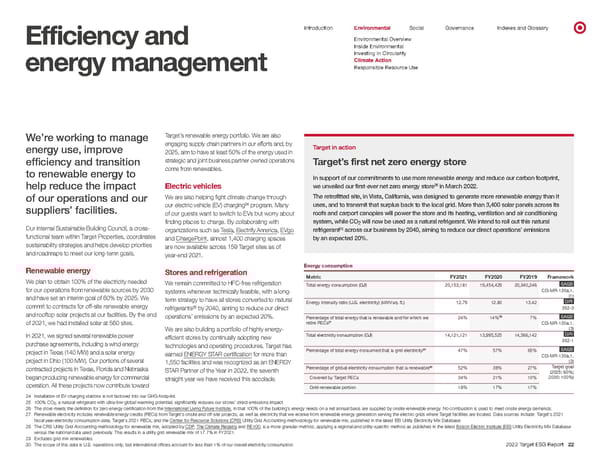
0 - - Introduction Environmental Social Governance Indexes and Glossary Environmental Overview Efficiency and energy management Inside Environmental Investing in Circularity Climate Action Responsible Resource Use We’re working to manage energy use, improve efficiency and transition to renewable energy to help reduce the impact of our operations and our suppliers’ facilities. Our internal Sustainable Building Council, a cross- functional team within Target Properties, coordinates sustainability strategies and helps develop priorities and roadmaps to meet our long-term goals. Renewable energy We plan to obtain 100% of the electricity needed for our operations from renewable sources by 2030 and have set an interim goal of 60% by 2025. We commit to contracts for off-site renewable energy and rooftop solar projects at our facilities. By the end of 2021, we had installed solar at 560 sites. In 2021, we signed several renewable power purchase agreements, including a wind energy project in Texas (140 MW) and a solar energy project in Ohio (100 MW). Our portions of several contracted projects in Texas, Florida and Nebraska began producing renewable energy for commercial operation. All these projects now contribute toward Target’s renewable energy portfolio. We are also engaging supply chain partners in our efforts and, by 2025, aim to have at least 50% of the energy used in strategic and joint business partner owned operations come from renewables. Electric vehicles We are also helping fight climate change through our electric vehicle (EV) charging 24 program. Many of our guests want to switch to EVs but worry about finding places to charge. By collaborating with organizations such as Tesla , Electrify America , EVgo and ChargePoint , almost 1,400 charging spaces are now available across 159 Target sites as of year-end 2021. Stores and refrigeration We remain committed to HFC-free refrigeration systems whenever technically feasible, with a long- term strategy to have all stores converted to natural refrigerants 25 by 2040, aiming to reduce our direct operations’ emissions by an expected 20%. We are also building a portfolio of highly energy- efficient stores by continually adopting new technologies and operating procedures. Target has earned ENERGY STAR certification for more than 1,550 facilities and was recognized as an ENERGY STAR Partner of the Year in 2022, the seventh straight year we have received this accolade. Target in action Target’s first net zero energy store In support of our commitments to use more renewable energy and reduce our carbon footprint, we unveiled our first-ever net zero energy store 26 in March 2022. The retrofitted site, in Vista, California, was designed to generate more renewable energy than it uses, and to transmit that surplus back to the local grid. More than 3,400 solar panels across its roofs and carport canopies will power the store and its heating, ventilation and air conditioning system, while CO 2 will now be used as a natural refrigerant. We intend to roll out this natural refrigerant 25 across our business by 2040, aiming to reduce our direct operations’ emissions by an expected 20%. Energy consumption Metric FY2021 FY2020 FY2019 Framework Total energy consumption (GJ) 20,153,181 19,454,429 20,040,246 CG-MR-130a.1. Energy intensity ratio (U.S. electricity) (kWh/sq. ft.) 12.79 12.80 13.42 (1) 302-3 SASB GRI Percentage of total energy that is renewable and for which we retire RECs 24% 14% 28 7% 27 SASB CG-MR-130a.1. (3) Total electricity consumption (GJ) 14,121,121 13,995,525 14,566,142 GRI 302-1 Percentage of total energy consumed that is grid electricity 29 47% 57% 65% CG-MR-130a.1. (2) SASB Percentage of global electricity consumption that is renewable 30 52% 38% 27% Target goal (2025: 60%; 2030: 100%) Covered by Target RECs 34% 21% 10% Grid-renewable portion 18% 17% 17% 24 Installation of EV charging stations is not factored into our GHG footprint. 25 100% CO 2 , a natural refrigerant with ultra-low global warming potential, significantly reduces our stores’ direct emissions impact. 26 The store meets the definition for zero energy certification from the International Living Future Institute , in that 100% of the building’s energy needs on a net annual basis are supplied by onsite renewable energy. No combustion is used to meet onsite energy demands. 27 Renewable electricity includes renewable energy credits (RECs) from Target’s onsite and off-site projects, as well as electricity that we receive from renewable energy generation serving the electric grids where Target facilities are located. Data sources include: Target’s 2021 fiscal year electricity consumption data; Target’s 2021 RECs; and the Center for Resource Solutions (CRS) Utility Grid Accounting methodology for renewable mix, published in the latest EEI Utility Electricity Mix Database. 28 The CRS Utility Grid Accounting methodology for renewable mix, adopted by CDP , The Climate Registry and RE100 , is a more granular method, applying a regional and utility-specific method as published in the latest Edison Electric Institute (EEI) Utility Electricity Mix Database versus the national data used previously. This results in a utility grid renewable mix of 17.7% in FY2021. 29 Excludes grid mix renewables. 30 The scope of this data is U.S. operations only, but international offices account for less than 1% of our overall electricity consumption. 2022 Target ESG Report 22
 Target ESG Report Page 21 Page 23