

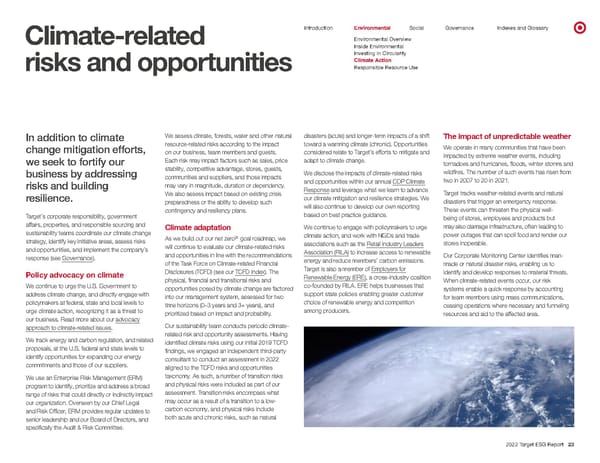
0 Introduction Environmental Social Governance Indexes and Glossary Environmental Overview Climate-related risks and opportunities Inside Environmental Investing in Circularity Climate Action Responsible Resource Use In addition to climate change mitigation efforts, we seek to fortify our business by addressing risks and building resilience. Target’s corporate responsibility, government affairs, properties, and responsible sourcing and sustainability teams coordinate our climate change strategy, identify key initiative areas, assess risks and opportunities, and implement the company’s response (see Governance ). Policy advocacy on climate We continue to urge the U.S. Government to address climate change, and directly engage with policymakers at federal, state and local levels to urge climate action, recognizing it as a threat to our business. Read more about our advocacy approach to climate-related issues . We track energy and carbon regulation, and related proposals, at the U.S. federal and state levels to identify opportunities for expanding our energy commitments and those of our suppliers. We use an Enterprise Risk Management (ERM) program to identify, prioritize and address a broad range of risks that could directly or indirectly impact our organization. Overseen by our Chief Legal and Risk Officer, ERM provides regular updates to senior leadership and our Board of Directors, and specifically the Audit & Risk Committee. We assess climate, forests, water and other natural resource-related risks according to the impact on our business, team members and guests. Each risk may impact factors such as sales, price stability, competitive advantage, stores, guests, communities and suppliers, and those impacts may vary in magnitude, duration or dependency. We also assess impact based on existing crisis preparedness or the ability to develop such contingency and resiliency plans. Climate adaptation As we build out our net zero 31 goal roadmap, we will continue to evaluate our climate-related risks and opportunities in line with the recommendations of the Task Force on Climate-related Financial Disclosures (TCFD) (see our TCFD Index ). The physical, financial and transitional risks and opportunities posed by climate change are factored into our management system, assessed for two time horizons (0–3 years and 3+ years), and prioritized based on impact and probability. Our sustainability team conducts periodic climate- related risk and opportunity assessments. Having identified climate risks using our initial 2019 TCFD findings, we engaged an independent third-party consultant to conduct an assessment in 2022 aligned to the TCFD risks and opportunities taxonomy. As such, a number of transition risks and physical risks were included as part of our assessment. Transition risks encompass what may occur as a result of a transition to a low- carbon economy, and physical risks include both acute and chronic risks, such as natural disasters (acute) and longer-term impacts of a shift toward a warming climate (chronic). Opportunities considered relate to Target’s efforts to mitigate and adapt to climate change. We disclose the impacts of climate-related risks and opportunities within our annual CDP Climate Response and leverage what we learn to advance our climate mitigation and resilience strategies. We will also continue to develop our own reporting based on best practice guidance. We continue to engage with policymakers to urge climate action, and work with NGOs and trade associations such as the Retail Industry Leaders Association (RILA) to increase access to renewable energy and reduce members’ carbon emissions. Target is also a member of Employers for Renewable Energy (ERE) , a cross-industry coalition co-founded by RILA. ERE helps businesses that support state policies enabling greater customer choice of renewable energy and competition among producers. The impact of unpredictable weather We operate in many communities that have been impacted by extreme weather events, including tornadoes and hurricanes, floods, winter storms and wildfires. The number of such events has risen from two in 2007 to 20 in 2021. Target tracks weather-related events and natural disasters that trigger an emergency response. These events can threaten the physical well- being of stores, employees and products but may also damage infrastructure, often leading to power outages that can spoil food and render our stores inoperable. Our Corporate Monitoring Center identifies man- made or natural disaster risks, enabling us to identify and develop responses to material threats. When climate-related events occur, our risk systems enable a quick response by accounting for team members using mass communications, ceasing operations where necessary and funneling resources and aid to the affected area. 2022 Target ESG Report 23
 Target ESG Report Page 22 Page 24