

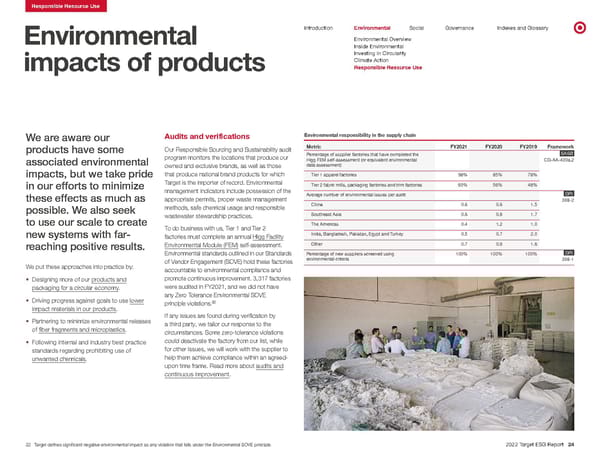
0 - - Responsible Resource Use Environmental impacts of products Introduction Environmental Social Environmental Overview Inside Environmental Investing in Circularity Climate Action Responsible Resource Use Environmental responsibility in the supply chain Governance Indexes and Glossary We are aware our products have some associated environmental impacts, but we take pride in our efforts to minimize these effects as much as possible. We also seek to use our scale to create new systems with far- reaching positive results. We put these approaches into practice by: • Designing more of our products and packaging for a circular economy . • Driving progress against goals to use lower impact materials in our products . • Partnering to minimize environmental releases of fiber fragments and microplastics . • Following internal and industry best practice standards regarding prohibiting use of unwanted chemicals . Audits and verifications Our Responsible Sourcing and Sustainability audit program monitors the locations that produce our owned and exclusive brands, as well as those that produce national brand products for which Target is the importer of record. Environmental management indicators include possession of the appropriate permits, proper waste management methods, safe chemical usage and responsible wastewater stewardship practices. To do business with us, Tier 1 and Tier 2 factories must complete an annual Higg Facility Environmental Module (FEM) self-assessment. Environmental standards outlined in our Standards of Vendor Engagement (SOVE) hold these factories accountable to environmental compliance and promote continuous improvement. 3,317 factories were audited in FY2021, and we did not have any Zero Tolerance Environmental SOVE principle violations. 32 If any issues are found during verification by a third party, we tailor our response to the circumstances. Some zero-tolerance violations could deactivate the factory from our list, while for other issues, we will work with the supplier to help them achieve compliance within an agreed- upon time frame. Read more about audits and continuous improvement . Metric Percentage of supplier factories that have completed the Higg FEM self-assessment (or equivalent environmental data assessment) FY2021 FY2020 FY2019 Framework CG-AA-430a.2 Tier 1 apparel factories 98% 85% 78% Tier 2 fabric mills, packaging factories and trim factories 90% 56% 48% Average number of environmental issues per audit China 0.6 0.6 1.5 308-2 Southeast Asia 0.6 0.8 1.7 The Americas 0.4 1.2 1.0 India, Bangladesh, Pakistan, Egypt and Turkey 0.5 0.7 2.0 Other 0.7 0.9 1.6 Percentage of new suppliers screened using environmental criteria 100% 100% 100% 308-1 SASB GRI GRI 2022 Target ESG Report 24 32 Target defines significant negative environmental impact as any violation that falls under the Environmental SOVE principle.
 Target ESG Report Page 23 Page 25