

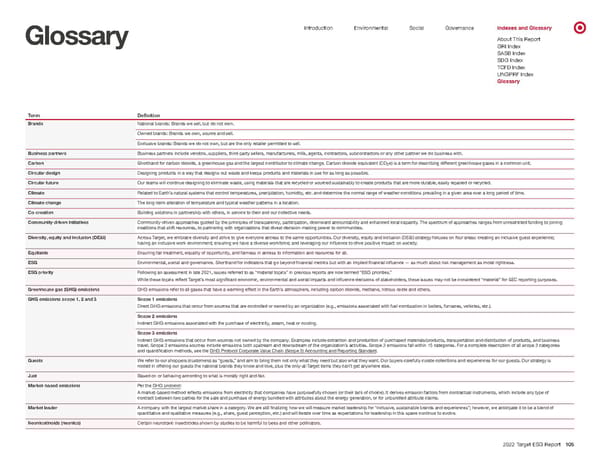
0 Glossary Introduction Environmental Social Governance Indexes and Glossary About This Report GRI Index SASB Index SDG Index TCFD Index UNGPRF Index Glossary Term Definition Brands National brands: Brands we sell, but do not own. Owned brands: Brands we own, source and sell. Exclusive brands: Brands we do not own, but are the only retailer permitted to sell. Business partners Business partners include vendors, suppliers, third-party sellers, manufacturers, mills, agents, contractors, subcontractors or any other partner we do business with. Carbon Shorthand for carbon dioxide, a greenhouse gas and the largest contributor to climate change. Carbon dioxide equivalent (CO 2 e) is a term for describing different greenhouse gases in a common unit. Circular design Designing products in a way that designs out waste and keeps products and materials in use for as long as possible. Circular future Our teams will continue designing to eliminate waste, using materials that are recycled or sourced sustainably to create products that are more durable, easily repaired or recycled. Climate Related to Earth’s natural systems that control temperatures, precipitation, humidity, etc. and determine the normal range of weather conditions prevailing in a given area over a long period of time. Climate change The long-term alteration of temperature and typical weather patterns in a location. Co-creation Building solutions in partnership with others, in service to their and our collective needs. Community-driven initiatives Community-driven approaches guided by the principles of transparency, participation, downward accountability and enhanced local capacity. The spectrum of approaches ranges from unrestricted funding to joining coalitions that shift resources, to partnering with organizations that divest decision-making power to communities. Diversity, equity and inclusion (DE&I) Across Target, we embrace diversity and strive to give everyone access to the same opportunities. Our diversity, equity and inclusion (DE&I) strategy focuses on four areas: creating an inclusive guest experience; having an inclusive work environment; ensuring we have a diverse workforce; and leveraging our influence to drive positive impact on society. Equitable Ensuring fair treatment, equality of opportunity, and fairness in access to information and resources for all. ESG Environmental, social and governance. Shorthand for indicators that go beyond financial metrics but with an implied financial influence — as much about risk management as moral rightness. ESG priority Following an assessment in late 2021, issues referred to as “material topics” in previous reports are now termed “ESG priorities.” While these topics reflect Target’s most significant economic, environmental and social impacts and influence decisions of stakeholders, these issues may not be considered “material” for SEC reporting purposes. Greenhouse gas (GHG) emissions GHG emissions refer to all gases that have a warming effect in the Earth’s atmosphere, including carbon dioxide, methane, nitrous oxide and others. GHG emissions scope 1, 2 and 3 Scope 1 emissions Direct GHG emissions that occur from sources that are controlled or owned by an organization (e.g., emissions associated with fuel combustion in boilers, furnaces, vehicles, etc.). Scope 2 emissions Indirect GHG emissions associated with the purchase of electricity, steam, heat or cooling. Scope 3 emissions Indirect GHG emissions that occur from sources not owned by the company. Examples include extraction and production of purchased materials/products, transportation and distribution of products, and business travel. Scope 3 emissions sources include emissions both upstream and downstream of the organization’s activities. Scope 3 emissions fall within 15 categories. For a complete description of all scope 3 categories and quantification methods, see the GHG Protocol Corporate Value Chain (Scope 3) Accounting and Reporting Standard . Guests We refer to our shoppers (customers) as “guests,” and aim to bring them not only what they need but also what they want. Our buyers carefully curate collections and experiences for our guests. Our strategy is rooted in offering our guests the national brands they know and love, plus the only-at-Target items they can’t get anywhere else. Just Based on or behaving according to what is morally right and fair. Market-based emissions Per the GHG protocol : A market-based method reflects emissions from electricity that companies have purposefully chosen (or their lack of choice). It derives emission factors from contractual instruments, which include any type of contract between two parties for the sale and purchase of energy bundled with attributes about the energy generation, or for unbundled attribute claims. Market leader A company with the largest market share in a category. We are still finalizing how we will measure market leadership for “inclusive, sustainable brands and experiences”; however, we anticipate it to be a blend of quantitative and qualitative measures (e.g., share, guest perception, etc.) and will iterate over time as expectations for leadership in this space continue to evolve. Neonicotinoids (neonics) Certain neurotoxic insecticides shown by studies to be harmful to bees and other pollinators. 2022 Target ESG Report 105
 Target ESG Report Page 104 Page 106