

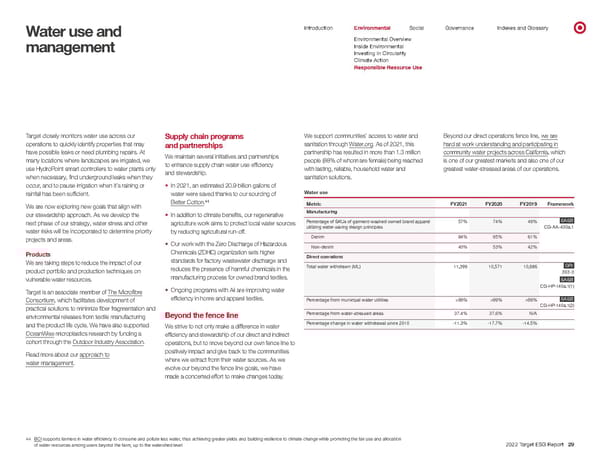
0 - - Introduction Environmental Social Governance Indexes and Glossary Water use and Environmental Overview Inside Environmental management Investing in Circularity Climate Action Responsible Resource Use Target closely monitors water use across our operations to quickly identify properties that may have possible leaks or need plumbing repairs. At many locations where landscapes are irrigated, we use HydroPoint smart controllers to water plants only when necessary, find underground leaks when they occur, and to pause irrigation when it’s raining or rainfall has been sufficient. We are now exploring new goals that align with our stewardship approach. As we develop the next phase of our strategy, water stress and other water risks will be incorporated to determine priority projects and areas. Products We are taking steps to reduce the impact of our product portfolio and production techniques on vulnerable water resources. Target is an associate member of The Microfibre Consortium , which facilitates development of practical solutions to minimize fiber fragmentation and environmental releases from textile manufacturing and the product life cycle. We have also supported OceanWise microplastics research by funding a cohort through the Outdoor Industry Association . Read more about our approach to water management . Supply chain programs and partnerships We maintain several initiatives and partnerships to enhance supply chain water use efficiency and stewardship. • In 2021, an estimated 20.9 billion gallons of water were saved thanks to our sourcing of Better Cotton . 44 • In addition to climate benefits, our regenerative agriculture work aims to protect local water sources by reducing agricultural run-off. • Our work with the Zero Discharge of Hazardous Chemicals (ZDHC) organization sets higher standards for factory wastewater discharge and reduces the presence of harmful chemicals in the manufacturing process for owned brand textiles. • Ongoing programs with Aii are improving water efficiency in home and apparel textiles. Beyond the fence line We strive to not only make a difference in water efficiency and stewardship of our direct and indirect operations, but to move beyond our own fence line to positively impact and give back to the communities where we extract from their water sources. As we evolve our beyond the fence line goals, we have made a concerted effort to make changes today. We support communities’ access to water and sanitation through Water.org . As of 2021, this partnership has resulted in more than 1.3 million people (88% of whom are female) being reached with lasting, reliable, household water and sanitation solutions. Water use Beyond our direct operations fence line, we are hard at work understanding and participating in community water projects across California , which is one of our greatest markets and also one of our greatest water-stressed areas of our operations. Metric FY2021 FY2020 FY2019 Framework Manufacturing Percentage of SKUs of garment-washed owned brand apparel utilizing water-saving design principles 57% 74% 49% CG-AA-430a.1 Denim 84% 95% 61% Non-denim 40% 53% 42% SASB Direct operations Total water withdrawn (ML) 11,399 10,571 10,986 303-3 CG-HP-140a.1(1) Percentage from municipal water utilities Percentage from water-stressed areas >99% 37.4% >99% 37.6% >99% CG-HP-140a.1(2) N/A Percentage change in water withdrawal since 2010 -11.3% -17.7% -14.5% GRI SASB SASB 44 BCI supports farmers in water efficiency to consume and pollute less water, thus achieving greater yields and building resilience to climate change while promoting the fair use and allocation of water resources among users beyond the farm, up to the watershed level. 2022 Target ESG Report 29
 Target ESG Report Page 28 Page 30