

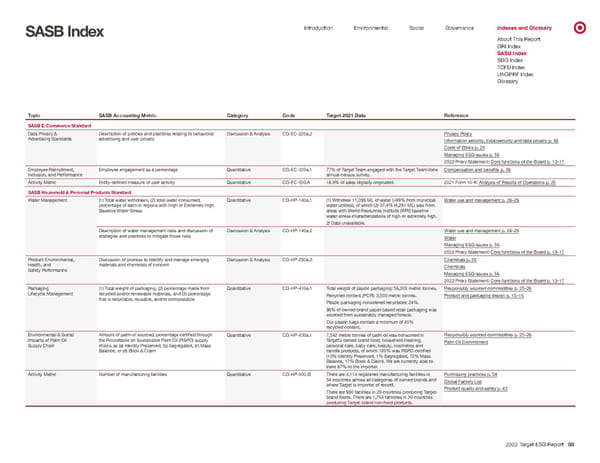
0 Introduction Environmental Social Governance Indexes and Glossary SASB Index About This Report GRI Index SASB Index SDG Index TCFD Index UNGPRF Index Glossary Topic SASB Accounting Metric Category Code Target 2021 Data Reference SASB E-Commerce Standard Data Privacy & Advertising Standar ds Description of policies and practices relating to behavioral advertising and user privacy Discussion & Analysis CG-EC-220a.2 Privacy Policy Information security, cybersecurity and data privacy p. 60 Code of Ethics p. 20 Managing ESG issues p. 56 2022 Proxy Statement: Core functions of the Board p. 13–17 Employee Recruitment, Inclusion, and Performance Employee engagement as a per centage Quantitative CG-EC-330a.1 77% of Target Team engaged with the Target TeamVoice annual census survey. Compensation and benefits p. 36 Activity Metric Entity-defined measure of user activity Quantitative CG-EC-000.A 18.9% of sales digitally originated. 2021 Form 10-K: Analysis of Results of Operations p. 20 SASB Household & Personal Products Standard Water Management (1) Total water withdrawn, (2) total water consumed, percentage of each in regions with High or Extr emely High Baseline Water Stress Quantitative CG-HP-140a.1 (1) Withdrew 11,399 ML of water (>99% from municipal water utilities), of which (2) 37.4% (4,261 ML) was from ar eas with World Resources Institute (WRI) baseline water-stress characterizations of high or extremely high. 2) Data unavailable. Water use and management p. 28–29 Description of water management risks and discussion of strategies and pr actices to mitigate those risks Discussion & Analysis CG-HP-140a.2 Water use and management p. 28–29 Water Managing ESG issues p. 56 2022 Proxy Statement: Core functions of the Board p. 13–17 Product Environmental, Health, and Safety Per formance Discussion of process to identify and manage emerging materials and chemicals of concern Discussion & Analysis CG-HP-250a.3 Chemicals p. 30 Chemicals Managing ESG issues p. 56 2022 Proxy Statement: Core functions of the Board p. 13–17 Packaging Lifecycle Management (1) Total weight of packaging, (2) percentage made from recycled and/or renewable mat erials, and (3) percentage that is recyclable, reusable, and/or compostable Quantitative CG-HP-410a.1 Total weight of plastic packaging: 56,300 metric tonnes. Recycled content (PCR): 3,500 metric tonnes. Plastic packaging consider ed recyclable: 24%. 86% of owned brand paper-based retail packaging was sourced from sustainably managed forests. Our plastic bags contain a minimum of 40% recycled content. Responsibly sourced commodities p. 25–26 Product and packaging design p. 15–16 Environmental & Social Impacts of Palm Oil Supply Chain Amount of palm oil sourced, per centage certified through the Roundtable on Sustainable Palm Oil (RSPO) supply chains as (a) Identity Pr eserved, (b) Segregated, (c) Mass Balance, or (d) Book & Claim Quantitative CG-HP-430a.1 7,542 metric tonnes of palm oil was consumed in Target’ s owned brand food, household cleaning, personal care, baby care, beauty, cosmetics and candle products, of which 100% was RSPO certified (10% Identity P reserved, 1% Segregated, 72% Mass Balance, 17% Book & Claim). We are currently able to trace 87% to the importer. Responsibly sourced commodities p. 25–26 Palm Oil Commitment Activity Metric Number of manufacturing facilities Quantitative CG-HP-000.B There are 4,114 registered manufacturing facilities in 54 countries across all categories of owned br ands and where Target is importer of record. There are 980 facilities in 29 countries producing Target- brand foods. There are 1,704 factories in 30 countries producing Target-brand non-food products. Purchasing practices p. 58 Global Factory List Product quality and safety p. 43 2022 Target ESG Report 88
 Target ESG Report Page 87 Page 89