

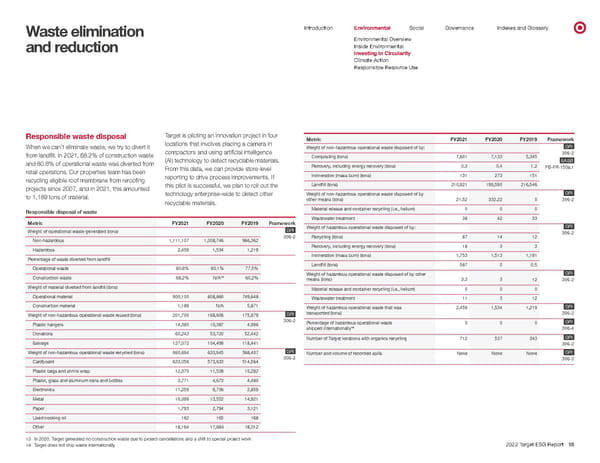
0 - - - - - - - - - - - - Waste elimination and reduction Responsible waste disposal When we can’t eliminate waste, we try to divert it from landfill. In 2021, 68.2% of construction waste and 80.8% of operational waste was diverted from retail operations. Our properties team has been recycling eligible roof membrane from reroofing projects since 2007, and in 2021, this amounted to 1,189 tons of material. Responsible disposal of waste Target is piloting an innovation project in four locations that involves placing a camera in compactors and using artificial intelligence (AI) technology to detect recyclable materials. From this data, we can provide store-level reporting to drive process improvements. If this pilot is successful, we plan to roll out the technology enterprise-wide to detect other recyclable materials. Metric FY2021 FY2020 FY2019 Framework Weight of operational waste generated (tons) 306-2 Non-hazardous 1,111,107 1,008,746 966,362 Hazardous 2,459 1,534 1,219 Percentage of waste diverted from landfill Operational waste 80.8% 80.1% 77.5% Construction waste 68.2% N/A 13 60.2% Weight of material diverted from landfill (tons) Operational material 900,100 808,860 749,648 Construction material 1,189 N/A 5,871 Weight of non-hazardous operational waste reused (tons) 201,700 168,606 175,879 306-2 Plastic hangers 14,385 10,387 4,996 Donations 60,243 53,720 52,442 Salvage 127,072 104,499 118,441 Weight of non-hazardous operational waste recycled (tons) 690,694 633,945 568,407 306-2 Cardboard 633,056 573,633 514,564 Plastic bags and shrink wrap 12,370 11,538 10,282 Plastic, glass and aluminum cans and bottles 3,771 4,673 4,480 Electronics 11,259 9,706 2,859 Metal 10,099 13,552 14,921 Paper 1,793 2,794 3,121 Used cooking oil 182 165 168 Other 18,164 17,884 18,012 13 In 2020, Target generated no construction waste due to project cancellations and a shift to special project work. 14 Target does not ship waste internationally. GRI GRI GRI Introduction Environmental Social Governance Indexes and Glossary Environmental Overview Inside Environmental Investing in Circularity Climate Action Responsible Resource Use Metric FY2021 FY2020 FY2019 Framework Weight of non-hazardous operational waste disposed of by: 306-2 Composting (tons) 7,601 7,133 5,345 Recovery, including energy recovery (tons) 0.3 0.4 1.2 FB-FR-150a.1 Incineration (mass burn) (tons) 131 273 151 Landfill (tons) 210,921 199,590 216,546 Weight of non-hazardous operational waste disposed of by other means (tons) 21.52 332.22 0 306-2 Material release and container recycling (i.e., helium) 0 0 0 Wastewater treatment 38 42 33 W eight of hazardous operational waste disposed of by: 306-2 Recycling (tons) 87 14 12 Recovery, including energy recovery (tons) 18 3 3 Incineration (mass burn) (tons) 1,753 1,513 1,191 Landfill (tons) 587 0 0.5 Weight of hazardous operational waste disposed of by other means (tons) 3.3 3 12 306-2 Material release and container recycling (i.e., helium) 0 0 0 Wastewater treatment 11 3 12 Weight of hazardous operational waste that was transported (tons) 2,459 1,534 1,219 306-2 Percentage of hazardous operational waste shipped internationally 0 0 0 14 306-4 Number of Target locations with organics recycling 712 537 343 306-2 Number and volume of recorded spills None None None 306-3 GRI SASB GRI GRI GRI GRI GRI GRI GRI 2022 Target ESG Report 18
 Target ESG Report Page 17 Page 19