

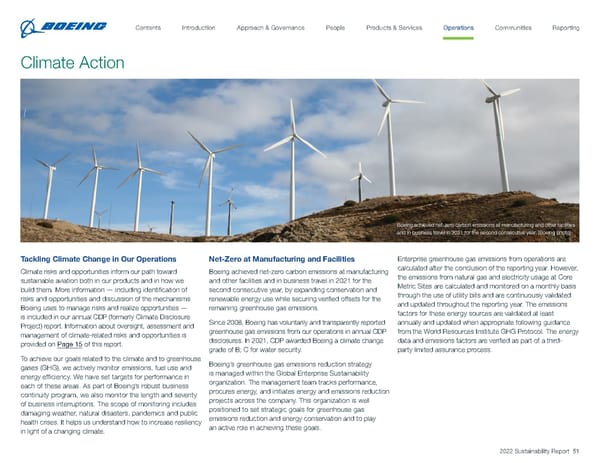
Climate Action Boeing achieved net-zero carbon emissions at manufacturing and other facilities and in business travel in 2021 for the second consecutive year. (Boeing photo) Tackling Climate Change in Our Operations Climate risks and opportunities inform our path toward sustainable aviation both in our products and in how we build them. More information — including identification of risks and opportunities and discussion of the mechanisms Boeing uses to manage risks and realize opportunities — is included in our annual CDP (formerly Climate Disclosure Project) report. Information about oversight, assessment and management of climate-related risks and opportunities is provided on Page 15 of this report. To achieve our goals related to the climate and to greenhouse gases (GHG), we actively monitor emissions, fuel use and energy efficiency. We have set targets for performance in each of these areas. As part of Boeing’s robust business continuity program, we also monitor the length and severity of business interruptions. The scope of monitoring includes damaging weather, natural disasters, pandemics and public health crises. It helps us understand how to increase resiliency in light of a changing climate. Net-Zero at Manufacturing and Facilities Boeing achieved net-zero carbon emissions at manufacturing and other facilities and in business travel in 2021 for the second consecutive year, by expanding conservation and renewable energy use while securing verified offsets for the remaining greenhouse gas emissions. Since 2008, Boeing has voluntarily and transparently reported greenhouse gas emissions from our operations in annual CDP disclosures. In 2021, CDP awarded Boeing a climate change grade of B; C for water security. Boeing’s greenhouse gas emissions reduction strategy is managed within the Global Enterprise Sustainability organization. The management team tracks performance, procures energy, and initiates energy and emissions reduction projects across the company. This organization is well positioned to set strategic goals for greenhouse gas emissions reduction and energy conservation and to play an active role in achieving these goals. Enterprise greenhouse gas emissions from operations are calculated after the conclusion of the reporting year. However, the emissions from natural gas and electricity usage at Core Metric Sites are calculated and monitored on a monthly basis through the use of utility bills and are continuously validated and updated throughout the reporting year. The emissions factors for these energy sources are validated at least annually and updated when appropriate following guidance from the World Resources Institute GHG Protocol. The energy data and emissions factors are verified as part of a third- party limited assurance process. 2022 Sustainability Report 51 Contents People Introduction Communities Operations Reporting Approach & Governance Products & Services
 The Boeing Company 2022 Sustainability Report Page 50 Page 52