

The Boeing Company 2022 Sustainability Report
THE BOEING COMPANY 2022 SUSTAINABILITY REPORT Sustainable Aerospace Together
Contents 3 Introduction 3 Message from Dave Calhoun 5 Reflecting on Progress, Defining the Future of Flight 7 2021 Sustainable Aerospace Journey 8 Map of Engagement 9 Approach & Governance 10 Company Profile 11 Our Sustainability Journey 12 Sustainability Goals 13 Report on Net Zero Indicator 15 Governance and Risk Management 17 Ethical and Compliant Business 21 People 23 Employee Safety 24 Employee Well-Being 27 Global Equity, Diversity and Inclusion 31 Professional Development, Education and Learning 32 Products & Services 34 Global Aerospace Safety 37 Sustainable Product Life Cycle 41 Innovation and Clean Technology 47 Operations 49 Enterprise Quality 51 Climate Action 53 Environmentally Responsible Operations 56 Environmental Compliance and Biodiversity 58 Responsible Supply Chain 60 Data Privacy and Information Security 61 Communities 62 Community Engagement 63 Our Heroes 64 Our Future 66 Our Homes 67 Reporting 68 Key ESG Data 72 GRI Index 82 SASB Index 84 TCFD Index 85 U.N. Sustainable Development Goals 87 Awards and Recognition 87 Memberships and Partnerships 88 Forward-Looking Statements Cover Photo: Carla Davis-Madgett, Vice President of Boeing’s Environment, Health & Safety organization, recently participated in a walk-through of the 787 manufacturing process in Boeing South Carolina with Paul Rollerson, a Fabrication Specialist. (Boeing photo) 2022 Sustainability Report 2 Contents People Introduction Communities Operations Reporting Approach & Governance Products & Services
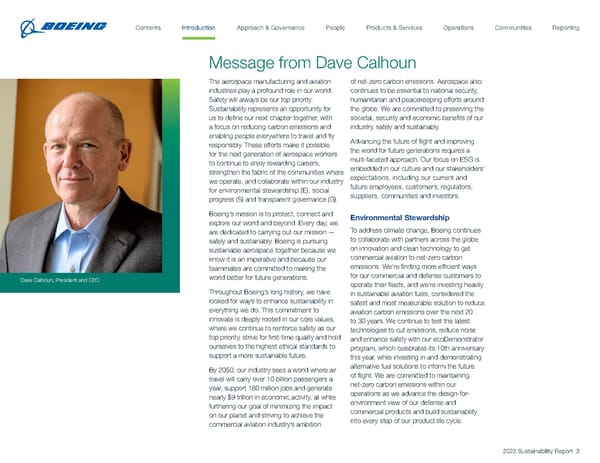
Message from Dave Calhoun The aerospace manufacturing and aviation industries play a profound role in our world. Safety will always be our top priority. Sustainability represents an opportunity for us to define our next chapter together, with a focus on reducing carbon emissions and enabling people everywhere to travel and fly responsibly. These efforts make it possible for the next generation of aerospace workers to continue to enjoy rewarding careers, strengthen the fabric of the communities where we operate, and collaborate within our industry for environmental stewardship (E), social progress (S) and transparent governance (G). Boeing’s mission is to protect, connect and explore our world and beyond. Every day, we are dedicated to carrying out our mission — safely and sustainably. Boeing is pursuing sustainable aerospace together because we know it is an imperative and because our teammates are committed to making the world better for future generations. Throughout Boeing’s long history, we have looked for ways to enhance sustainability in everything we do. This commitment to innovate is deeply rooted in our core values, where we continue to reinforce safety as our top priority, strive for first-time quality and hold ourselves to the highest ethical standards to support a more sustainable future. By 2050, our industry sees a world where air travel will carry over 10 billion passengers a year, support 180 million jobs and generate nearly $9 trillion in economic activity, all while furthering our goal of minimizing the impact on our planet and striving to achieve the commercial aviation industry’s ambition of net-zero carbon emissions. Aerospace also continues to be essential to national security, humanitarian and peacekeeping efforts around the globe. We are committed to preserving the societal, security and economic benefits of our industry, safely and sustainably. Advancing the future of flight and improving the world for future generations requires a multi-faceted approach. Our focus on ESG is embedded in our culture and our stakeholders’ expectations, including our current and future employees, customers, regulators, suppliers, communities and investors. Environmental Stewardship To address climate change, Boeing continues to collaborate with partners across the globe on innovation and clean technology to get commercial aviation to net-zero carbon emissions. We’re finding more efficient ways for our commercial and defense customers to operate their fleets, and we’re investing heavily in sustainable aviation fuels, considered the safest and most measurable solution to reduce aviation carbon emissions over the next 20 to 30 years. We continue to test the latest technologies to cut emissions, reduce noise and enhance safety with our ecoDemonstrator program, which celebrates its 10th anniversary this year, while investing in and demonstrating alternative fuel solutions to inform the future of flight. We are committed to maintaining net-zero carbon emissions within our operations as we advance the design-for- environment view of our defense and commercial products and build sustainability into every step of our product life cycle. Dave Calhoun, President and CEO 2022 Sustainability Report 3 Contents People Introduction Communities Operations Reporting Approach & Governance Products & Services
Social Progress Our people are our most important asset. Employee safety and well-being is our priority. We have taken steps to create open, candid and respectful environments for all our teammates — not just within our four walls, but within the communities where we live and work. Boeing’s Seek, Speak & Listen habits are foundational to a culture of integrity and inclusion. We’re committed to increasing the representation of women and underrepresented racial and ethnic minorities at every level of our company. And we continue to invest in our future through technical and educational organizations that inspire the next generation of aerospace innovators. Global Engagement Most recently, our focus has been on our employees affected by the war in Ukraine. As a global company with over a century in flight and a long legacy of advancing human freedom, Boeing has continuously navigated challenging and shifting geopolitical dynamics and we will continue to do so in this case, guided by our values. We have taken action and will continue to follow the lead of the U.S. Government and focus on strictly adhering to the export controls and restrictions that have been announced governing work in Russia as a baseline, while also taking additional actions. As always, our first priority is safety and the safety of our employees in Ukraine has our total focus. We also announced a significant humanitarian assistance package to support the Ukrainian people affected by the ongoing conflict. I am incredibly proud of our teammates who have made their own donations in support of Ukrainian humanitarian relief, which the company is matching through our Boeing Gift Match Program. Transparent Governance Our Board of Directors works closely with Boeing leaders to ensure we hold ourselves to the highest standards in our work, ethical conduct and information protection. We all sign a Code of Conduct annually and commit to prioritizing safety, quality and integrity and holding one another accountable. Through the Board’s Governance & Public Policy Committee, we have enhanced our practices and policies and formalized oversight of public policy, political advocacy and corporate sustainability practices — including matters related to environmental stewardship and climate change, and to diversity, equity and inclusion. Opportunity lies before us as we advance safe and sustainable aerospace, which is critical to our commercial and defense customers and to our communities at large. I am proud of our teams as they explore innovative ways to help us continue to take meaningful steps toward a more sustainable future. I invite you to join us on our journey as we advance the future of flight together, safely and sustainably. David L. Calhoun President and CEO Our Values How We Operate Start with engineering excellence Be accountable — from beginning to end Apply Lean principles Eliminate traveled work Reward predictability and stability — everywhere in our business How We Act Lead on safety, quality, integrity and sustainability Foster a Just Culture grounded in humility, inclusion and transparency Import best leadership practices Earn stakeholder trust and preference Respect one another and advance a global, diverse team Innovate and operate to make the world better 2022 Sustainability Report 4 Contents People Introduction Communities Operations Reporting Approach & Governance Products & Services

Reflecting on Progress, Defining the Future of Flight Boeing’s purpose is to protect, connect and explore our world and beyond. We have a responsibility to do it safely, with quality, integrity and sustainability. We strive to earn trust and ideally preference with our stakeholders through collaboration, humility, inclusion, transparency and learning. Above all else is safety. As air travel resumes around the globe and workplaces change, health and safety are always our top priority. We will continue working across the industry to enhance employee health and global aerospace safety; and you will see that addressed throughout this report. Boeing established its first Chief Sustainability Officer role and formed a Global Enterprise Sustainability organization in September 2020, but that was not the beginning of our focus on sustainability. Many environmental, social and governance (ESG) elements have been part of Boeing’s fabric throughout our 106-year aerospace history, and we must always learn and continuously improve. In 1929, Bill Boeing said, “Our job is to keep everlastingly at research and experiment, to adapt our laboratories to production as soon as practicable...to let no new improvement in flying equipment pass us by.” This philosophy endures today as we move forward and pursue sustainable aerospace with our stakeholders across Boeing’s commercial, defense and services businesses. Through collaboration with our stakeholders, we learned a lot in 2021 and we see exciting opportunity going forward. While we still have more to learn, the following are a few reflections on the journey. Our stakeholders increasingly value sustainability. ESG efforts are increasingly important to our current and future employees, our customers, our suppliers, our regulators, our communities and our financial stakeholders. We must continue to engage and listen to them about what’s important, bring the outside in and collaborate on solutions. Last year, we described six sustainability goals that will define sustainability progress for Boeing and its stakeholders. This year we added several waypoints and metrics to measure progress (see Page 12 ). We also explicitly included sustainability in our enterprise values and strategic objectives to further embed the importance and the opportunity and, for the first time, Boeing is including compensation incentives tied to sustainability performance. The industry is committed to combating climate change and it will require collective action. Aerospace has always been about efficiency and has competed on innovation and fuel efficiency to meet customers’ expectations. Climate change and decarbonizing aerospace have further increased the urgency for progress. Airlines, defense customers, leasing companies and governments around the globe are aligning to bold climate change ambitions. We support the commercial aviation industry’s ambition to achieve net-zero carbon emissions by 2050. Boeing’s strategy to decarbonize aviation is focused on four key areas: fleet renewal, operational efficiency, renewable energy transition and advanced technologies. We are engaged in studies, tests, research and partnering across these areas and the industry to learn together and provide customers with sustainable product life cycle insights and solutions to help them meet their climate change commitments. Aerospace protects and connects; people will continue to take flight. Aerospace plays a profound role in our world and enables societal benefits. Aerospace connects and protects, and while the COVID-19 pandemic challenged the industry it also reminded us of our industry’s value. People all over the world yearned to be connected to others and global air transport delivered necessary products and goods to people’s doorsteps. Billions of passengers fly every year to connect with loved ones, explore new places and understand cultures, engage in commerce and care for those in need. Dave mentioned the industry’s vision for sustainable growth by 2050, which will require us to work, learn and solve challenges together to create future opportunities for passengers, workers and economies. At the same time, aerospace continues to be essential to national security, humanitarian and peacekeeping efforts, which are social responsibilities the world too often reminds us remain much needed. Our industry has a responsibility to preserve and grow the societal and economic benefits of aerospace, safely and sustainably. Chris Raymond, Chief Sustainability Officer 2022 Sustainability Report 5 Contents People Introduction Communities Operations Reporting Approach & Governance Products & Services
Nicola Sturgeon (center), Scotland’s first female First Minister and the first female leader of any of the devolved U.K. administrations, met with women attending the Boeing Innovation Forum after touring the ecoDemonstrator at Glasgow Airport. (Boeing photo) Partnerships, innovation and learning together are critical to our collective success. To explore and mature sustainable solutions, we must continue to work together with partners — across our communities, our industry, academia, governments and non-governmental organizations, and philanthropic foundations — given each have a role to play in tackling climate change and aerospace decarbonization. In October 2021, we hosted a Boeing Innovation Forum in Glasgow. We convened customers, government officials, manufacturers, academia and future talent to discuss the future of sustainable aerospace. It was an enlightening few days as expert stakeholders hosted panels on future sustainable solutions. Perhaps most inspiring was that this forum lent itself to diverse perspectives, given the range of participants and talent. The First Minister of Scotland Nicola Sturgeon opened the day with inspiring remarks and announced plans for The Newton Flight Academy at Glasgow Science Center. This Boeing- supported academy is used to teach students about aviation-related STEM concepts and inspire our next generation of leaders. Boeing’s ecoDemonstrator was a popular attraction at the event. The ecoDemonstrator program celebrates its 10th anniversary this year and continues to take technologies out of a lab and test them in the sky with airline and industry partners. It is perhaps one of the best and most visual representations of how innovation and partnerships are informing and maturing sustainable technologies for current and future aircraft. Boeing also participated in COP26, where the world convened to discuss climate change across all industries and on a global scale. There, the World Economic Forum, in partnership with US Special Presidential Envoy for Climate John Kerry, announced the First Movers Coalition — a new platform for companies to make purchasing commitments that create new market demand for low- carbon technologies. Boeing is honored to be a founding member. This is just one example of companies and governments collaborating together to advance and accelerate progress. Forward, the Future of Flight Going forward, we will remain focused on employee well-being and safety; global aviation safety; equity, diversity and inclusion; sustainable operations; innovation and clean tech; and global community engagement; among many other important elements. As we look to the future of flight, aerospace innovation is energized by how to decarbonize the industry. Boeing’s strategy is focused on four key areas. Continued fleet renewal with more fuel-efficient aircraft and operational efficiencies will remain critically important levers to reduce carbon emissions. Renewable energy will intersect aviation in new, exciting ways with the industrialization and growth of new sustainable aviation fuel (SAF) pathways, technology innovation, and production volumes. SAF and the parallel research, studies and demonstrations of electric and hydrogen applications, the renewable energy total life-cycle accounting, zero climate impact aircraft design concepts, safe certification and infrastructure implications, coupled with a sustainable product life-cycle approach, will drive our industry talent, partnerships, innovation and policies going forward. It is an exciting era for aerospace. These are ambitious challenges. Throughout our industry and our company history, we have had the resolve and teamwork to bring jet travel to the world and take people to the moon. We must continue to help humanity take flight in every sense while protecting our planet for generations to come. As Bill Boeing also said, “We are embarked as pioneers on a new science and industry in which our problems are so new and unusual that it behooves no one to dismiss any novel idea with the statement that ‘It can’t be done!’” In that spirit, we are on a journey to solve sustainable aerospace challenges together. We appreciate our stakeholders’ partnership for shared successes as we move forward. Onward, Chris Raymond Chief Sustainability Officer 2022 Sustainability Report 6 Contents People Introduction Communities Operations Reporting Approach & Governance Products & Services
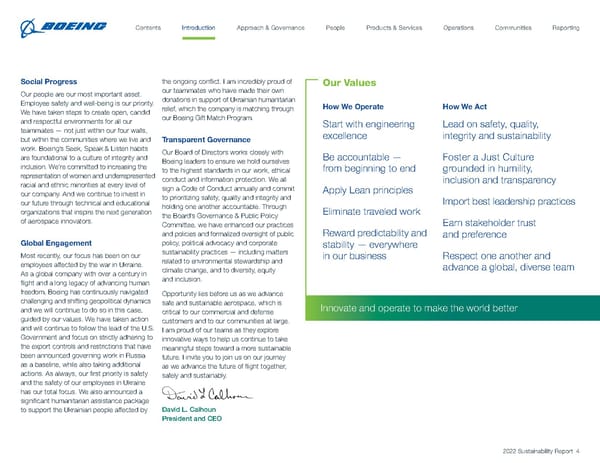
2021 Sustainable Aerospace Journey Boeing innovated and partnered across the industry in 2021, making significant progress toward our industry’s net-zero commitments and goals. January Committed to deliver 100% SAF capable airplanes by 2030 February Became founding member of MIT Climate and Sustainability Consortium April ENERGY STAR Partner of the Year Award for Sustained Excellence [ Insert Custom Partner Te xt ] June Announced Alaska Airlines as 2021 ecoDemonstrator partner July Announced partnership with SkyNRG to scale availability and use of sustainable aviation fuels globally Highlighted sustainable technologies at congressional event in Washington, D.C. August Showcased new technologies tested on ecoDemonstrator to STEM-focused students, part of the Alaska Native Science & Engineering Program September Amplified SAF ambitions during White House sustainability roundtable Showcased sustainable technologies on ecoDemonstrator at Boeing Field in Seattle October Partnered with United Airlines on first passenger flight with 100% SAF in one engine Partnered with Etihad Airways on sustainable flight Partnered with Rolls-Royce on 100% SAF flight Partnered with NASA Langley Research Center to test the emissions of SAF on ecoDemonstrator Supported commercial aviation industry’s ambition to achieve net-zero carbon emissions by 2050 Hosted Innovation Forum in Glasgow, convening industry to discuss decarbonizing aerospace within the region and globally November Became founding member of First Movers Coalition, partnering with leading companies to accelerate new technology development to reduce emissions Hosted 2021 STEM event at San Francisco International Airport to showcase ecoDemonstrator’s sustainable technologies Participated in COP26, highlighting our perspectives, innovations and partnerships for a more sustainable aerospace future Expanded sustainability alliance with Etihad Airways December Conducted successful testing with NASA and DARPA on a large, fully composite, linerless cryogenic fuel tank with the capacity to hold 16,000 gallons (over 60,500 liters) of liquid hydrogen Bought 2 million gallons (7.6 million liters) of SAF blended with EPIC Fuels to power Commercial Airplanes operations in Washington state and South Carolina through 2022 2022 Sustainability Report 7 Contents People Introduction Communities Operations Reporting Approach & Governance Products & Services
Map of Engagement Sustainable Aerospace Together Boeing remains committed to pioneering sustainable aerospace for current and future generations. This involves a long history of innovative solutions with our people, and partnerships that are foundational to all we do. While the activities on the map are not exhaustive, they give an indication of the actions we’ve taken and the partnerships we’ve formed around the globe to decarbonize aerospace. Learn more about our global presence and partnerships . People and Presence Products and Services Efficient Operations Communities and Industry Recycling Solar-Powered Paint Facility Energy Star Award 100% Renewable Energy Facility Hydrokinetic Turbines Air Traf c Management Research Aircraft Recycling Sustainable Aviation Fuels Supply Chain Development Sustainable Aviation Fuels Initiative Sustainable Aviation Fuels Collaboration Resin Infusion and Carbon Fiber Recycling Guam Solar Facility Aluminum Recycling Sustainable Aviation Fuels Flight and Research Sustainable Aviation Fuels Sustainable Aviation Fuels Roadmap HEFA+ Fuel Commercialization Sustainable Aviation Fuels Research Air Space Capabilities Small Farm Sustainable Aviation Fuels Initiative Air Traf c Management Research Air Traf c Management Research Air Traf c Management Research Air Traf c Management Research People and Presence Locations with Boeing teammates and key partners focused on advancing sustainable aerospace efforts. • Abu Dhabi, UAE • Amsterdam, Netherlands • Beijing, China • Brasilia, Brazil • Brussels, Belgium • Brisbane, Australia • London, U.K. • Pulau Ujong, Singapore • Tokyo, Japan • Washington D.C., U.S. Communities and Industry • Aerospace Industries Association (AIA) • Aerospace Defence, Security and Space • Air Transport Action Group (ATAG) (Geneva, Switzerland) • Aircraft Fleet Recycling Association (AFRA) • Airlines for America (A4A) • Airlines for Europe • Association of Aerospace Industries (Singapore) • Boeing Aerospace Technology Institute Accelerator project • Commercial Aviation Alternative Fuels Initiative (CAAFI) • International Aerospace Environmental Group (IAEG) • International Air Transport Association (IATA) • International Civil Aviation Organization (ICAO) • Jet Zero Council (London, UK) • MIT Climate & Sustainability Consortium • Nordic Initiative for Sustainable Aviation • Roundtable on Sustainable Biomaterials (Geneva, Switzerland) • Sustainable Aviation Buyers Alliance (SABA), BC-SMART • Sustainable Aviation Fuel Alliance of Australia and New Zealand (SAFAANZ) • UK Sustainable Aviation • World Economic Forum Clean Skies for Tomorrow Coalition (Cologny, Switzerland) STEM Newton Rooms • Angers Mobile Room (France) • Bari Mobile Room (Italy) • Beijing Room (China) • Dijon Mobile Room (France) • Hoogerheide Mobile Room (Netherlands) • Łód ź Permanent Room (Poland) • Lyon Mobile Room (France) • Ourense Permanent Room (Spain) • STEM Education (Turkey) Recycling Solar-Powered Paint Facility Energy Star Award 100% Renewable Energy Facility Hydrokinetic Turbines Air Traf c Management Research Aircraft Recycling Sustainable Aviation Fuels Supply Chain Development Sustainable Aviation Fuels Initiative Sustainable Aviation Fuels Collaboration Resin Infusion and Carbon Fiber Recycling Guam Solar Facility Aluminum Recycling Sustainable Aviation Fuels Flight and Research Sustainable Aviation Fuels Sustainable Aviation Fuels Roadmap HEFA+ Fuel Commercialization Sustainable Aviation Fuels Research Air Space Capabilities Small Farm Sustainable Aviation Fuels Initiative Air Traf c Management Research Air Traf c Management Research Air Traf c Management Research Air Traf c Management Research People and Presence Locations with Boeing teammates and key partners focused on advancing sustainable aerospace efforts. • Abu Dhabi, UAE • Amsterdam, Netherlands • Beijing, China • Brasilia, Brazil • Brussels, Belgium • Brisbane, Australia • London, U.K. • Pulau Ujong, Singapore • Tokyo, Japan • Washington D.C., U.S. Communities and Industry • Aerospace Industries Association (AIA) • Aerospace Defence, Security and Space • Air Transport Action Group (ATAG) (Geneva, Switzerland) • Aircraft Fleet Recycling Association (AFRA) • Airlines for America (A4A) • Airlines for Europe • Association of Aerospace Industries (Singapore) • Boeing Aerospace Technology Institute Accelerator project • Commercial Aviation Alternative Fuels Initiative (CAAFI) • International Aerospace Environmental Group (IAEG) • International Air Transport Association (IATA) • International Civil Aviation Organization (ICAO) • Jet Zero Council (London, UK) • MIT Climate & Sustainability Consortium • Nordic Initiative for Sustainable Aviation • Roundtable on Sustainable Biomaterials (Geneva, Switzerland) • Sustainable Aviation Buyers Alliance (SABA), BC-SMART • Sustainable Aviation Fuel Alliance of Australia and New Zealand (SAFAANZ) • UK Sustainable Aviation • World Economic Forum Clean Skies for Tomorrow Coalition (Cologny, Switzerland) STEM Newton Rooms • Angers Mobile Room (France) • Bari Mobile Room (Italy) • Beijing Room (China) • Dijon Mobile Room (France) • Hoogerheide Mobile Room (Netherlands) • Łód ź Permanent Room (Poland) • Lyon Mobile Room (France) • Ourense Permanent Room (Spain) • STEM Education (Turkey) 2022 Sustainability Report 8 Contents People Introduction Communities Operations Reporting Approach & Governance Products & Services
Approach & Governance Section Key Topics Company Profile Our Sustainability Journey Sustainability Goals Report on Net Zero Indicator Governance and Risk Management Ethical and Compliant Business Boeing Defense, Space & Security satellite orbits Earth. (Boeing image) 2022 Sustainability Report 9 Contents People Introduction Communities Operations Approach & Governance Products & Services Reporting
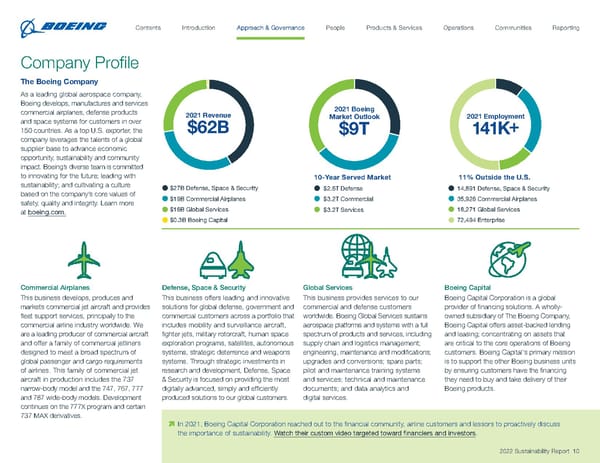
Company Profile The Boeing Company As a leading global aerospace company, Boeing develops, manufactures and services commercial airplanes, defense products and space systems for customers in over 150 countries. As a top U.S. exporter, the company leverages the talents of a global supplier base to advance economic opportunity, sustainability and community impact. Boeing’s diverse team is committed to innovating for the future; leading with sustainability; and cultivating a culture based on the company’s core values of safety, quality and integrity. Learn more at boeing.com . Commercial Airplanes This business develops, produces and markets commercial jet aircraft and provides fleet support services, principally to the commercial airline industry worldwide. We are a leading producer of commercial aircraft and offer a family of commercial jetliners designed to meet a broad spectrum of global passenger and cargo requirements of airlines. This family of commercial jet aircraft in production includes the 737 narrow-body model and the 747, 767, 777 and 787 wide-body models. Development continues on the 777X program and certain 737 MAX derivatives. Defense, Space & Security This business offers leading and innovative solutions for global defense, government and commercial customers across a portfolio that includes mobility and surveillance aircraft, fighter jets, military rotorcraft, human space exploration programs, satellites, autonomous systems, strategic deterrence and weapons systems. Through strategic investments in research and development, Defense, Space & Security is focused on providing the most digitally advanced, simply and efficiently produced solutions to our global customers. Global Services This business provides services to our commercial and defense customers worldwide. Boeing Global Services sustains aerospace platforms and systems with a full spectrum of products and services, including supply chain and logistics management; engineering, maintenance and modifications; upgrades and conversions; spare parts; pilot and maintenance training systems and services; technical and maintenance documents; and data analytics and digital services. Boeing Capital Boeing Capital Corporation is a global provider of financing solutions. A wholly- owned subsidiary of The Boeing Company, Boeing Capital offers asset-backed lending and leasing; concentrating on assets that are critical to the core operations of Boeing customers. Boeing Capital's primary mission is to support the other Boeing business units by ensuring customers have the financing they need to buy and take delivery of their Boeing products. In 2021, Boeing Capital Corporation reached out to the financial community, airline customers and lessors to proactively discuss the importance of sustainability. Watch their custom video targeted toward financiers and investors . $19B Commercial Airplanes $27B Defense, Space & Security $0.3B Boeing Capital $16B Global Services $62B 2021 Revenue $2.6T Defense $3.2T Commercial $3.2T Services 2021 Boeing Market Outlook $9T 72,494 Enterprise 35,926 Commercial Airplanes 18,271 Global Services 14,891 Defense, Space & Security 141K + 2021 Employment 10-Year Served Market 11% Outside the U.S. 2022 Sustainability Report 10 Contents People Introduction Communities Operations Reporting Approach & Governance Products & Services
Our Sustainability Journey Boeing is committed to protecting, connecting and exploring our world and beyond, safely and sustainably. Our commitment to sustainability is rooted in our company values and our stakeholders’ expectations. It encompasses our focus on environmental stewardship, social progress and inclusion as well as values-based, transparent governance. Since the publication of our inaugural Sustainability Report in 2021, we have been engaging with our stakeholders, advancing our efforts in support of our sustainability goals, and continuing to learn and to mature our approaches. Stakeholder-Driven Transparency Boeing is committed to transparency. Through our annual disclosure and reporting cycle, we compile and share a broad set of data, information and operating examples that are relevant to our stakeholders, including our employees, customers, industry partners, investors, regulatory authorities, communities and others. Using the most widely applicable disclosure frameworks, Boeing reports each year on our financial performance and company priorities; our employee demographics and progress toward achieving equity, diversity and inclusion commitments; our environmental, social and governance performance; our community investments and advocacy; and our industry-leading aerospace market outlooks. Throughout 2021, we brought together a comprehensive stakeholder engagement strategy that focused on engaging with key stakeholders through proactive ongoing dialogue, surveys, industry forums and events, and monitoring external data. We look forward to continuing to evolve and refine our stakeholder engagement strategy throughout 2022 and beyond. Embedding Sustainability at Boeing We continue to embed sustainability across our business, building on this important work and evolving our approaches. We have organized our sustainability efforts around four key pillars: People, Products & Services, Operations and Communities. Our sustainability priorities and enterprise initiatives are managed through these pillars, with key goals and metrics monitored by company leaders including our Global Sustainability Council. (See full list of key metrics in the Reporting section, Page 68 .) Our efforts reflect the shared value we create with our key stakeholders. You will see our sustainability priorities, listed below, emphasized in this report. The collaborative nature of our mutual relationships informs these priorities and our sustainability goals, driving long-term value for our stakeholders. • Ethical and Compliant Business • Employee Safety and Well-Being • Global Equity, Diversity and Inclusion • Professional Development, Education and Learning • Aerospace Safety • Climate Action • Environmentally Responsible Operations • Economic Performance • Responsible Supply Chain • Data Privacy and Information Security • Community Engagement Reporting Approach and Alignment To address the diverse interests of our stakeholders, we have brought together a detailed overview of our environmental, social and governance (ESG) activities and data in this report. We are providing indexes with alignment to the Global Reporting Initiative (GRI), Sustainability Accounting Standards Board (SASB), Task Force on Climate-related Financial Disclosures (TCFD) and the United Nations Sustainable Development Goals (U.N. SDGs) in the Reporting section. We support the objectives of the Paris Agreement and consider climate change to be an urgent issue. We demonstrate the importance of climate considerations to the company by aligning our governance, strategy, risk management, metrics and targets to the TCFD core elements. To supplement this report, we publish additional information at boeing.com/sustainability . Boeing Ties Sustainability to Compensation Boeing enhanced its incentive plans as part of its full package of benefits for employees and managers in 2022 to include two new operational performance measures – one for climate and one for equity, diversity and inclusion – building on the 2021 measures of product safety, employee safety and quality. Together, these measures account for 25% of the total incentive with financial performance making up the other 75%. To meet the climate metric, employees are challenged to reduce energy at major sites by 5%, compared with a 2019 baseline, which ties to the company’s carbon emissions reduction goal. Employees are urged to advance diversity by having all manager-and-above requisitions adhere to 90% qualified, diverse candidates at the interview stage and by adding an absolute reduction in the percentage of direct placements over 2021. In 2021, employees and managers were motivated by completing model-based engineering solution kits; completing specified design practices; reducing injuries and near-miss and hazard reporting; and improving rework percentages to support a focus on product safety, employee safety and quality. These efforts will continue in 2022. The 2022 annual incentive plan design is largely based on the 2021 core design, measuring both financial performance at the company and business unit levels and operational performance across the enterprise. 2022 Sustainability Report 11 Contents People Introduction Communities Operations Reporting Approach & Governance Products & Services
Sustainability Goals Goal Statement 2030 Target Accomplishments Employee Safety & Well-Being We value human life and well-being above all else and take action accordingly; we strive to prevent all workplace injuries • Top quartile Recordable Injury Rate (among sector benchmarked performance) • ≥90% believe their manager supports their well-being • 13% Reduction in 2021 OSHA recordable cases compared with 2020 • Deployed EHS Strategic Framework to achieve step function change in program performance • 90% of employees surveyed responded positively when asked if they believe their manager supports their well-being • Launched virtual tutoring and virtual therapy appointments; doubled back up care benefit in 2021 Global Aerospace Safety Drive aerospace safety to prevent accidents, injury or loss of life with our Boeing culture and actions rooted in safety • Drive aerospace safety via global aerospace safety initiatives to maintain downward trend of worldwide commercial jet fleet 10 Year Moving Average Fatal Accident Rate • Steady progress implementing our enterprise SMS & strengthening our safety culture; a continuous improvement journey • Established the independent Chief Aerospace Safety Office to align critical safety functions under one organization • Incorporated product safety, employee safety and quality metrics into our primary annual incentive structures • Implementing competency based training through programs, product deployments and regulatory course approvals Equity, Diversity & Inclusion Address representation gaps and strengthen equity, diversity and inclusion so that all team members feel supported and inspired to reach their full potential • Increase representation of women globally and underrepresented racial/ ethnic minorities in the U.S. • Increased women and racial/ethnic minority representation at Boeing overall in 2021 as compared with the prior year • Launched Seek, Speak, Listen (SS&L) habits to strengthen culture of inclusion and achieve better business outcomes • 96.6% of teammates completed SS&L training; 85% of teammates surveyed reported using the habits daily • Increased transparency in GEDI Report by sharing data on women of color, disability, gender identity and sexual orientation for the first time Sustainable Operations Maintain net-zero future for Boeing operations (Scope 1 and 2) through conservation and renewable energy Partner with supply chain for responsible business practices • Achieve 55% absolute reduction in Scope 1 and 2 GHG from 2017 baseline 1 • Maintain net-zero emissions for Scope 1 and 2 • Achieve 100% renewable electricity • Work with our suppliers to increase GHG reporting and proactively address climate change driven risks • Achieved 15% absolute GHG reduction at year end 2021 from 2017 baseline toward 2030 goal (Scope 1 and 2) 1 • Maintained net-zero emissions for Scope 1 and 2 for second year in a row • Achieved 28% renewable electricity in 2021 • Implemented supplier code of conduct aligned to ESG elements including climate change and environment priorities • Launched supplier engagement via CDP Climate Change submissions to report emissions, assess reduction targets/progress and identify collaboration opportunities Innovation & Clean Tech Enable the transition to carbon neutral aerospace through investments and partnerships for fleet efficiency improvements, sustainable aviation fuel and future platform technologies • Support the commercial aviation industry’s ambition to achieve net-zero carbon emissions for global civil aviation operations by 2050 • Current and future commercial airplanes will be 100% SAF capable • Build and certify our first zero-emission, electric, autonomous aircraft • Launched five-year ecoDemonstrator program partnership with NASA to collect and analyze data on SAF emissions • Partnered with SkyNRG to scale up the availability and use of SAF • Purchased 2M gallons of SAF, in 2021, for use in 2022 commercial operations • Announced $450M investment in the Wisk JV and increased Boeing-Wisk engineering collaboration effort with 100+ engineers working on avionics, autonomy, certification, electrification and model-based systems engineering Community Engagement Build better, more equitable communities through corporate investments, employee engagement programs and advocacy efforts • Expand opportunities for more than 12.5 million youth, veterans, veteran’s families and underserved individuals across communities around the world • Reached 2.7M young women and girls in STEM through community programs, grants and sponsorships • Invested $13M across 108 grants supporting skills development and training for veterans • Supported 107K students in 158 schools via grant to Medical University of South Carolina school-based wellness initiative • Funded Northwestern University FUSE STEAM Chicagoland program serving 6,000 under-represented students 1. The 2030 GHG reduction target is set with an operational boundary of The Boeing Company, and includes all Scope 1 and Scope 2 emissions. 2022 Sustainability Report 12 Contents People Introduction Communities Operations Reporting Approach & Governance Products & Services
Report on Net Zero Indicator At our 2022 Annual Meeting of Shareholders, our Board recommended a vote in favor of — and our shareholders approved — a shareholder proposal requesting a report on the Net Zero Indicator, which is defined as the Climate Action 100+ Benchmark’s Indicator 1. The requested report, evaluating and disclosing if and how we meet the criteria of the Net Zero Indicator, including Scope 3 Use of Sold Products emissions, is set forth below. Climate Action 100+ Net Zero Benchmark Indicator 1: Our Approach What’s Included Scope 1 and 2 Scope 3 Scope 3 Direct Company Activities Downstream Activities Upstream Activities Manufacturing and Other Facilities Commercial Defense and Space Supply Chain Climate Action 100+ Net Zero Company Benchmark: Indicator 1 Indicator 1: Partially meets Metric 1.1.a: The company has made a qualitative net-zero GHG emissions ambition statement that explicitly includes at least 95% of Scope 1 and 2 emissions. Metric 1.1.b: • The company’s net-zero GHG emissions ambition covers the most relevant Scope 3 GHG emissions categories for the company’s sector. • Boeing is classified as Other Transport, for which the Category 11 — Use of Sold Products is the only relevant Scope 3 category 1 . Climate Action 100+ does not list purchased goods and services, capital goods, or upstream transportation and distribution as relevant Scope 3 categories for the company’s sector. Company Assessment Meets: Boeing’s ambitions and actions for Scopes 1 and 2 meet the Climate Action 100+ Net Zero Company Benchmark Disclosure Indicator 1. Partially meets: Our active engagement and support for the commercial aviation industry’s net-zero ambition largely — but not fully — aligns with the Climate Action 100+ Net Zero Benchmark Disclosure Indicator 1 objective for addressing Scope 3 emissions by working with and supporting aviation’s decarbonization, without establishing company-specific Scope 3 GHG reduction targets at this time. Not applicable: See above Company Ambitions and Actions We have set several 2030 goals to support GHG action on operational emissions: • Reduce Scope 1 and 2 GHG emissions by 55% from 2017 levels • Maintain net-zero emissions for Scope 1 and 2 • Achieve 100% renewable electricity Our strategy to reduce Scope 1 and 2 emissions is founded on science and aligns to a reduction pathway for a 1.5°C scenario, in support of global goals. We address Scope 3, Category 11 (Use of Sold Products) emissions collaboratively as an industry; this approach makes sense for our sector. In support of a net-zero transition, the first step is to ensure we have a path that is credible and aligned with the industry in support of the global GHG emissions reduction goals. • Boeing supports the commercial aviation industry’s ambition to achieve net-zero carbon emissions for global civil aviation operations by 2050, which focuses on Use of Sold Products. • Boeing has established a goal that current and future commercial aircraft will be 100% SAF capable by 2030. • Boeing is actively working with our government customers to understand and support their future requirements. Boeing works with our suppliers to increase GHG reporting and proactively address climate change-driven risks. 1. Climate Action 100+ Net Zero Company Benchmark (v1.1) sector classification & Scope 3 emissions application. 2022 Sustainability Report 13 Contents People Introduction Communities Operations Reporting Approach & Governance Products & Services
Report on Net Zero Indicator (continued) The aerospace industry as a whole and Boeing face significant climate change-driven risks and opportunities as well as the need to decarbonize for sustained long-term growth. We believe that safe and sustainable aviation is an imperative for our commercial and defense customers, communities and employees. This is a primary strategic focus for Boeing; our efforts are outlined below. Boeing strives to reduce operational greenhouse gas (GHG) emissions, both during times of growth and during times of challenge. Boeing achieved net-zero carbon emissions at manufacturing sites and other facilities (Scope 1 and 2) and in its business travel (Scope 3, Category 6) in 2020 and 2021 by expanding conservation and renewable energy use, while securing responsible offsets for the remaining GHG emissions. The company’s ambition includes our goals to reduce operational GHG emissions, maintain net-zero emissions for Scope 1 and 2, and increase our adoption of renewable energy sources. Read more about how we reduce operational GHG on Page 51 . Achieving aviation industry climate objectives to decarbonize requires a portfolio of solutions and partnerships. Boeing is working to advance the development of key technologies to further these objectives. On the products side, Boeing committed that its commercial airplanes will be capable to fly on 100% SAF by 2030. Long term, we support the commercial aviation industry’s ambition to achieve net-zero carbon emissions for global civil aviation operations by 2050. We are partnering across the industry with the goal to reimagine and ultimately decarbonize commercial aviation in the second half of this century. Learn more about our plans to decarbonize commercial aviation on Page 41 . Boeing is actively developing low-carbon transition plans to meet long-term goals with meaningful milestones. In October 2021, we announced our support for the commercial aviation industry’s ambition to achieve net-zero carbon emissions for global civil aviation operations by 2050. By supporting this industry goal, we are addressing emissions from the use of Boeing’s sold commercial aircraft (Scope 3 Category 11) which is estimated to comprise greater than 90% of Boeing’s total GHG emissions, and therefore defined as the only relevant category of Scope 3 emissions for Boeing under the Climate Action 100+ Net Zero Benchmark. 1 Our active support for the commercial aviation industry’s net-zero ambition largely — but not fully — aligns with the Climate Action 100+ Net Zero Indicator objective for addressing Scope 3 emissions. In 2021, Boeing disclosed our Scope 3 Use of Sold Product emissions for commercial aircraft, an important step toward understanding our contributions and potential reduction pathways. Due to the unique aspects of our sector including global scope, long product life-span, and financial and technological decarbonization challenges, Scope 3, Category 11 emissions are best addressed as a collaborative effort across the industry. In support of a net-zero transition, the first step is to ensure we have a path that is credible and aligned with the commercial aviation industry in support of its global reduction goals. Boeing’s existing Scope 3 ambitions to support our commercial industry’s net-zero goals do not address (i) our defense portfolio, where we are actively working with our government customers to understand and support their future requirements, or (ii) our supply chain, where we are working with our suppliers to increase GHG reporting and proactively address climate change-driven risks to create resilience and stability within our supply base. Read more about our work to decarbonize commercial aviation on Page 41 . Boeing protects, connects and explores our world and beyond, safely and sustainably. We believe that safe and sustainable aerospace is an imperative for all of our stakeholders. Achieving desired decarbonization will require continued partnerships with airlines, industry, governments and research institutions over decades. Learn more about our goals and partnerships to decarbonize aerospace on Page 8 . 1. This relevance is based on the sector classification and Scope 3 emissions application of the Climate Action 100+ Net Zero Company Benchmark v1.1 (March 2022) . 2022 Sustainability Report 14 Contents People Introduction Communities Operations Reporting Approach & Governance Products & Services
Governance and Risk Management Corporate Governance The Board of Directors has extensive oversight of strategy development, company culture, the company’s safety programs and initiatives, political and charitable contributions, corporate sustainability and key strategic, operational and compliance risks. Our Board has adopted a set of Corporate Governance Principles to assist the Board in the exercise of its responsibilities. Along with Boeing’s Certificate of Incorporation and By-Laws and charters of the committees of the Board, it provides an effective framework for Boeing’s governance. The Governance & Public Policy (GPP) Committee reviews our governance practices and policies on an ongoing basis and, where appropriate, proposes modifications to the Board. Our corporate governance materials are available at www.boeing.com/company/general-info/ corporate-governance.page . Sustainability Governance Sustainability is rooted in Boeing’s values. The Board oversees a variety of sustainability topics and in 2021, the GPP Committee charter was amended to expressly include oversight of our practices — relating to corporate sustainability, including matters related to environmental stewardship and climate change, and to diversity, equity and inclusion. Chris Raymond is Boeing’s Chief Sustainability Officer (CSO), a Boeing Executive Council position reporting to Boeing’s Chief Executive Officer. As CSO, Raymond reports the progress of Boeing’s sustainability objectives and stakeholder- oriented reports regularly to the GPP Committee and the full Board. Raymond is responsible for advancing Boeing’s approach to sustainability, focusing on priorities, stakeholder-oriented reporting and company performance. He leads the Global Enterprise Sustainability organization, designed to sharpen our focus on key environmental, social and governance efforts through dedicated leadership alignment in these areas. Raymond’s team includes a Chief Engineer who advances sustainability technologies as well as future mobility applications and a Global Sustainability Policy and Partnerships leader who strengthens our company focus on sustainability outside the United States. Reinforcing our commitment and enterprise approach, a Global Sustainability Council composed of global leaders from across our business units and functions was established to provide executive leadership, advocacy and partnership with the sustainability organization to advance our objectives and strategy. This council works to partner and advance sustainability objectives and strategy throughout the enterprise. The council also oversees subcouncils with focuses on policy, customers, sustainability and enterprise services, sustainable aviation fuels, finance and governance, and technology and future mobility. Oversight of Political Activity Together, the Board, the GPP Committee and senior leadership, are committed to ensuring that our political activities align with the company’s values, business strategies, long-term shareholder interests and long- term strategic imperatives. At Boeing, oversight of political activities starts at the top. The Board works closely with the Executive Vice President (EVP) of Government Operations on the oversight of our engagement in the political process. This includes regular discussions about the company’s public policy priorities; the company’s memberships in and payments to trade associations and other tax-exempt organizations; Boeing Political Action Committee (BPAC) strategy and expenditures; and the company’s network of compliance procedures related to these activities. The GPP Committee leads the oversight activities on these issues and makes appropriate recommendations to the full Board about Boeing’s engagement in the political process. The EVP of Government Operations also works closely with the Law and Global Compliance organization to ensure that the company’s political activities adhere to all legal requirements and company policies and procedures as well as meet the highest ethical standards and Boeing’s values. Each year, the Company’s Compliance Risk Management and Enterprise Risk Management boards provide the Board with an update and overview of the effectiveness of the policies and procedures in place to ensure that the company’s political activities meet these high standards. You can review the company’s oversight and internal compliance procedures for political activities here . Oversight of Sustainability Board of Directors Governance & Public Policy Committee Oversees Boeing’s sustainability policies and practices, including matters related to environmental stewardship and climate change Subcouncils Chief Sustainability Of cer Executive Council Member Leads Global Enterprise Sustainability Responsible for enterprise-wide sustainability strategy, focusing on priorities, stakeholder- oriented reporting and company performance Global Sustainability Council & Extended Council Global leaders from across business units and functions provide leadership, partnership and action to advance objectives and strategy for sustainability Technology & Future Mobility Finance & Governance Policy Sustainability & Enterprise Services Customers Sustainable Aviation Fuel 2022 Sustainability Report 15 Contents People Introduction Communities Operations Reporting Approach & Governance Products & Services
The Board’s Oversight of Risk Boeing takes measured risks as an innovation leader. The Board and senior management avoid imprudent risks and mitigate strategic, operational and compliance risks to emphasize safety, quality, integrity and sustainability. Senior management supervises day-to-day risk management, including creating relevant policies and procedures. The Board oversees and assesses the execution of and approach to risk management. The Board evaluates significant risks during corporate strategy reviews and develops long-range business plans, including significant new development programs. The Board and its standing committees regularly review strategic, operational, financial, compensation and compliance risks with senior management. For further details on our risk management practices, see our Proxy Statement . Product Safety The Aerospace Safety Committee (ASC), established in 2019, is responsible for directly overseeing engineering, design, development, manufacturing, production, operations, maintenance and delivery of aerospace products and services in order to ensure the safety of our commercial, defense, space and other aerospace products and services. The ASC also consults with the Compensation Committee, linking safety review and individual executive performance. Diversity and Inclusion The Board oversees diversity and inclusion efforts, including supervision of outreach efforts as well as reviews of workplace diversity metrics and complaints received — and corrective actions taken — related to behavior inconsistent with Boeing’s values. The Board is committed to its membership’s diversity, with 42% of directors, including the Audit, Compensation and GPP committee chairs, who represent gender, racial or ethnic diversity (as of report publication). Climate Change The Board participates in strategy development for our products, services and operations, including the integral environmental sustainability strategy that considers current and future impact of products and services. The Board oversees climate-related risks, goals and opportunities, including reducing greenhouse gas emissions in operations and maintaining net-zero at manufacturing and other facilities. Boeing has robust processes to control risks and provide management and Board oversight. See graphic on this page. For further details on our identified risks, see our Annual Report . Business Continuity Management Boeing navigated challenges in 2021 that added to the company’s risk profile, including: • COVID-19 related economic and workplace disruptions. • Social and political issues. • Organizational and structural challenges. • Regulatory review of the 737 MAX. Through Business Continuity Management (BCM) we identify vulnerabilities and develop recovery strategies to minimize the impact of potential threats or disruptions. Our BCM is built on five preparedness programs: Business, Emergency, Information Technology, Supply Chain and Human Resources. All come together to aid recovery from emergencies or disasters. Tax Governance and Compliance We are committed to being a responsible taxpayer wherever we operate. Our global tax team is responsible for maintaining the highest compliance standards, being transparent in our dealings with authorities and sustaining robust internal controls for risk management. Boeing’s principled tax approach is grounded in ethical business practices and tax guidance that follows business substance. Please visit our website for information about Boeing’s approach to global tax governance and compliance . Enterprise Risk Management Compliance Risk Management Audit Committee The Audit Committee receives annual reports on Boeing’s Enterprise Risk Management (ERM) and Compliance Risk Management (CRM) processes and regular reporting on the company’s compliance and ethics programs from the Company’s Controller and Chief Compliance Of cer. Enterprise Risk Management and Compliance Risk Management Annual Employee Training All employees, from senior leaders to new workers, receive annual training on compliance risk areas tailored to their speci c work, including U.S. Department of Defense procurement rules, proper handling of sensitive information and anti-corruption. The full Board of Directors reviews enterprise risks on a regular basis as well as conducts regular reviews of our ethics and business conduct programs. ERM assesses strategic risks to the company and industry, including topics within the environmental, social and governance elements of sustainability, such as climate and policy change. The CRM, jointly co-chaired by Boeing’s Chief Compliance Of cer and Controller, includes senior company leaders who identify, evaluate and prioritize the most signi cant compliance risks; assess mitigation strategies; and provide visibility to Boeing’s CEO and Audit Committee of the board. The CRM also regularly pressure-tests the risk mitigation measures to ensure the strongest compliance program possible. 2022 Sustainability Report 16 Contents People Introduction Communities Operations Reporting Approach & Governance Products & Services
Ethical and Compliant Business Boeing’s Board Champions Company Values, Ethics Boeing’s Board recognizes that the company’s long-term interests are advanced when members are responsive to the concerns of customers, employees, public officials, shareholders, suppliers and the communities we serve. The Board actively fosters a corporate culture that puts safety, quality, integrity and sustainability at the forefront of all that we do. Board members commit to, and use, a Code of Ethics as guiding principles; the code emphasizes the importance of compliance with all applicable laws, rules and regulations; maintaining confidentiality; avoiding any conflicts of interest; and reporting of illegal or unethical behavior. The Audit Committee and the full Board oversee our compliance and ethics programs through close collaboration with Boeing’s Chief Compliance Officer (CCO) and periodic reviews of program metrics. These touchpoints provide visibility to the Board of significant compliance and ethics risks, as well as, specific cases that are identified through the company’s various reporting channels. Code of Conduct: Emphasizing the Importance of How We Do Our Work At Boeing, our first commitment is to the people and customers who rely on our products and services to protect, connect, and explore our world and beyond. Each of us has a personal responsibility to honor that promise and to serve as stewards of our company’s legacy of aerospace excellence and innovation. New employees sign the Code of Conduct and complete Recommitment training when they join the company — and we all reaffirm this commitment every year. Compliance is everyone’s responsibility at Boeing. Employees must hold themselves — and each other — accountable to following all rules and regulations and to doing what is right. In 2022, our Recommitment training featured real stories told by Boeing employees and company leaders that reinforced our commitment to put safety and quality above all else; to hold ourselves accountable to follow all policies and procedures; to be transparent with all stakeholders, including government regulators and customers; and to treat co-workers, customers, regulators and stakeholders with respect. It also reminded everyone of their obligation to speak up and be a voice for others when something does not align with our values. Robust Anti-Corruption Program Integrity is a core company value and Boeing strictly forbids bribery and corruption of any kind. Boeing’s robust anti-corruption program includes extensive controls, rigorous policies and procedures, and an annual risk assessment to ensure effectiveness and identify potential enhancement opportunities. Boeing publishes an internal policy that explains its anti-corruption and anti-bribery requirements and expectations for employees, while making its guidelines for ethical business conduct publicly available to employees and other stakeholders. The company also makes employees aware of their federally protected whistleblower rights, which are designed to protect employees against retaliation for reporting potential wrongdoing by a U.S. contractor or subcontractor. Commitments and Actions on Human Rights Boeing is committed to responsible business practices and promoting positive change while simultaneously creating value for our customers, shareholders and other stakeholders. In recognition of this commitment, the company has developed policies and practices designed to enforce our Code of Basic Working Conditions and Human Rights. We expect similar commitments and behaviors from our suppliers, incorporate these expectations into our supplier contracts, and verify that they are being met through in-person engagements and third-party monitors. There is nothing we can’t accomplish when we work together and lead with our values. At the end of the day, how we do our work is just as important as the work we do. It’s up to all of us to hold ourselves accountable to the highest standards.” Uma Amuluru, Chief Compliance Officer and Vice President, Global Compliance 2022 Sustainability Report 17 Contents People Introduction Communities Operations Reporting Approach & Governance Products & Services
Efficient and Trusted Reporting Mechanisms Boeing provides several confidential and anonymous reporting options for employees to report concerns, seek guidance or share ideas. Reporting channels include managers; the U.S. Domestic and International Ethics hotlines; Compliance and Ethics Officers embedded in the business; and the Speak Up website that houses online portals for employees to report issues. Retaliation against reporting parties is strictly prohibited: action is taken against violators of our anti-retaliation policies. We are enhancing our ability to analyze available reporting data to identify areas of concern and understand the root cause of the problem, allowing us to promptly escalate issues to appropriate leaders and work with business partners to mitigate and address risks. The chart below demonstrates Boeing’s robust reporting culture and Boeing’s efforts to respond. Additionally, our anonymous reporting rate of 13% is lower than other published benchmarks, which suggests employees generally trust management to address their concerns and do not fear retaliation. Employees are encouraged to raise concerns through The Boeing Ethics Line (1-888-970-7171) or through the Integrity Counts website . Understanding Ethical Concerns 2021 Data 1 2,167 inquiries 2 1,7 3 0 conflict of interest determinations 3,503 investigative requests 7,400 total contacts with Ethics submitted for employees in 2021 2,896 of investigative requests had enough information to investigate 3 of investigated requests were substantiated 3,4 5 1% 1. Data reflects the reporting period of November 2020 through October 2021. 2. Inquiries comprise Requests for Guidance and Information Requests. Requests for Guidance are situations where employees are seeking guidance when facing ethical dilemmas or when they need assistance in understanding company policies or expected behaviors. Information Requests are situations where employees are seeking general information. Both demonstrate awareness of Boeing’s Compliance and Ethics program, but Requests for Guidance are viewed as the most positive types of contact. 3. Investigated matters are considered unsubstantiated when the investigation findings do not support a violation of policy or expected behaviors or where there is not sufficient evidence of misconduct. 4. Ongoing evaluations demonstrate that Boeing’s substantiation rate is slightly higher than other published benchmarks, indicating an effective investigation process and informed reporting by company employees. 2022 Sustainability Report 18 Contents People Introduction Communities Operations Reporting Approach & Governance Products & Services
Focus on Continuous Improvement The past few years have challenged our company like never before, reinforcing our unwavering focus on safety, quality, integrity and transparency. We recognize the need to drive continuous improvement in all that we do and in the past year have taken the following action: • Advanced our enterprise wide Safety Management System (SMS), which facilitates timely collection and analysis of data in order to embed safety in every aspect of how we design, build and support our products and our services. • Strengthened our Global Compliance organization and compliance program by aligning teams, revamping trainings and processes, and launching new employee- focused efforts to enable compliant company performance across all of our locations around the globe. • Demonstrated a commitment to promoting a just culture grounded in humility, inclusion and transparency that protects and treats people fairly when they report safety, quality and compliance concerns. • Built Seek, Speak & Listen habits to foster open and transparent dialogue in all employee interactions. • Fostered a diverse, inclusive and open workplace environment that encourages teammates to voice concerns, raise issues and share ideas. • Published the Boeing Supplier Code of Conduct, which provides a clear set of expectations for suppliers doing business with Boeing, that is consistent with our policies, principles and sustainability efforts. We expect suppliers to adhere to the Boeing Supplier Code of Conduct throughout the time they do business with us and notify Boeing of any instances where expectations are not met. These steps have been vital in driving near-term progress and ensuring the long-term health of our company. We will continue to refine and improve our program to meet the needs of a dynamic business and compliance environment. Simple Habits Drive Culture Change Over the past year, individuals, teams and leaders around the world have helped build an inclusive culture of trust, care and connection, by focusing on three simple habits — Seek, Speak & Listen (SS&L) that guide how we work together. These habits help us learn from others’ diverse perspectives, speak up about issues or ideas and listen with openness and curiosity. Embedding these habits in everything we do helps us to continuously improve, build stronger teams and live our values. SS&L is fundamental to who we are as a company and how we work together — 85% of team members surveyed said they use the habits in their day-to-day interactions. With this open and inclusive culture, improved business outcomes follow — in safety, quality, production, performance and inclusion. By embracing these habits, we make better decisions, drive innovation and build connection. We seek out the places where things aren’t going well, where anxiety may be brewing, so we can learn and address issues before they become problems; where we get all perspectives on the table and every team member feels safe to speak up; and where we listen to each other with humility. We will continue to embed the habits into our daily work, processes, systems and communications to hold ourselves accountable and keep moving forward. Our Habits Seek Because awareness can teach us and help us improve Speak Because it’s the right thing to do and every voice matters Listen Because listening builds trust and leads to better decisions Seeking, speaking and listening are driving an open and inclusive culture with improved business outcomes — in safety, quality, production, performance and inclusion. 2022 Sustainability Report 19 Contents People Introduction Communities Operations Reporting Approach & Governance Products & Services
Developing Future Leaders and Embodying Integrity In 2021, Boeing launched a new Ethics Ambassador Program designed to ensure our future leaders embody integrity, and to further connect the compliance program to the business. Piloted at Boeing Philadelphia in April 2021, the Ethics Ambassador Program is a leadership development program developed for Boeing employees embedded within the business to amplify our values and extend the reach of the company’s Global Compliance efforts at local sites. Ethics Ambassadors serve as local advocates to encourage employees to speak up, while bringing forward localized trends to help monitor and reduce compliance risks and ensure employees adhere to the company’s Code of Conduct. Boeing Philadelphia Ethics Ambassadors Christine Vasko, Tasha Silas and Ieisha Hinson each provide a friendly face for more than 4,000 local employees who have questions or concerns about compliance or ethics. “Employees can come to us directly, but I always have my eyes and ears open for pockets of anxiety that we need to look at before they potentially escalate into something problematic,” said Vasko, who is an Engineering Manager. “Generally, we recommend that our teammates talk to their manager or to our site’s compliance and ethics officer. But before doing that, we will talk things through with someone by giving them our undivided attention and asking curious, nonjudgmental questions.” To date, the Ambassadors have engaged more than 2,500 teammates, sharing information about compliance and ethics via floor walks, staff meetings, diversity council and business resource group briefings, and new-employee orientation sessions. The program was recently launched at sites in Mesa, New Orleans and North Charleston with plans to expand to additional sites in the future. Tasha Silas, Philadelphia Ethics Ambassador and Manufacturing Operations Analyst Ieisha Hinson, Philadelphia Ethics Ambassador and Materials & Process Engineer Christine Vasko, Philadelphia Ethics Ambassador and Mechanical Engineer 2022 Sustainability Report 20 Contents People Introduction Communities Operations Reporting Approach & Governance Products & Services
People Section Key Topics Employee Safety Employee Well-Being Global Equity, Diversity and Inclusion Professional Development, Education and Learning F-15 Advance Technologies and Concepts Systems Engineer Indica Bennett using mixed reality smart glasses. (Boeing photo) 2022 Sustainability Report 21 Contents People Introduction Communities Operations Approach & Governance Products & Services Reporting
People Healthy and Empowered Our story starts with our people. We commit to advancing a collaborative, inclusive and globally diverse culture that creates unique careers in aerospace. Goal: Employee Safety and Well-Being Value human life and well-being above all else and take action accordingly; we strive to prevent all workplace injuries Goal: Equity, Diversity and Inclusion Address representation gaps and strengthen equity, diversity and inclusion so that all team members feel supported and inspired to reach their full potential 2021 Highlights Enhanced workplace safety via 27% reduction of serious injuries from 2020 to 2021 1 Expanded U.S. employee benefits to include domestic partnerships 90% of employees surveyed say their manager supports their overall well-being 3.6M total hours of employee training 1. 5% Increase in racial/ethnic minority representation within our U.S. workforce from 2020 to 2021 Boeing ranked #7 Best for Vets Employer by Military Times out of 144 companies DiversityInc #16 ranked Boeing on the 2022 To p 50 Companies for Diversity Disability:IN recognized Boeing as one of Best Places to Work for Disability Inclusion for sixth year in a row Published aspirations for advancing equity, diversity and inclusion in our first Global Equity, Diversity & Inclusion (GEDI) report 1. U.S., Canada and Australia employees only. 2022 Sustainability Report 22 Contents People Introduction Communities Operations Reporting Approach & Governance Products & Services
Employee Safety Boeing knows that operating to keep ourselves and our teammates safe in the workplace is everyone’s responsibility. Safety is central to everything we do for ourselves, those we care about and our communities. Leveraging Technology to Improve Workplace Safety For over a century, Boeing has empowered employees to incorporate the latest technology into production processes. This increases workplace safety, quality and efficiency simultaneously. Through automation and robotics, Boeing has greatly enhanced workplace safety and reduced employee exposure to some high hazards. Serious injuries significantly decreased by 27% from 83 in 2020 to 61 in 2021. 1 Currently, the majority of workplace injuries are ergonomic. This is another key area where Boeing is improving designs and using technology to safeguard against injuries. “We’ve worked to make advancements to the equipment we use daily by developing ergonomically designed tools and other equipment,” said Erik Pham, Boeing Environment, Health & Safety Senior Director. “We also use exoskeleton technology to help protect our employees in a variety of ways, such as repetitive motion stress injuries and overhead work. Over 200 units have been deployed and are being used throughout Commercial Airplanes programs. Qualitative benefits were immediately realized as data is being collected to evaluate quantitative benefits. These wearable technologies target repetitive motion that could cause ergonomic issues and, by alleviating some of that burden off the user, minimizes some risks and injuries.” Pham said the company goes beyond regulatory compliance and leverages technology to mitigate or prevent workplace safety risks and injuries. Boeing is working toward incorporating sensor technology and augmented reality into the workplace. Technology is instrumental in preventing fatalities and in reducing serious and ergonomic injuries. It’s tangible evidence of Boeing’s prioritized values of safety, quality, integrity and sustainability. 1. Represents U.S., Canada and Australia employees only. Working on a 767 in Everett, Washington, mechanic Jason Turner is much more comfortable thanks to a shoulder support exoskeleton. (Boeing photo) By enhancing Boeing’s safety culture through risk reduction, creating a safe work environment and ensuring productive processes and interactions, all employees can leave work as safely as they arrived.” Erik Pham, Boeing Environment, Health & Safety Senior Director 39:1 Near Miss to Hazard (includes COVID-19 cases) 98% Found/Fixed Metric 0.53 Lost Workday (includes COVID-19 cases) 1,026 Health and Safety Training Courses Available 2022 Sustainability Report 23 Contents People Introduction Communities Operations Reporting Approach & Governance Products & Services
Employee Well-Being Boeing takes a holistic approach to employee safety and overall well-being, including physical, financial and mental health components at work and at home. We value human life and well-being above all else and take action to improve many aspects of an employee’s life. Innovative Care Options Support Employees Through the Pandemic As the COVID-19 pandemic continued through the entirety of 2021, Boeing employees and their families, as with communities across the globe, faced numerous challenges to their physical and emotional well-being. To address these challenges, Boeing introduced innovative programs in the U.S. to provide employees with the care they needed, when and where they needed it. Building on an existing platform of physical and emotional coaching services, Boeing added access to virtual primary care, behavioral health and musculoskeletal support for those employees who prefer to take advantage of care from the safety and convenience of their homes — at no cost in 2021. With increased demand for behavioral health services, confidential video-based visits with a coach or therapist for anxiety, depression, grief, self-confidence and medication management proved to be particularly valuable during the pandemic. In addition, to help busy parents and other caregivers, Boeing doubled the number of back-up child and adult/elder care days subsidized by the company to 20 days per eligible employee per year. Back-up care may be used when a regular caregiver is unavailable — all too common during the pandemic — and the employee needs to work. Boeing opened several company locations as public COVID-19 vaccination sites, including this one at Auburn, Washington. (Boeing photo) Boeing Expands Benefits to Include Domestic Partners Employees said that Boeing could be doing more to support its diverse workforce. And they were right. Our actions as a company need to reflect our values, which means supporting not only our employees, but also the people most important to them. Effective June 1, 2021, Boeing expanded eligibility for certain benefits to cover all qualifying domestic partners of U.S. employees. These benefits include features of the company’s health, life and accident insurance programs, as well as retirement, relocation and leave of absence benefits. New domestic partner benefits include the following: Employees are able to cover their domestic partner and their domestic partner’s eligible children under their health care plan. An employee may request a leave of absence to take care of their domestic partner or dependents of a domestic partner with a serious health condition. Pension plan participants can elect a joint and survivor payment option with their domestic partner as the beneficiary. This change was made as part of our ongoing effort to create a more inclusive work environment where everyone is respected and feels valued. The company also believes that extending these benefits to employees in domestic partnerships will allow us to attract and retain the best team and talent. 2022 Sustainability Report 24 Contents People Introduction Communities Operations Reporting Approach & Governance Products & Services
Proactive Steps to Protect Employee Health and Safety The COVID-19 pandemic continues to affect lives and businesses. In 2021, Boeing’s Crisis Management Working Group took steps to help protect the health and safety of employees and maintain business continuity. As vaccines became available, we encouraged employees to get vaccinated, followed government requirements, provided resources and support, offered paid time off for vaccinations, and supported several injection clinics for employees and their families. We provided access to virtual primary care physicians and behavioral health clinicians at no cost for employees in the U.S. and various global locations. We continued virtual work options, with many employees telecommuting. We maintained safety protocols at our sites, including face coverings, physical distance and enhanced cleaning requirements. We continued daily self-health checks and operated a phone line to allow employees to promptly report positive COVID-19 test results directly to Boeing. As part of that reporting process, we managed a robust contact-tracing program to identify those who had been in close contact in the workplace with employees who tested positive for COVID-19. Our greatest strength as a company is our people. Prioritizing their well-being and providing them opportunities to speak up and be heard is critically important for creating an inclusive workplace. I seek to empower and uplift my teammates to provide them space for creativity, growth and a sense of purpose because when they succeed, we all succeed.” Stephanie Pope, President and CEO, Boeing Global Services Employees and Their Families Find Success With Free Tutoring Program Leah Lenzner’s daughter was in the first grade and falling behind her classmates in reading skills when Leah decided to jump on a new program offered at Boeing: tutoring for students. Boeing started offering free tutoring in early 2021 to support employees in response to the challenges many families were facing during the COVID-19 pandemic. Through Boeing’s partnership with Bright Horizons, Varsity Tutors offers educational tutoring for children in grades K-12 including virtual private tutoring, small group academic support, personalized action plans to meet academic goals, and support for children with functional needs. Eligible U.S. employees can receive up to 80 hours of company-paid tutoring per year. Lenzner, a strength analyst on the T-7A program, contacted Varsity Tutors and enrolled her daughter, where she was matched with a reading specialist. By the end of the school year, Leah’s daughter moved up in her reading level, so they decided to continue the tutoring during the summer. When her daughter started second grade, she was at the appropriate reading level for her grade. Leah recommends the tutoring program to other Boeing employees, citing the ease in scheduling the service and the benefit it provides to children. “The tutors know what they are doing,” Lenzner said. “They knew how to help her by offering teaching that was targeted to what she needed.” Leah Lenzner, Boeing St. Louis strength analyst on the T-7A program, used a company-provided tutoring program during the pandemic to help her daughter, Zoe, with reading skills. (Boeing photo) 2022 Sustainability Report 25 Contents People Introduction Communities Operations Reporting Approach & Governance Products & Services
Polish Employees Help Colleagues Flee Ukraine Poland has received more than 3 million refugees from Ukraine, more than all other countries combined. Employees from all three Boeing sites in Poland have helped colleagues from Kyiv find safe shelter and amenities, with all the means to continue their work. “I thank all our colleagues for their truly outstanding display of humanity,” said Rafal Stepnowski, head of Government Relations at Boeing Poland. How Boeing Employees Helped Each Other: • Initiated employee aid efforts from Polish sites in Gdansk, Warsaw and Rzeszow when the crisis emerged and continue to respond to needs as they emerge. • Enrolled schoolchildren, found COVID-19 boosters and sourced veterinarians for pets. • Transformed a former gym in Gdansk (Northern Poland) into a room filled with supplies for colleagues from Ukraine, offering everything from hygiene products and clothes to strollers and children ’ s games. • Purchased and collected essentials in Gdansk, where supplies were still available, and then drove eight hours south in a rented car to deliver them to Rzeszów, near the Ukrainian border. • Provided warm meals to refugees via a Boeing Warsaw employee, who drove to the border with her family food truck to serve refugees waiting in line. Colleagues supplied the necessary provisions, cleaning supplies and dishes. • Helped organize 1,000 accommodations for refugees in cooperation with the local technical university in Rzeszow to support the high volume of incoming refugees. • Picked up people in Ukraine with their cars to compensate for overwhelmed public transport close to the border, some directly welcomed into employees’ homes. How Boeing Assisted Employees in Need: • Providing resources via the Employee Assistance Program for Boeing Ukrainian colleagues. • Offered hotel accommodations and then transitioned to individual apartments. Ukrainian colleagues on arrival in Poland were given a prepaid Boeing credit card to buy basic necessities — food, clothing, over-the-counter medicines and toiletries. • Supporting fundraising and donations, including Boeing gifting $2 million for those displaced by the conflict, by matching qualifying employee donations made through YourCause, Boeing’s employee engagement portal. Top: Anna Samchuk, a Boeing employee from Kyiv, stands in a room at the Boeing site in Gdansk that is filled with clothes and supplies donated by her local colleagues. (Boeing photo) Bottom: Boeing employees carry supplies to a shelter for Ukrainian refugees in the Polish city of Rzeszów. (Boeing photo) 2022 Sustainability Report 26 Contents People Introduction Communities Operations Reporting Approach & Governance Products & Services
Global Equity, Diversity and Inclusion Progress on Our Equity, Diversity and Inclusion Commitments Over the past year, we have seen the value inclusion brings to our global team as we continue to advance our equity, diversity and inclusion commitments. Although there is more work to be done, we are encouraged by our progress, especially in light of the COVID-19 pandemic and dynamic business environment. In 2021, women and racial/ethnic minority representation at Boeing increased overall as compared with the prior year. And, in the second half of 2021, exit rates for women, men and teammates of all races were within 0.1 point of one another, meaning the rate of people exiting was relatively equal among race and gender. For the first time, we shared data related to women of color, disability, gender identity and sexual orientation. In 2021, we established a set of near-term aspirations that we are striving to achieve by 2025 and introduced the Seek, Speak & Listen habits to build stronger teams and drive better business outcomes. While we are moving in the right direction, we want — and need — to accelerate change. In the spirit of Seek, Speak & Listen, we will continue seeking out and listening to ensure that we foster a culture of belonging and inclusion. With nearly 142,000 team members across the U.S. and in over 65 countries, we remain committed to recruiting, supporting and developing diverse talent. Learn more about our team and the actions we’re taking to recruit, support and develop diverse talent while creating an inclusive culture where everyone is seen, heard, valued and respected in the 2022 Global Equity, Diversity & Inclusion Report . Gender 1 Race and Ethnicity 2 76.3% Men 23.2% Women 0.5% Undisclosed 71.9% Men 24.6% Women 3.4% Undisclosed 67.1% White 14.6% Asian 7.4% Hispanic/Latino/a/x 6.6% Black 0.8% Native American 0.7% Paci c Islander 2.3% 2 or More Races 32. 7% Racial and Ethnic Minorities 24. 6% Women 23.2% Women U.S. Overall U.S. Overall International Overall +.3pt +.3pt +1.5pt U.S. Veterans 3 Veterans 14.6% -.2pt U.S. Disability 4 Self-ID participation rate Self-ID as having a disability 28% 6.4% U.S. LGBTQIA+ 5 Gender identity self-ID participation rate Sexual orientation self- ID participation rate 7.1% 6.1% Above data based on voluntary, confidential self-identification by employees. 1. All data on gender is collected globally. Numbers for gender may not total 100% due to team members who identify as non-binary or who choose not to disclose. Data is segmented to show U.S. and International, which indicates team members outside the U.S. 2. Race identification formatting was changed in 2021 to more correctly reflect the identities of employees. Race and ethnicity data reflects the U.S. workforce only. Numbers may not total 100% due to inclusion of people who choose not to disclose or due to rounding. Racial and ethnic minority representation includes Asian, Black, Hispanic/ Latino/a/x, Native American, Pacific Islander and Two or More Races as defined by the U.S. Equal Employment Opportunity Commission. 3. A veteran is defined as a person who served in the active military, naval, or air service and who was discharged or released therefrom under conditions other than dishonorable. 4. A disability is defined as a physical or mental impairment or medical condition that substantially limits a major life activity, or a history or record of such an impairment or medical condition. 5. LGBTQIA+ is a term that includes people of all genders and sexualities, such as lesbian, gay, bisexual, transgender, questioning, queer, intersex, asexual, pansexual and all others. pt change from previous year 2022 Sustainability Report 27 Contents People Introduction Communities Operations Reporting Approach & Governance Products & Services
Inspiring the Next Generation to Build the Future Through his leadership both inside and outside of Boeing, Ted Colbert, CEO of Boeing Defense, Space & Security, is developing the next generation of science, technology, engineering and mathematics (STEM) leaders and making Boeing — and the communities in which we operate — more inclusive. His efforts were recognized earlier this year when he was awarded the 2022 Black Engineer of the Year Award, a prestigious award recognizing a public or private sector leader who has expanded opportunities for African Americans in STEM. “Boeing’s commitment to equity, diversity and inclusion is first and foremost about treating each other with respect while acknowledging differences at the same time. When we not only recognize but also respectfully accept how race, gender, ability, age and life experience affect the perspective people bring to challenges and opportunities, we improve the way we innovate and problem solve together,” said Colbert upon receiving the accolade. From championing employee resource groups to supporting Historically Black Colleges and Universities, Colbert’s leadership has made a profound impact on shaping Boeing’s diversity and inclusion initiatives. A member of the Racial Equity Task Force, Colbert has advocated for increasing Black employee representation at Boeing in the U.S. by 20% and spearheaded Boeing partnerships with minority-focused STEM programming and the Thurgood Marshall College Fund, the nation’s largest organization representing the Black college community. Ted Colbert, CEO of Boeing Defense, Space & Security is the 2022 Black Engineer of the Year. (Boeing photo) 2022 Sustainability Report 28 Contents People Introduction Communities Operations Reporting Approach & Governance Products & Services
Racial Equity Task Force Celebrates Progress Boeing’s Racial Equity Task Force was established as a think tank, to elevate and amplify the voices of our workforce. The team has worked to advance Boeing’s action plan to root out racism, advance progress on key measures of equity and inclusion, and strengthen the company’s commitment to community investments and diverse suppliers. The Racial Equity Task Force has partnered with Boeing’s Global Equity, Diversity & Inclusion team to engage thousands of employees; strengthen the Black experience; help employees identify and interrupt bias; improve retention; and disrupt the perception that equity, diversity and inclusion are optional parts of our culture. “The task force has worked to drive change by incorporating feedback from our stakeholders to outline a path forward for combating racial injustice and building a culture of inclusion and racial equity,” said Paris Forest, Senior Director of Boeing Information Technology & Data Analytics and co-chair of the Racial Equity Task Force. Recommendations from this team, derived from listening to employees from across the company, have been elevated as priorities for the company and include improved ethics and HR processes, further enforcement of the company’s anti-harassment and anti-discrimination policies, tying equity, diversity and inclusion to performance incentives, presentation of All In: Advancing Inclusion training and strengthening expectations for inclusive interviews. We’re seeing progress, but will still have work to do and it will take all of us to get where we want to be.” Tommy Preston, Jr., Vice President of Ethics and Co-chair of the Racial Equity Task Force Racial Equity Task Force Members left to right, top to bottom: Alonso Acosta, William Ampofo, Annette Bade, David Baker, Earica Bines, David Canada, Mallory Floyd, Paris Forest, Komako Gillan, Charli Greene, Syed Hussain, Charity Ikpe, Christopher Miller, Elia Morales, Teresa Olympio, Tommy Preston, Edward Rawl, Jamal Redman, Aro Royston, Ritu Sharma, Wyatt Truschel, Alex Tsosie, Brandon Tyson, Chinyere Udoh, Christine Vasko, Scott Walston 2022 Sustainability Report 29 Contents People Introduction Communities Operations Reporting Approach & Governance Products & Services
Advancing Inclusion Through Neurodiverse Hiring Practices Boeing teammates in Poland are realizing the benefits of a more inclusive workforce. By implementing an Autism at Work program first piloted at a U.S.-based Boeing site, European teammates are improving neurodiverse hiring practices locally. In 2021, a Boeing Philadelphia team brought the talents of neurodivergent people to the company through the Autism at Work program. Traditional hiring selection processes may overlook strengths and unduly emphasize weaknesses of neurodivergent people, who are often unemployed or underemployed. The Autism at Work program draws on and develops the capabilities of college students with autism by providing work experiences and learning opportunities while they finish their degrees. After graduation, many are hired as part of Boeing’s workforce. Scaling the Autism at Work program helps Boeing teams worldwide to replicate and customize best practices in neurodiverse hiring. “The Philadelphia team’s successful pilot program guided our efforts locally,” said Maja Tomczak, Engineering Manager for Boeing AvionX in Poland. To grow and sustain inclusion of neurodivergent communities, the Poland team regularly advocates for hiring improvements by attending conferences and events and sharing best practices. Maja Tomczak, an Engineering Manager for AvionX based in Gdansk, Poland, is helping to advance inclusion and increase awareness of neurodiversity. (Boeing photo) Increasing awareness of neurodiversity was the first step to setting everyone on our team up for success.” Maja Tomczak, Engineering Manager, AvionX in Poland Boeing Women Take Spacewalk Support Lead Boeing women made history in November 2021 when they became the first all-female Boeing team to lead the engineering support team for a spacewalk on the International Space Station (ISS). Left to right: Jennifer Hammond, Ahna Isaak and Sarah Morgan provided careful guidance and real-time problem-solving to the NASA flight controllers as astronauts Tom Marshburn and Kayla Barron executed their meticulous work aboard the orbiting laboratory. All three Boeing managers are veteran Mission Evaluation Room engineers, representing the Boeing engineering teams who have supported on-orbit operations throughout the 23 years the ISS has been in space. (Boeing photo) 737-10 Flight Test Completed by All-Female Crew In November, a 737-10 test and certification flight was executed by an all-female crew. Chief Pilot Jennifer Henderson attributed this milestone to Boeing’s attention to equity, diversity and inclusion over the years. Left to right: Rachel Soderberg, Colette Posse, Queondra Hendrix, Bailey Bonaci, Laura Garcia-Schmitz, Janet Prentice, Lauren Meyer, Chelsea Katan, Sarah Price and Patty Graves stand in the rear of 737-10 airplane model 1G001. With Jennifer Henderson and Heather Ross on the flight deck, they gathered stability and control data during a late October flight test. (Boeing photo) 2022 Sustainability Report 30 Contents People Introduction Communities Operations Reporting Approach & Governance Products & Services
Professional Development, Education and Learning We attract and retain top talent by investing in our people, while supporting equity, diversity and inclusion. Boeing offers tuition reimbursement, learning, professional development and upskilling opportunities. Read more about our Total Rewards program . Apprenticeships Shape the Future Workforce Boeing is addressing the skilled-talent shortage with an innovative program to find underrepresented and nontraditional candidates motivated to acquire the skills to win the digital revolution. In mid-2021, Boeing’s Learning & Development experts brainstormed ways to combat hiring pressures from the COVID-19 pandemic and retiring baby boomers. College graduates were not providing the candidate volumes or skills needed for the latest technologies. Boeing’s Technical Apprenticeship Program (BTAP) was born to address this skill shortage and shape the future workforce. BTAP creates a high-quality career pathway for a diverse pool of candidates for cybersecurity, software engineering, data analysis and other jobs. “We are addressing shortages while bringing powerful new perspectives to our business from diverse skill sets and talent, which will strengthen our technical ecosystem,” said Michael Fors, Boeing Learning & Development. “The socioeconomic impact will provide disrupted workers access to family-wage jobs while reducing pay inequity.” Boeing is committed to placing at least 1,000 technical apprentices into highly-skilled technical roles by 2025, as it scales up this innovative program. The first BTAP cohort began in April 2022. Learning Together Demonstrates Success Since early 2021, over 2,100 Boeing employees have completed degree and certificate programs using the Learning Together Program, our industry leading tuition assistance benefit, which provides generous funding at all levels and teammates can apply the educational benefit toward more than 300 colleges and universities globally. Holistic Approach Grows Gender Equity in Our Trades Workforce Boeing Aerostructures Australia is addressing the challenge of recruiting and retaining women in traditionally male-dominated talent pools of engineering, IT and mechanical trades. Boeing is partnering with organizations, such as Women in Aviation, to introduce a four-year apprenticeship program that supports women’s engagement in aerospace skills or engineering. Growing a diverse and gender-equitable workforce is central to our business model. The approach extends beyond developing practical skills to well-being, safety and belonging, across the following pillars: Attract: Partnering with Aviation/Aerospace Australia, an independent nonprofit association focused on the long-term health and sustainability of Australia’s aviation sector, providing micro-credential courses to women interested in a career in aviation. Recruit: Working with an organization that promotes, supports, connects and encourages females in nontraditional roles and trades. Retain: Engaging with an organization to deliver a tailored, respectful workplace training program, which incorporates feedback from former BAA apprentices and trade-qualified female employees, as well as aligns with BAA’s diversity and inclusion goals. Educating Employees on Sustainability Boeing launched a series of online, self-guided, digital learning modules providing a view into our sustainability vision and strategy, called the Aerospace Sustainability Foundations Training . The training also informs employees about sustainable behavior changes at work, at home and in our communities. All employees are encouraged to set aside an hour to earn the learning and development badge. (Boeing photo) Boeing offering mentoring and support during an apprenticeship is a fantastic idea. We need females in trades — their voice and perspective are important — and I like to think that we bring a different dynamic to the workforce.” Liz Thornton, BAA Team Lead, 737 Aileron assembly 2022 Sustainability Report 31 Contents People Introduction Communities Operations Reporting Approach & Governance Products & Services
Products & Services Section Key Topics Global Aerospace Safety Sustainable Product Life Cycle Innovation and Clean Technology 787-9 flying above Mount Rainier (Boeing photo) 2022 Sustainability Report 32 Contents People Introduction Communities Operations Approach & Governance Products & Services Reporting
Products and Services Safe and Sustainable We innovate for a better tomorrow. We demonstrate an unwavering commitment to safety, quality, integrity and sustainability in all that we do. Goal: Global Aerospace Safety Drive aerospace safety to prevent accidents, injury or loss of life with our Boeing culture and actions rooted in safety Goal: Innovation and Clean Technology Enable the transition to carbon-neutral aerospace through investments and partnerships for fleet efficiency improvements, sustainable aviation fuel and future platform technologies Read about our safety journey in the Chief Aerospace Safety Officer Report . 2021 Highlights Safety Management System implementation across enterprise, fostering positive safety culture Partnered with SkyNRG to scale up the availability and use of sustainable aviation fuel 2021 ecoDemonstrator tested 20 new technologies that can make flying safer and more sustainable Purchased 2M gallons (7.6M liters) of SAF for 2022 commercial operations Invested $450M in Wisk to advance autonomous electric flight 2021 Defense Award Recipient Aviation Week Network’s 65th Annual Laureate Awards recognized Boeing’s Air Teaming System and SAF initiatives Completed 6 th hydrogen technology demonstration with successful test of cryogenic fuel tank 2022 Sustainability Report 33 Contents People Introduction Communities Operations Reporting Approach & Governance Products & Services
Global Aerospace Safety We made significant strides toward strengthening our safety and quality culture in 2021, instilling renewed discipline and rigor throughout our operations to build and deliver products and services that achieve excellence. We are profoundly committed to regaining the trust of our customers, regulators, investors and other key stakeholders through transparency, integrity and delivering on our values and priorities. Enterprise Safety Management System Evolves When a Boeing teammate noticed a pair of unclaimed safety glasses, they spoke up about the potential foreign object debris (FOD) and safety concern. Reporting the missing glasses via Boeing’s Speak Up website led to a new process for tracking personal protective equipment and preventing FOD on the job site. This is one of many stories exemplifying Boeing’s positive safety culture. A positive safety culture has several critical elements, all of which are essential to enable Boeing to build and maintain the safest possible products and services. In a recent Boeing Innovation Quarterly article , Boeing Chief Aerospace Safety Officer Mike Delaney offered an inside look into positive safety culture as it relates to activating Boeing’s Safety Management System and advancing the safety of the company’s products and services. Read more about our safety journey in the Boeing Chief Aerospace Safety Officer Report . Boeing teammates can voice concerns, raise issues and share ideas through various methods, including the Speak Up website. This confidential reporting channel provides employees another avenue for sharing concerns when they see or experience something not aligned to Boeing’s values. Whether it’s reporting missing safety glasses or any other potential safety issue, every Boeing teammate has the opportunity and responsibility to create an environment in which everyone is respected, valued and inspired to contribute to the company’s shared success. Strengthening Aerospace Safety Safety is a collaborative journey to continuously improve how we identify potential safety risks and prevent incidents, hazards and risks — both now and in the future. Our enterprise Safety Management System (SMS) serves as an integrating framework for managing risks throughout the life cycle of our products and services. Over the past year, we’ve made steady progress implementing the SMS: • The U.S. Federal Aviation Administration (FAA) determined our Commercial Airplanes SMS was meeting regulatory expectations and operating as intended • Over 128,000 Boeing teammates have completed SMS training since 2020 • We continue to further implement the SMS into all parts of our company Fostering a positive safety culture is foundational to the SMS. Our teams are empowered to voice concerns, raise issues and share ideas to improve product safety. Positive Safety Culture A positive safety culture is a key enabler for the Safety Management System to be successful. Informed People are knowledgeable about the human, technical, organizational and environmental factors that determine the safety of the system as a whole. Flexible People can adapt organizational processes when facing high temporary operations or certain kinds of danger, shifting from the conventional hierarchical mode to a flatter mode. Learning People have the willingness and the competence to draw conclusions from safety information systems and the will to implement major reforms. Reporting People are prepared to report their errors and experiences. Just People are encouraged (even rewarded) for providing essential safety-related information. However, there is a clear line that differentiates between acceptable and unacceptable behavior. 2022 Sustainability Report 34 Contents People Introduction Communities Operations Reporting Approach & Governance Products & Services
Engineering Excellence A strong engineering foundation enables us to build and maintain our products with safety, quality, integrity and sustainability in the factory and in service. Our customers expect it. That’s why we will always take the time to get the engineering right. Sustainable: Boeing Advances Transonic Truss-Braced Wing Concept Boeing is advancing the design of the Transonic Truss-Braced Wing (TTBW) concept, which has the potential to make future airplanes more aerodynamic and environmentally sustainable. Under this configuration, fuel efficiency is estimated to improve by 9%. It is also designed to offer unprecedented aerodynamic efficiency while flying at Mach 0.80 — consistent with the current speed of commercial air travel. In partnership with NASA under the Sustainable Flight Demonstrator and the Subsonic Ultra Green Aircraft Research programs, Boeing is continuing to research and develop the TTBW concept before it is evaluated for future Boeing aircraft. Boeing is studying the Transonic Truss-Braced Wing concept, designed to be more aerodynamic and fuel efficient, through a collaboration with NASA as part of the Subsonic Ultra Green Aircraft Research program. (Boeing illustration) Engineers are problem solvers at heart. We are partnering across our industry to tackle one of the biggest challenges of our time, decarbonizing aerospace. Many people are really passionate and energized by this challenge and it inspires me daily to be a part of that. The determination and collaboration of many is what we need to get there.” Ellen Ebner, Director, Sustainable Technologies, Sustainability & Future Mobility 2022 Sustainability Report 35 Contents People Introduction Communities Operations Reporting Approach & Governance Products & Services
Inkjet-printing technology, still in development, created this test case orca livery for Alaska Airlines, demonstrating a promising, efficient and environmentally friendly process. (Boeing photo) Improving First-Time Quality: Cracking Down on Defects Welding is a fabrication process used to fuse together two or more parts with heat, pressure or both, forming a join as the parts cool. When welding aluminum, heat affected zone (HAZ) cracking can occur due to a number of variables. When this happens, it leads to significant rework. This affects quality, causing part supply and production impacts and adding cost. A cross-functional team of Boeing engineers and mechanics wanted to tackle this chronic problem, so they performed a robust root-cause analysis to identify all contributing factors. Based on the findings, they documented and implemented a new standard work and procedures process. Subsequently, all Boeing mechanics and welders were trained on the new procedures, welding equipment was evaluated and tested to optimize machine settings, and additional part-cleaning measures were put in place prior to assembly to reduce the likelihood of HAZ defects. Thanks to this committed team, HAZ cracking has been reduced by over 35% each month, improving quality and efficiency and saving tens of thousands of dollars per month. Design Insights: New Livery Inkjet-Printing Process Could Offer Advantages Boeing teams from across the globe worked together to adapt inkjet-printing technology to create photorealistic airplane liveries by precisely applying billions of dots of ink to curved surfaces using a rotatable, eight-axis print head. “This new inkjet printing process takes our aircraft livery and image-design efforts to the next level,” said Chip Frohlich, Director of Advanced Manufacturing for Commercial Airplanes Product Development. “If the customer can imagine it, we will be able to deliver it — from solid colors to photos. Eventually, we could operate it similarly to a car wash, without the multiple passes and cure cycles needed with traditional paint. Not only can the results be far more creative, but we also will have faster turnaround times and reduced costs.” Traditionally, it takes three to 12 production days to paint liveries. With inkjet printing, the time required for image application will be reduced to just a couple of days, even for complex designs, plus safety is improved by minimizing work at heights. It also provides better aerodynamics in flight, thanks to the elimination of paint steps and edges. In addition, with the reduction of up to 100 pounds (45 kilograms) of weight resulting from multiple paint layers being replaced by a single thin layer of ink, fuel efficiency is enhanced. The technology is still in development and is not yet available to customers, but is showing great promise as a simpler and more environmentally preferred process. 2022 Sustainability Report 36 Contents People Introduction Communities Operations Reporting Approach & Governance Products & Services
Sustainable Product Life Cycle The Key to Boeing’s Product Life Cycle From a customer’s initial request to the creation of the aircraft or product to its use and eventual retirement, every stage along the way can be engineered with Earth and all its inhabitants in mind. This is Boeing’s life-cycle approach: Design, build and deliver each of its products and services with the highest standards of safety, quality, integrity and sustainability. Digital solutions span many aspects of our product life cycle. Boeing’s product life-cycle strategy centers around creating a product with its own end of life taken into account. These examples demonstrate how Boeing technology is sustaining and maintaining fleets and accelerating product life-cycle development from design to production to use — all the time supporting customer’s efficiency needs. Read more about the Sustainable Product Life Cycle here . SUST AINABLE P LIFE CYCLE RODU CT End of Service Demand/ Sales Design/ Technology Materials/ Feedstocks Parts Build/Test Use The MQ-25 T1 test asset refuels an F/A-18 Super Hornet for the first time. (Boeing photos) Materials and Use MQ-25 Stingray: Mission and Design Efficiency Leads the Way Efficiency is a founding principle for the MQ-25 Stingray, the U.S. Navy’s first uncrewed aerial refueler. Instead of diverting F/A-18 Super Hornets from their fighter mission to refuel other carrier aircraft, the MQ-25 — with its highly efficient commercial engine and lightweight composite skins — will be able to stay in the air much longer, using little fuel itself to complete its mission. “Efficiency is part of the mission, but it’s also part of our design and production philosophy,” said Jim Young, Boeing MQ-25 Chief Engineer. MQ-25 is a digitally native aircraft, with 3D models of every structure and system. Even their performance is modeled, which helps predict operations and sustainment. “Using the models — and validating them over more than 120 flight-test hours and three refueling flights — has accelerated our confidence in this design and helped us identify improvements much earlier than traditional programs,” said Young. The efficiency thread continues through MQ-25 production, where advanced manufacturing techniques eliminate the need for drilling during aircraft assembly. “As a result, our mechanics are holding digital tablets — not drills — that guide the assembly process,” Young said. “It’s not only safer and more ergonomic, but also helps increase quality and reduce foreign object debris. It’s all part of supporting the Navy’s air wing of the future.” 2022 Sustainability Report 37 Contents People Introduction Communities Operations Reporting Approach & Governance Products & Services
Uncrewed Aircraft Manufacturing Technology Rises to Sustainability Challenge Safe and sustainable manufacturing technology developed for Boeing’s commercial airplanes has transitioned to improving efficiency of the Airpower Teaming System (ATS), the first military aircraft designed, developed and manufactured in Australia in over 50 years. “Our team leverages several advanced technologies, including additive manufacturing, to produce the aircraft structures in the most efficient manner,” said Phil Crothers, Affordability and Technology Integration, ATS. Many of the resulting flyaway parts are made from composites — carbon-fiber reinforced plastic combined with an advanced resin-infusion process — which are much lighter than the more commonly used metallics, thereby reducing fuel use and emissions. Excess and end-of-life composite material can be recycled into laptop cases, car parts, rail-car undercarriages and other products. “To evaluate the benefits of these measures and to uncover where we can strive further, we are conducting research to address the full life-cycle impact of materials used in the aircraft,” said Crothers. “This is an essential part of our commitment to sustainability transparency.” Airpower Teaming System manufacturing underway at the Boeing Melbourne, Australia site. (Boeing photo) 2022 Sustainability Report 38 Contents People Introduction Communities Operations Reporting Approach & Governance Products & Services
Using Data to Improve C–17 Readiness and Reduce Costs Deploying predictive technology in the area of fleet sustainment is a maintenance game-changer. Through the Boeing Aircraft Data Reasoner (ADR), C-17 airlifter service teams are identifying concerns before they become issues. Starting in 2015, the ADR system has been a part of operations for several of Boeing’s global defense customers. “We have seen proven results utilizing the data collected by the ADR,” said Brian Hansen, C-17 Digital Engineering Services Manager at Boeing. “The ADR enables customers to be proactive with data rather than waiting for something to happen.” The ADR records over 65,000 parameters while executing approximately 36,000 sensor-based algorithms. The derived analytics enable data-driven decisions for C-17 operations by minimizing unscheduled repairs, reducing troubleshooting times and supporting crew training and safety initiatives, all while aligning with CBM+ principles. Hansen said the ADR has also positively affected sustainability results by saving customers over 4.5 million pounds (2 million kilograms) of fuel and over 28,000 maintenance hours over a six-year time frame. In addition, the ADR provided over 1,100 maintenance recommendations and mitigated over 17,000 non-mission-capable hours. “We owe it to our customers to keep the C-17 flying as efficiently as possible. ADR enables us to do just that,” said Hansen. An aviator with the Royal Australian Air Force performs system checks on a C-17 with Boeing’s Aircraft Data Reasoner. (RAAF photo) 2022 Sustainability Report 39 Contents People Introduction Communities Operations Reporting Approach & Governance Products & Services
Emissions Reporter: Air Astana Case Study With a complex emissions-reporting process and a busy operation, employees at Air Astana, the flag carrier of Kazakhstan, used to spend hours manually sorting data and filling out forms to report on their annual carbon dioxide emissions for every single flight to ensure accurate reporting. Since adopting the Boeing Emissions Reporter (ER) solution in 2021, all that has changed. Air Astana required a solution that automates the data sorting process and generates ready-to-use reports with clearly displayed results, reducing time spent on repetitive tasks that could otherwise be used for deeper analysis or completing other projects. ER’s tailored and automated data validation capabilities enable Air Astana to easily pinpoint all types of possible errors and address them more quickly. This smart application is part of the Boeing Flight Data Analytics suite of fuel efficiency solutions that identifies broad opportunities to reduce fuel consumption, costs and emissions. Key Benefits of ER Tool • A single tool to meet multiple carbon-reporting requirements • Accurate and automated report generation • Secure, flexible and easy-to-use web-based tool • Rapid implementation (one to two weeks) • Airline has full administrative control • Efficient data validation and auditing process • Enables compliance with legislative requirements • Complements Boeing Fuel Dashboard solution Using Emissions Reporter, I no longer have to manually sort flights and fill out the report forms. It saves time and lets me focus on my other projects and tasks.” Darya Sotskova, Operations Analyst, Air Astana Boeing’s Emissions Reporter enables customers of all sizes to easily report their carbon emissions and improve fuel efficiency by identifying broad opportunities to reduce fuel consumption, costs and emissions. (Stock photo) 2022 Sustainability Report 40 Contents People Introduction Communities Operations Reporting Approach & Governance Products & Services
Innovation and Clean Technology The societal benefits of aerospace are immense. It protects and connects people, enables livelihoods and cargo, provides humanitarian relief and national security and allows for human exploration of space. In 2019, 4.5 billion people flew, $7 trillion in goods were exchanged and the aviation industry supported 87.7 million jobs (Aviation Benefits Beyond Borders). Air Transport Action Group analysis predicts that by 2050 air travel will carry over 10 billion passengers a year, support 180 million jobs and generate nearly $9 trillion in economic activity. The aviation industry also created 900 million tons of carbon emissions in 2019, which is about 2% of the world’s emissions and ~12% of transportation’s emissions. As we look to create a sustainable future of flight, we are united with our customers and governments around the globe in establishing bold climate change goals and supporting civil aviation’s ambition to achieve net-zero carbon emissions by 2050. To ensure the benefits of aerospace remain available for generations to come, we have work to do. We’ve made great strides since the beginning of the jet age, but our greatest accomplishments are yet to come. In creating the future of flight, Boeing is focused on four key areas to decarbonize aviation. Throughout this section of the report, you will find examples of how Boeing is putting this strategy to work. Fleet Renewal Each new generation of airplanes significantly reduces CO2 emissions Operational Efficiency Operate and fly more efficiently leveraging data and technology Renewable Energy Transition to renewable energy solutions in our operations and our products and services Advanced Technology Incorporate advanced digital tools, airframe, propulsion and systems technology and energy solutions Etihad Airways has utilized 787s to test new, sustainable operations for more than three years. (Etihad Airways photo) Stan Deal, Boeing Commercial Airplanes President and CEO (left), and Tony Douglas, Group Chief Executive of Etihad Aviation Group, in November 2021. (Boeing photo) Boeing and Etihad — Pioneering Sustainability Solutions Together Boeing and Etihad Airways extended their partnership in November 2021, focusing on improving the efficiency of navigation and flight operations. The agreement builds upon the Etihad-dubbed “Greenliner program” that has utilized 787s to test new, sustainable operations since the original partnership launched in 2019. In past years, an Etihad 787 has served as the Boeing ecoDemonstrator platform, while the airline has been at the forefront of incorporating SAF into its fleet. This includes using SAF on 787 delivery flights and revenue flights, where Etihad has pioneered new approaches in developing a more sustainable network. 2022 Sustainability Report 41 Contents People Introduction Communities Operations Reporting Approach & Governance Products & Services
Boeing and CSIRO Launch New 5-Year, AU$41M R&D Program Boeing and CSIRO, Australia’s national science agency, have launched a five-year, AU$41 million ($29.5 million) research-and-development program to boost manufacturing safety and productivity and to improve aviation sustainability. Building on a 32-year partnership, the program aims to advance sustainable aviation solutions that deliver on the great challenge of lowering emissions while expanding the global economy. Projects include accelerating satellite communications and other space-related technologies and enhancing Boeing’s digital twin and model-based engineering capabilities. These initiatives will further improve the operational efficiency and sustainability of Boeing’s commercial, government and defense products. The Rolls-Royce 747 flying test bed carried out a flight with one Trent 1000 engine running on 100% SAF. (Rolls-Royce photo) David Pook (left), Boeing Research & Technology Melbourne Centre Manager, and Shravan Singh, CSIRO Senior Technical Adviser to Boeing. (Boeing photo) Advancing Sustainable Aviation Fuel Managing the various blends of sustainable aviation fuel (SAF) for Boeing’s commercial operations is no easy feat for fuel truck driver Terry Garl. Garl is a vital part of the Boeing Licensed Transportation fueling team that coordinates the storage and distribution of three different types of SAF at Seattle’s Boeing Field — the 100% SAF, a 50/50 blend (half SAF, half conventional jet fuel) used for the Boeing ecoDemonstrator program and a 30/70 blend previously reserved for delivery flights by customer request, in addition to various types of conventional jet fuel. When Boeing signed a deal to purchase 2 million gallons of SAF from EPIC Fuels for its commercial airplane operations for 2022, the largest announced SAF procurement by an airframer, Garl’s job became a bit easier. “We used to have to take our SAF deliveries and segregate them into a fuel truck,” said Garl. “Now with this large of a shipment, it goes straight into the fuel farms at each site. So any airplane being fueled at Boeing Field could get SAF in its tank.” By 2030, all commercial airplanes Boeing delivers will be capable to fly on 100% SAF — that was the commitment we made in January 2021. Keeping that promise requires steady progress and strong partnerships. Boeing is forging ahead with other stakeholders to advance this drop-in replacement for conventional jet fuel. A key challenge of SAF is creating commercial-scale production of price-competitive supplies. Producing this level of SAF globally will require significant investment and policy changes. To address these challenges, Boeing announced a partnership with SkyNRG on scaling the availability and use of SAF globally, including an investment in SkyNRG’s SAF production project. 2022 Sustainability Report 42 Contents People Introduction Communities Operations Reporting Approach & Governance Products & Services
A big thumbs-up from the 100 passengers who flew on the United Airlines 737-8 from O’Hare International Airport in Chicago to Ronald Reagan Washington National Airport in Virginia on Dec. 1, 2021, with 100% SAF in one engine. (United Airlines photo) Sustainable Aviation Fuel Development is a Team Sport No one entity can decarbonize aviation alone, so Boeing provided technical support for SAF flights with two customers on board 737 MAXs and for Rolls-Royce’s 100% SAF flight with its 747 test bed. In December, several Boeing leaders boarded a United Airlines 737-8 in Chicago for the first-ever passenger flight on 100% SAF in one engine. They flew to Washington, D.C., on 500 gallons (1,900 liters) of 100% SAF in one engine and an equivalent volume of conventional jet fuel in the other. “United continues to lead from the front when it comes to climate change action,” United CEO Scott Kirby said on the day of the historic flight. “Today’s SAF flight is not only a significant milestone for efforts to decarbonize our industry, but when combined with the surge in commitments to produce and purchase alternative fuels, we’re demonstrating the scalable and impactful way companies can join together and play a role in addressing the biggest challenge of our lifetimes.” SAF advancements in aviation can happen on the ground as well. In late 2021, Boeing entered into a long-term partnership with the NASA Langley Research Center to test SAF emissions. The two aerospace pioneers joined forces to collect and analyze SAF emissions on the ground from the 2021 Boeing ecoDemonstrator, an Alaska Airlines 737-9. The testing included a flight with 100% SAF in one engine and conventional jet fuel in the other. The data collected thus far is consistent with the expectations of the benefits of the renewable fuel. Working with our industry partners, Boeing is conducting the research not only to make our commercial airplanes 100% SAF-capable, but also to better understand all aspects of SAF and how it will improve aviation sustainability. 2022 Sustainability Report 43 Contents People Introduction Communities Operations Reporting Approach & Governance Products & Services
Alaska Airlines Partners with Boeing ecoDemonstrator to Innovate The 2021 Boeing ecoDemonstrator leaned into the program’s mission — innovate, collaborate, accelerate. Since 2012, the ecoDemonstrator has tested over 200 technologies in a flying laboratory, enabling engineers to gain knowledge faster. Our collaboration with airlines, suppliers, government agencies and academia allows those learnings to be shared. Both accelerate the path to products, services and production for a more sustainable aerospace future. “One of the best parts the ecoDemonstrator program is sharing the innovative work we do with others,” said Program Manager Rae Lutters. “Collaboration with industry partners is a key component of the program and Boeing’s strategy to decarbonize aviation. Alaska Airlines was instrumental in making this year’s program a success.” Boeing and Alaska Airlines partnered on the 2021 ecoDemonstrator program using one of the airline’s new 737 MAX airplanes. In addition to its test flights, it flew to Anchorage, Alaska; Washington, D.C.; San Francisco; Glasgow, Scotland; and the Dubai Airshow — all on a 50/50 blend of sustainable aviation fuel (SAF) and conventional jet fuel, which is the current maximum allowable blend for commercial flights. “Alaska Airlines flies to some of the most beautiful places in the world and we care deeply about ensuring the communities, lands and natural habitats where we live and fly are strong and healthy for the long haul,” said Diana Birkett Rakow, Alaska Airlines Senior Vice President of Public Affairs & Sustainability. In 2021, 20 new technologies were tested that can reduce fuel use and noise, enhance safety and operational efficiency, and incorporate more sustainable materials. Those technologies include an acoustic lining inside the engine nacelle that reduces noise. Boeing and Alaska Airlines partnered with the National Oceanic and Atmospheric Administration on sensors that measure greenhouse gas emissions. Engineers conducted ground tests on a fire-extinguishing agent intended to replace Halon 1301. We also tested cabin interior sidewalls made from recycled carbon composite fiber, a by-product of our own production. The sidewalls can reduce noise and waste going to landfills and are lighter than the panels they replaced. This was the eighth airplane to serve as a flying test bed for the ecoDemonstrator program, which will celebrate its 10-year anniversary this year. The 2021 Boeing ecoDemonstrator soars above Washington state’s San Juan Islands. (Boeing photo) We've set a goal of achieving net-zero carbon emissions by 2040, but we can’t do it alone. That’s why partners like Boeing and programs like the ecoDemonstrator are so critical – to innovate and test new technologies and to work together to ensure they’re implemented and scalable. We are grateful for Boeing’s visionary leadership in setting a sustainable course for aviation.” Diana Birkett Rakow, Alaska Airlines Senior Vice President of Public Affairs & Sustainability 2022 Sustainability Report 44 Contents People Introduction Communities Operations Reporting Approach & Governance Products & Services
Propelling the Future of Aerospace The future of flight will take into account the latest digital design, test and production tools, airframe, and propulsion and systems technology. Boeing is at the forefront of informing the future of aerospace and understanding how alternative power and energy solutions such as hydrogen and electrification systems will apply across market segments and missions. We need green hydrogen — generated using electrolysis powered by renewable electricity — to produce SAF. Beyond using hydrogen for SAF, the industry is considering using it as an energy carrier on board an aircraft. Boeing has innovated with hydrogen and fuel cell applications onboard aircraft for over 15 years. We have developed insights through five flight demonstration programs with crewed and uncrewed aircraft using hydrogen fuel cells and combustion engines. We also have substantial experience with hydrogen and especially cryogenic storage systems from our space and launch business. Performing Under Pressure In late 2021, Boeing and the Defense Advanced Research Projects Agency (DARPA) conducted testing on a new type of large, fully composite, linerless cryogenic fuel tank, designed and manufactured by Boeing. It passed a series of burst tests at NASA’s Marshall Space Flight Center, validating the tank’s composite materials and fabrication methods and signifying that the technology is mature, ready and reliable for use in aerospace vehicles — in space and in the air. While this particular cryotank was designed for space applications, the lessons learned from this testing campaign, along with our previous hydrogen demonstration flight-test programs, mark an important leap in materi - als technology for sustainable aviation. The 30-foot (9-meter) tank has the capacity to hold 16,000 gallons (60,600 liters) of liquid hydrogen, the energy equivalent of about 3,700 gallons (14,000 liters) of Jet A fuel, which is typical of a regional jet-sized airplane. Using hydrogen aboard a commercial aircraft can eliminate in-flight carbon emissions, which has exciting potential. But it also introduces a number of important engineering and life-cycle sustainability challenges that Boeing continues to actively assess. Read more here. This cryotank designed for space has the capacity to hold This cryotank designed for space has the capacity to hold 16,000 gallons (60,600 liters) of liquid hydrogen, the energy equivalent of about 3,700 gallons (14,000 liters) of Jet A fuel, typical of a regional jet-sized airplane. (Boeing photo) 2022 Sustainability Report 45 Contents People Introduction Communities Operations Reporting Approach & Governance Products & Services
Top: (Wisk photo) Bottom: (GE Aviation photo) Advancing Electric Aerospace Our work in electric aviation is equally exciting. Boeing and Wisk are developing a two-passenger eVTOL air taxi which has flown more than 1,500 successful test flights since 2017. Boeing recently invested $450M in addition to previous funding, establishing Wisk as one of the most well-funded Advanced Air Mobility companies in the world. Wisk’s 6th generation eVTOL aircraft will represent a first-ever candidate for the certification of autonomous, all-electric, passenger-carrying aircraft in the U.S. In early 2022, GE Aviation selected Boeing and its subsidiary Aurora Flight Sciences to support flight tests of its hybrid electric propulsion system using a modified Saab 340B aircraft and CT7-9B turboprop engines. The flight tests are in support of NASA and its Electrified Powertrain Flight Demonstration project. We’re taking these learnings and incorporating them into a series of flight concept developments to understand the art of the possible in sustainable technology applications across markets. Innovating Safe Return to Travel Through the Confident Travel Initiative, Boeing has been working with airlines, industry organizations, infectious disease experts and behavioral specialists around the world to innovate and enhance health safeguards and develop new solutions. As air travel resumes and restrictions ease around the globe, the health and safety of those who fly is always our top priority. We continue working across the industry to enhance health safeguards and develop new solutions. Read more https://www.boeing.com/ confident-travel/ 2022 Sustainability Report 46 Contents People Introduction Communities Operations Reporting Approach & Governance Products & Services
Operations Section Key Topics Enterprise Quality Climate Action Environmentally Responsible Operations Environmental Compliance and Biodiversity Responsible Supply Chain Data Privacy and Information Security Mechanic Thipp Bounyasith, 737 Preflight, performs an airworthiness inspection in Renton, Washington. (Boeing photo) 2022 Sustainability Report 47 Contents People Introduction Communities Operations Approach & Governance Products & Services Reporting
Operations Responsible and Resilient It’s not just what we do — it’s also how we do it. We strive to operate sustainably and engage transparently on behalf of our customers and stakeholders. Goal: Sustainable Operations Maintain a net-zero future for Boeing manufacturing and work-site operations through conservation, renewable energy and responsible offsets Partner with the supply chain for responsible business practices 2021 Highlights Manufacturing and other facilities achieved NET-ZERO CO 2 e emissions again in 2021 Since 2017, Boeing has reduced greenhouse gas emissions from our operations 1 by 25% Achieved 28% renewable electricity in 2021 on our path to 100% in 2030 Received EPA ENERGY STAR Partner of the Year Award for Sustained Excellence 72,000 employee actions taken in a month in support of the Battle of the Buildings conservation program Boeing spent $4B + with small and diverse suppliers Supplier Code of Conduct implemented 1. Greenhouse gas (GHG) emissions from our operations is calculated using GHG emissions from the energy (electricity and natural gas) consumption at Boeing’s Core Metric Sites. Core Metric Sites represent the majority (70%) of Boeing’s GHG footprint from operations. This is an absolute reduction in GHG emissions; no normalization has been applied. 2022 Sustainability Report 48 Contents People Introduction Communities Operations Reporting Approach & Governance Products & Services
Enterprise Quality Start with Quality to Finish with Quality: Early Involvement Sets the Stage The best way to achieve quality is by incorporating it into products and services from the beginning of design. Quality fuels sustainability by evaluating and improving efficiency, reducing waste and improving management processes. For years, design and proposal teams in Phantom Works — a Boeing organization that innovates the next generation of aerospace and defense solutions — have been using Early Quality Involvement (EQI) methods and tools to ensure that quality is incorporated from the start. This helps to identify quality issues, concerns and risks that may surface and to prevent them from happening. With Phantom Works ’ success, teams are replicating EQI across Defense, Space & Security (BDS). BDS Total Quality is driving EQI methods and tools across BDS and integrates them into the Enterprise Standard Gated Process by which development programs are shepherded from initial concepts through deployment. All BDS Total Quality employees are asked to take a 10-minute trainer on EQI. The EQI Toolset lays out a series of checklists and templates for program managers and others to follow as they pass through the first stages of new-product development, helping them identify crucial issues that could crop up and plan ahead for them, said Clark Rucker, Manager of BDS Integrated Quality. Rucker served on the Phantom Works Quality team when EQI was designed. “ The intent of EQI, then and now, is not to correct quality issues, but to avoid them in the first place, ” Rucker said. Strengthening System Drives Higher Quality in Building and Delivering Products The Boeing Quality Management System (QMS) is an established business management system meant to ensure customer, regulatory and business requirements are met. In 2021, the company continued to strengthen its system through application of the One Boeing Production System and lean principles, using new industry assessment tools and operating in alignment with a Safety Management System (SMS). QMS and SMS work together and are built into the company’s organizational policies, processes, procedures and resources. They are intended to enable teams to make a perfect copy — conforming and safe — every time. The Boeing QMS is based on AS9100, the internationally recognized and premier aerospace QMS standard. Like other major aerospace manufacturers, Boeing flows down AS9100 certification and compliance requirements to its suppliers to build a quality foundation that enables effective and efficient processes that meet multiple customer, regulatory and business requirements. Boeing St. Louis employee Keith Gallup works on the MQ-25 uncrewed aerial refueling aircraft. (Boeing photo) When I put safety and quality rst, I enable performance. Quality is our customers’ fundamental expectation. I am responsible for the quality of my work. I believe all defects are preventable. Own Quality Each teammate’s contributions to high-quality performance directly relate to the safety and quality of all products and services Boeing delivers. 2022 Sustainability Report 49 Contents People Introduction Communities Operations Reporting Approach & Governance Products & Services
Design Engineer Rupinder Aulakh checks 737 MAX electrical system architecture in Renton, Washington. (Boeing photo) Getting it Right the First Time – Safe and Clean The Boeing Production System (BPS) is the framework by which Boeing uses standards and problem solving to continually improve its production system. The goal is zero safety incidents, zero foreign object debris (FOD) and 100% first-pass quality. Teammates can expect a safe place to work, the right tools, training and materials, timely feedback and recognition, and ways to raise concerns and get the help they need. By learning, adopting and maturing the BPS standards across our global enterprise, we foster the predictability and discipline neces - sary to operate with excellence and deliver results with first-time quality. As we apply lean principles and take steps to eliminate waste in every aspect of our business, we need to determine not only how to solve the problems that arise, but also how to prevent them from happening again. BPS contributes to sustainability by improving efficiency, reducing waste and improving management processes. 2022 Sustainability Report 50 Contents People Introduction Communities Operations Reporting Approach & Governance Products & Services
Climate Action Boeing achieved net-zero carbon emissions at manufacturing and other facilities and in business travel in 2021 for the second consecutive year. (Boeing photo) Tackling Climate Change in Our Operations Climate risks and opportunities inform our path toward sustainable aviation both in our products and in how we build them. More information — including identification of risks and opportunities and discussion of the mechanisms Boeing uses to manage risks and realize opportunities — is included in our annual CDP (formerly Climate Disclosure Project) report. Information about oversight, assessment and management of climate-related risks and opportunities is provided on Page 15 of this report. To achieve our goals related to the climate and to greenhouse gases (GHG), we actively monitor emissions, fuel use and energy efficiency. We have set targets for performance in each of these areas. As part of Boeing’s robust business continuity program, we also monitor the length and severity of business interruptions. The scope of monitoring includes damaging weather, natural disasters, pandemics and public health crises. It helps us understand how to increase resiliency in light of a changing climate. Net-Zero at Manufacturing and Facilities Boeing achieved net-zero carbon emissions at manufacturing and other facilities and in business travel in 2021 for the second consecutive year, by expanding conservation and renewable energy use while securing verified offsets for the remaining greenhouse gas emissions. Since 2008, Boeing has voluntarily and transparently reported greenhouse gas emissions from our operations in annual CDP disclosures. In 2021, CDP awarded Boeing a climate change grade of B; C for water security. Boeing’s greenhouse gas emissions reduction strategy is managed within the Global Enterprise Sustainability organization. The management team tracks performance, procures energy, and initiates energy and emissions reduction projects across the company. This organization is well positioned to set strategic goals for greenhouse gas emissions reduction and energy conservation and to play an active role in achieving these goals. Enterprise greenhouse gas emissions from operations are calculated after the conclusion of the reporting year. However, the emissions from natural gas and electricity usage at Core Metric Sites are calculated and monitored on a monthly basis through the use of utility bills and are continuously validated and updated throughout the reporting year. The emissions factors for these energy sources are validated at least annually and updated when appropriate following guidance from the World Resources Institute GHG Protocol. The energy data and emissions factors are verified as part of a third- party limited assurance process. 2022 Sustainability Report 51 Contents People Introduction Communities Operations Reporting Approach & Governance Products & Services
Enhancing Nature to Benefit Humans Globally In 2021, we maintained manufacturing and other facilities net-zero emissions, specifically Boeing-controlled emissions and business travel. The company is continuously increasing renewable energy use, conserving resources and using carefully selected offsets to sustain this achievement. Boeing chooses offsets that meet rigorous requirements set by Verified Carbon Standard (VCS), American Carbon Registry or Gold Standard. Many projects leverage the power of nature and are designed for the protection and restoration of forests. Boeing looks for “co-benefits” or the positive effects that a policy or measure aimed at one objective might have on other objectives. For example, forest health may be the main objective, and while other benefits extend to supporting local communities and protecting biodiversity. Since 2020, Boeing has been an official partner of the Aviation Carbon Exchange (ACE), a partnership between the International Air Transport Association (IATA) and XCHG company, CBL Markets. ACE is a centralized marketplace for airlines and other stakeholders to buy offsets eligible for the Carbon Offsetting and Reduction Scheme for International Aviation (CORSIA). Winston Creek Forest Carbon Project is located in western Washington in the shadow of Mount Rainier. (Winston Creek photo) A few of the certified offsets Boeing invested in include: Winston Creek Forest Carbon Project: Winston Creek is a 10,000 acre (4,047- hectare) forest in south Washington state. A family-owned company established five generations ago works to lower atmospheric carbon dioxide levels by supporting improved forest management, such as wildlife habitat protection, watershed management and fostering mature trees through delayed harvesting, which substantially increases the volume of carbon sequestered. Liangdu Afforestation Project: In the southwestern Chinese city of Liupanshui, this project is helping to convert 58,613 acres (23,720 hectares) of barren lands into budding forests by transforming rocky, dry land into a restored woodland, with burgeoning biodiversity that will benefit the local community. Indigenous Reservation of the Mataven Forest: Located in the Colombian indigenous territory of Orinoco-Amazon transition zone (Spanish acronym is RIU-SM), the project is REDD+, a United Nations-created framework to sustainably guide forest sector activities. RIU-SM is the fourth largest indigenous reservation in Colombia, consisting of about 4.6 million acres (1.9 million hectares). Members aim to develop a participatory process to establish an integrated system of protected forests and lands to avoid deforestation. 2022 Sustainability Report 52 Contents People Introduction Communities Operations Reporting Approach & Governance Products & Services
Environmentally Responsible Operations Addressing GHG, Conserving Energy and Water, Reducing Solid and Hazardous Waste Boeing invests in sustainable operations to drive our extremely high levels of industrial performance at our manufacturing sites. As we demonstrate progress on our goals for 2030, our previously set 2025 targets will act as a milestone to guide our actions. All of our 2025 goals are absolute targets and are not indexed to production levels or growth. Our progress on these 2025 goals is shown in the table and reflects how our performance was affected by changes associated with occupancy and operations during the COVID-19 pandemic in 2021. The aspirational 2030 goals/targets encompass more of our company and reach further than ever before. The companywide goals shown are converted to site-level goals annually. Site performance is assessed throughout the year to monitor challenges and opportunities to share best practices. In 2021, we continued to invest in the conservation projects that advance our operational environmental goals. Performance Area 1 2025 Goals Versus 2017 2021 Progress Toward 2025 Goals 3 2030 Goals Greenhouse Gas Emissions Reduce emissions by 25% 2 25% reduction Greenhouse gas emissions were 10% under plan primarily due to reduced production activities and procurement of renewables. • Net-zero emissions 4 • 55% GHG reduction from 2017 • 100% renewable electricity Energy Reduce energy 5 consumption by 10% 12.2% reduction Despite cold northwestern U.S. weather in December, energy continued to be under plan overall for the enterprise, ending the 2021 reporting year at 9.8% under plan. Remote working conditions; reduced production activities; and conservation gains contributed. • 10% energy-intensity reduction from 2025 Water Reduce water withdrawal by 20% 26.4% reduction Water consumption was 18.9% under plan in 2021, primarily due to remote working conditions and reduced production. • 5% reduction from 2025 Solid Waste Reduce solid waste to landfill by 20% 53% reduction Solid waste was steady at 44% under plan in 2021. Reduced production rates and work-from-home operations throughout 2021 drove this metric. • 30% reduction in waste produced from 2025 • Over 90% diversion from landfill or incineration • Zero solid waste where applicable at major sites Hazardous Waste Reduce hazardous waste by 5% 28% reduction Hazardous waste was 16% under plan in 2021. Key events, including improvements in treatments lines, were positive. Dealing with unused expired materials is an issue. • 5% hazardous waste reduction from 2025 1. Operational goals shown are absolute targets and not indexed to production levels or growth. 2021 performance was affected by changes associated with occupancy and operations during the COVID-19 pandemic, as well as conservation and changes in how Boeing purchases energy. The targets were established against a 2017 baseline. The 2025 goals will act as a milestone to guide actions and progress to the 2030 goals. 2. The 2025 GHG reduction goal was set with an operational boundary of the Core Metric Sites, which represent the majority (70%) of Boeing’s operations, and includes emissions from electricity use and natural gas. 3. The 2030 GHG reduction goal is set with an operational boundary of The Boeing Company, and includes all Scope 1 and Scope 2 emissions. 4. The net-zero achievement covered Scope 1 and Scope 2 emissions for all manufacturing and work sites within the company’s operational control as well as Scope 3 – Business Travel. 5. Energy includes natural gas, other fuels and electricity. 2022 Sustainability Report 53 Contents People Introduction Communities Operations Reporting Approach & Governance Products & Services
Sustainable Fix Keeps 52 Miles of Nylon Out of Landfill At the Boeing EnCore Interiors (BEI) facility in Seal Beach, California, technicians noticed a sticky situation on the shop floor: During 737 floor panel fabrication, the double-sided tape used to create a vacuum seal during curing was difficult to work with and damaging tooling. The materials used in the process were also single use, so over 11,000 rolls of tape and 52 miles (84 kilometers) of nylon were making their way to the landfill each year. “We knew we needed to find a solution that was better for our tooling and the environment,” said David Brink, General Manager of the facility. Alongside Boeing Research & Technology, the BEI team researched, tested and implemented a new design with a reusable silicone bag and nonadhesive zipper seal that doesn’t damage tooling. The sustainable solution keeps 8.7 tons (7.9 tonnes) of waste out of the landfill and saves an estimated $175,000 annually in material costs. There are also ergonomic benefits, as technicians no longer have to peel the double-sided tape off the tooling. “Oftentimes a new project improves one area at the sacrifice of another for the greater good,” Brink said. “Implementing the reusable bag was a win on all fronts: financially, ergonomically and environmentally.” BEI is a Boeing subsidiary that supplies cabin products for new production and retrofit on Boeing and non-Boeing airplanes. Boeing EnCore Interiors layup technicians Alberto Nieto Garcia (left) and Bang Nguyen laying out a silicone bag as part of the 737 floor panel fabrication process. The new reusable bagging system is expected to save an estimated $175,000 annually in material costs. (David Brink photo) Employee Acts Reduce Waste, Energy and Water Use Boeing celebrated Earth Day on April 22 by kicking off its Battle of the Buildings (BoB) competition, an annual event since 2018. BoB engages employees to conserve resources at manufacturing and office work sites. In 2021, employees at 163 sites in 39 countries participated by taking over 72,000 60-second actions to benefit the environment over a month. Boeing Munich emerged as the winner. “The Battle of the Buildings really speaks to what so many of our employees care about,” said Maria Bethke, conservation team lead in Munich. “We were able to reduce waste and conserve energy by taking small yet meaningful, steps.” Top 60-second actions included turning off lights, HVAC, electronics and equipment; sorting waste properly; refusing to use single-use plastic; and picking up foreign object debris and litter onsite. Conservation leaders used Boeing’s production system boards to engage manufacturing employees. Other Boeing sites that excelled in the competition included employees from St. Louis; Mesa, Arizona; San Antonio, the Spares Distribution Center in Seattle and Boeing Distribution in Melbourne, Australia. Conservation Manager Crystal Frost adapted the program from the U.S. Environmental Protection Agency (EPA), after Boeing participated in a 90-day pilot in 2016 and reduced energy use by 26 percent in several Renton, Washington, buildings. 2022 Sustainability Report 54 Contents People Introduction Communities Operations Reporting Approach & Governance Products & Services
Circling Back Waste: Reduce, Redesign and Recapture This diagram reflects Boeing’s transition to a circular economy across our value chain. A circular economy reduces material use, redesigns materials to be less resource-intensive, and recaptures “waste” as a resource to manufacture new materials and products. Waste Process Flow Raw materials and manufacture of components and parts Boeing activities, products and services Use and end-of-service for aerospace products and services UPSTREAM IN VALUE CHAIN CIRCULAR FLOW LINEAR FLOW BOEING OPERATIONS DOWNSTREAM IN VALUE CHAIN Upstream waste reduction practices Boeing waste reduction practices Downstream waste reduction practices Upstream Waste Operational Waste Downstream Waste Waste reduction practices • Reuse & recycling to aerospace and non-aerospace applications • Composting Reuse & recycling to aerospace and non-aerospace applications Reuse & recycling to aerospace and non-aerospace applications (up to 90% at end of service) Disposal Disposal Waste reduction practices Disposal 2022 Sustainability Report 55 Contents People Introduction Communities Operations Reporting Approach & Governance Products & Services
Environmental Compliance and Biodiversity Environmental Compliance is Good for Business, People and the Planet A fundamental element of Boeing’s environmental policy is to maintain regulatory compliance. When noncompliance is identified in our environmental management systems, Boeing evaluates and analyzes the incident, implements corrective actions and shares process improvements to build the learning into the organization. Boeing had one federal reportable spill in 2021. A hot water boiler overflowed into the Boeing South Carolina campus storm drainage and pond retention system. The boiler water contained sodium nitrite, which is a rust inhibitor. One penalty greater than $10,000 ($16,450) was incurred in 2021, in connection with a hazardous waste inspection at Kennedy Space Center in Florida. Corrective actions have been identified and implemented to prevent recurrence. There were no allegations of waste release to the environment. Biodiversity is the Essence of Nature Boeing owns thousands of acres of habitat across five locations that are being protected or restored. Each habitat is actively managed and maintained by site employees, nonprofit organizations or contract biologists. For some locations, additional agreements and monitoring are in place to ensure all legal, contractual and certification requirements are met. Each habitat is certified by the Wildlife Habitat Council (WHC), with three certified at the Gold level. The WHC’s certification program is the only voluntary sustainability standard designed for broad-based biodiversity enhancement and conservation education activities on corporate landholdings. Recertification is required every two years. Boeing also partners with local nongovernmental and governmental organizations and third parties that vary by location, depending on project needs such as restoration and community educational activities. Habitats Certified by Wildlife Habitat Council Location Size Boeing Plant 2 in Seattle, WA 5 acres of marine habitat Boeing South Carolina Keystone/ Fairlawn Project in North Charleston, SC 3,923 acres, including 2,025 acres of wetland Emery Landfill in Wichita, KS 56.5 acres, including 35 acres of grassland Pollinator Prairie in Olathe, KS 1.5 acres of pollinator gardens Santa Susana in Canoga Park, CA 2,400 acres of diverse habitats National Park Service collared mountain lion (P-62) and two of her cubs at Boeing’s Santa Susana Field Laboratory. (Roy Dunn, Cougarmagic, photo) An artist’s rendering of the Wallis Annenberg Wildlife Crossing, which will span the 101 Freeway in Los Angeles when complete. (Rendering courtesy of National Wildlife Federation) Giving Protected Species Safe Passage Over 10-Lane Highway As part of our commitment to sustainability — with a focus on environmental stewardship and biodiversity — Boeing donated $1 million to the National Wildlife Federation in February 2022 for the Wallis Annenberg Wildlife Crossing in Los Angeles. The crossing, with ceremonial groundbreaking in April 2022, will span 10 lanes of U.S. Highway 101 to reconnect an integral wildlife zone near Boeing’s Santa Susana Field Laboratory. The wildlife crossing will be critical to saving the threatened local mountain lion population from extinction. Boeing has a history of partnership with the National Wildlife Federation, including donations for the wildlife crossing campaign, a long-term mountain lion study in the Santa Monica Mountains and educational outreach. “We thank Boeing for their long-term partnership and support in helping to make this project a reality, as well as for their donations to our important community-based work, like Wildlife 2 Watts and building schoolyard habitats,” said Dirk Sellers, Chief Development Officer, National Wildlife Federation. 2022 Sustainability Report 56 Contents People Introduction Communities Operations Reporting Approach & Governance Products & Services
Championing This Idea: ‘Commit to Do What You Can’ Environmental scientist Kristin Marshall is Boeing ’ s 2021 Environment Champion, an annual award given to an employee who exemplifies leadership by improving environmental performance and inspiring others to do the same. Throughout her career, Marshall has been inspired by one of President Theodore Roosevelt’s favorite sayings: “Do what you can, with what you’ve got, where you are.” She encourages everyone at Boeing to act to ensure environmental sustainability. Some examples of Marshall’s environmental commitment include leading the installation of an award-winning rain garden and working with a team to implement automated environmental monitoring at paint booths. “Many of the sustainability and environmental challenges we face are definitely huge in scale, but everyone at Boeing can — and should — contribute to the solution,” Marshall said. “You can figure out what single action you are going to take with the options you have and take action today, tomorrow and in the future.” Kristin Marshall, Boeing’s 2021 Environment Champion (Boeing photo) Shining a Focus on Safety, Sustainability and Clean Tools In 2021, motivated teams of engineers and technical experts advanced the safety and sustainability of automated laser tool cleaning, earning a Boeing Technical Replication Award for their efforts. Employees at Boeing Auburn in Washington pioneered the work, while the Composite Wing Center in Everett, Washington, advanced the concept and colleagues at Boeing Canada Winnipeg expanded it even further. Conventional tool cleaning uses manual sanders or chemical processing, which adds ergonomic, safety and environmental concerns. Laser ablation nearly eliminates those risks. The teams’ solution has the following benefits: • Eliminates 100% of ergonomic/repetitive risks from manual sanding • Removes 100% of hazardous chemicals from de-painting • Reduces hazardous waste by 90% • Reduces worker exposure to hazardous chemicals • Reduces damage to tooling as a result of oversanding We implemented this technique on tools to get our arms around how to use lasers in a manufacturing setting. Once we gained confidence, we graduated to other aircraft applications.” Kay Blohowiak, Senior Technical Fellow, Boeing Research & Technology 2022 Sustainability Report 57 Contents People Introduction Communities Operations Reporting Approach & Governance Products & Services
Responsible Supply Chain Supply Chain: Important Role in Creating Positive Impact Responsible supply chain practices are key to advancing industry ESG standards. It requires transparency about business processes and supplied goods, meeting stakeholder expectations, addressing due diligence regulations, and creating positive environmental and social impact. Boeing is driving a holistic approach to responsible supply chain practices that aligns to the Organization for Economic Co-operation and Development’s Due Diligence Guidance for Responsible Business Conduct. In 2021, we co-founded an industry effort through the International Aerospace Environmental Group to establish a voluntary standard for ESG due diligence and to demonstrate stewardship. We remain committed to collaborating with suppliers to advance ESG efforts. Supplier Code of Conduct: Sustainable Business Conduct Extends to Suppliers Ethical, responsible and sustainable business conduct is at the core of how Boeing operates: These core principles extend to our suppliers. The Boeing Supplier Code of Conduct, based on the International Forum on Business Ethical Conduct for the Aerospace and Defense Industry’s model code, provides suppliers with a set of responsible business conduct expectations consistent with our policies, principles and ESG efforts. How our suppliers operate is just as important as how we operate. Boeing remains committed to working with suppliers to source responsibly; create economic opportunity for diverse communities; proactively manage supply chain quality, readiness and health; and advance global sustainability and social responsibility. See Supplier Code of Conduct . Boeing Partners With Diverse Suppliers Boeing is committed to partnering with suppliers to create the world’s strongest and most capable aerospace supply chain; to provide opportunities to diverse suppliers (including women-owned, veteran-owned and minority-owned businesses) and to small businesses; and to support a healthy, stable supply base reflective of our global customers and communities. 2021 Highlights ~ 5,10 0 Total Diverse Suppliers 1 and Small Businesses 2 $4.2B Total Amount Spent with Diverse Suppliers and Small Businesses 450 Veteran Owned 800 Women Owned 550 Minority Owned 330 + New Diverse Suppliers and Small Businesses Onboarded 1. Diverse suppliers refer to women-owned, veteran-owned or minority owned (independent of size). 2. Small business refers to a business that is independently owned and operated, is not dominant in the field of operations in which it is bidding and meets the NAICS size standards as prescribed in http://www.census.gov/epcd/naics02/naicod02.htm and Code of Federal Regulations, Title 13, Part 121. 2022 Sustainability Report 58 Contents People Introduction Communities Operations Reporting Approach & Governance Products & Services
Stitching Together Partnerships, Developing Global Suppliers Partnerships are the building blocks for growth and opportunity. A new supplier in Ethiopia has hired and trained its first employees to manufacture airplane insulation blankets for Boeing, thanks to a partnership between an established Italian supplier and a Boeing Commercial Airplanes customer. Skytecno and Ethiopian Airlines established the Ethiopian Sky Technologies joint venture in April 2021. The partnership’s origins trace back about six years, when a Boeing Supplier Development team conducted a capability assessment in Ethiopia and found skills in textiles and assembly work. Boeing reached out to Geven/Skytecno, an insulation-blanket supplier in Italy, to help form the joint venture with Ethiopian Airlines. “This partnership helps to expand our sourcing options and to build aerospace manufacturing skills in Ethiopia,” said Savas Bostanci, Project Manager, Boeing International. Boeing helps foster collaborations such as Ethiopian Sky Technologies as part of its commitment to partnering with suppliers to source responsibly and to create economic opportunity for diverse communities. Supplier Diversity: Partnerships Advance Boeing and Indigenous Businesses Boeing Australia and the Indigenous Defence and Infrastructure Consortium (iDiC) have been creating win-win solutions since signing a groundbreaking five-year relational agreement to grow and support businesses owned and/or controlled by Indigenous mainland and Torres Strait Islander Australians. “Boeing and iDiC have worked together to create a true partnership based on trust and aligned values,” said Adam Goodes, Chief Executive Officer and Director of iDiC. “In the pursuit of growth for Indigenous businesses, we operate as one team.” The contractual model is based on a co-created vision and guiding principles that ensure reciprocity, trust building, transparency and compatibility in daily interactions, aiming for both parties to operate as a united ethical body. Partnership successes include: • Supporting TQCSI-Yaran to become the first Indigenous person-owned business in Australia qualified to audit and certify against the AS9100 series Quality Management System — the international standard for the aerospace industry. • Partnering with Willyama, one of Australia’s leading Indigenous person-owned and veteran-owned professional services companies, to deliver cybersecurity capability in support of the Australian Defence Force (ADF). • Partnering with the iDiC and its partner PSG Holdings in a tender submission to develop next-generation military satellite communications capability for the ADF. • Boeing Defence Australia’s aggregated spend with Indigenous businesses has grown to over AU$24.5M since 2009. Ethiopian Sky Technologies employees produce insulation blankets in their new facility in Addis Ababa, Ethiopia. (Boeing photo) 2022 Sustainability Report 59 Contents People Introduction Communities Operations Reporting Approach & Governance Products & Services
Data Privacy and Information Security Data privacy and information security remain key priorities as Boeing continues transforming to meet the needs of our workforce and the changing compliance landscape, and to counter sophisticated cyber threats. Innovative and effective security controls and the safeguarding of personal information are central to every one of our processes at every layer. Protecting Privacy Boeing’s Global Privacy Office is responsible for overseeing the management, use and security of personal information held by the company, including personal data from employees, customers and suppliers. To manage the varying requirements for safeguarding personal information, we employ a principles-based approach to data privacy that aligns with applicable privacy laws and frameworks in the United States, European Union members and other countries. Our privacy team works across the enterprise to collaborate and advise on privacy compliance. The program is deployed through a community structure, with Privacy Focals and Privacy Champs embedded in business areas across the company to promote data protection awareness and best practices. At the heart of our privacy program is the “Privacy by Design” approach, which factors privacy requirements into the development of products, services or systems that utilize personal information. This approach ensures that technical controls and administrative processes implement data protection principles, and that necessary safeguards are in place to comply with applicable privacy laws and regulations. Information Security Information security is critical to Boeing’s operations around the world. We continue to employ industry-leading security practices while leveraging software and product security engineering to protect networks, systems and information from cyber threats. With our global presence and the continued growth of malicious cyber activities, we maintain a dynamic, risk-based approach to cybersecurity that is structured around the National Institute of Standards and Technology (NIST) Cybersecurity Framework, contractual requirements and other global standards. To counter the ever-changing threat environment, we continue to focus on bolstering our perimeter and internal systems, and on honing processes for secure development and security review. Our ongoing efforts include incorporating zero trust principles building security into our products and services to better anticipate, withstand, recover and adapt to cyberattacks or other disruptions. We also are continuing to work jointly with our supply chain and other partners to align our cybersecurity strategies and adopt the latest best practices to protect our data and systems. As we evaluate and test our processes, we continue to engage industry and government associations — to employ third-party benchmarking, audits and threat intelligence feeds — to strengthen our cybersecurity efforts and allocate resources. Cyber Governance Boeing has established a Global Cybersecurity Governance Council to further strengthen governance and enhance coordination of our cybersecurity activities. The Council comes at an important time as Boeing enhances its cybersecurity posture around the world. Inside the company, digital transformation is speeding adoption of advanced technologies, while outside the company, sophisticated cyber actors who increasingly target critical infrastructure systems and operations pose a significant risk. The Council is a decision-making body responsible for developing and coordinating enterprise cybersecurity policy and strategy, as well as providing direction and guidance to Boeing cybersecurity functions and other stakeholders to integrate and align operations with the company’s priorities. Cross-enterprise action teams will be formed as needed to manage and implement key decisions. With our Chief Information Security Officer (CISO) serving as the chair, the Council will meet at least quarterly and report directly to the company’s Executive Council on progress toward specific cybersecurity objectives. Engineer During the Week, Environmental Steward on the Weekend Ankita Sharma, an early-career Boeing engineer, plants trees along the banks of the Snoqualmie River near Seattle in her free time. Sharma joined other Boeing volunteers working with Stewardship Partners, a nonprofit that creates people- based solutions to engage Puget Sound communities as caretakers of the land and water that sustain us. The trees she planted at Changing Seasons Farm will shade the river, cooling the waters to improve the habitat for salmon spawning. 2022 Sustainability Report 60 Contents People Introduction Communities Operations Reporting Approach & Governance Products & Services
Communities Section Key Topics Community Engagement Our Heroes Our Future Our Homes Boeing volunteers build sustainable trails in the Cascade Range, near Seattle, with partners Mountain to Sound Greenway. 2022 Sustainability Report 61 Contents People Introduction Communities Operations Approach & Governance Products & Services Reporting
Community Engagement Where Is Our Impact? Through purposeful investments, employee engagement and advocacy efforts, Boeing supports partnerships and programs that align with our business, create value and help build better communities worldwide. Boeing charitable grants drive positive, lasting change in the communities where our employees and their families live and work. Boeing focuses on opportunities that inspire our future, empower our heroes and strengthen our homes, with an emphasis on advancing racial equity, protecting the environment and combating systemic racism. In 2021, Boeing and its employees invested over $187 million and volunteered 290,000 hours to help build better communities worldwide. Since 2020, Boeing has committed over $30 million to organizations working toward racial equity and social justice, including over $15.3 million in 2021. Goal: Community Engagement Build better, more equitable communities through corporate investments, employee engagement programs and advocacy efforts Read about Boeing Global Engagement 2022 purposeful giving. 2021 Highlights Approx. $2B in Boeing community investments over the last 10 years Since 2020, $30M toward racial equity & social justice More than $187M in community investments in 2021 $13M to support humanitarian relief , including COVID-19 $18.7M in support of veterans programs in 2021 Boeing employees contributed more than $36.5M to charitable causes in 2021 In 2021, we partnered with more than 13,900 community partners globally More than 8M students reached through Boeing’s hands-on STEM learning program FUTURE U. since 2019 In 2021, 648 organizations received contributions supporting STEM education and workforce development 37 unique grants supporting environmental programs in 2021 In 2021, 290,000 volunteer hours worldwide 2022 Sustainability Report 62 Contents People Introduction Communities Operations Reporting Approach & Governance Products & Services
Our Heroes Boeing Supports Veterans In March 2021, Boeing helped celebrate the most recent graduating class from the Adaptive Training Foundation’s (ATF) Military to the Mountains ReDefine course — an all-veteran class, composed of 10 veterans representing all branches of military service. The ReDefine program, funded with support from Boeing, is a nine-week course that challenges veteran participants both physically and mentally, leading athletes to find confidence, mobility and hope. ATF places a high priority on recruiting veterans of color who are struggling with a physical disability or trauma. Boeing has invested in the Adaptive Training Foundation since 2017. Graduates of the Adaptive Training Foundation’s first all-veteran class. (Adaptive Training Foundation photo) There are not enough words to thank Boeing for what I’ve been able to get out here. It’s not just the physical; it’s the emotional — it’s the changes in me as a person and the changes in my family.” Retired U.S. Air Force and U.S. Army 1st Lt. Ellie Kennedy, Adaptive Training Foundation Participant 2022 Sustainability Report 63 Contents People Introduction Communities Operations Reporting Approach & Governance Products & Services
Our Future Coding Summer School Equips Next Generation in Kenya Coding Summer School is a partnership between Boeing and ThinkYoung, launched in 2016 to address skills needed to meet future aviation workforce needs. Students learn up-to-date skills in professionally designed, STEM-focused courses, augmented by inspiring guest lectures and hands-on activities. The program includes a session dedicated to coding skills related to the aviation industry, with hands-on activities involving robotics and drones. Students learn to code, design and build games and other mobile apps. Approximately 60 young people between 13 and 25 years old participated in Coding Summer School in Nairobi, Kenya, in 2021. Over the past six years, ThinkYoung and Boeing have trained over 700 teenagers, 60% of whom were girls. More Coding Schools are opening in 2022 in Kenya, Ethiopia and Rwanda. Students participate in a Coding Summer School class in Nairobi, Kenya. (ThinkYoung photo) 2022 Sustainability Report 64 Contents People Introduction Communities Operations Reporting Approach & Governance Products & Services
Boeing Supports Clemson Highly Skilled Diverse Workforce Plans Boeing is partnering with Clemson University to help create pathways to higher education and to cultivate a diverse and highly skilled workforce. In 2021, Boeing sponsored Clemson’s Men of Color National Summit. The event brings together Black and Latino high school students from around the U.S. to expose them to inspiring leaders and mentors, with the goal of encouraging the students to attend college. Boeing also invested in the university’s year-round Tiger Alliance college mentorship program, created a scholarship for students pursuing STEM fields, and deepened collaboration with Clemson’s nationally acclaimed Call Me MISTER program to inspire young men of color to consider careers in STEM and advanced manufacturing. This investment in Clemson’s diversity, equity and inclusion initiatives is designed to close the opportunity gap for Black and Latino males, from cradle to career. Boeing is continuing to partner with Clemson on these initiatives in 2022. Clemson Men of Color work toward being part of the highly skilled workforce. (Clemson University photo) 2022 Sustainability Report 65 Contents People Introduction Communities Operations Reporting Approach & Governance Products & Services
Our Homes Boeing and Uzbekistan Airways Support Humanitarian Flights Boeing and Uzbekistan Airways initiated their third humanitarian delivery flight when the airline’s newest 787 Dreamliner departed Everett, Washington, in May 2021. The shipment included hospital beds, mattresses and wheelchairs to equip medical facilities in Uzbekistan to improve care for the country’s most vulnerable population. Boeing also announced a $100,000 donation to support Project C.U.R.E.’s (Commission on Urgent Relief and Equipment) efforts providing humanitarian medical supplies to Uzbekistan hospitals and medical facilities in the Aral Sea region. People living in this region experience high incidence of diseases and one of the world’s highest rates of infant mortality. In total, Boeing donated $13 million to disaster response and humanitarian efforts, including COVID-19 relief, globally in 2021. Pictured from left: Monte Frazier, Vice President, Russia and Central Asia, Boeing Commercial Airplanes Sales; Javlon Vakhabov, Ambassador of the Republic of Uzbekistan; Bill McSherry, Vice President, Government Operations, Boeing Commercial Airplanes; Dr. Douglas Jackson, Project C.U.R.E. President and CEO; and Melisa Esposti, Project C.U.R.E. Director of Government and NGO Relations. 2022 Sustainability Report 66 Contents People Introduction Communities Operations Reporting Approach & Governance Products & Services
Reporting This Sustainability Report has been prepared in accordance with the GRI Standards: Core Option. The GRI Index on the following page indicates the location of each GRI disclosure within this Sustainability Report, on our external website or other Boeing reports, or it states the information directly. In the SASB Index and TCFD Index, we have aligned our disclosures with the recommended disclosures and metrics in the SASB Aerospace & Defense Standard and the TCFD framework. We will continue to evaluate our disclosure approach moving forward to ensure we are providing relevant information in an efficient and effective manner. All data within Key ESG Data and the GRI, SASB and TCFD indexes is for the period from Jan. 1, 2021, through Dec. 31, 2021, unless otherwise noted. Section Key Topics Key ESG Data GRI Index SASB Index TCFD Index U.N. Sustainable Development Goals Awards and Recognition/Memberships and Partnerships Forward-Looking Statements Boeing worked with local community stakeholders to create the Pollinator Prairie in Olathe, near Kansas City, Kansas, as part of its cleanup effort at the former Chemical Commodities Inc. site. The habitat consists of mostly native plants that provide bees, birds and butterflies food, shelter and safe areas for breeding. (Boeing photo) 2022 Sustainability Report 67 Contents People Introduction Communities Operations Approach & Governance Products & Services Reporting
Key ESG Data Environmental Data Energy 1 Megawatt hours Terajoules Natural gas 1,683,000 6,059 Jet kerosene 786,000 2,830 Fuel oil #2 107,000 385 Motor gasoline 21,000 76 Propane 10,000 36 Liquefied petroleum gas – – Total nonrenewable fuels 2,607,000 9,385 Sustainable aviation fuel 4,000 14 Total renewable fuels 4,000 14 Purchased nonrenewable electricity 1,474,000 5,306 Purchased renewable electricity 2 574,000 2,066 Total purchased electricity 2,048,000 7,373 Total energy use 4,659,000 16,772 Percentage of total energy that is renewable 12% Percentage of total energy that is grid electricity 32% Energy intensity 0.00007 kWh/$ revenue 1. Data represents 100% of the company. 2. Renewable electricity data excludes any renewable energy that is part of the grid by default, in alignment with SASB and other frameworks. Notably, Boeing operates in a number of grids that rely significantly on renewable sources. • Boeing did not sell any electricity, heating or cooling energy. Water Kilogallons Megaliters Total water withdrawal from water-stressed areas Off-site water sources Surface water withdrawal 639,501 2,421 – Combination of surface water and groundwater withdrawal 366,460 1,387 21% Water 1 Kilogallons Megaliters Total water withdrawal from water-stressed areas 2 Groundwater withdrawal 89,855 340 30% Reclaimed water (not withdrawn) 3,114 12 – Total water withdrawal 1,095,816 4,148 10% On-site water sources On-site well water use 4,755 18 100% On-site water reclamation 9,576 36 – 1. Data represents 83% of operations by square footage. 2. Water-stressed areas are those with high or extremely high water stress in the World Resources Institute Aqueduct Model. • Boeing does not use seawater. Emissions 1 Tons CO 2 e Metric tons CO 2 e Scope 1 GHG 2,3 675,000 612,000 Scope 2 GHG — location-based 2,3 833,000 756,000 Scope 2 GHG — market-based 2,3 492,000 446,000 Scope 3 GHG — business travel 57,000 52,000 Scope 3 GHG — use of sold products (Commercial Airplanes) 3,4 306,000,000 278,000,000 Scope 3 GHG — use of sold products (Defense, Space and Security) 3,5 24,000,000 22,000,000 Total calculated GHG excluding sold products 1,224,000 1,110,000 Core metrics sites GHG — location-based 701,000 636,000 Core metrics sites GHG — market-based 375,000 340,000 GHG intensity 6 0.00002 MT/$ revenue 1. Emissions (Enterprise Scope 1, Scope 2, and Scope 3 Categories 5 and 11) data is verified by an accredited independent third party to the level of limited assurance, see assurance statements . To read further and to see restated 2020 GHG data, visit our GHG supplement . 2. Scopes 1 and 2 data represents 100% of the company. 3. For Scopes 1, 2 and 3, we calculate emissions from CO2, CH4, N2O, HFCs, PFCs, SF6 and NF3 for this dataset. 4. Use of sold products emissions are based on estimated lifetime emissions of Boeing Commercial Airplanes product deliveries in 2021, including direct emissions from combustion of fuel (242M metric tons) and indirect emissions from production of fuel (36M metric tons). 5. Use of sold products emissions are based on estimated lifetime emissions of Boeing Defense, Space & Security aircraft product deliveries in 2021, including direct emissions from combustion of fuel (19M metric tons) and indirect emissions from production of fuel (3M metric tons). 6. GHG intensity includes Scope 1 and Scope 2 (market-based) GHG (CO2, CH4, N2O, HFCs, PFCs, SF6 and NF3). • Core metrics sites data represents emissions of CO2, CH4 and N2O where we track a subset of emissions from natural gas combustion and purchased electricity associated with sites that represent the majority (70%) of Boeing operations. 2022 Sustainability Report 68 Contents People Introduction Communities Operations Reporting Approach & Governance Products & Services
Environmental Data Waste 1 Tonnes Hazardous waste incinerated for energy recovery 590 Hazardous waste incinerated without energy recovery 843 Hazardous waste sent to landfill 1,977 Hazardous waste otherwise disposed 2,651 Percentage of hazardous waste recycled 0.996% Total hazardous waste generated 6,122 Nonhazardous waste incinerated for energy recovery 286 Nonhazardous waste incinerated without energy recovery 365 Nonhazardous waste sent to landfill 149 Nonhazardous waste otherwise disposed 11,138 Percentage of nonhazardous waste recycled 0.36% Total nonhazardous waste generated 11,981 Universal waste incinerated for energy recovery 4 Universal waste incinerated without energy recovery 2 Universal waste sent to landfill 11 Universal waste otherwise disposed 123 Percentage of universal waste recycled 10% Total universal waste generated 155 Waste Tonnes Solid waste incinerated for energy recovery 2,291 Solid waste sent to landfill 7,801 Percentage of solid waste recycled, reused and composted 78% Total solid waste generated (includes all recycled, reused and composted materials) 44,959 Total waste incinerated for energy recovery 3,171 Total waste incinerated without energy recovery 1,210 Total waste sent to landfill 9,938 Total waste otherwise disposed 13,912 Percentage of total waste recycled 55% Total waste generated 2 63,217 Environmental Penalties Incidents incurring a penalty over US$10,000 (all operations) 1 Total of penalties over US$10,000 (all operations) 1 $16,450 1. See page 56 of this report for further details about this incident and penalty. Waste — Spills Number of aggregate spills (all operations) 1 1 Quantity spilled (all operations) 203kg Quantity of spilled material recovered (all operations) 0 1. Data represents number of federally reportable aggregate spills. 1. Waste data represents approximately 83% of operations by square footage. 2. Total waste generated includes all recycled, reused and composted material. 3. Compliance data represents all operations. 2022 Sustainability Report 69 Contents People Introduction Communities Operations Reporting Approach & Governance Products & Services
People 1 Global Equity, Diversity and Inclusion Employee Representation Total Boeing employees 142,000 Non-U.S. employees 11% Total Boeing employees covered by collective bargaining agreements 33% U.S. employees who are veterans 2 14.6% 1. Unless otherwise indicated, data presented are snapshots taken in December of the year referenced. 2. Veteran data reflects the U.S. workforce only based on voluntary, confidential self-identification. A veteran is defined as a person who served in the active military, naval, or air service and who was discharged or released therefrom under conditions other than dishonorable. Female Representation 1,3,4 Overall (U.S.) 23.2% Overall (Non-U.S.) 5 24.6% Board of Directors 25.0% Executive Council 6 19.0% Executives 33.5% Managers 22.8% New hires 23.9% 3. All data on gender is collected globally. 4. Numbers for gender may not total 100% due to team members who identify as non-binary or who choose not to disclose. 5. Non-U.S. indicates team members outside the U.S. 6. Executive Council gender data includes both U.S. and non-U.S. leaders. Racial and Ethnic Minority Representation 7 Overall 32.7% Board of Directors 25.0% Executive Council 8 33.3% Executives 22.5% Managers 24.3% New hires 42.5% 7. Race and ethnicity data reflects the U.S. workforce only. Numbers may not total 100% due to inclusion of people who choose not to disclose or due to rounding. Racial and ethnic minority representation includes Asian, Black, Hispanic/Latino/a/x, Native American, Pacific Islander and Two or More Races as defined by the U.S. Equal Em - ployment Opportunity Commission. 8. Race and ethnicity data reflects U.S. leaders only; however, Susan Doniz, Chief Information Officer and Senior Vice President of Information Technology & Data Analytics, based in Canada, identifies as Hispanic. Employee Training 1 Total Hours Employee Training 3,600,000 Average Employee Training Hours per Learner 23.6 Total Mandatory Employee Training Hours 1,000,000 Average Mandatory Employee Training Hours per Learner 6.8 Average Voluntary Employee Training Hours 17 1. Mandatory and voluntary employee training hours represent different types of learning that are stored in separate data sources. Training data residing in Boeing’s Learning Management System (LMS) includes mandatory and compliance training. Voluntary training is not considered mandatory and represents hours spent participating in learning tracked outside of our LMS. Health and Well-Being 1 Fatalities as a result of work-related injury 0 Lost workday case rate 2 0.53 Near-miss/hazard ratio to recordable injuries 2 39:1 Found/fixed metric 98% 1. Injury data represents U.S., Canadian and Australian operations; New Miss/Hazard Reports represent global operations. 2. Includes COVID-19 cases. 2022 Sustainability Report 70 Contents People Introduction Communities Operations Reporting Approach & Governance Products & Services
Communities Community Engagement Community giving 1 $187,100,000 Total volunteer hours 290,000 Number of community partners 13,957 Contributions supporting STEM education and workforce development programs $56,300,000 Total number of organizations receiving contributions supporting STEM education and workforce development programs 648 Contributions to veterans organizations $18,700,000 Total organizations receiving contributions supporting veterans programs 416 Contributions to organizations supporting racial equity and social justice $15,300,000 Total number of countries where contributions were made 70 Total international partners receiving contributions 459 Approximate students reached through Boeing's hands-on STEM learning program FUTURE U 645,963 Humanitarian response, including COVID-19 $13,000,000 Total number of contributions supporting environmental programs 482 1. Community giving is inclusive of Boeing and employee giving. Governance Ethics Metrics Inquiries 2,167 Conflict of interest determinations 1,730 Investigative requests 3,503 Total contacts to Ethics & Business Conduct 1 7,400 Investigative requests with enough information to investigate 2 2,896 Percentage of investigated requests that were substantiated 3,4 51% 1. Inquiries comprise Requests for Guidance and Information Requests. Requests for Guidance are situations where employees are seeking guidance when facing ethical dilemmas or when they need assistance in understanding company policies or expected behaviors. Information Requests are situations where employees are seeking general information. Both demonstrate awareness of Boeing’s Compliance and Ethics program, but Requests for Guidance are viewed as the most positive types of contact. 2. Data reflects the reporting period of November 2020 through October 2021. 3. Investigated matters are considered unsubstantiated when the investigation findings do not support a violation of policy or expected behaviors or where there is not sufficient evidence of misconduct. 4. Ongoing evaluations demonstrate that Boeing’s substantiation rate is slightly higher than other published benchmarks, indicating an effective investigation process and informed reporting by company employees. 2022 Sustainability Report 71 Contents People Introduction Communities Operations Reporting Approach & Governance Products & Services
GRI Index Disclosure Disclosure Title Sustainability Report Section(s) Additional Reference(s)/Link(s) GRI 102: General Disclosures 102-1 Name of the organization The Boeing Company AR Form 10-K , Cover Page 102-2 Activities, brands, products and services Company Profile, Page 10 AR Form 10-K , Pages 1-6 AR Form 10-K , Pages 1 46-155 Boeing Overview 102-3 Location of headquarters Arlington, VA (as of May 2022) AR Form 10-K , Cover Page 102-4 Location of operations Company Profile, Page 10 State Impact Global Impact Boeing International AR Form 10-K , Page 21 102-5 Ownership and legal form AR Form 10-K , Cover Page 102-6 Markets served Company Profile, Page 10 AR Form 10-K , Page 21 102-7 Scale of the organization Company Profile, Page 10 AR Form 10-K , Pages 2, 21, 26, 32-44, 58, 60 PR , Page 64 102-8 Information on employees and other workers Global Diversity, Equity and Inclusion, Page 27 AR Form 10-K , Pages 2-3 Boeing 2022 Global Equity, Diversity & Inclusion Report 102-9 Supply chain Key ESG Data, Page 68 State Impact Global Impact Boeing Suppliers 102-10 Significant changes to the organization and its supply chain PR , Page 1 102-11 Precautionary Principle or approach Boeing has a robust enterprise risk management (ERM) process, which is described in the Governance and Risk Management section. While the Precautionary Principle is not specifically applied as part of our ERM, we do consider environmental protection as a fundamental part of our approach to business. For example, the Due Diligence program conducts reviews designed to reduce risks and to facilitate efficient environment, health and safety integration of acquired properties and business operations. Environmental considerations are also included in our life-cycle assessments of products and projects. Life-cycle assessments are discussed further in the Products & Services section of this report. 102-12 External initiatives U.N. SDGs, Page 85 ; Awards and Recognition/Memberships and Partnerships, Page 87 2022 Boeing Global Engagement Portfolio , Pages 40-41 102-13 Membership of associations Awards and Recognition/Memberships and Partnerships, Page 87 Trade Association Memberships AR = 2021 Annual Report PR = 2022 Proxy Report 2022 Sustainability Report 72 Contents People Introduction Communities Operations Reporting Approach & Governance Products & Services
Disclosure Disclosure Title Sustainability Report Section(s) Additional Reference(s)/Link(s) GRI 102: General Disclosures (continued) 102-14 Statement from senior decision-maker Message from Dave Calhoun, Page 3 AR Form 10-K , Page 4 PR Page 1 102-15 Key impacts, risks and opportunities Approach and Governance, Pages 9-20 ; Governance and Risk Management, Pages 15-16 AR Form 10-K , Page 18 PR , Pages 28-33 102-16 Values, principles, standards and norms of behavior Ethical and Compliant Business, Pages 17-20 Our Principles ; Our Values ; Ethics and Compliance ; Code of Ethical Business Conduct for Members of the Board of Directors ; Boeing Code of Conduct ; Supplier Code of Conduct ; Conflict Minerals Policy ; Code of Basic Working Conditions and Human Rights ; Boeing Australia Modern Slavery Statement ; Boeing UK Modern Slavery Statement 102-17 Mechanisms for advice and concerns about ethics Ethical and Compliant Business, Pages 17- 20 ; Key ESG Data, Page 68 Ethical Business Conduct Guidelines 102-18 Governance structure Approach and Governance, Pages 9-20 ; Governance and Risk Management, Pages 15-16 ; Global Aerospace Safety, Pages 34-36 Board Governance PR , Pages 16-18 102-19 Delegating authority Governance and Risk Management, Pages 15-16 PR , Page 28 102-20 Executive-level responsibility for economic, environmental and social topics Governance and Risk Management, Pages 15-16 PR , Pages 21; 28 102-22 Composition of the highest governance body and its committees Board Governance PR , Pages 16-18 102-23 Chair of the highest governance body The Board chair is not an executive officer of the company. PR , Page 16; Board Chair Profile 102-24 Nominating and selecting the highest governance body PR , Pages 7-8 102-25 Conflicts of interest PR , Pages 23; 26 102-26 Role of highest governance body in setting purpose, values and strategy Governance and Risk Management, Pages 15-16 PR , Page 28 102-27 Collective knowledge of highest governance body Governance and Risk Management, Pages 15-16 PR , Page 28 102-28 Evaluating the highest governance body’s performance PR , Page 22 102-29 Identifying and managing economic, environmental and social impacts Approach and Governance, Pages 9-20 AR Form 10-K , Page 18 PR , Page 28 102-30 Effectiveness of risk management processes Governance and Risk Management, Pages 15-16 PR , Page 28 102-31 Review of economic, environmental and social topics Governance and Risk Management, Pages 15-16 PR , Pages 18; 28 AR = 2021 Annual Report PR = 2022 Proxy Report 2022 Sustainability Report 73 Contents People Introduction Communities Operations Reporting Approach & Governance Products & Services
Disclosure Disclosure Title Sustainability Report Section(s) Additional Reference(s)/Link(s) GRI 102: General Disclosures (continued) 102-32 Highest governance body’s role in sustainability reporting Governance and Risk Management, Pages 15-16 PR , Page 28 102-33 Communicating critical concerns (to highest governing body) Ethical and Compliant Business, Pages 17-20 Ethical Business Conduct Guidelines PR , Page 23 Critical concerns submitted through external and internal reporting portals are reported by the Chief Compliance Officer to the Chief Executive Officer, Chief Legal Officer, Audit Committee and Board of Directors. For critical concerns, the issue details, findings and response are disclosed. In addition, the data identifies case trends, including reporting channels, case categories, organizations, locations and types of corrective actions taken. 102-34 Nature and total number of critical concerns Ethical and Compliant Business, Pages 17- 20 ; Key ESG Data, Page 68 102-35 Remuneration policies (for the highest governance body and senior executives for the following types of remuneration) Our Sustainability Journey, Page 11 PR , Pages 36-55 102-36 Process for determining remuneration PR , Pages 41-46 102-37 Stakeholders' involvement in remuneration PR , Page 43 102-38 Annual total compensation ratio PR , Page 67 102-40 List of stakeholder groups Our Sustainability Journey, Page 11 102-41 Collective bargaining agreements AR Form 10-K , Page 3 Boeing respects the rights of our employees to choose – or not to choose – a representative body. In fact, about 47,000 of our employees around the world are included in some type of representative body, including Works Councils, Unions and Employee Committees. This population includes those represented by the IAM, SPEEA, UAW, AMWU and Unifor collective bargaining agreements as well as other collective agreements and representative organizations. Boeing aims for strict compliance with applicable legislation, regulation and requirements regarding employees’ preference to choose a representative body or not. 102-42 Identifying and selecting stakeholders Our Sustainability Journey, Page 11 102-43 Approach to stakeholder engagement Our Sustainability Journey, Page 11 PR , Page 4 102-44 Key topics and concerns raised Our Sustainability Journey, Page 11 PR , Pages 28-33 102-45 Entities included in the consolidated financial statements The Boeing Company and Subsidiaries Exhibit 21 to AR Form 10-K 102-46 Defining report content and topic boundaries Our Sustainability Journey, Page 11 AR = 2021 Annual Report PR = 2022 Proxy Report 2022 Sustainability Report 74 Contents People Introduction Communities Operations Reporting Approach & Governance Products & Services
Disclosure Disclosure Title Sustainability Report Section(s) Additional Reference(s)/Link(s) GRI 102: General Disclosures (continued) 102-47 List of material topics Our Sustainability Journey, Page 11 102-48 Restatements of information • Water Data: Over the past several years, there has been substantial shift in work location arrangements for Boeing employees across the globe. Large proportions of headcount have transitioned into either fully virtual or hybrid (virtual and in person) work schedules. As a result, head count is no longer a meaningful descriptor of our data boundary. Instead, Boeing will utilize building size (square footage) to describe data boundaries, which is consistent with the GHG reporting boundary. • Waste Data: Data for 2020 hazardous waste was restated due to an omission of international site data. Data for 2020 hazardous waste, universal waste and nonhazardous waste was restated due to an omission in whole or part of data considered “otherwise disposed” in the GRI framework. Data for 2020 solid waste was restated due to an omission of recycled waste from the total waste generated. The total waste generated and percentage of waste recycled calculations across all waste categories were also restated following the correction of the previously described omissions. • GHG: For restatements related to GHG data, please see GHG supplement . 102-49 Changes in reporting None. 102-50 Reporting period 1/1/2021-12/31/2021, unless otherwise noted 102-51 Date of most recent report July 26, 2021 102-52 Reporting cycle Annual 102-53 Contact point for questions regarding the report Boeing Communications Email: media@boeing.com Mailing Address: 929 Long Bridge Drive, Arlington, VA 22202 102-54 Claims of reporting in accordance with the GRI Standards Our Sustainability Journey, Page 11 The Boeing Sustainability Report has been prepared in accordance with the Global Reporting Initiative (GRI) Standards: Core Option. 102-55 GRI content index GRI Index, Page 72 102-56 External assurance Select environmental data have been externally verified by DNV GL. See statement . GRI 201: Economic Performance 103-1, 103-2, 103-3 Explanation of Economic Performance as a material topic and its Boundary, the management approach and its components and the evaluation of the management approach Our Sustainability Journey, Page 11 Company Profile, Page 10 Corporate Governance ; Approach to Taxes ; PR , Pages 16-20, 22, 36-41 201-1 Direct economic value generated and distributed Company Profile, Page 10 ; Community Engagement by the Numbers, Page 62 ; Key ESG Data, Page 68 AR Form 10-K , Pages 16, 60-62 AR = 2021 Annual Report PR = 2022 Proxy Report 2022 Sustainability Report 75 Contents People Introduction Communities Operations Reporting Approach & Governance Products & Services
Disclosure Disclosure Title Sustainability Report Section(s) Additional Reference(s)/Link(s) GRI 201: Economic Performance (continued) 201-2 Financial implications and other risks and opportunities due to climate change Report on Net Zero Indicator, Pages 13-14 ; Innovation and Clean Technology, Pages 41- 46 ; Climate Action, Pages 51-53 CDP climate report 1 C2.3a, C2.4a AR Form 10-K , Pages 5, 17-18 201-3 Defined benefit plan obligations and other retirement plans AR Form 10-K , Pages 99-106 Benefits GRI 203: Indirect Economic Impacts 103-1, 103-2, 103-3 Explanation of Indirect Economic Performance as a material topic and its Boundary, the management approach and its components and the evaluation of the management approach Our Sustainability Journey, Page 11 ; Communities, Pages 61-66 Community Engagement 2022 Boeing Global Engagement Portfolio 203-2 Significant indirect economic impacts Communities, Pages 61-66 Community Engagement 2022 Boeing Global Engagement Portfolio GRI 204: Procurement Practices 103-1, 103-2, 103-3 Explanation of Procurement Practices as a material topic and its Boundary, the management approach and its com - ponents and the evaluation of the management approach Our Sustainability Journey, Page 11 ; Responsible Supply Chain, Pages 58-59 ; Key ESG Data, Page 68 Supplier Code of Conduct 204-1 Proportion of spending on local suppliers 90% of our suppliers are local to our significant locations of operations, and spend with these local suppliers comprised 81% of our supplier spend. Local suppliers are defined as domestic in relation to the location of operation and significant locations of operation are defined as major operational areas as determined by square footage. GRI 205: Anti-Corruption 103-1, 103-2, 103-3 Explanation of Anti-Corruption as a material topic and its Boundary, the management approach and its components and the evaluation of the management approach Our Sustainability Journey, Page 11 ; Ethical and Compliant Business, Pages 17-20 Anti-Corruption Program 205-1 Operations assessed for risks related to corruption Ethical and Compliant Business, Pages 17-20 Anti-Corruption Program 205-2 Communication and training about anti-corruption policies and procedures Ethical and Compliant Business, Pages 17-20 Anti-Corruption Program GRI 301: Materials 103-1, 103-2, 103-3 Explanation of Materials as a material topic and its Boundary, the management approach and its components and the evaluation of the management approach Our Sustainability Journey, Page 11 ; Sustainable Product Life Cycle, Pages 37-40 ; Responsible Supply Chain, Pages 58-59 Environment Airplane and Carbon Fiber Recycling Conflict Mineral Policy 301-1 Materials used by weight or volume AR Form 10-K , Page 5 AR = 2021 Annual Report PR = 2022 Proxy Report 1. Boeing participates annually in the CDP climate report. Our most recent response is available on our website here in accordance with the CDP reporting schedule. 2022 Sustainability Report 76 Contents People Introduction Communities Operations Reporting Approach & Governance Products & Services
Disclosure Disclosure Title Sustainability Report Section(s) Additional Reference(s)/Link(s) GRI 302: Energy 103-1, 103-2, 103-3 Explanation of Energy as a material topic and its Boundary, the management approach and its components and the evaluation of the management approach Our Sustainability Journey, Page 11 ; Environmentally Responsible Operations, Pages 53-55 ; Key ESG Data, Page 68 Environmental Policy 302-1 Energy consumption within the organization Key ESG Data, Page 68 CDP climate report 1 C8.2a 302-3 Energy intensity Key ESG Data, Page 68 CDP climate report 1 302-4 Reduction of energy consumption Environmentally Responsible Operations, Pages 53-55 CDP climate report 1 GRI 303: Water 103-1, 103-2, 103-3 Explanation of Water as a material topic and its Boundary, the management approach and its components and the evaluation of the management approach Our Sustainability Journey, Page 11 ; Environmentally Responsible Operations, Pages 53-55 ; Key ESG Data, Page 68 Environmental Policy CDP Water Report 303-1 Interactions with water as a shared resource Environmentally Responsible Operations, Pages 53-55 ; Key ESG Data, Page 68 CDP Water Report 303-2 Management of water discharge-related impacts Environmentally Responsible Operations, Pages 53-55 CDP Water Report 303-3 Water withdrawal Key ESG Data, Page 68 CDP Water Report GRI 304: Biodiversity 103-1, 103-2, 103-3 Explanation of Biodiversity as a material topic and its Boundary, the management approach and its components and the evaluation of the management approach Our Sustainability Journey, Page 11 ; Environmental Compliance and Biodiversity, Page 56 Environmental Policy 304-3 Habitats protected or restored Environmental Compliance and Biodiversity, Page 56 GRI 305: Emissions 103-1, 103-2, 103-3 Explanation of Emissions as a material topic and its Boundary, the management approach and its components and the evaluation of the management approach Our Sustainability Journey, Page 11 ; Innovation and Clean Technology, Pages 41-46 ; Climate Action, Pages 51-52 Environmental Policy CDP climate report 1 C2.3a and C1 305-1 Direct (Scope 1) GHG emissions Key ESG Data, Page 68 CDP climate report 1 C6.1 AR = 2021 Annual Report PR = 2022 Proxy Report 1. Boeing participates annually in the CDP climate report. Our most recent response is available on our website here in accordance with the CDP reporting schedule. 2022 Sustainability Report 77 Contents People Introduction Communities Operations Reporting Approach & Governance Products & Services
Disclosure Disclosure Title Sustainability Report Section(s) Additional Reference(s)/Link(s) GRI 305: Emissions (continued) 305-2 Energy indirect (Scope 2) GHG emissions Key ESG Data, Page 68 CDP climate report 1 C6.3 305-3 Other indirect (Scope 3) GHG emissions Key ESG Data, Page 68 CDP climate report 1 C6.5 305-4 GHG emissions intensity Key ESG Data, Page 68 CDP climate report 1 C6.10 305-5 Reduction of GHG emissions Environmentally Responsible Operations, Pages 53-55 CDP climate report 1 C4 GRI 306: Waste 103-1, 103-2, 103-3 Explanation of Waste as a material topic and its Boundary, the management approach and its components and the evaluation of the management approach Our Sustainability Journey, Page 11 ; Environmentally Responsible Operations, Pages 53-55 ; Key ESG Data, Page 68 Environmental Policy 76% of Boeing operations are covered, based on square footage. All major manufacturing sites are covered by ISO14001 external certification. 306-1 Waste generation and significant waste-related impacts Environmentally Responsible Operations, Pages 53-55 306-2 Management of significant waste-related impacts Environmentally Responsible Operations, Pages 53-55 306-5 Waste directed to disposal Key ESG Data, Page 68 GRI 307: Environmental Compliance 103-1, 103-2, 103-3 Explanation of Environmental Compliance as a material topic and its Boundary, the management approach and its com - ponents and the evaluation of the management approach Our Sustainability Journey, Page 11 ; Governance and Risk Management, Pages 15-16 Environmental Policy Environmental: ISO 14001 Certifications 76% of Boeing operations are covered, based on square footage. All major manufacturing sites are covered by ISO14001 external certification. AR Form 10-K Pages 5, 18 307-1 Noncompliance with environmental laws and regulations Environmental Compliance and Biodiversity, Page 56 ; Key ESG Data, Page 68 GRI 308: Supplier Environmental Assessment 103-1, 103-2, 103-3 Explanation of Supplier Environmental Assessments as a material topic and its Boundary, the management approach and its components and the evaluation of the management approach Our Sustainability Journey, Page 11 ; Responsible Supply Chain, Pages 58-59 Supplier Code of Conduct 308-1 New suppliers that were screened using environmental criteria Boeing does not screen suppliers using environmental criteria. AR = 2021 Annual Report PR = 2022 Proxy Report 1. Boeing participates annually in the CDP climate report. Our most recent response is available on our website here in accordance with the CDP reporting schedule. 2022 Sustainability Report 78 Contents People Introduction Communities Operations Reporting Approach & Governance Products & Services
Disclosure Disclosure Title Sustainability Report Section(s) Additional Reference(s)/Link(s) GRI 401: Employment 103-1, 103-2, 103-3 Explanation of Employment as a material topic and its Boundary, the management approach and its components and the evaluation of the management approach Our Sustainability Journey, Page 11 ; People, Pages 21-31 Working Here 401-3 Parental leave Employee Well-Being, Page 24 Benefits GRI 402: Labor/Management Relations 103-1, 103-2, 103-3 Explanation of Labor/Management Relations as a material topic and its Boundary, the management approach and its components and the evaluation of the management approach People, Pages 21-31 AR Form 10-K , Pages 2-4 402-1 Minimum notice periods regarding operational changes We provide advance notice in accordance with all applicable legal and/or contractual requirements in the different locations where we operate. GRI 403: Occupational Health and Safety 103-1, 103-2, 103-3 Explanation of Occupational Health and Safety as a material topic and its Boundary, the management approach and its components and the evaluation of the management approach Our Sustainability Journey, Page 11 ; Employee Safety, Page 23 ; Key ESG Data, Page 68 Safety Management System Policy Safety at Boeing 403-1 Occupational health and safety management system Ethical and Compliant Business, Pages 17- 20 ; Employee Safety, Page 23 ; Employee Well-Being, Page 24 403-2 Hazard identification, risk assessment and incident investigation Employee Safety, Page 23 403-5 Worker training on occupational health and safety Employee Safety, Page 23 403-6 Promotion of worker health Employee Safety, Page 23 ; Professional Development, Education and Training, Page 31 403-8 Workers covered by an occupational health and safety management system Employee Safety, Page 23 403-9 Work-related injuries Employee Safety, Page 23 ; Key ESG Data, Page 68 GRI 404: Training and Education 103-1, 103-2, 103-3 Explanation of Training and Education as a material topic and its Boundary, the management approach and its com - ponents and the evaluation of the management approach Our Sustainability Journey, Page 11 AR Form 10-K , Page 3 Careers Benefits AR = 2021 Annual Report PR = 2022 Proxy Report 2022 Sustainability Report 79 Contents People Introduction Communities Operations Reporting Approach & Governance Products & Services
Disclosure Disclosure Title Sustainability Report Section(s) Additional Reference(s)/Link(s) GRI 404: Training and Education (continued) 404-1 Average hours of training per year per employee Key ESG Data, Page 68 ; Professional Development, Education and Training, Page 31 AR Form 10-K , Page 3 Benefits 404-2 Programs for upgrading employee skills and transition assistance programs Key ESG Data, Page 68 ; Professional Development, Education and Training, Page 31 AR Form 10-K , Page 3 Benefits GRI 405: Diversity and Equal Opportunity 103-1, 103-2, 103-3 Explanation of Diversity and Equal Opportunity as a material topic and its Boundary, the management approach and its components and the evaluation of the management approach Our Sustainability Journey, Page 11 ; Global Equity, Diversity and Inclusion, Pages 27-30 ; Key ESG Data, Page 68 PR , Pages 8-9, 10-15 Boeing 2022 Global Equity, Diversity & Inclusion Report EEO-1 405-1 Diversity of governance bodies and employees Gender, Equity, Diversity and Inclusion, Pages 27-30 ; Governance and Risk Management, Pages 15-16 ; Key ESG Data, Page 68 PR , Pages 8-9, 10-15 Boeing 2022 Global Equity, Diversity & Inclusion Report GRI 406: Nondiscrimination 103-1, 103-2, 103-3 Explanation of Nondiscrimination as a material topic and its Boundary, the management approach and its components and the evaluation of the management approach Our Sustainability Journey, Page 11 ; Ethical and Compliant Business, Pages 17- 20 ; Key ESG Data, Page 68 PR , Pages 8-9, 10-15 Boeing 2022 Global Equity, Diversity & Inclusion Report 406-1 Incidents of discrimination and corrective actions taken Global Equity, Diversity and Inclusion, Pages 27-30 ; Key ESG Data, Page 68 Boeing 2022 Global Equity, Diversity & Inclusion Report GRI 407: Freedom of Association and Collective Bargaining 103-1, 103-2, 103-3 Explanation of Freedom of Association and Collective Bargaining as a material topic and its Boundary, the management approach and its components and the evaluation of the management approach Our Sustainability Journey, Page 11 ; People, Pages 21-31 ; Key ESG Data, Page 68 AR Form 10-K , Page 20 Human Rights Basic Working Conditions and Human Rights in Boeing's Supply Chain 407-1 Operations and suppliers in which the right to freedom of association and collective bargaining may be at risk Ethical and Compliant Business, Pages 17-20 AR Form 10-K , Page 20 GRI 413: Local Communities 103-1, 103-2, 103-3 Explanation of Local Communities as a material topic and its Boundary, the management approach and its components and the evaluation of the management approach Our Sustainability Journey, Page 11 ; Communities, Pages 61-66 ; Key ESG Data, Page 68 Community Engagement 413-1 Operations with local community engagement, impact assessments and development programs (percentage of operations) Communities, Pages 61-66 2022 Boeing Global Engagement Portfolio AR = 2021 Annual Report PR = 2022 Proxy Report 2022 Sustainability Report 80 Contents People Introduction Communities Operations Reporting Approach & Governance Products & Services
Disclosure Disclosure Title Sustainability Report Section(s) Additional Reference(s)/Link(s) GRI 414: Supplier Social Assessment 103-1, 103-2, 103-3 Explanation of Supplier Social Assessment as a material topic and its Boundary, the management approach and its components and the evaluation of the management approach Our Sustainability Journey, Page 11 ; Responsible Supply Chain, Pages 58-59 ; Key ESG Data, Page 68 Boeing Supplier Code of Conduct Boeing Australia Modern Slavery Statement Boeing UK Modern Slavery Statement 414-1 New suppliers that were screened using social criteria Boeing does not screen suppliers using social criteria. GRI 416: Customer Health and Safety 103-1, 103-2, 103-3 Explanation of Customer Health and Safety as a material topic and its Boundary, the management approach and its components and the evaluation of the management approach Our Sustainability Journey, Page 11 ; Global Aerospace Safety, Pages 34-36 Chief Aerospace Safety Officer Report Aerospace Safety Committee Charter Confident Travel Initiative Aviation Safety Supplier Quality 416-1 Assessment of the health and safety impacts of product and service categories Employee Safety, Page 23 ; Employee Well-Being, Pages 24-26 ; Global Aerospace Safety, Pages 34-36 Confident Travel Initiative Statistical Summary of Commercial Jet Airplane Accidents 416-2 Incidents of noncompliance concerning the health and safety impacts of products and services Global Aerospace Safety, Pages 34-36 AR Form 10-K , Pages 2-3 PR , Page 1 SASB RT-AE-250a.3 Statistical Summary of Commercial Jet Airplane Accidents GRI 418: Customer Privacy 103-1, 103-2, 103-3 Explanation of Customer Privacy as a material topic and its Boundary, the management approach and its components and the evaluation of the management approach Our Sustainability Journey, Page 11 ; Key ESG Data, Page 68 AR Form 10-K , Page 17 418-1 Substantiated complaints concerning breaches of customer privacy and losses of customer data Data Privacy and Information Security, Page 60 SASB RT-AE-230a.2 GRI 419: Socioeconomic Compliance 103-1, 103-2, 103-3 Explanation of Socioeconomic Compliance as a material topic and its Boundary, the management approach and its components and the evaluation of the management approach Our Sustainability Journey, Page 11 ; Company Profile, Page 10 AR Form 10-K 419-1 Noncompliance with laws and regulations in the social and economic area We are not aware of any items that we believe would be responsive to 419-1a. AR = 2021 Annual Report PR = 2022 Proxy Report 2022 Sustainability Report 81 Contents People Introduction Communities Operations Reporting Approach & Governance Products & Services
SASB Index Accounting Metric Code Boeing Metric or Qualitative Disclosure(s) and Disclosure Location(s) Energy Management Total energy consumed RT-AE-130a.1 Environmental Compliance and Biodiversity, Pages 56-57 ; Key ESG Data, Page 68 CDP climate report Percentage of grid electricity RT-AE-130a.1 Environmental Compliance and Biodiversity, Pages 56-57 ; Key ESG Data, Page 68 Percentage of renewable energy RT-AE-130a.1 Environmental Compliance and Biodiversity, Pages 56-57 ; Key ESG Data, Page 68 Hazardous Waste Management Amount of hazardous waste generated RT-AE-150a.1 Environmental Compliance and Biodiversity, Pages 56-57 ; Key ESG Data, Page 68 Percentage of hazardous waste recycled RT-AE-150a.1 Environmental Compliance and Biodiversity, Pages 56-57 ; Key ESG Data, Page 68 Number and aggregate quantity of reportable spills RT-AE-150a.2 Environmental Compliance and Biodiversity, Pages 56-57 ; Key ESG Data, Page 68 Quantity recovered from reportable spills RT-AE-150a.2 N/A (no reportable spills per SASB application guidance) Data Security Description of approach to identifying and addressing data security risks in company operations RT-AE-230a.2 Boeing takes a risk-based approach to managing the security of its data and has a documented low-risk appetite for cybersecurity and data protection. This approach starts early in the development life cycle and is supported by a partnership between IT and various functions with responsibility for data protection regulations and intellectual property protection. In benchmarking against industry, Boeing has found that its cross-functional approach to data protection is unique and provides a comprehensive view of data security risks throughout the life cycle of information. Data is classified by sensitivity and the protective controls required for each sensitivity level are documented, implemented and audited on a regular basis. Regular reviews of systems are meant to ensure that the appropriate controls are in place and provide opportunities to evaluate risk as change occurs in the operational and cyber environments. If an issue or data security risk is identified, there are clear reporting channels and remediation timelines established based on system and data criticality. Corrective Action Plans are put in place and monitored to completion. Strong partnerships between IT and Boeing Legal ensure that issues are addressed in a timely manner and reporting of incidents to the appropriate regulatory bodies occurs as required. Description of approach to identifying and addressing data security risks in products RT-AE-230a.2 Product Security Engineering provides a disciplined approach to the development and sustainment of our products, which is essential to ensuring mission assurance/resiliency and security. Security is integrated into our engineering processes starting from concept development, ensuring that we develop products that are secure by design. Key cyber attributes and adversity (or threat) to the system are identified during requirements engineering, allocated throughout design, implemented and validated during development, fully tested, and supported during sustainment. Additionally, Boeing works to ensure that our products are designed to anticipate, withstand, recover, and adapt to cyber attack. Specifically, our internal design practices have high-level requirements to baseline and monitor data flow and system behavior, detect anomalies, and actively manage system configuration. The ability of our systems to understand normal operations and rapidly detect and mitigate abnormalities, combined with the security engineering focus of our development processes, provides Boeing’s programs with a proactive approach to risk management. Product Security is also integrated into the Boeing enterprise Incident Response process. We work seamlessly with stakeholders to rapidly identify, analyze and mitigate vulnerabilities and breaches across our portfolio. AR = 2021 Annual Report PR = 2022 Proxy Report 2022 Sustainability Report 82 Contents People Introduction Communities Operations Reporting Approach & Governance Products & Services
Accounting Metric Code Boeing Metric or Qualitative Disclosure(s) and Disclosure Location(s) Product Safety Number of Airworthiness Directives received RT-AE-250a.3 53 (see the FAA Dynamic Regulatory System ) Statistical Summary of Commercial Jet Airplane Accidents Fuel Economy and Emissions in Use-Phase Revenue from alternative-energy-related products RT-AE-410a.1 Per ASTM standards, all commercial turbojet airplanes are certified to fly revenue passengers with a blend of up to 50% sustainable aviation fuels derived from biomass and other sustainable sources. Boeing Commercial Airplanes 2021 revenues ($19.5M) are listed in our AR Form 10-K , Page 26; CDP 1 C4.5a Description of approach and discussion of strategy to address fuel economy and GHG emissions of products RT-AE-410a.2 2021 Sustainable Aerospace Safety, Page 7 ; Innovation and Clean Technology, Pages 41-46 Materials Sourcing Description of the management of risks associated with the use of critical materials RT-AE-440a.1 AR Form 10-K , Page 5 We are highly dependent on the availability of essential materials, parts and subassemblies from our suppliers and subcontractors. The most important raw materials required for our aerospace products are aluminum (sheet, plate, forgings and extrusions), titanium (sheet, plate, forgings and extrusions) and composites (including carbon and boron). Although alternative sources generally exist for these raw materials, qualification of the sources could take a year or more. Many major components and product equipment items are procured or subcontracted on a sole-source basis with a number of companies. Business Ethics Discussion of processes to manage business ethics risks throughout the value chain RT-AE-510a.3 Ethical and Compliant Business, Pages 16-20 ; Ethics and Compliance Anti-Corruption Suppliers: Suppliers are encouraged to model their ethics program in accordance with the Federal Sentencing Guidelines and industry best practices. Boeing believes that our suppliers and partners share the goal of maintaining the highest standards of business conduct, as defined in our Boeing Supplier Code of Conduct . This shared goal helps enable compliant company performance across all geographic locations. We also recognize that continued, collaborative partnership between our company, suppliers and other third parties leads to relationships built on trust and respect — which leads to enhanced business performance. Suppliers Activity Metrics Production by reportable segment RT-AE-000.A AR Form 10-K , Pages 142-156; Orders and Deliveries Patents: 5,331 in 2021 (U.S. and foreign); 61,034 since 1962 (U.S. and non-U.S.) Number of employees RT-AE-000.B 142,000 Key ESG Data, Page 68 AR = 2021 Annual Report PR = 2022 Proxy Report 1. Boeing participates annually in the CDP climate report. Our most recent response is available on our website here in accordance with the CDP reporting schedule. 2022 Sustainability Report 83 Contents People Introduction Communities Operations Reporting Approach & Governance Products & Services
TCFD Index Disclosure TCFD Recommended Disclosure Sustainability Report Section(s) Additional Reference(s) Governance Describe the Board’s oversight of climate-related risks and opportunities Governance and Risk Management, Pages 15-16 ; Climate Action, Pages 51-52 CDP climate report 1 C1.1b Describe management’s role in assessing and managing climate-related risks and opportunities Governance and Risk Management, Pages 15-16 ; Climate Action, Pages 51-52 CDP climate report 1 C1.2, C1.2a Strategy Describe the climate-related risks and opportunities the organization has identified over the short, medium and long term CDP climate report 1 C2.3a, C2.4a Describe the impact of climate-related risks and opportunities on the organization’s businesses, strategy and financial planning CDP climate report 1 C2.3a, C2.4a, C3.3, C3.4 Describe the potential impact of different scenarios, including a 2 ̊C scenario, on the organization’s businesses, strategy and financial planning CDP climate report 1 C3.2a Risk Management Describe the organization’s process for identifying and assessing climate-related risks Governance and Risk Management, Pages 15-16 CDP climate report 1 C2.1, C2.2, C2.2a Describe the organization’s processes for managing climate-related risks Governance and Risk Management, Pages 15-16 CDP climate report 1 C2.1, C2.2 Describe how processes for identifying, assessing and managing climate- related risks are integrated into the organization’s overall risk management Governance and Risk Management, Pages 15-16 CDP climate report 1 C2.1, C2.2 Metrics and Targets Disclose the metrics used by the organization to assess climate-related risks and opportunities in line with its strategy and risk-management process CDP climate report 1 C4.1, C4.2, C9.1 Disclose Scope 1, Scope 2 and, if appropriate, Scope 3 greenhouse gas (GHG) emissions and the related risks Key ESG Data, Page 68 CDP climate report 1 C6.1, C6.3, C6.5 Describe the targets used by the organization to manage climate-related risks and opportunities and performance against targets Climate Action, Pages 51-52 ; Environmentally Responsible Operations, Pages 53-55 CDP climate report 1 C4.1, C4.1a, C4.2, C4.2b, C4.2c Boeing supports the commercial aviation industry’s ambition to achieve net-zero carbon emissions for global civil aviation operations by 2050, which focuses on Use of Sold Products. AR = 2021 Annual Report PR = 2022 Proxy Report 1. Boeing participates annually in the CDP climate report. Our most recent response is available on our website here in accordance with the CDP reporting schedule. 2022 Sustainability Report 84 Contents People Introduction Communities Operations Reporting Approach & Governance Products & Services
The U.N. Sustainable Development Goals (SDG) are a universal call to action to end poverty, protect the planet, and improve the lives and prospects of everyone, everywhere. 1 Boeing believes in all 17 SDGs and has identified alignment between the following 10 goals and our efforts to support the outcomes that make the world a better place for all. Goal Key SDG Sub-Indicators 2021 Progress Good Health & Well-Being 3.2, 3.3, 3.9 • Since Go for Zero’s introduction in 2013, Boeing has seen significant reductions in serious safety accidents and injuries. More than 128,000 Boeing teammates have completed Safety Management System (SMS) training since 2020. • To help busy parents and other caregivers, Boeing doubled the number of backup child and adult/elder care days subsidized by the company to 20 days per eligible employee per year. • Boeing added access to virtual primary care, behavioral health and musculoskeletal support for those employees who prefer to take advantage of care from the safety and convenience of their homes — at no cost in 2021. With increased demand for behavioral health services, confidential video-based visits with a coach or therapist for anxiety, depression, grief, self-confidence and medication management proved to be particularly valuable during the pandemic. 2 Quality Education 4.3, 4.4, 4.5 • We support STEM education and seek to inspire the next generation of innovators, contributing nearly $56.3M across 648 grants to support STEM education and workforce development programs in 2020. For example, Coding Summer School is a partnership between Boeing and ThinkYoung which has trained over 700 teenagers, 60% of which were girls, over the last six years. Additional Coding Schools are opening in 2022 in Kenya, Ethiopia and Rwanda. • In 2021, we provided employees with over 3.5 million hours of training. Gender Equality 5.5.2 • In 2021, women and racial/ethnic minority representation at Boeing increased overall as compared with the prior year. • In the second half of 2021, exit rates for women, men and teammates of all races were within 0.1 point of each other, meaning the rate of people exiting was relatively equal among race and gender. • For the first time, we shared data related to women of color, disability, gender identity and sexual orientation. Affordable & Clean Energy 7.2.1, 7.8.1 • Our team is shaping the future of sustainable aviation through research and technology development focused on unlocking the potential of sustainable fuels, improved flight performance and renewable energy applications. • Boeing is committed to delivering commercial airplanes that are capable to fly on 100% sustainable aviation fuel by 2030. • Boeing has set a goal of achieving 100% renewable energy in operations by 2030. Decent Work & Economic Growth 8.2, 8.3, 8.4 • Through The Boeing Technical Apprenticeship Program (BTAP) we are committed to placing at least 1,000 technical apprentices into high-skill, technical roles by 2025. • Boeing and its employees donated more than $187 million and contributed 290,000 volunteer hours to 13,957 community partners in 2021 to help build better communities worldwide. • Boeing contracts with approximately 11,000 suppliers globally. In 2021, we spent nearly $38 billion with suppliers from 58 countries and in all 50 U.S. states. 1. Source: https://www.un.org/sustainabledevelopment/development-agenda/ 2. While some benefit programs are global, certain programs and offerings vary by country, subject to program availability, local laws and customs. 2022 Sustainability Report 85 Contents People Introduction Communities Operations Reporting Approach & Governance Products & Services
Goal Key SDG Sub-Indicators 2021 Progress Industry, Innovation & Infrastructure 9.1.2, 9.3.1, 9.4.1, 9.5.1, 9.5.2, 9.8.1 • In January 2022, Boeing announced a $450M investment in addition to previous funding, establishing Wisk as one of the most well-funded Advanced Air Mobility companies in the world. Wisk’s sixth-generation eVTOL aircraft will represent a first-ever candidate for the certification of autonomous, all-electric, passenger-carrying aircraft in the U.S. • In January 2022, GE Aviation announced it had selected Boeing and Aurora to support flight tests of its hybrid electric propulsion system, a big step forward in exploring electric for the future of commercial flight to reduce carbon emissions. • In late 2021, we conducted testing with DARPA on a new type of large, fully composite, linerless cryogenic fuel tank, designed and manufactured by Boeing. While this particular cryotank was designed for space applications, the lessons learned from this testing campaign, along with our previous hydrogen demonstration flight-test programs, mark an important leap in materials technology for sustainable aviation. Reduced Inequalities 10.7.2 • The Racial Equity Task Force has partnered with the Global Equity, Diversity & Inclusion team to engage thousands of employees, strengthen the Black experience, help employees identify and interrupt bias, improve retention, and disrupt the perception that equity, diversity and inclusion are optional parts of our culture. • In 2021, a Boeing Philadelphia team brought the talents of neurodiverse individuals to Boeing through the Autism at Work program. The program leverages the capabilities of those with autism by providing work experiences and development opportunities while they finish their degrees. After graduation, many are hired as part of Boeing’s workforce. Responsible Consumption & Production 12.2, 12.4, 12.5.1, 12.6.1, 12.7 • Boeing has set goals to reduce greenhouse gas emissions by 25%, water consumption and solid waste to landfill by 20%, energy use by 10% and hazardous waste by 5% within its operations by 2025 (compared with 2017 levels). • Since our baseline year of 2017, Boeing has increased our global renewable energy by 64%, reduced our global Direct GHG Emissions by 15% 1 and reduced GHG emissions from major manufacturing sites by 24%. 1,2 • In 2021, employees at 163 sites in 39 countries participated by taking more than 72,000 60-second actions to benefit the environment each day for over a month. Climate Action 13.1 • In 2021, Boeing became founding member of the First Movers Coalition, partners with leading companies across sectors to accelerate development of new technologies to reduce emissions. • Boeing supports the commercial aviation industry’s ambition to achieve net-zero carbon emissions, for Scope 3 emissions (Category 11), by 2050. Achieving the desired decarbonization requires continued partnerships with airlines, industry, governments and research institutions over decades. Partnerships for the Goals 17.16, 17.17 • Boeing and CSIRO, Australia’s national science agency, have launched a five-year, AU$41 million (US $29.5 million) research program with focus areas that include digital twin and model-based engineering, space and technologies used to boost manufacturing safety and productivity, and helping to improve aviation sustainability. • In 2021, we co-founded an industry effort through the International Aerospace Environmental Group to establish a voluntary standard for ESG due diligence and to demonstrate stewardship. We remain committed to collaborating with suppliers to advance ESG efforts. 1. Scope 1 and 2 Market. 2. Major Manufacturing Sites or Metric sites. 2022 Sustainability Report 86 Contents People Introduction Communities Operations Reporting Approach & Governance Products & Services
Awards and Recognition People • American Indian Science and Engineering Society Top 50 Workplace for Indigenous STEM Professionals • Career Communications Group Inc. Top Supporters of HBCU Engineering Schools – Industry (No. 4 in 2022) • Disability:IN Best Places to Work for Disability Inclusion (achieved score of 100% for 6th consecutive year) • DiversityInc Top 50 Companies for Diversity (No. 16 in 2022) • HIRE Vets Medallion Award (Platinum in 2021) • Human Rights Campaign Corporate Equality Index (achieved score of 100% in 2022) • LinkedIn Top Companies – United States (No. 20 in 2022) • Military Friendly Employers (Gold in 2022) • Military Times Best for Vets: Employers (No. 7 in 2021) • National Organization on Disability – Leading Disability Employer Communities • CSR China Top 100 in 2021 Products and Services • Aviation Week Network’s Laureate Awards (Defense award recipient in 2021) • Aviation Week Program Excellence Award for Prime Sustainment Work (received for International Space Station support in 2021) • Clarivate Top 100 Global Innovators • SME 2021 Excellence in Manufacturing Training Award Operations • U.S. Environmental Protection Agency (EPA) Green Power Partnership Fortune 500 Partner List (No. 26) • EPA ENERGY STAR Partner of the Year Award for Sustained Excellence • 2022 Military Friendly Top 10 Supplier Diversity (No. 1) • Aviation Week Network’s Laureate Awards (Commercial award recipient for SAF initiative in 2021) Memberships and Partnerships • Aerospace Industries Association of America Inc. • Air Transport Action Group • Aircraft Fleet Recycling Association • Alliance of Western Energy Consumers • American Indian Science and Engineering Society • Association for Unmanned Vehicle Systems International • Association of Washington Business • Brazil-U.S. Business Council • Business Roundtable • Corporate Eco Forum • Dallas Regional Chamber • Disability:IN • FIRST Robotics • General Aviation Manufacturers Association • Great Seattle Chamber of Commerce • International Aerospace Environmental Group • International Air Transport Association • International Aviation Womens Association • International Civil Aviation Organization • MIT Climate & Sustainability Consortium • National Association of Manufacturers • National Society of Black Engineers • Newton Europe • Out in Science, Technology, Engineering, and Mathematics • Renewable Energy Buyers Alliance • Responsible Business Alliance • Roundtable on Sustainable Biomaterials • St. Louis Regional Chamber of Commerce • Society of Asian Scientists and Engineers • Society of Hispanic Professional Engineers • Society of Women Engineers • Sustainability 50/World 50 • United Service Organization • United States Council for International Business • U.S. Chamber of Commerce • Washington Roundtable • Wildlife Habitat Council • World Economic Forum • Women in Aviation International • World Economic Forum • Yale Center for Natural Carbon Capture For a list of community partners, refer to Pages 38-41 of the 2022 Bo eing Global Engagement Portfolio . 2022 Sustainability Report 87 Contents People Introduction Communities Operations Reporting Approach & Governance Products & Services
Forward-Looking Statements Caution Concerning Forward-Looking Statements Certain statements in this report may be “forward-looking” within the meaning of the Private Securities Litigation Reform Act of 1995. Words such as “may,” “should,” “expects,” “intends,” “projects,” “plans,” “believes,” “estimates,” “targets,” “anticipates” and similar expressions generally identify these forward-looking statements. Examples of forward-looking statements include statements relating to our future plans, business prospects, financial condition and operating results, as well as any other statement that does not directly relate to any historical or current fact. Forward-looking statements are based on expectations and assumptions that we believe to be reasonable when made, but that may not prove to be accurate. These statements are not guarantees and are subject to risks, uncertainties and changes in circumstances that are difficult to predict. Many factors could cause actual results to differ materially and adversely from these forward-looking statements, including the COVID-19 pandemic and related industry effects impacts; the 737 MAX, including the timing and conditions of remaining 737 MAX regulatory approvals, lower than planned production rates and/or delivery rates, and additional considerations to customers and suppliers; economic conditions in the United States and globally; general market and industry conditions as they may affect us or our customers; reliance on our commercial customers, our U.S. Government customers and our suppliers; the overall health of our aircraft production system, as well as the other important factors disclosed previously and from time to time in The Boeing Company’s filings with the Securities and Exchange Commission. Any forward-looking statement speaks only as of the date on which it is made, and we assume no obligation to update or revise any such statement, whether as a result of new information, future events or otherwise, except as required by law. 2022 Sustainability Report 88 Contents People Introduction Communities Operations Reporting Approach & Governance Products & Services
The Boeing Company 929 Long Bridge Drive, Arlington, VA, 22202, USA THE BOEING FAMILY OF REPORTS We are continually collecting, assessing and making available data about our company and the broader aerospace ecosystem to keep our employees, customers, communities, industry partners, investors and other stakeholders informed and engaged. Annual Report and Proxy Statement View our Annual Report and Proxy Statement to find additional information about our financial performance and Boeing business practices. boeing.com/ annual-report . Global Equity, Diversity & Inclusion We believe in a culture and workplace where everyone is respected, valued and inspired to reach their fullest potential. Learn more about our Global Equity, Diversity & Inclusion efforts at boeing.com/diversity . Community Engagement Through purposeful investments, employee engagement and thoughtful advocacy efforts, Boeing and its employees are helping build better communities worldwide. Learn more at boeing.com/community . Copyright © 2022 Boeing. All rights reserved.