

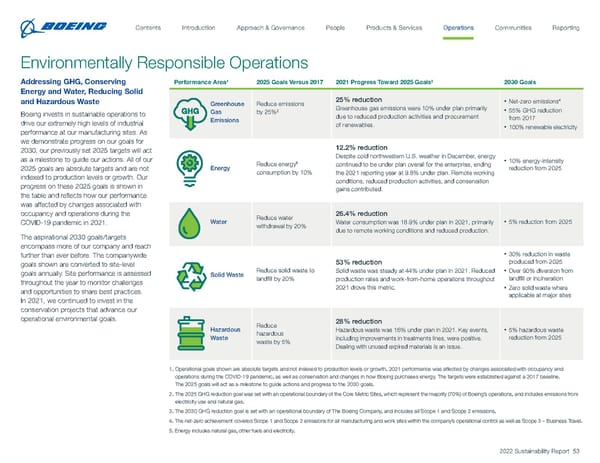
Environmentally Responsible Operations Addressing GHG, Conserving Energy and Water, Reducing Solid and Hazardous Waste Boeing invests in sustainable operations to drive our extremely high levels of industrial performance at our manufacturing sites. As we demonstrate progress on our goals for 2030, our previously set 2025 targets will act as a milestone to guide our actions. All of our 2025 goals are absolute targets and are not indexed to production levels or growth. Our progress on these 2025 goals is shown in the table and reflects how our performance was affected by changes associated with occupancy and operations during the COVID-19 pandemic in 2021. The aspirational 2030 goals/targets encompass more of our company and reach further than ever before. The companywide goals shown are converted to site-level goals annually. Site performance is assessed throughout the year to monitor challenges and opportunities to share best practices. In 2021, we continued to invest in the conservation projects that advance our operational environmental goals. Performance Area 1 2025 Goals Versus 2017 2021 Progress Toward 2025 Goals 3 2030 Goals Greenhouse Gas Emissions Reduce emissions by 25% 2 25% reduction Greenhouse gas emissions were 10% under plan primarily due to reduced production activities and procurement of renewables. • Net-zero emissions 4 • 55% GHG reduction from 2017 • 100% renewable electricity Energy Reduce energy 5 consumption by 10% 12.2% reduction Despite cold northwestern U.S. weather in December, energy continued to be under plan overall for the enterprise, ending the 2021 reporting year at 9.8% under plan. Remote working conditions; reduced production activities; and conservation gains contributed. • 10% energy-intensity reduction from 2025 Water Reduce water withdrawal by 20% 26.4% reduction Water consumption was 18.9% under plan in 2021, primarily due to remote working conditions and reduced production. • 5% reduction from 2025 Solid Waste Reduce solid waste to landfill by 20% 53% reduction Solid waste was steady at 44% under plan in 2021. Reduced production rates and work-from-home operations throughout 2021 drove this metric. • 30% reduction in waste produced from 2025 • Over 90% diversion from landfill or incineration • Zero solid waste where applicable at major sites Hazardous Waste Reduce hazardous waste by 5% 28% reduction Hazardous waste was 16% under plan in 2021. Key events, including improvements in treatments lines, were positive. Dealing with unused expired materials is an issue. • 5% hazardous waste reduction from 2025 1. Operational goals shown are absolute targets and not indexed to production levels or growth. 2021 performance was affected by changes associated with occupancy and operations during the COVID-19 pandemic, as well as conservation and changes in how Boeing purchases energy. The targets were established against a 2017 baseline. The 2025 goals will act as a milestone to guide actions and progress to the 2030 goals. 2. The 2025 GHG reduction goal was set with an operational boundary of the Core Metric Sites, which represent the majority (70%) of Boeing’s operations, and includes emissions from electricity use and natural gas. 3. The 2030 GHG reduction goal is set with an operational boundary of The Boeing Company, and includes all Scope 1 and Scope 2 emissions. 4. The net-zero achievement covered Scope 1 and Scope 2 emissions for all manufacturing and work sites within the company’s operational control as well as Scope 3 – Business Travel. 5. Energy includes natural gas, other fuels and electricity. 2022 Sustainability Report 53 Contents People Introduction Communities Operations Reporting Approach & Governance Products & Services
 The Boeing Company 2022 Sustainability Report Page 52 Page 54