

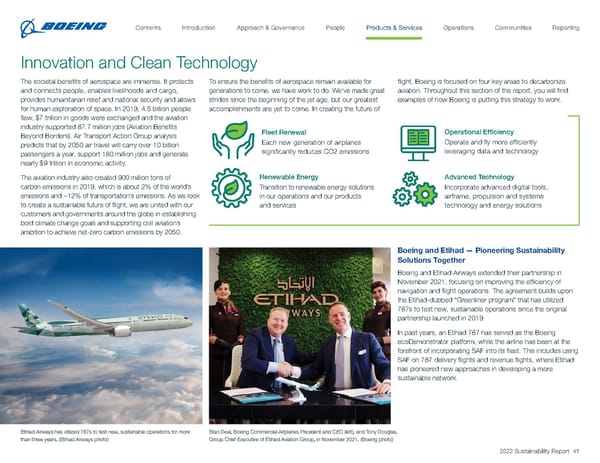
Innovation and Clean Technology The societal benefits of aerospace are immense. It protects and connects people, enables livelihoods and cargo, provides humanitarian relief and national security and allows for human exploration of space. In 2019, 4.5 billion people flew, $7 trillion in goods were exchanged and the aviation industry supported 87.7 million jobs (Aviation Benefits Beyond Borders). Air Transport Action Group analysis predicts that by 2050 air travel will carry over 10 billion passengers a year, support 180 million jobs and generate nearly $9 trillion in economic activity. The aviation industry also created 900 million tons of carbon emissions in 2019, which is about 2% of the world’s emissions and ~12% of transportation’s emissions. As we look to create a sustainable future of flight, we are united with our customers and governments around the globe in establishing bold climate change goals and supporting civil aviation’s ambition to achieve net-zero carbon emissions by 2050. To ensure the benefits of aerospace remain available for generations to come, we have work to do. We’ve made great strides since the beginning of the jet age, but our greatest accomplishments are yet to come. In creating the future of flight, Boeing is focused on four key areas to decarbonize aviation. Throughout this section of the report, you will find examples of how Boeing is putting this strategy to work. Fleet Renewal Each new generation of airplanes significantly reduces CO2 emissions Operational Efficiency Operate and fly more efficiently leveraging data and technology Renewable Energy Transition to renewable energy solutions in our operations and our products and services Advanced Technology Incorporate advanced digital tools, airframe, propulsion and systems technology and energy solutions Etihad Airways has utilized 787s to test new, sustainable operations for more than three years. (Etihad Airways photo) Stan Deal, Boeing Commercial Airplanes President and CEO (left), and Tony Douglas, Group Chief Executive of Etihad Aviation Group, in November 2021. (Boeing photo) Boeing and Etihad — Pioneering Sustainability Solutions Together Boeing and Etihad Airways extended their partnership in November 2021, focusing on improving the efficiency of navigation and flight operations. The agreement builds upon the Etihad-dubbed “Greenliner program” that has utilized 787s to test new, sustainable operations since the original partnership launched in 2019. In past years, an Etihad 787 has served as the Boeing ecoDemonstrator platform, while the airline has been at the forefront of incorporating SAF into its fleet. This includes using SAF on 787 delivery flights and revenue flights, where Etihad has pioneered new approaches in developing a more sustainable network. 2022 Sustainability Report 41 Contents People Introduction Communities Operations Reporting Approach & Governance Products & Services
 The Boeing Company 2022 Sustainability Report Page 40 Page 42