

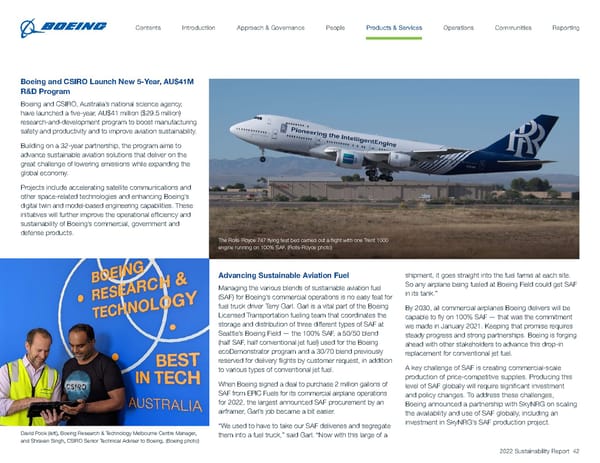
Boeing and CSIRO Launch New 5-Year, AU$41M R&D Program Boeing and CSIRO, Australia’s national science agency, have launched a five-year, AU$41 million ($29.5 million) research-and-development program to boost manufacturing safety and productivity and to improve aviation sustainability. Building on a 32-year partnership, the program aims to advance sustainable aviation solutions that deliver on the great challenge of lowering emissions while expanding the global economy. Projects include accelerating satellite communications and other space-related technologies and enhancing Boeing’s digital twin and model-based engineering capabilities. These initiatives will further improve the operational efficiency and sustainability of Boeing’s commercial, government and defense products. The Rolls-Royce 747 flying test bed carried out a flight with one Trent 1000 engine running on 100% SAF. (Rolls-Royce photo) David Pook (left), Boeing Research & Technology Melbourne Centre Manager, and Shravan Singh, CSIRO Senior Technical Adviser to Boeing. (Boeing photo) Advancing Sustainable Aviation Fuel Managing the various blends of sustainable aviation fuel (SAF) for Boeing’s commercial operations is no easy feat for fuel truck driver Terry Garl. Garl is a vital part of the Boeing Licensed Transportation fueling team that coordinates the storage and distribution of three different types of SAF at Seattle’s Boeing Field — the 100% SAF, a 50/50 blend (half SAF, half conventional jet fuel) used for the Boeing ecoDemonstrator program and a 30/70 blend previously reserved for delivery flights by customer request, in addition to various types of conventional jet fuel. When Boeing signed a deal to purchase 2 million gallons of SAF from EPIC Fuels for its commercial airplane operations for 2022, the largest announced SAF procurement by an airframer, Garl’s job became a bit easier. “We used to have to take our SAF deliveries and segregate them into a fuel truck,” said Garl. “Now with this large of a shipment, it goes straight into the fuel farms at each site. So any airplane being fueled at Boeing Field could get SAF in its tank.” By 2030, all commercial airplanes Boeing delivers will be capable to fly on 100% SAF — that was the commitment we made in January 2021. Keeping that promise requires steady progress and strong partnerships. Boeing is forging ahead with other stakeholders to advance this drop-in replacement for conventional jet fuel. A key challenge of SAF is creating commercial-scale production of price-competitive supplies. Producing this level of SAF globally will require significant investment and policy changes. To address these challenges, Boeing announced a partnership with SkyNRG on scaling the availability and use of SAF globally, including an investment in SkyNRG’s SAF production project. 2022 Sustainability Report 42 Contents People Introduction Communities Operations Reporting Approach & Governance Products & Services
 The Boeing Company 2022 Sustainability Report Page 41 Page 43