

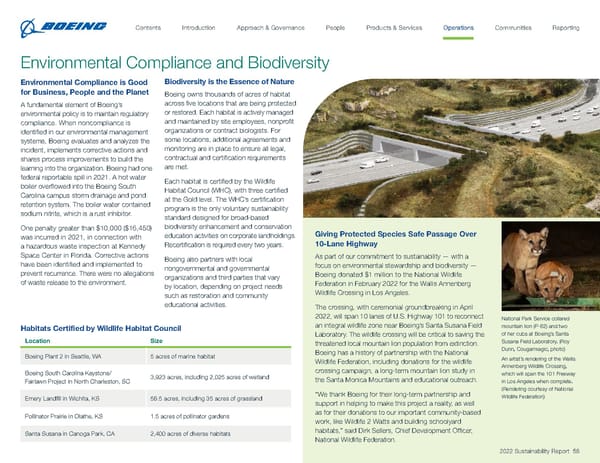
Environmental Compliance and Biodiversity Environmental Compliance is Good for Business, People and the Planet A fundamental element of Boeing’s environmental policy is to maintain regulatory compliance. When noncompliance is identified in our environmental management systems, Boeing evaluates and analyzes the incident, implements corrective actions and shares process improvements to build the learning into the organization. Boeing had one federal reportable spill in 2021. A hot water boiler overflowed into the Boeing South Carolina campus storm drainage and pond retention system. The boiler water contained sodium nitrite, which is a rust inhibitor. One penalty greater than $10,000 ($16,450) was incurred in 2021, in connection with a hazardous waste inspection at Kennedy Space Center in Florida. Corrective actions have been identified and implemented to prevent recurrence. There were no allegations of waste release to the environment. Biodiversity is the Essence of Nature Boeing owns thousands of acres of habitat across five locations that are being protected or restored. Each habitat is actively managed and maintained by site employees, nonprofit organizations or contract biologists. For some locations, additional agreements and monitoring are in place to ensure all legal, contractual and certification requirements are met. Each habitat is certified by the Wildlife Habitat Council (WHC), with three certified at the Gold level. The WHC’s certification program is the only voluntary sustainability standard designed for broad-based biodiversity enhancement and conservation education activities on corporate landholdings. Recertification is required every two years. Boeing also partners with local nongovernmental and governmental organizations and third parties that vary by location, depending on project needs such as restoration and community educational activities. Habitats Certified by Wildlife Habitat Council Location Size Boeing Plant 2 in Seattle, WA 5 acres of marine habitat Boeing South Carolina Keystone/ Fairlawn Project in North Charleston, SC 3,923 acres, including 2,025 acres of wetland Emery Landfill in Wichita, KS 56.5 acres, including 35 acres of grassland Pollinator Prairie in Olathe, KS 1.5 acres of pollinator gardens Santa Susana in Canoga Park, CA 2,400 acres of diverse habitats National Park Service collared mountain lion (P-62) and two of her cubs at Boeing’s Santa Susana Field Laboratory. (Roy Dunn, Cougarmagic, photo) An artist’s rendering of the Wallis Annenberg Wildlife Crossing, which will span the 101 Freeway in Los Angeles when complete. (Rendering courtesy of National Wildlife Federation) Giving Protected Species Safe Passage Over 10-Lane Highway As part of our commitment to sustainability — with a focus on environmental stewardship and biodiversity — Boeing donated $1 million to the National Wildlife Federation in February 2022 for the Wallis Annenberg Wildlife Crossing in Los Angeles. The crossing, with ceremonial groundbreaking in April 2022, will span 10 lanes of U.S. Highway 101 to reconnect an integral wildlife zone near Boeing’s Santa Susana Field Laboratory. The wildlife crossing will be critical to saving the threatened local mountain lion population from extinction. Boeing has a history of partnership with the National Wildlife Federation, including donations for the wildlife crossing campaign, a long-term mountain lion study in the Santa Monica Mountains and educational outreach. “We thank Boeing for their long-term partnership and support in helping to make this project a reality, as well as for their donations to our important community-based work, like Wildlife 2 Watts and building schoolyard habitats,” said Dirk Sellers, Chief Development Officer, National Wildlife Federation. 2022 Sustainability Report 56 Contents People Introduction Communities Operations Reporting Approach & Governance Products & Services
 The Boeing Company 2022 Sustainability Report Page 55 Page 57