

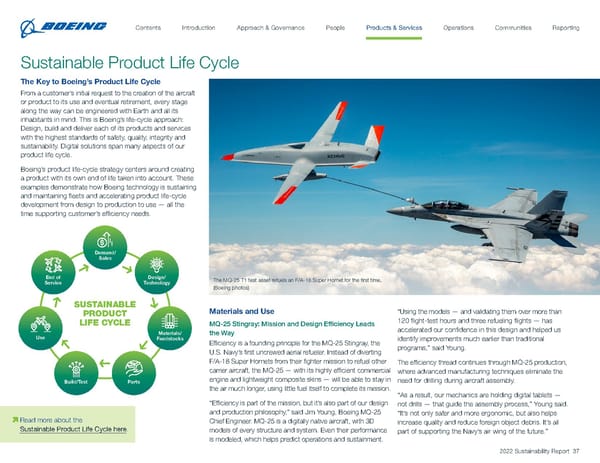
Sustainable Product Life Cycle The Key to Boeing’s Product Life Cycle From a customer’s initial request to the creation of the aircraft or product to its use and eventual retirement, every stage along the way can be engineered with Earth and all its inhabitants in mind. This is Boeing’s life-cycle approach: Design, build and deliver each of its products and services with the highest standards of safety, quality, integrity and sustainability. Digital solutions span many aspects of our product life cycle. Boeing’s product life-cycle strategy centers around creating a product with its own end of life taken into account. These examples demonstrate how Boeing technology is sustaining and maintaining fleets and accelerating product life-cycle development from design to production to use — all the time supporting customer’s efficiency needs. Read more about the Sustainable Product Life Cycle here . SUST AINABLE P LIFE CYCLE RODU CT End of Service Demand/ Sales Design/ Technology Materials/ Feedstocks Parts Build/Test Use The MQ-25 T1 test asset refuels an F/A-18 Super Hornet for the first time. (Boeing photos) Materials and Use MQ-25 Stingray: Mission and Design Efficiency Leads the Way Efficiency is a founding principle for the MQ-25 Stingray, the U.S. Navy’s first uncrewed aerial refueler. Instead of diverting F/A-18 Super Hornets from their fighter mission to refuel other carrier aircraft, the MQ-25 — with its highly efficient commercial engine and lightweight composite skins — will be able to stay in the air much longer, using little fuel itself to complete its mission. “Efficiency is part of the mission, but it’s also part of our design and production philosophy,” said Jim Young, Boeing MQ-25 Chief Engineer. MQ-25 is a digitally native aircraft, with 3D models of every structure and system. Even their performance is modeled, which helps predict operations and sustainment. “Using the models — and validating them over more than 120 flight-test hours and three refueling flights — has accelerated our confidence in this design and helped us identify improvements much earlier than traditional programs,” said Young. The efficiency thread continues through MQ-25 production, where advanced manufacturing techniques eliminate the need for drilling during aircraft assembly. “As a result, our mechanics are holding digital tablets — not drills — that guide the assembly process,” Young said. “It’s not only safer and more ergonomic, but also helps increase quality and reduce foreign object debris. It’s all part of supporting the Navy’s air wing of the future.” 2022 Sustainability Report 37 Contents People Introduction Communities Operations Reporting Approach & Governance Products & Services
 The Boeing Company 2022 Sustainability Report Page 36 Page 38