

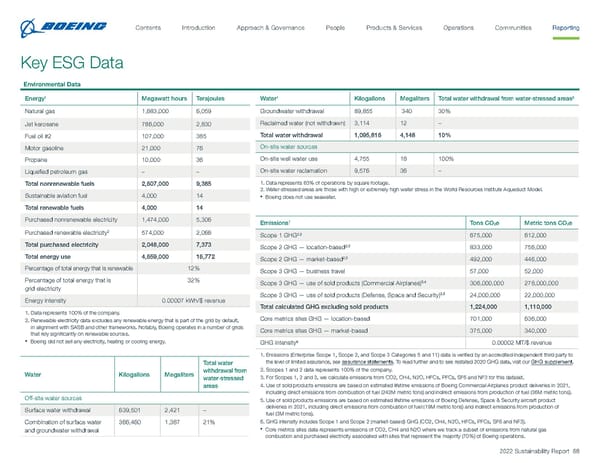
Key ESG Data Environmental Data Energy 1 Megawatt hours Terajoules Natural gas 1,683,000 6,059 Jet kerosene 786,000 2,830 Fuel oil #2 107,000 385 Motor gasoline 21,000 76 Propane 10,000 36 Liquefied petroleum gas – – Total nonrenewable fuels 2,607,000 9,385 Sustainable aviation fuel 4,000 14 Total renewable fuels 4,000 14 Purchased nonrenewable electricity 1,474,000 5,306 Purchased renewable electricity 2 574,000 2,066 Total purchased electricity 2,048,000 7,373 Total energy use 4,659,000 16,772 Percentage of total energy that is renewable 12% Percentage of total energy that is grid electricity 32% Energy intensity 0.00007 kWh/$ revenue 1. Data represents 100% of the company. 2. Renewable electricity data excludes any renewable energy that is part of the grid by default, in alignment with SASB and other frameworks. Notably, Boeing operates in a number of grids that rely significantly on renewable sources. • Boeing did not sell any electricity, heating or cooling energy. Water Kilogallons Megaliters Total water withdrawal from water-stressed areas Off-site water sources Surface water withdrawal 639,501 2,421 – Combination of surface water and groundwater withdrawal 366,460 1,387 21% Water 1 Kilogallons Megaliters Total water withdrawal from water-stressed areas 2 Groundwater withdrawal 89,855 340 30% Reclaimed water (not withdrawn) 3,114 12 – Total water withdrawal 1,095,816 4,148 10% On-site water sources On-site well water use 4,755 18 100% On-site water reclamation 9,576 36 – 1. Data represents 83% of operations by square footage. 2. Water-stressed areas are those with high or extremely high water stress in the World Resources Institute Aqueduct Model. • Boeing does not use seawater. Emissions 1 Tons CO 2 e Metric tons CO 2 e Scope 1 GHG 2,3 675,000 612,000 Scope 2 GHG — location-based 2,3 833,000 756,000 Scope 2 GHG — market-based 2,3 492,000 446,000 Scope 3 GHG — business travel 57,000 52,000 Scope 3 GHG — use of sold products (Commercial Airplanes) 3,4 306,000,000 278,000,000 Scope 3 GHG — use of sold products (Defense, Space and Security) 3,5 24,000,000 22,000,000 Total calculated GHG excluding sold products 1,224,000 1,110,000 Core metrics sites GHG — location-based 701,000 636,000 Core metrics sites GHG — market-based 375,000 340,000 GHG intensity 6 0.00002 MT/$ revenue 1. Emissions (Enterprise Scope 1, Scope 2, and Scope 3 Categories 5 and 11) data is verified by an accredited independent third party to the level of limited assurance, see assurance statements . To read further and to see restated 2020 GHG data, visit our GHG supplement . 2. Scopes 1 and 2 data represents 100% of the company. 3. For Scopes 1, 2 and 3, we calculate emissions from CO2, CH4, N2O, HFCs, PFCs, SF6 and NF3 for this dataset. 4. Use of sold products emissions are based on estimated lifetime emissions of Boeing Commercial Airplanes product deliveries in 2021, including direct emissions from combustion of fuel (242M metric tons) and indirect emissions from production of fuel (36M metric tons). 5. Use of sold products emissions are based on estimated lifetime emissions of Boeing Defense, Space & Security aircraft product deliveries in 2021, including direct emissions from combustion of fuel (19M metric tons) and indirect emissions from production of fuel (3M metric tons). 6. GHG intensity includes Scope 1 and Scope 2 (market-based) GHG (CO2, CH4, N2O, HFCs, PFCs, SF6 and NF3). • Core metrics sites data represents emissions of CO2, CH4 and N2O where we track a subset of emissions from natural gas combustion and purchased electricity associated with sites that represent the majority (70%) of Boeing operations. 2022 Sustainability Report 68 Contents People Introduction Communities Operations Reporting Approach & Governance Products & Services
 The Boeing Company 2022 Sustainability Report Page 67 Page 69