

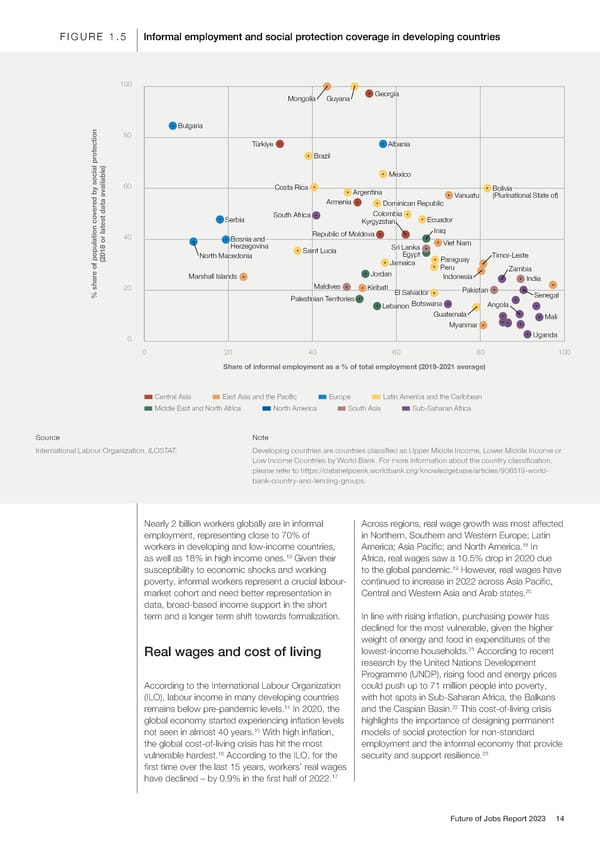
FIGURE 1.5 Informal employment and social protection coverage in developing countries 100 Mongolia Guyana Georgia Bulgaria 80 Türkiye Albania otection Brazil Mexico 60 Costa Rica Argentina Bolivia Vanuatu (Plurinational State of) ed by social pr Armenia Dominican Republic Serbia South Africa Colombia Ecuador Kyrgyzstan Republic of Moldova Iraq 40 Bosnia and Viet Nam Herzegovina Saint Lucia Sri Lanka (2018 or latest data available) North Macedonia Egypt Paraguay Timor-Leste Jamaica Peru Zambia e of population cover Marshall Islands Jordan Indonesia India 20 Maldives Kiribati El Salvador Pakistan % shar Palestinian Territories Senegal Lebanon Botswana Angola Guatemala Mali Myanmar 0 Uganda 0 20 40 60 80 100 Share of informal employment as a % of total employment (2019-2021 average) Central Asia East Asia and the Pacific Europe Latin America and the Caribbean Middle East and North Africa North America South Asia Sub-Saharan Africa Source Note International Labour Organization, ILOSTAT. Developing countries are countries classified as Upper Middle Income, Lower Middle Income or Low Income Countries by World Bank. For more information about the country classification, please refer to https://datahelpdesk.worldbank.org/knowledgebase/articles/906519-world- bank-country-and-lending-groups. Nearly 2 billion workers globally are in informal Across regions, real wage growth was most affected employment, representing close to 70% of in Northern, Southern and Western Europe; Latin 18 workers in developing and low-income countries, America; Asia Pacific; and North America. In 13 as well as 18% in high income ones. Given their Africa, real wages saw a 10.5% drop in 2020 due 19 susceptibility to economic shocks and working to the global pandemic. However, real wages have poverty, informal workers represent a crucial labour- continued to increase in 2022 across Asia Pacific, 20 market cohort and need better representation in Central and Western Asia and Arab states. data, broad-based income support in the short term and a longer term shift towards formalization. In line with rising inflation, purchasing power has declined for the most vulnerable, given the higher weight of energy and food in expenditures of the 21 Real wages and cost of living lowest-income households. According to recent research by the United Nations Development Programme (UNDP), rising food and energy prices According to the International Labour Organization could push up to 71 million people into poverty, (ILO), labour income in many developing countries with hot spots in Sub-Saharan Africa, the Balkans 14 22 remains below pre-pandemic levels. In 2020, the and the Caspian Basin. This cost-of-living crisis global economy started experiencing inflation levels highlights the importance of designing permanent 15 not seen in almost 40 years. With high inflation, models of social protection for non-standard the global cost-of-living crisis has hit the most employment and the informal economy that provide vulnerable hardest.16 According to the ILO, for the security and support resilience.23 first time over the last 15 years, workers’ real wages 17 have declined – by 0.9% in the first half of 2022. Future of Jobs Report 2023 14
 The Future of Jobs Report 2023 Page 13 Page 15