

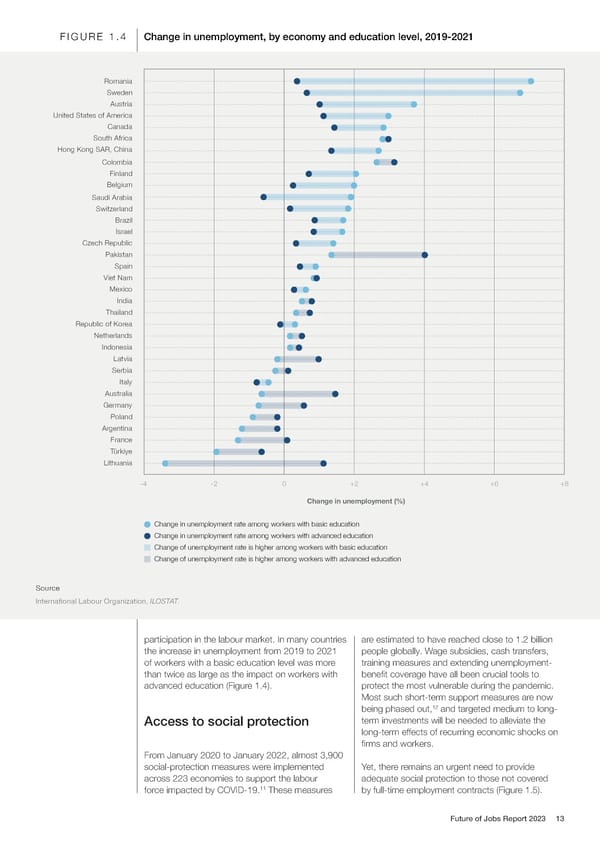
FIGURE 1.4 Change in unemployment, by economy and education level, 2019-2021 Romania Sweden Austria United States of America Canada South Africa Hong Kong SAR, China Colombia Finland Belgium Saudi Arabia Switzerland Brazil Israel Czech Republic Pakistan Spain Viet Nam Mexico India Thailand Republic of Korea Netherlands Indonesia Latvia Serbia Italy Australia Germany Poland Argentina France Türkiye Lithuania -4 -2 0 +2 +4 +6 +8 Change in unemployment (%) Change in unemployment rate among workers with basic education Change in unemployment rate among workers with advanced education Change of unemployment rate is higher among workers with basic education Change of unemployment rate is higher among workers with advanced education Source International Labour Organization, ILOSTAT. participation in the labour market. In many countries are estimated to have reached close to 1.2 billion the increase in unemployment from 2019 to 2021 people globally. Wage subsidies, cash transfers, of workers with a basic education level was more training measures and extending unemployment- than twice as large as the impact on workers with benefit coverage have all been crucial tools to advanced education (Figure 1.4). protect the most vulnerable during the pandemic. Most such short-term support measures are now 12 being phased out, and targeted medium to long- Access to social protection term investments will be needed to alleviate the long-term effects of recurring economic shocks on firms and workers. From January 2020 to January 2022, almost 3,900 social-protection measures were implemented Yet, there remains an urgent need to provide across 223 economies to support the labour adequate social protection to those not covered 11 force impacted by COVID-19. These measures by full-time employment contracts (Figure 1.5). Future of Jobs Report 2023 13
 The Future of Jobs Report 2023 Page 12 Page 14