

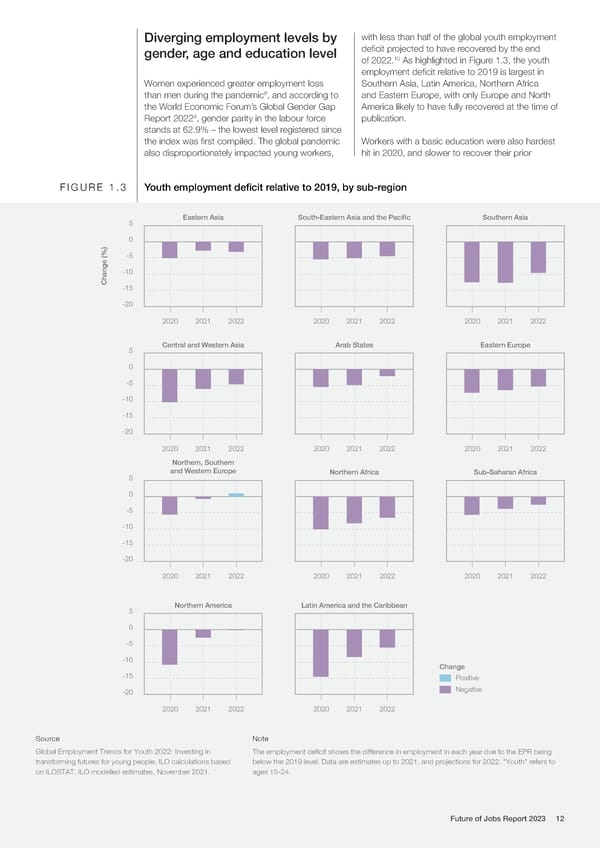
with less than half of the global youth employment Diverging employment levels by gender, age and education level deficit projected to have recovered by the end of 2022.10 As highlighted in Figure 1.3, the youth employment deficit relative to 2019 is largest in Women experienced greater employment loss Southern Asia, Latin America, Northern Africa 8 than men during the pandemic , and according to and Eastern Europe, with only Europe and North the World Economic Forum’s Global Gender Gap America likely to have fully recovered at the time of Report 20229, gender parity in the labour force publication. stands at 62.9% – the lowest level registered since the index was first compiled. The global pandemic Workers with a basic education were also hardest also disproportionately impacted young workers, hit in 2020, and slower to recover their prior FIGURE 1.3 Youth employment deficit relative to 2019, by sub-region 5 Eastern Asia South-Eastern Asia and the Pacific Southern Asia 0 -5 -10 Change (%)-15 -20 2020 2021 2022 2020 2021 2022 2020 2021 2022 5 Central and Western Asia Arab States Eastern Europe 0 -5 -10 -15 -20 2020 2021 2022 2020 2021 2022 2020 2021 2022 Northern, Southern and Western Europe Northern Africa Sub-Saharan Africa 5 0 -5 -10 -15 -20 2020 2021 2022 2020 2021 2022 2020 2021 2022 5 Northern America Latin America and the Caribbean 0 -5 -10 Change -15 Positive -20 Negative 2020 2021 2022 2020 2021 2022 Source Note Global Employment Trends for Youth 2022: Investing in The employment deficit shows the difference in employment in each year due to the EPR being transforming futures for young people, ILO calculations based below the 2019 level. Data are estimates up to 2021, and projections for 2022. "Youth" refers to on ILOSTAT, ILO modelled estimates, November 2021. ages 15-24. Future of Jobs Report 2023 12
 The Future of Jobs Report 2023 Page 11 Page 13