

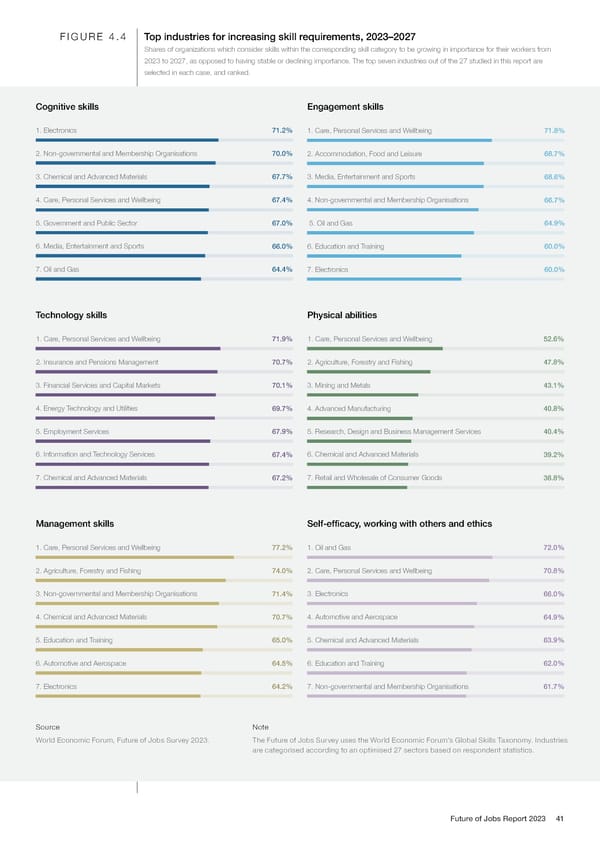
FIGURE 4.4 Top industries for increasing skill requirements, 2023–2027 Shares of organizations which consider skills within the corresponding skill category to be growing in importance for their workers from 2023 to 2027, as opposed to having stable or declining importance. The top seven industries out of the 27 studied in this report are selected in each case, and ranked. Cognitive skills Engagement skills 1. Electronics 71.2% 1. Care, Personal Services and Wellbeing 71.8% 2. Non-governmental and Membership Organisations 70.0% 2. Accommodation, Food and Leisure 68.7% 3. Chemical and Advanced Materials 67.7% 3. Media, Entertainment and Sports 68.6% 4. Care, Personal Services and Wellbeing 67.4% 4. Non-governmental and Membership Organisations 66.7% 5. Government and Public Sector 67.0% 5. Oil and Gas 64.9% 6. Media, Entertainment and Sports 66.0% 6. Education and Training 60.0% 7. Oil and Gas 64.4% 7. Electronics 60.0% Technology skills Physical abilities 1. Care, Personal Services and Wellbeing 71.9% 1. Care, Personal Services and Wellbeing 52.6% 2. Insurance and Pensions Management 70.7% 2. Agriculture, Forestry and Fishing 47.8% 3. Financial Services and Capital Markets 70.1% 3. Mining and Metals 43.1% 4. Energy Technology and Utilities 69.7% 4. Advanced Manufacturing 40.8% 5. Employment Services 67.9% 5. Research, Design and Business Management Services 40.4% 6. Information and Technology Services 67.4% 6. Chemical and Advanced Materials 39.2% 7. Chemical and Advanced Materials 67.2% 7. Retail and Wholesale of Consumer Goods 38.8% Management skills Self-efficacy, working with others and ethics 1. Care, Personal Services and Wellbeing 77.2% 1. Oil and Gas 72.0% 2. Agriculture, Forestry and Fishing 74.0% 2. Care, Personal Services and Wellbeing 70.8% 3. Non-governmental and Membership Organisations 71.4% 3. Electronics 66.0% 4. Chemical and Advanced Materials 70.7% 4. Automotive and Aerospace 64.9% 5. Education and Training 65.0% 5. Chemical and Advanced Materials 63.9% 6. Automotive and Aerospace 64.5% 6. Education and Training 62.0% 7. Electronics 64.2% 7. Non-governmental and Membership Organisations 61.7% Source Note World Economic Forum, Future of Jobs Survey 2023. The Future of Jobs Survey uses the World Economic Forum's Global Skills Taxonomy. Industries are categorised according to an optimised 27 sectors based on respondent statistics. Future of Jobs Report 2023 41
 The Future of Jobs Report 2023 Page 40 Page 42