

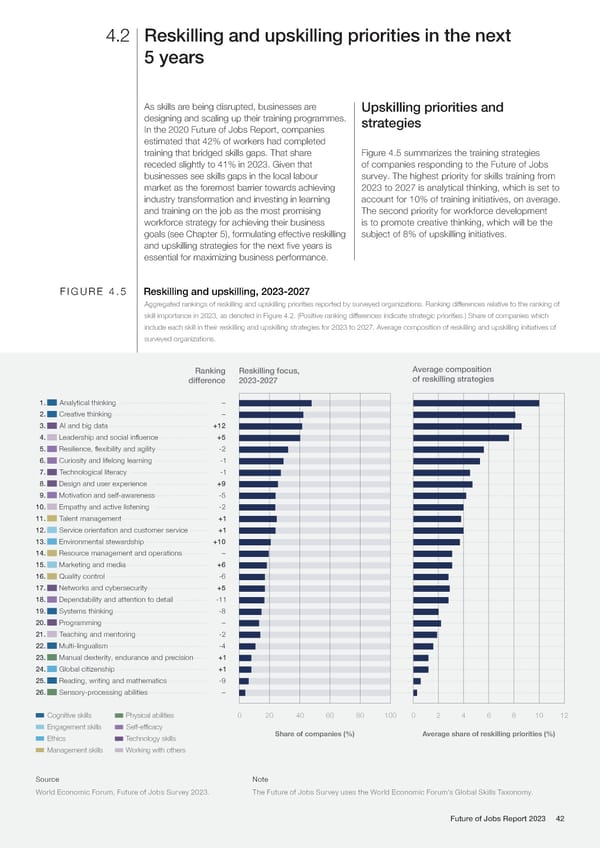
4.2 Reskilling and upskilling priorities in the next 5 years As skills are being disrupted, businesses are Upskilling priorities and designing and scaling up their training programmes. strategies In the 2020 Future of Jobs Report, companies estimated that 42% of workers had completed training that bridged skills gaps. That share Figure 4.5 summarizes the training strategies receded slightly to 41% in 2023. Given that of companies responding to the Future of Jobs businesses see skills gaps in the local labour survey. The highest priority for skills training from market as the foremost barrier towards achieving 2023 to 2027 is analytical thinking, which is set to industry transformation and investing in learning account for 10% of training initiatives, on average. and training on the job as the most promising The second priority for workforce development workforce strategy for achieving their business is to promote creative thinking, which will be the goals (see Chapter 5), formulating effective reskilling subject of 8% of upskilling initiatives. and upskilling strategies for the next five years is essential for maximizing business performance. FIGURE 4.5 Reskilling and upskilling, 2023-2027 Aggregated rankings of reskilling and upskilling priorities reported by surveyed organizations. Ranking differences relative to the ranking of skill importance in 2023, as denoted in Figure 4.2. (Positive ranking differences indicate strategic priorities.) Share of companies which include each skill in their reskilling and upskilling strategies for 2023 to 2027. Average composition of reskilling and upskilling initiatives of surveyed organizations. Ranking Reskilling focus, Average composition difference 2023-2027 of reskilling strategies 1. Analytical thinking – 2. Creative thinking – 3. AI and big data +12 4. Leadership and social influence +5 5. Resilience, flexibility and agility -2 6. Curiosity and lifelong learning -1 7. Technological literacy -1 8. Design and user experience +9 9. Motivation and self-awareness -5 10. Empathy and active listening -2 11. Talent management +1 12. Service orientation and customer service +1 13. Environmental stewardship +10 14. Resource management and operations – 15. Marketing and media +6 16. Quality control -6 17. Networks and cybersecurity +5 18. Dependability and attention to detail -11 19. Systems thinking -8 20. Programming – 21. Teaching and mentoring -2 22. Multi-lingualism -4 23. Manual dexterity, endurance and precision +1 24. Global citizenship +1 25. Reading, writing and mathematics -9 26. Sensory-processing abilities – Cognitive skills Physical abilities 0 20 40 60 80 100 0 2 4 6 8 10 12 Engagement skills Self-efficacy Ethics Technology skills Share of companies (%) Average share of reskilling priorities (%) Management skills Working with others Source Note World Economic Forum, Future of Jobs Survey 2023. The Future of Jobs Survey uses the World Economic Forum's Global Skills Taxonomy. Future of Jobs Report 2023 42
 The Future of Jobs Report 2023 Page 41 Page 43