

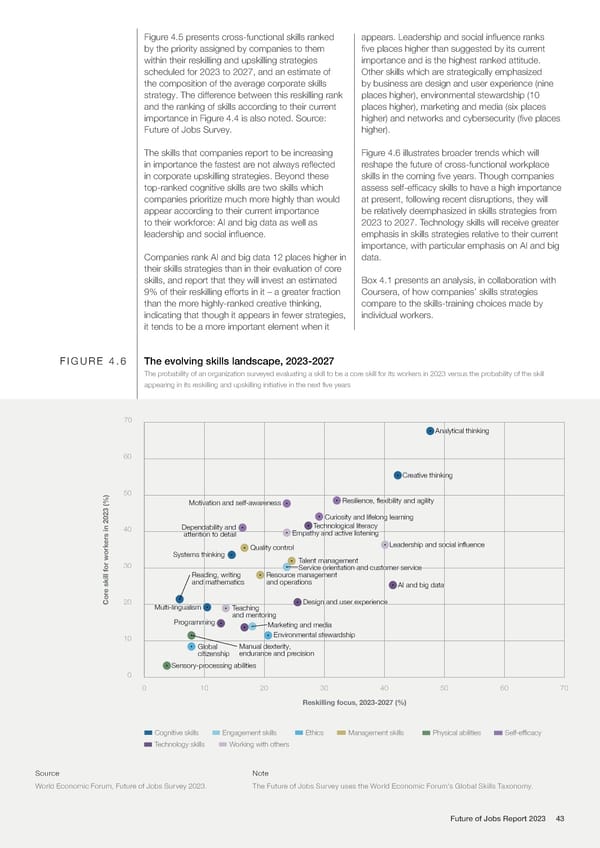
Figure 4.5 presents cross-functional skills ranked appears. Leadership and social influence ranks by the priority assigned by companies to them five places higher than suggested by its current within their reskilling and upskilling strategies importance and is the highest ranked attitude. scheduled for 2023 to 2027, and an estimate of Other skills which are strategically emphasized the composition of the average corporate skills by business are design and user experience (nine strategy. The difference between this reskilling rank places higher), environmental stewardship (10 and the ranking of skills according to their current places higher), marketing and media (six places importance in Figure 4.4 is also noted. Source: higher) and networks and cybersecurity (five places Future of Jobs Survey. higher). The skills that companies report to be increasing Figure 4.6 illustrates broader trends which will in importance the fastest are not always reflected reshape the future of cross-functional workplace in corporate upskilling strategies. Beyond these skills in the coming five years. Though companies top-ranked cognitive skills are two skills which assess self-efficacy skills to have a high importance companies prioritize much more highly than would at present, following recent disruptions, they will appear according to their current importance be relatively deemphasized in skills strategies from to their workforce: AI and big data as well as 2023 to 2027. Technology skills will receive greater leadership and social influence. emphasis in skills strategies relative to their current importance, with particular emphasis on AI and big Companies rank AI and big data 12 places higher in data. their skills strategies than in their evaluation of core skills, and report that they will invest an estimated Box 4.1 presents an analysis, in collaboration with 9% of their reskilling efforts in it – a greater fraction Coursera, of how companies’ skills strategies than the more highly-ranked creative thinking, compare to the skills-training choices made by indicating that though it appears in fewer strategies, individual workers. it tends to be a more important element when it FIGURE 4.6 The evolving skills landscape, 2023-2027 The probability of an organization surveyed evaluating a skill to be a core skill for its workers in 2023 versus the probability of the skill appearing in its reskilling and upskilling initiative in the next five years 70 Analytical thinking 60 Creative thinking 50 Motivation and self-awareness Resilience, flexibility and agility Curiosity and lifelong learning 40 Dependability and Technological literacy attention to detail Empathy and active listening Quality control Leadership and social influence Systems thinking Talent management 30 Service orientation and customer service Reading, writing Resource management and mathematics and operations AI and big data e skill for workers in 2023 (%) Cor 20 Multi-lingualism Teaching Design and user experience and mentoring Programming Marketing and media 10 Environmental stewardship Global Manual dexterity, citizenship endurance and precision Sensory-processing abilities 0 0 10 20 30 40 50 60 70 Reskilling focus, 2023-2027 (%) Cognitive skills Engagement skills Ethics Management skills Physical abilities Self-efficacy Technology skills Working with others Source Note World Economic Forum, Future of Jobs Survey 2023. The Future of Jobs Survey uses the World Economic Forum's Global Skills Taxonomy. Future of Jobs Report 2023 43
 The Future of Jobs Report 2023 Page 42 Page 44