

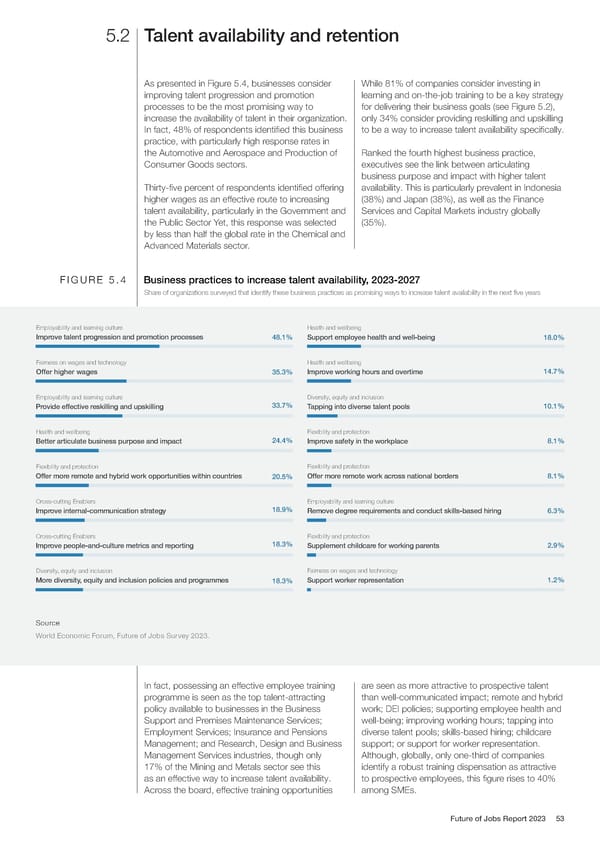
5.2 Talent availability and retention As presented in Figure 5.4, businesses consider While 81% of companies consider investing in improving talent progression and promotion learning and on-the-job training to be a key strategy processes to be the most promising way to for delivering their business goals (see Figure 5.2), increase the availability of talent in their organization. only 34% consider providing reskilling and upskilling In fact, 48% of respondents identified this business to be a way to increase talent availability specifically. practice, with particularly high response rates in the Automotive and Aerospace and Production of Ranked the fourth highest business practice, Consumer Goods sectors. executives see the link between articulating business purpose and impact with higher talent Thirty-five percent of respondents identified offering availability. This is particularly prevalent in Indonesia higher wages as an effective route to increasing (38%) and Japan (38%), as well as the Finance talent availability, particularly in the Government and Services and Capital Markets industry globally the Public Sector Yet, this response was selected (35%). by less than half the global rate in the Chemical and Advanced Materials sector. FIGURE 5.4 Business practices to increase talent availability, 2023-2027 Share of organizations surveyed that identify these business practices as promising ways to increase talent availability in the next five years Employability and learning culture Health and wellbeing Improve talent progression and promotion processes 48.1% Support employee health and well-being 18.0% Fairness on wages and technology Health and wellbeing Offer higher wages 35.3% Improve working hours and overtime 14.7% Employability and learning culture Diversity, equity and inclusion Provide effective reskilling and upskilling 33.7% Tapping into diverse talent pools 10.1% Health and wellbeing Flexibility and protection Better articulate business purpose and impact 24.4% Improve safety in the workplace 8.1% Flexibility and protection Flexibility and protection Offer more remote and hybrid work opportunities within countries 20.5% Offer more remote work across national borders 8.1% Cross-cutting Enablers Employability and learning culture Improve internal-communication strategy 18.9% Remove degree requirements and conduct skills-based hiring 6.3% Cross-cutting Enablers Flexibility and protection Improve people-and-culture metrics and reporting 18.3% Supplement childcare for working parents 2.9% Diversity, equity and inclusion Fairness on wages and technology More diversity, equity and inclusion policies and programmes 18.3% Support worker representation 1.2% Source World Economic Forum, Future of Jobs Survey 2023. In fact, possessing an effective employee training are seen as more attractive to prospective talent programme is seen as the top talent-attracting than well-communicated impact; remote and hybrid policy available to businesses in the Business work; DEI policies; supporting employee health and Support and Premises Maintenance Services; well-being; improving working hours; tapping into Employment Services; Insurance and Pensions diverse talent pools; skills-based hiring; childcare Management; and Research, Design and Business support; or support for worker representation. Management Services industries, though only Although, globally, only one-third of companies 17% of the Mining and Metals sector see this identify a robust training dispensation as attractive as an effective way to increase talent availability. to prospective employees, this figure rises to 40% Across the board, effective training opportunities among SMEs. Future of Jobs Report 2023 53
 The Future of Jobs Report 2023 Page 52 Page 54