

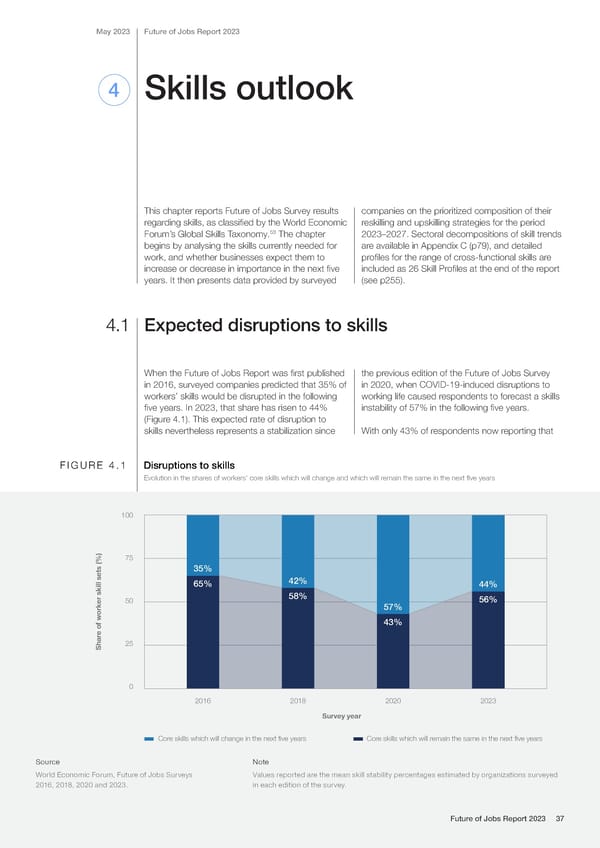
May 2023 Future of Jobs Report 2023 4 Skills outlook This chapter reports Future of Jobs Survey results companies on the prioritized composition of their regarding skills, as classified by the World Economic reskilling and upskilling strategies for the period 53 Forum’s Global Skills Taxonomy. The chapter 2023–2027. Sectoral decompositions of skill trends begins by analysing the skills currently needed for are available in Appendix C (p79), and detailed work, and whether businesses expect them to profiles for the range of cross-functional skills are increase or decrease in importance in the next five included as 26 Skill Profiles at the end of the report years. It then presents data provided by surveyed (see p255). 4.1 Expected disruptions to skills When the Future of Jobs Report was first published the previous edition of the Future of Jobs Survey in 2016, surveyed companies predicted that 35% of in 2020, when COVID-19-induced disruptions to workers’ skills would be disrupted in the following working life caused respondents to forecast a skills five years. In 2023, that share has risen to 44% instability of 57% in the following five years. (Figure 4.1). This expected rate of disruption to skills nevertheless represents a stabilization since With only 43% of respondents now reporting that FIGURE 4.1 Disruptions to skills Evolution in the shares of workers' core skills which will change and which will remain the same in the next five years 100 75 35% 65% 42% 44% 50 58% 56% 57% 43% e of worker skill sets (%) Shar 25 0 2016 2018 2020 2023 Survey year Core skills which will change in the next five years Core skills which will remain the same in the next five years Source Note World Economic Forum, Future of Jobs Surveys Values reported are the mean skill stability percentages estimated by organizations surveyed 2016, 2018, 2020 and 2023. in each edition of the survey. Future of Jobs Report 2023 37
 The Future of Jobs Report 2023 Page 36 Page 38