

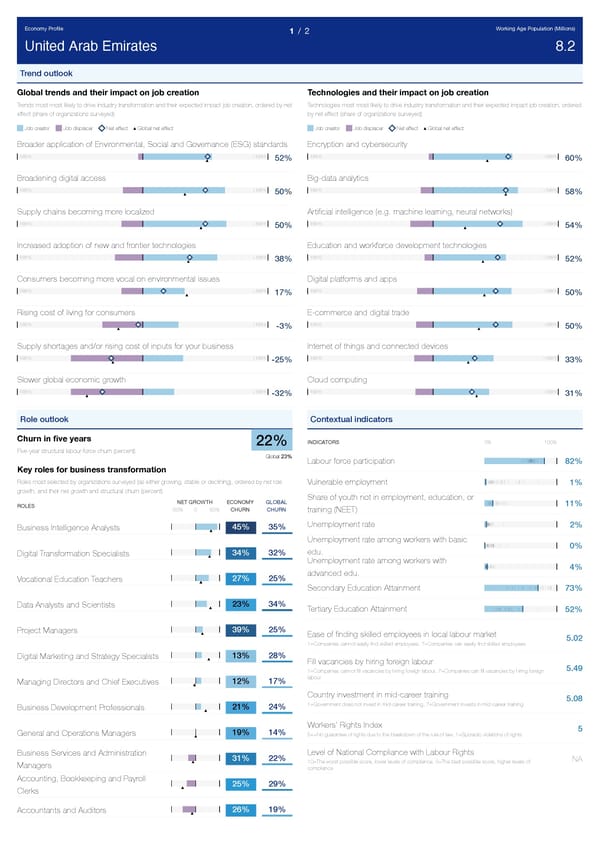
Economy Profile Working Age Population (Millions) 1 / 2 United Arab Emirates 8.2 Trend outlook Global trends and their impact on job creation Technologies and their impact on job creation Trends most most likely to drive industry transformation and their expected impact job creation, ordered by net Technologies most most likely to drive industry transformation and their expected impact job creation, ordered effect (share of organizations surveyed) by net effect (share of organizations surveyed) Job creator Job displacer Net effect Global net effect Job creator Job displacer Net effect Global net effect Broader application of Environmental, Social and Governance (ESG) standards Encryption and cybersecurity -100% +100% -100% +100% 52% 60% Broadening digital access Big-data analytics -100% +100% -100% +100% 50% 58% Supply chains becoming more locali]ed Artificial intelligence (e.g. machine learning, neural networks) -100% +100% -100% +100% 50% 54% Increased adoption of new and frontier technologies Education and workforce development technologies -100% +100% -100% +100% 38% 52% Consumers becoming more vocal on environmental issues Digital platforms and apps -100% +100% -100% +100% 17% 50% Rising cost of living for consumers E-commerce and digital trade -100% +100% -100% +100% -3% 50% Supply shortages and/or rising cost of inputs for your business Internet of things and connected devices -100% +100% -100% +100% -25% 33% Slower global economic growth Cloud computing -100% +100% -100% +100% -32% 31% Role outlook Contextual indicators Churn in five years INDICATORS 0% 100% 22% Five-year structural labour-force churn (percent) Global 23% Labour force participation 82% Key roles for business transformation Roles most selected by organizations surveyed (as either growing, stable or declining), ordered by net role Vulnerable employment 1% growth, and their net growth and structural churn (percent) Share of youth not in employment, education, or NET GROWTH ECONOMY GLOBAL 11% ROLES -50% 0 50% CHURN CHURN training (NEET) Unemployment rate 2% 45% 35% Business Intelligence Analysts Unemployment rate among workers with basic 0% edu. 34% 32% Digital Transformation Specialists Unemployment rate among workers with 4% advanced edu. 27% 25% Vocational Education Teachers Secondary Education Attainment 73% 23% 34% Data Analysts and Scientists Tertiary Education Attainment 52% 39% 25% Project Managers Ease of finding skilled employees in local labour market 5.02 1=Companies cannot easily find skilled employees, 7=Companies can easily find skilled employees 13% 28% Digital Marketing and Strategy Specialists Fill vacancies by hiring foreign labour 5.49 1=Companies cannot fill vacancies by hiring foreign labour, 7=Companies can fill vacancies by hiring foreign labour 12% 17% Managing Directors and Chief Executives Country investment in mid-career training 5.08 1=Government does not invest in mid-career training, 7=Government invests in mid-career training 21% 24% Business Development Professionals Workers' Rights Index 5 19% 14% General and Operations Managers 5+=No guarantee of rights due to the breakdown of the rule of law, 1=Sporadic violations of rights Level of National Compliance with Labour Rights Business Services and Administration 31% 22% NA 10=The worst possible score, lower levels of compliance, 0=The best possible score, higher levels of Managers compliance Accounting, Bookkeeping and Payroll 25% 29% Clerks 26% 19% Accountants and Auditors
 The Future of Jobs Report 2023 Page 175 Page 177