

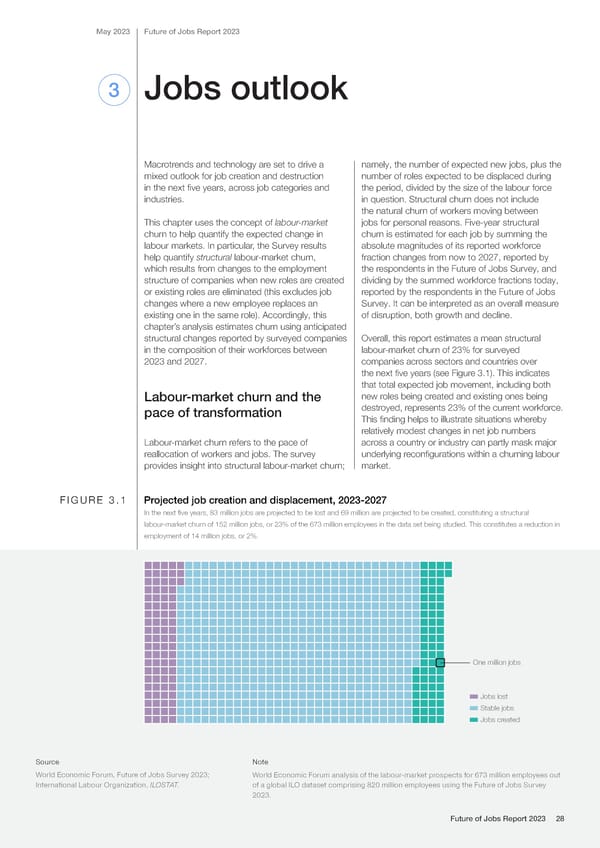
May 2023 Future of Jobs Report 2023 3 Jobs outlook Macrotrends and technology are set to drive a namely, the number of expected new jobs, plus the mixed outlook for job creation and destruction number of roles expected to be displaced during in the next five years, across job categories and the period, divided by the size of the labour force industries. in question. Structural churn does not include the natural churn of workers moving between This chapter uses the concept of labour-market jobs for personal reasons. Five-year structural churn to help quantify the expected change in churn is estimated for each job by summing the labour markets. In particular, the Survey results absolute magnitudes of its reported workforce help quantify structural labour-market churn, fraction changes from now to 2027, reported by which results from changes to the employment the respondents in the Future of Jobs Survey, and structure of companies when new roles are created dividing by the summed workforce fractions today, or existing roles are eliminated (this excludes job reported by the respondents in the Future of Jobs changes where a new employee replaces an Survey. It can be interpreted as an overall measure existing one in the same role). Accordingly, this of disruption, both growth and decline. chapter’s analysis estimates churn using anticipated structural changes reported by surveyed companies Overall, this report estimates a mean structural in the composition of their workforces between labour-market churn of 23% for surveyed 2023 and 2027. companies across sectors and countries over the next five years (see Figure 3.1). This indicates that total expected job movement, including both Labour-market churn and the new roles being created and existing ones being pace of transformation destroyed, represents 23% of the current workforce. This finding helps to illustrate situations whereby relatively modest changes in net job numbers Labour-market churn refers to the pace of across a country or industry can partly mask major reallocation of workers and jobs. The survey underlying reconfigurations within a churning labour provides insight into structural labour-market churn; market. FIGURE 3.1 Projected job creation and displacement, 2023-2027 In the next five years, 83 million jobs are projected to be lost and 69 million are projected to be created, constituting a structural labour-market churn of 152 million jobs, or 23% of the 673 million employees in the data set being studied. This constitutes a reduction in employment of 14 million jobs, or 2%. One million jobs Jobs lost Stable jobs Jobs created Source Note World Economic Forum, Future of Jobs Survey 2023; World Economic Forum analysis of the labour-market prospects for 673 million employees out International Labour Organization, ILOSTAT. of a global ILO dataset comprising 820 million employees using the Future of Jobs Survey 2023. Future of Jobs Report 2023 28
 The Future of Jobs Report 2023 Page 27 Page 29