

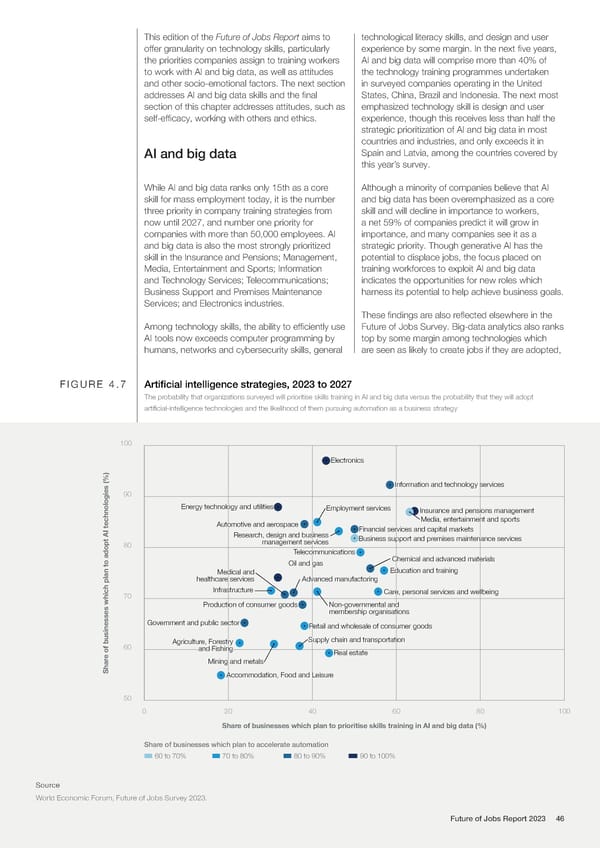
This edition of the Future of Jobs Report aims to technological literacy skills, and design and user offer granularity on technology skills, particularly experience by some margin. In the next five years, the priorities companies assign to training workers AI and big data will comprise more than 40% of to work with AI and big data, as well as attitudes the technology training programmes undertaken and other socio-emotional factors. The next section in surveyed companies operating in the United addresses AI and big data skills and the final States, China, Brazil and Indonesia. The next most section of this chapter addresses attitudes, such as emphasized technology skill is design and user self-efficacy, working with others and ethics. experience, though this receives less than half the strategic prioritization of AI and big data in most countries and industries, and only exceeds it in AI and big data Spain and Latvia, among the countries covered by this year’s survey. While AI and big data ranks only 15th as a core Although a minority of companies believe that AI skill for mass employment today, it is the number and big data has been overemphasized as a core three priority in company training strategies from skill and will decline in importance to workers, now until 2027, and number one priority for a net 59% of companies predict it will grow in companies with more than 50,000 employees. AI importance, and many companies see it as a and big data is also the most strongly prioritized strategic priority. Though generative AI has the skill in the Insurance and Pensions; Management, potential to displace jobs, the focus placed on Media, Entertainment and Sports; Information training workforces to exploit AI and big data and Technology Services; Telecommunications; indicates the opportunities for new roles which Business Support and Premises Maintenance harness its potential to help achieve business goals. Services; and Electronics industries. These findings are also reflected elsewhere in the Among technology skills, the ability to efficiently use Future of Jobs Survey. Big-data analytics also ranks AI tools now exceeds computer programming by top by some margin among technologies which humans, networks and cybersecurity skills, general are seen as likely to create jobs if they are adopted, FIGURE 4.7 Artificial intelligence strategies, 2023 to 2027 The probability that organizations surveyed will prioritise skills training in AI and big data versus the probability that they will adopt artificial-intelligence technologies and the likelihood of them pursuing automation as a business strategy 100 Electronics Information and technology services 90 Energy technology and utilities Employment services Insurance and pensions management Automotive and aerospace Media, entertainment and sports Research, design and business Financial services and capital markets management services Business support and premises maintenance services 80 Telecommunications Oil and gas Chemical and advanced materials Medical and Education and training healthcare services Advanced manufactoring 70 Infrastructure Care, personal services and wellbeing Production of consumer goods Non-governmental and membership organisations Government and public sector Retail and wholesale of consumer goods Agriculture, Forestry Supply chain and transportation 60 and Fishing Real estate e of businesses which plan to adopt AI technologies (%)Mining and metals Shar Accommodation, Food and Leisure 50 0 20 40 60 80 100 Share of businesses which plan to prioritise skills training in AI and big data (%) Share of businesses which plan to accelerate automation 60 to 70% 70 to 80% 80 to 90% 90 to 100% Source World Economic Forum, Future of Jobs Survey 2023. Future of Jobs Report 2023 46
 The Future of Jobs Report 2023 Page 45 Page 47