

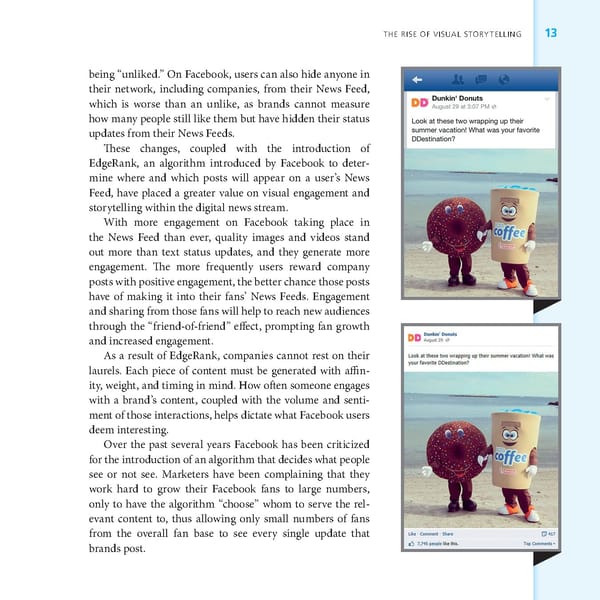
THE RISE OF VISUAL STORYTELLING 13 being “unliked.” On Facebook, users can also hide anyone in their network, including companies, from their News Feed, which is worse than an unlike, as brands cannot measure how many people still like them but have hidden their status updates from their News Feeds. These changes, coupled with the introduction of EdgeRank, an algorithm introduced by Facebook to deter- mine where and which posts will appear on a user’s News Feed, have placed a greater value on visual engagement and storytelling within the digital news stream. With more engagement on Facebook taking place in the News Feed than ever, quality images and videos stand out more than text status updates, and they generate more engagement. The more frequently users reward company posts with positive engagement, the better chance those posts have of making it into their fans’ News Feeds. Engagement and sharing from those fans will help to reach new audiences through the “friend-of-friend” effect, prompting fan growth and increased engagement. As a result of EdgeRank, companies cannot rest on their laurels. Each piece of content must be generated with affin- ity, weight, and timing in mind. How often someone engages with a brand’s content, coupled with the volume and senti- ment of those interactions, helps dictate what Facebook users deem interesting. Over the past several years Facebook has been criticized for the introduction of an algorithm that decides what people see or not see. Marketers have been complaining that they work hard to grow their Facebook fans to large numbers, only to have the algorithm “choose” whom to serve the rel- evant content to, thus allowing only small numbers of fans from the overall fan base to see every single update that brands post.
 The Power of Visual Storytelling: How to Use Visuals, Videos, and Social Media to Market Your Brand Page 26 Page 28