

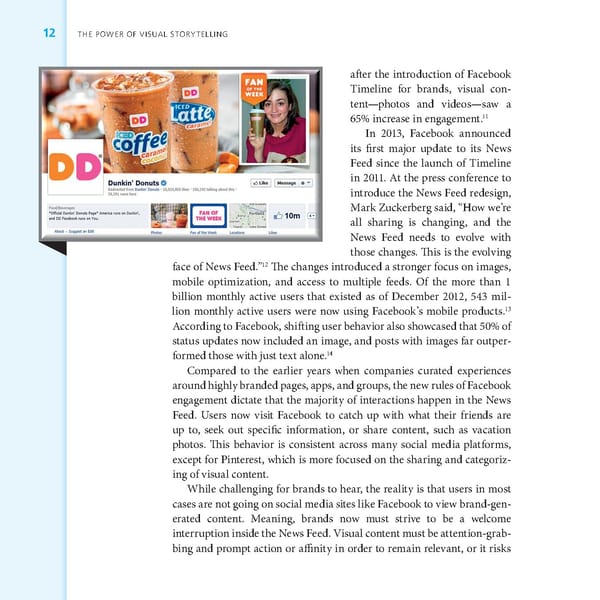
12 THE POWER OF VISUAL STORYTELLING after the introduction of Facebook Timeline for brands, visual con- tent—photos and videos—saw a 11 65% increase in engagement. In 2013, Facebook announced its first major update to its News Feed since the launch of Timeline in 2011. At the press conference to introduce the News Feed redesign, Mark Zuckerberg said, “How we’re all sharing is changing, and the News Feed needs to evolve with those changes. This is the evolving 12 face of News Feed.” The changes introduced a stronger focus on images, mobile optimization, and access to multiple feeds. Of the more than 1 billion monthly active users that existed as of December 2012, 543 mil- 13 lion monthly active users were now using Facebook’s mobile products. According to Facebook, shifting user behavior also showcased that 50% of status updates now included an image, and posts with images far outper- 14 formed those with just text alone. Compared to the earlier years when companies curated experiences around highly branded pages, apps, and groups, the new rules of Facebook engagement dictate that the majority of interactions happen in the News Feed. Users now visit Facebook to catch up with what their friends are up to, seek out specific information, or share content, such as vacation photos. This behavior is consistent across many social media platforms, except for Pinterest, which is more focused on the sharing and categoriz- ing of visual content. While challenging for brands to hear, the reality is that users in most cases are not going on social media sites like Facebook to view brand-gen- erated content. Meaning, brands now must strive to be a welcome interruption inside the News Feed. Visual content must be attention-grab- bing and prompt action or affinity in order to remain relevant, or it risks
 The Power of Visual Storytelling: How to Use Visuals, Videos, and Social Media to Market Your Brand Page 25 Page 27