

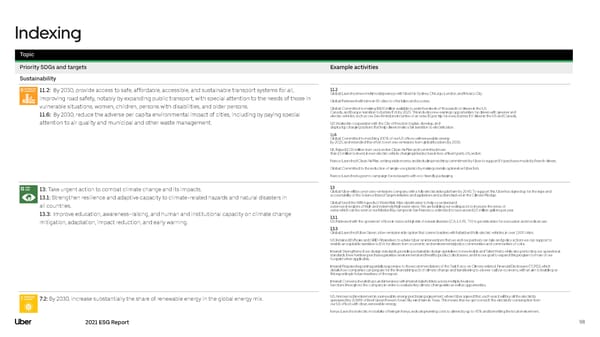
Indexing Topic Priority SDGs and targets Example activities Sustainability 11.2: By 2030, provide access to safe, affordable, accessible, and sustainable transport systems for all, 11.2 Global: Launched new multimodal journeys with UberX in Sydney, Chicago, London, and Mexico City. improving road safety, notably by expanding public transport, with special attention to the needs of those in Global: Partnered with Lime in 85 cities to offer bikes and scooters. vulnerable situations, women, children, persons with disabilities, and older persons. Global: Committed to making $800 million available to assist hundreds of thousands of drivers in the US, 11.6: By 2030, reduce the adverse per capita environmental impact of cities, including by paying special Canada, and Europe transition to battery EVs by 2025. This includes new earnings opportunities for drivers with greener and electric vehicles, such as our Zero Emissions incentive of an extra $1 per trip for every battery EV driver in the US and Canada. attention to air quality and municipal and other waste management. US: Worked in cooperation with the City of Houston to plan, develop, and deploy bp charging stations that help drivers make a fair transition to electrification. 11.6 Global: Committed to matching 100% of our US offices with renewable energy by 2025, and extended that effort to net zero emissions from global locations by 2030. UK: Raised £135 million from our London Clean Air Plan and committed more than £5 million to invest in new electric vehicle charging infrastructure in less-affluent parts of London. France: Launched Clean Air Plan, setting aside money and including matching commitment by Uber to support EV purchases made by French drivers. Global: Committed to the reduction of single-use plastics by making utensils optional on Uber Eats. France: Launched a promo campaign for restaurants with eco-friendly packaging. 13: Take urgent action to combat climate change and its impacts. 13 Global: Uber will be a net-zero-emissions company, with a fully electric rides platform by 2040. To support this, Uber has signed up for the rigor and 13.1: Strengthen resilience and adaptive capacity to climate-related hazards and natural disasters in accountability of the Science Based Targets initiative and aspirations and actions laid out in the Climate Pledge. Global: Used the WRI Aqueduct Water Risk Atlas classification to help us understand all countries. water use in regions of high and extremely high water stress. We are building our workspaces to increase the reuse of 13.3: Improve education, awareness-raising, and human and institutional capacity on climate change water, which can be seen at our Mission Bay campus in San Francisco, estimated to save around 2.5 million gallons per year. 13.1 mitigation, adaptation, impact reduction, and early warning. US: Partnered with the governors’ offices in states at high risk of natural disasters (CA, LA, FL, TX) to provide rides for evacuation and medical care. 13.3 Global: Launched Uber Green, a low-emission ride option that connects riders with hybrid and fully electric vehicles, in over 1,500 cities. US: Retained EVNoire and GRID Alternatives to advise Uber on interventions that we and our partners can take and policy actions we can support to enable an equitable transition to EVs for drivers from economic and environmental justice communities and communities of color. Internal: Strengthened our design standards, providing sustainable design guidelines to new builds and Talent Hubs, while also perfecting our operational standards. New furniture purchases prioritize environmental and healthy product disclosures, and it is our goal to expand this program to more of our footprint when applicable. Internal: Prepared reporting partially responsive to the recommendations of the Task Force on Climate-related Financial Disclosures (TCFD), which details how companies can prepare for the financial impacts of climate change and transitioning to a lower-carbon economy, with an aim to building on this reporting in future iterations of the report. Internal: Convened workshops and interviews with internal stakeholders across multiple business functions throughout the company in order to evaluate key climate change risks as well as opportunities. 7.2: By 2030, increase substantially the share of renewable energy in the global energy mix. US: Announced involvement in a renewable energy purchasing agreement, where Uber agreed that, each year, it will buy all the electricity generated by 10 MW of Enel Green Power’s Azure Sky wind farm in Texas. This means that we get to match the electricity consumption from our US offices with clean, renewable energy. Kenya: Launched electric motorbike offering in Kenya, reducing running costs to drivers by up to 45% and benefiting the local environment. 2021 ESG Report 98
 Uber ESG Report Page 97 Page 99