

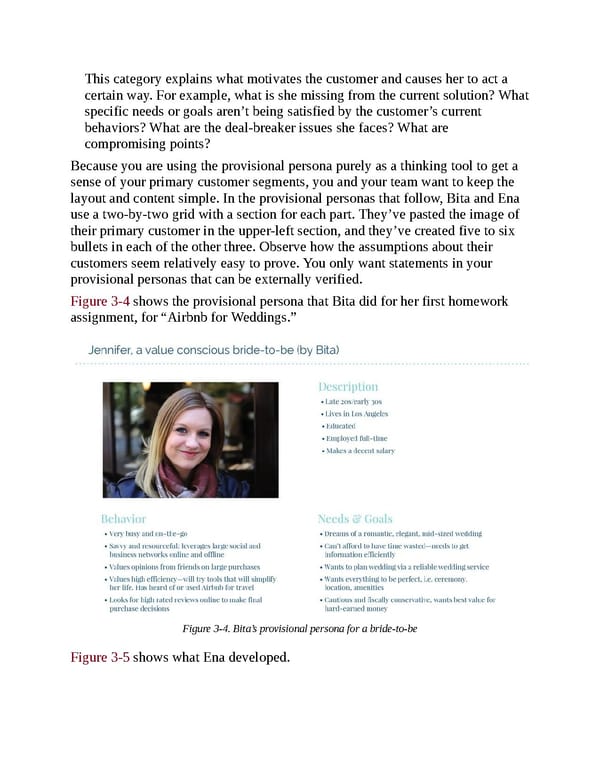
This category explains what motivates the customer and causes her to act a certain way. For example, what is she missing from the current solution? What specific needs or goals aren’t being satisfied by the customer’s current behaviors? What are the deal-breaker issues she faces? What are compromising points? Because you are using the provisional persona purely as a thinking tool to get a sense of your primary customer segments, you and your team want to keep the layout and content simple. In the provisional personas that follow, Bita and Ena use a two-by-two grid with a section for each part. They’ve pasted the image of their primary customer in the upper-left section, and they’ve created five to six bullets in each of the other three. Observe how the assumptions about their customers seem relatively easy to prove. You only want statements in your provisional personas that can be externally verified. Figure 3-4 shows the provisional persona that Bita did for her first homework assignment, for “Airbnb for Weddings.” Figure 3-4. Bita’s provisional persona for a bride-to-be Figure 3-5 shows what Ena developed.
 UX Strategy: How to Devise Innovative Digital Products that People Want Page 64 Page 66