

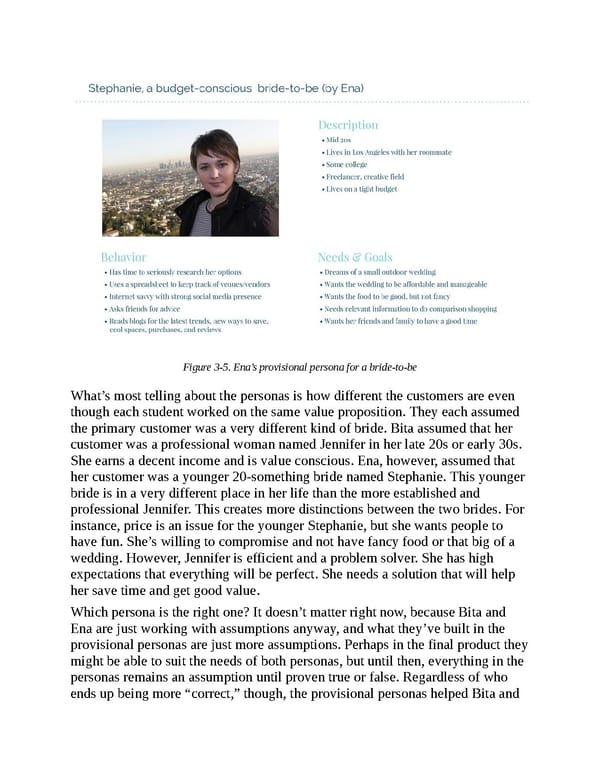
Figure 3-5. Ena’s provisional persona for a bride-to-be What’s most telling about the personas is how different the customers are even though each student worked on the same value proposition. They each assumed the primary customer was a very different kind of bride. Bita assumed that her customer was a professional woman named Jennifer in her late 20s or early 30s. She earns a decent income and is value conscious. Ena, however, assumed that her customer was a younger 20-something bride named Stephanie. This younger bride is in a very different place in her life than the more established and professional Jennifer. This creates more distinctions between the two brides. For instance, price is an issue for the younger Stephanie, but she wants people to have fun. She’s willing to compromise and not have fancy food or that big of a wedding. However, Jennifer is efficient and a problem solver. She has high expectations that everything will be perfect. She needs a solution that will help her save time and get good value. Which persona is the right one? It doesn’t matter right now, because Bita and Ena are just working with assumptions anyway, and what they’ve built in the provisional personas are just more assumptions. Perhaps in the final product they might be able to suit the needs of both personas, but until then, everything in the personas remains an assumption until proven true or false. Regardless of who ends up being more “correct,” though, the provisional personas helped Bita and
 UX Strategy: How to Devise Innovative Digital Products that People Want Page 65 Page 67